The Science of Life – From Earth to the Stars

neutron stars — Artist illustration of a rapidly spinning pulsar neutron star emitting twin beams of radio waves

Neutron Stars Explained: The Densest Objects in the Observable Universe

When a massive star exhausts its nuclear fuel and explodes as a supernova, it sometimes leaves behind something stranger than a black hole – a neutron star. Not strange because it is invisible or because nothing escapes it. Strange because it exists at all: a stellar remnant roughly the size of a city, containing more mass than the Sun, spinning hundreds of times per second, and radiating energy across the entire electromagnetic spectrum. Neutron stars represent physics at extremes that cannot be reproduced in any laboratory on Earth. Their interiors contain matter compressed beyond atomic density, squeezed so hard that protons and electrons merge into neutrons. Their surfaces generate magnetic Read more

Hubble Space Telescope image of double quasar J0749+2255 — two quasars in merging galaxies when the universe was just 3 billion years old

What Is a Quasar? The Most Luminous Objects in the Universe Explained

What is a quasar? A quasar is the most luminous persistent object in the universe. The brightest known quasar outshines its entire host galaxy by a factor of more than 100. It releases energy equivalent to trillions of suns, from a region smaller than our solar system. And it does this powered by nothing more exotic than gravity (the same force that holds you to Earth), operating on the most extreme scales nature allows. So what is a quasar, exactly? It is a hyper-luminous galactic core powered by a supermassive black hole in a feeding frenzy. Quasars are not a different kind of object from galaxies. They are the active, Read more

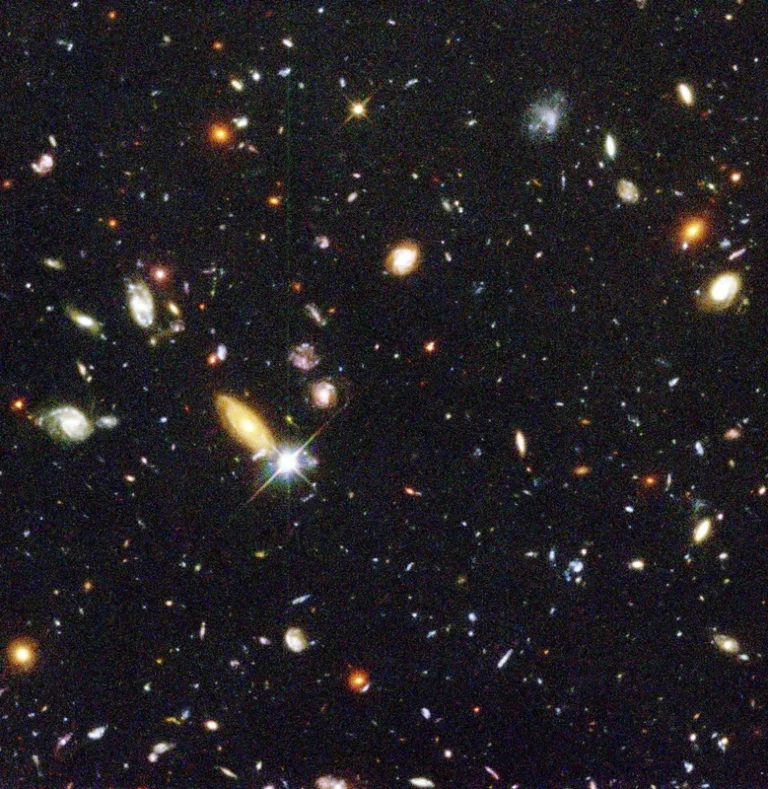
JWST First Deep Field image showing thousands of distant galaxies including the galaxy cluster SMACS 0723, the deepest infrared image of the universe ever taken

The Big Bang Theory Explained: What It Actually Says About the Origin of the Universe

The Big Bang theory is the most tested and well-supported cosmological model in the history of science. It is also the most widely misunderstood. It does not describe an explosion in empty space. It does not say the universe began as a pinpoint of matter. And it does not attempt to explain what came “before” the beginning, not because scientists are afraid of the question, but because the concept of “before” may not apply. What the Big Bang theory actually says is this: if you extrapolate the observed expansion of the universe backward in time, the universe was once in an extraordinarily hot, dense state. The farther back you go, Read more

what is dark energy — Type Ia supernova explosion in a distant galaxy — the observations that led to the discovery of dark energy and the accelerating universe

What Is Dark Energy? The Force Accelerating the Universe’s Expansion

In 1998, two independent teams of astronomers studying distant supernovae made a discovery that upended cosmology. They expected to find that the universe‘s expansion was slowing down, pulled back by the gravity of all the matter within it. Instead, they found the opposite: the expansion of the universe is accelerating. Something is pushing space apart faster and faster. That something is what we now call dark energy. What is dark energy? That question, unanswered since the discovery of cosmic acceleration in 1998, may be the most important open problem in cosmology. Dark energy is the name for whatever is causing the accelerating expansion. It makes up approximately 68% of the Read more

A black hole slowly evaporating through Hawking radiation — particle pairs splitting at the event horizon

Hawking Radiation Explained: How Black Holes Slowly Evaporate

Black holes are defined by the impossibility of escape. Nothing that crosses the event horizon, the boundary of no return, can ever get out. That is the foundational property of a black hole, derived directly from general relativity. Yet in 1974, Stephen Hawking used quantum mechanics to show that black holes do emit radiation. They lose mass. They evaporate. And eventually, if left alone long enough, they disappear entirely. This result, Hawking radiation, is one of the most profound in all of theoretical physics. It connects general relativity, quantum field theory, thermodynamics, and information theory in ways that still generate active debate nearly fifty years later. The Vacuum Is Not Read more

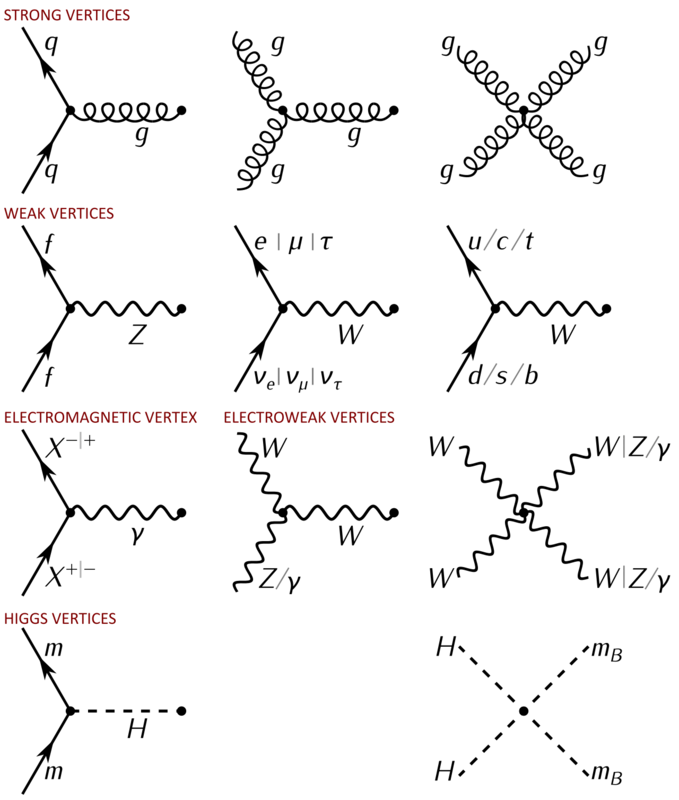
Higgs boson particle physics visualization

The Higgs Boson Explained: The Particle That Gives Everything Mass

On July 4, 2012, physicists at CERN announced one of the most anticipated discoveries in the history of science. After nearly fifty years of searching, they had found the Higgs boson, a particle so fundamental to the workings of the universe that it had been called, somewhat controversially, the “God particle.” The announcement came from two independent detector teams at the Large Hadron Collider, both reporting a new particle consistent with the theoretical prediction. The Standard Model of particle physics was complete. But what is the Higgs boson, why does it matter, and why did it take nearly half a century to find? Why Particles Have Mass: The Higgs Field Read more

how black holes form — Artist illustration of a massive star collapsing in a supernova to form a stellar-mass black hole

How Black Holes Form: Stellar Collapse, Mergers, and the Early Universe

A black hole is not a thing in the ordinary sense; it is a region of spacetime where gravity has become so extreme that nothing, not even light, can escape once it crosses the event horizon. Understanding what a black hole is requires understanding how it forms. And the answer turns out to depend entirely on mass. Different masses produce black holes through different processes, on different timescales, in different corners of the universe. Here is how black holes form — through several distinct physical processes, each leaving a different signature on the black hole’s mass and environment. Stellar Collapse: The Main Factory The most common path to a black Read more

cosmic inflation — Planck satellite map of the cosmic microwave background showing tiny temperature fluctuations across the full sky, the primary evidence for cosmic inflation

Cosmic Inflation Explained: The Universe’s First Trillionth of a Trillionth of a Second

The Big Bang model describes the universe expanding from a hot, dense state. But when cosmologists trace that expansion backward, they run into problems, not with the physics, but with what the physics implies about the universe we observe today. The cosmos is too smooth, too flat, and too uniform at large scales for a simple, decelerating expansion to explain. The solution, proposed in the early 1980s, is cosmic inflation: a brief, extraordinarily violent period of exponential expansion in the universe’s first moments that set the initial conditions for everything that followed. Cosmic inflation is one of the most successful and contested ideas in modern cosmology. Its predictions have been Read more