
Everything you have ever touched, seen, breathed, or been is made of particles governed by four fundamental forces. The theory that describes these particles and forces, tested to extraordinary precision and confirmed by decades of experiments, is called the Standard Model of Particle Physics.
It is the most precisely verified scientific theory in human history. It correctly predicted the existence of particles that weren’t discovered until years or decades later. Its calculations match measurements to more than 10 significant figures, a precision equivalent to measuring the distance from Earth to the Moon within the width of a human hair.
It is also, almost certainly, incomplete.
The Particle Zoo
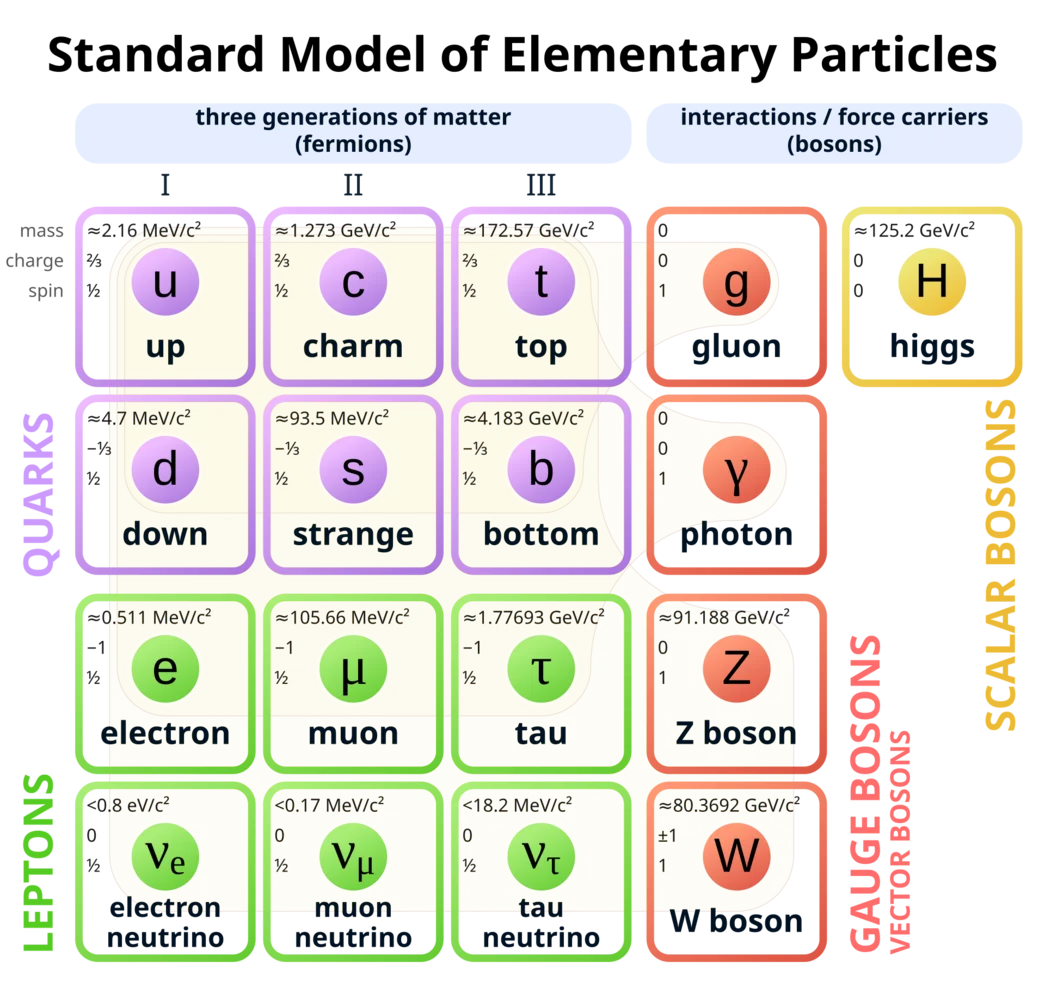
At the heart of the Standard Model is a classification of matter into two families: quarks and leptons. Both are considered elementary, meaning they have no known internal structure. They are not made of anything smaller (at least as far as we currently know).
Table of elementary particle families in the Standard Model:
| Family | Particle Types | Examples | Role in Matter |
|---|---|---|---|
| Quarks | Up, down, charm, strange, top, bottom | Up, down | Build protons and neutrons |
| Leptons | Electron, muon, tau; plus one neutrino each | Electron | Carry electric charge and participate in weak interactions |
| Gauge Bosons (force carriers) | Photon, gluon, W⁺, W⁻, Z | Photon | Mediate forces (electromagnetic, strong, weak) |
| Scalar Boson | Higgs | Higgs | Gives mass to other particles |
Quarks
Quarks are the building blocks of protons and neutrons: and therefore of the atomic nucleus, and therefore of virtually all the mass you encounter in everyday life.
There are six types, called flavors, of quarks:
- Up and down (the lightest; form protons and neutrons)
- Charm and strange (heavier; found in exotic particles)
- Top and bottom (the heaviest; extremely short-lived)
Quarks never exist in isolation. They are always bound together into composite particles called hadrons by the strong nuclear force. A proton is made of two up quarks and one down quark. A neutron is made of two down quarks and one up quark.

Leptons
Leptons are a different family of particles. Unlike quarks, they don’t feel the strong force and can exist in isolation. There are six leptons:
- Electron, the familiar particle orbiting atomic nuclei
- Muon, a heavier copy of the electron (about 207 times heavier)
- Tau, heavier still (about 3,477 times the electron’s mass)
- Electron neutrino, muon neutrino, tau neutrino: nearly massless, electrically neutral, barely interacting with anything
Neutrinos are famously ghostly. About 100 trillion of them pass through your body every second, most coming from the Sun. Nearly all of them pass straight through without interacting with a single atom.
The Generational Structure
Quarks and leptons come in three generations. The first generation contains the lightest and most stable particles: up quark, down quark, electron, and electron neutrino. These are the particles that make up ordinary matter.
The second and third generations are heavier copies of the first. They are unstable and decay rapidly back into first-generation particles. The existence of three generations is one of the unexplained patterns in the Standard Model: why three? Why not one, or five, or seventeen?
The Four Forces; And Their Carriers
Forces, in the quantum picture, are not mysterious invisible pulls. They are mediated by gauge bosons: exchange particles that are emitted and absorbed by matter particles, transferring momentum and energy between them.
The Electromagnetic Force
The electromagnetic force governs the interaction between electrically charged particles. Its carrier is the photon: the quantum of light. When two electrons repel each other, they are exchanging virtual photons.
The electromagnetic force is responsible for chemistry, magnetism, light, radio waves, and the behavior of electrons in atoms. It is infinite in range, weakening with the square of distance but never entirely vanishing.
The Strong Nuclear Force
The strong force binds quarks together inside protons and neutrons, and binds protons and neutrons together inside atomic nuclei. Its carriers are gluons: eight types in total, corresponding to the eight possible color-anticolor combinations that carry the strong force.
The strong force has a peculiar property called confinement: it gets stronger, not weaker, as quarks are pulled apart. Trying to separate two quarks is like stretching a rubber band: the farther you pull, the harder it resists, until the band snaps and the energy produces new quark-antiquark pairs.
Gluons themselves carry color charge (the quantum number of the strong force), which means they interact with each other as well as with quarks. This makes the strong force mathematics among the most complex in physics.
The Weak Nuclear Force
The weak force is responsible for radioactive decay and the nuclear reactions that power the Sun. Its carriers are the W+ boson, the W- boson, and the Z boson: all extremely heavy, which is why the weak force has an extremely short range (about 10⁻¹⁸ meters, or 0.1% the diameter of a proton).
The weak force has a remarkable property: it can change the flavor of quarks and leptons. A down quark inside a neutron can be changed into an up quark via emission of a W- boson, converting the neutron into a proton: the core process of beta decay. The mixing of quark flavors is quantified by the CKM matrix (Cabibbo-Kobayashi-Maskawa), a key parameter set that describes how strongly each quark can transform into another; for neutrinos, the analogous PMNS matrix plays the same role.
The weak force also distinguishes between left and right: through charged-current interactions (W bosons), it acts only on left-handed particles; the Z boson interacts with both chiralities but with different strengths. This violation of parity symmetry was one of the most shocking discoveries in 20th-century physics.
Gravity
Gravity is conspicuously absent from the Standard Model. Despite being the most familiar force in everyday life, gravity has resisted incorporation into the quantum framework. The hypothetical carrier particle, the graviton, has never been detected and may be fundamentally undetectable with foreseeable technology.
General relativity, our best theory of gravity, describes it as the curvature of spacetime caused by mass and energy. Quantum mechanics describes forces as the exchange of particles. These two frameworks are mathematically incompatible at the quantum level, and reconciling them is the deepest unsolved problem in physics.
The Higgs Boson and the Origin of Mass
One of the Standard Model’s greatest triumphs was the prediction, and eventual discovery, of the Higgs boson.
The problem the Higgs solves is this: the W and Z bosons that carry the weak force are very massive, but quantum field theory predicted that force carriers should be massless. A massless W boson would make the weak force infinite-range and equal in strength to electromagnetism, which is observably not the case.
In 1964, Peter Higgs and colleagues proposed that the universe is permeated by a quantum field: essentially a kind of invisible fluid that fills all space, where particles are the ripples in that fluid. The W and Z bosons acquire mass by interacting with this Higgs field. The more strongly a particle interacts with the Higgs field, the more mass it has. The photon, which doesn’t interact with the Higgs field, is massless. The top quark, which interacts very strongly, is among the heaviest particles known.
Fermions (quarks and leptons) also gain mass by interacting with the Higgs field, though the coupling strength, called the Yukawa coupling, is an arbitrary parameter in the theory. For a deeper dive into how this discovery fits into the broader framework of physics, see our article on The Higgs Boson Explained: The Particle That Gives Everything Mass.
The Higgs boson is the quantum ripple in the Higgs field, the particle produced when the field is energetically disturbed. Its existence was confirmed in 2012 by both the ATLAS and CMS experiments at CERN’s Large Hadron Collider, one of the greatest experimental achievements in the history of science, confirming a 48-year-old prediction.
Antimatter
For every particle in the Standard Model, there is an antiparticle, identical in mass but opposite in charge and other quantum numbers. The antiparticle of the electron is the positron. The antiparticle of the up quark is the anti-up quark.
When a particle and its antiparticle meet, they annihilate each other, converting their mass entirely into energy (typically photons). This is the most energy-dense reaction known: far more efficient than nuclear fusion. To understand more about this mirror world of matter, see Antimatter Explained: The Mirror Image of Matter and Why the Universe Exists.
The mystery is why the universe is made of matter rather than antimatter. The Big Bang should have produced equal amounts of both, which would have annihilated each other, leaving nothing but photons. Yet here we are, made of matter. Something in the early universe created a slight asymmetry, approximately one extra matter particle for every billion matter-antimatter pairs, and that tiny surplus is everything we see.
The Standard Model includes a mechanism for this asymmetry, CP violation (a subtle difference in the behavior of matter and antimatter), but not nearly enough CP violation to explain the observed imbalance. Finding the missing asymmetry is one of the major goals of current particle physics.
What the Standard Model Doesn’t Explain
For all its power, the Standard Model has conspicuous gaps.
Dark matter (27% of the universe): None of the Standard Model’s particles fit the bill; requires new physics. Learn more in Dark Matter Explained: What We Know, What We Don’t, and Why It Matters.
Dark energy (68% of the universe): The mysterious cause of accelerating expansion; the Standard Model offers no explanation.
Gravity: As noted, general relativity sits entirely outside the Standard Model.
Neutrino masses: The Standard Model as originally formulated treated neutrinos as massless, because no right-handed neutrinos were included in its particle content. The discovery that neutrinos oscillate between flavors, switching from electron to muon to tau type as they travel, proves they have nonzero mass. But the mechanism giving them mass doesn’t fit naturally into the Standard Model framework.
Matter-antimatter asymmetry: As discussed above, the Standard Model can’t explain why we exist.
The hierarchy problem: The Higgs boson is much lighter than quantum corrections should make it. Loops involving the top quark would drive the Higgs mass up to near the Planck scale (10¹⁹ GeV) without extremely precise cancellations: requiring an extraordinary fine-tuning of parameters. This suggests either that the Standard Model is missing a mechanism that naturally keeps the Higgs light (like supersymmetry), or that there’s something wrong with our understanding.
The strong CP problem: Quantum chromodynamics (QCD) does not naturally forbid a CP-violating term in its equations, yet experimental limits on such violations, such as the neutron’s electric dipole moment, are extremely tight. This fine-tuning puzzle motivates the existence of axions, a leading dark matter candidate.
Three generations: Why are there exactly three generations of quarks and leptons?
19 free parameters: The Standard Model has 19 adjustable parameters that must be measured experimentally rather than derived from first principles. These include:
- 9 fermion masses (six quarks and three charged leptons)
- 3 mixing angles and 1 CP-violating phase (from the CKM matrix)
- 3 gauge coupling constants (for the strong, weak, and electromagnetic forces)
- 2 Higgs parameters (the Higgs boson’s mass and its field’s vacuum expectation value)
- 1 strong CP phase (the θ angle)
(If neutrino masses are included, 7–9 additional parameters are needed, depending on whether neutrinos are Dirac or Majorana particles.)
A truly fundamental theory would derive these from deeper principles.
How the Model Is Tested
How do scientists know the Standard Model is correct to such extraordinary precision? Two complementary approaches are used.
First, precision measurements test the model at its most vulnerable points. For example, the magnetic moment of the electron, a measure of how much it behaves like a tiny bar magnet, has been measured to an accuracy of a few parts in a trillion. The Standard Model’s prediction matches that measurement to nearly the same precision, a triumph that earned the electron’s magnetic moment the title of the most precisely verified quantity in all of science.
However, the muon’s magnetic moment disagrees with the Standard Model at roughly 4 standard deviations, a possible crack in the framework that is currently one of the most watched precision tests in particle physics. Experiments at CERN have also measured the masses and decay properties of the W and Z bosons to confirm the electroweak theory’s predictions.
Second, discovery experiments look for particles predicted by the model. The Higgs boson, discovered at the LHC in 2012, is the most famous example, but the model also predicted the top quark (discovered in 1995) and the tau neutrino (discovered in 2000). Each successful prediction deepens our confidence that the framework captures something fundamental about reality.
The Search for What’s Beyond
Physicists are certain the Standard Model is not the final word. The search for what lies beyond it drives the largest and most expensive experiments in the history of science: the LHC at CERN, deep underground dark matter detectors, neutrino observatories, and gravitational wave detectors.
Supersymmetry (SUSY): which predicts a partner particle for every Standard Model particle – was the leading candidate for new physics for decades, but LHC searches have not found any supersymmetric particles despite searching at the predicted masses. This has pushed physicists toward a broader exploration: extra dimensions, new force carriers, composite Higgs bosons, and ideas not yet invented.
Why the Standard Model Matters
The Standard Model is easy to underestimate because its success has made its discoveries seem inevitable in retrospect. But it represents an extraordinary achievement: the complete description of three of the four known fundamental forces and all observed matter fields, unified into a single coherent mathematical framework verified to extraordinary precision.
Every electron in every device you use, every chemical reaction in every cell in your body, every photon of light that reaches your eye, all of it is governed by the Standard Model. Understanding it is understanding the operating system of matter itself.
The gaps in that understanding, dark matter, dark energy, gravity, the matter-antimatter mystery, are where the next revolution in physics will come from. And the Standard Model, for all its completeness, may be the best map we have to find it. Will the next revolution come from a tenth-dimensional theory, or from an unexpected crack in this model? To follow the search for new physics, keep an eye on results from the LHC’s high-luminosity upgrade and next-generation neutrino experiments.
Sources
- Griffiths, D. (2008). Introduction to Elementary Particles (2nd ed.). Wiley-VCH.
- CERN. (2012). Higgs boson discovery. CERN.
- Particle Data Group. (2022). Review of Particle Physics. Progress of Theoretical and Experimental Physics.
- NASA. (2021). Dark Matter and Dark Energy. NASA Science.
- CERN Standard Model page: an accessible introduction to the Standard Model and its experimental tests.
- Nature: The Standard Model of particle physics: a concise review of the model’s successes and limitations.
What is the Standard Model of Particle Physics?
The Standard Model is the theory describing all known elementary particles and three of the four fundamental forces (electromagnetic, weak, and strong), excluding gravity.
Why is the Standard Model considered the most precisely verified scientific theory?
Its calculations match experimental measurements to over 10 significant figures, equivalent to measuring the Earth-Moon distance within a human hair’s width.
What are the two main families of elementary particles in the Standard Model?
The two families are quarks (which build protons and neutrons) and leptons (which include electrons and neutrinos).
Is the Standard Model complete?
No, it is almost certainly incomplete because it does not include gravity, dark matter, or dark energy.
What role does the Large Hadron Collider play in testing the Standard Model?
The LHC at CERN tests the Standard Model by colliding particles at extreme energies to verify its predictions and search for new physics.
Further reading: Standard Model on Wikipedia