
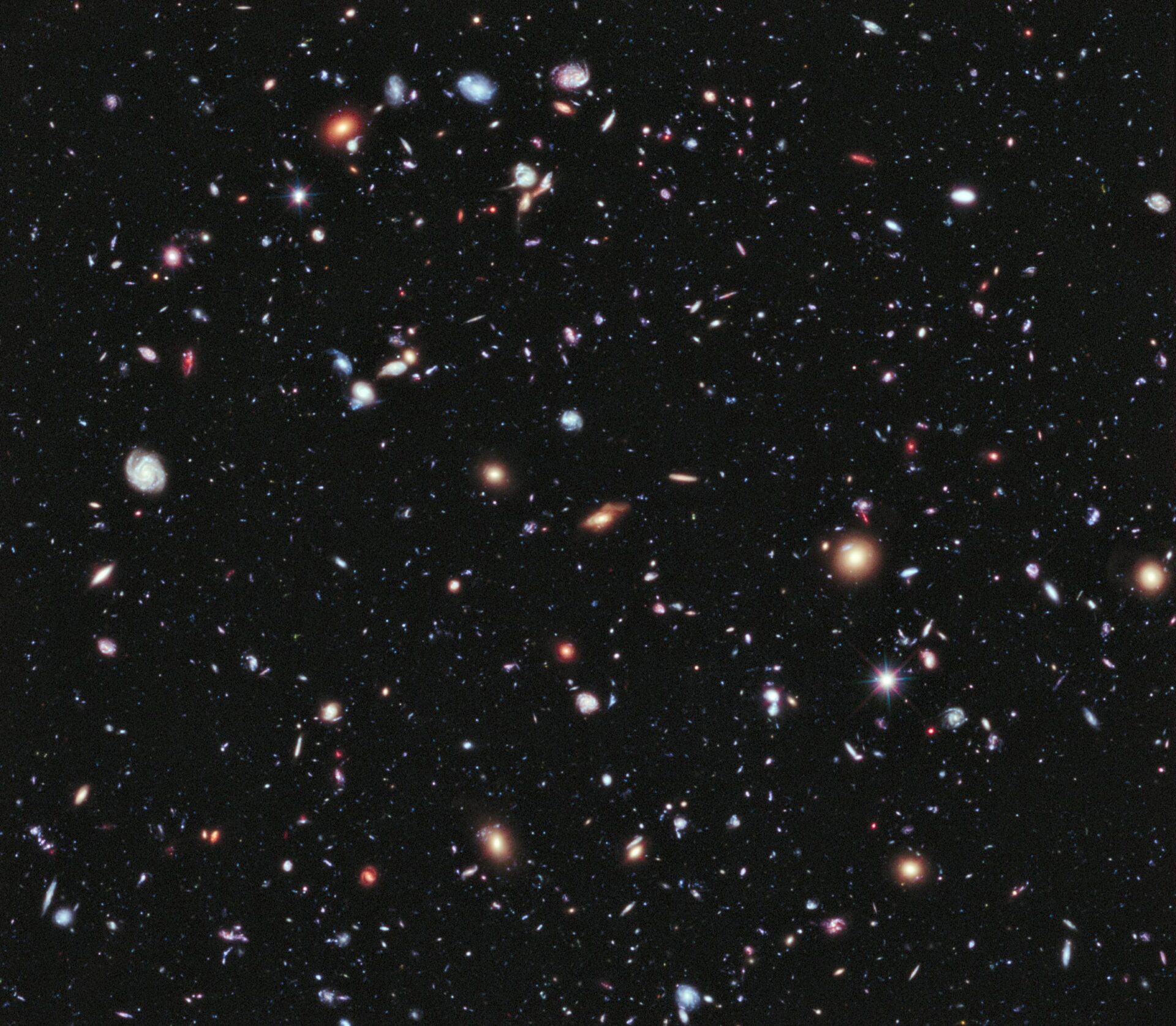
The cosmic distance ladder is a chain of methods, each calibrated against closer measurements, that together span the observable universe, from nearby planets to the most distant quasars. Astronomers use this interconnected system to determine cosmic distances with remarkable precision, often to within a few percent.
The universe is incomprehensibly large. The nearest star is 4.2 light-years away. The nearest large spiral galaxy is 2.5 million light-years away. Quasars exist at distances of 10 billion light-years or more.
None of these objects has ever been reached. No ruler has been stretched between Earth and Alpha Centauri. No tape measure has been unreeled to the Andromeda Galaxy.
Yet astronomers know these distances with remarkable precision: in some cases, to within a few percent. How?
The answer is a chain of interconnected methods, each calibrated against closer measurements and each extending our reach farther into the cosmos. Astronomers call this the cosmic distance ladder: a series of overlapping techniques, each reliable over a specific range, that together span the observable universe.

Rung 1: Radar Ranging (Solar System)
The most direct distance measurements in the solar system use radar. A radio pulse is sent toward a planet (Venus is often the closest planet and its thick atmosphere makes it the most practical target for radar ranging), the reflected signal is received, and the round-trip time gives the distance with extraordinary precision. By measuring the round-trip time to Venus and using orbital geometry, astronomers have determined the astronomical unit (AU), the Earth-Sun distance – with modern precision better than a meter. This becomes the foundation of all other distance measurements.
Rung 2: Stellar Parallax (Nearby Stars, up to ~10,000 parsecs)
Parallax is the apparent shift of a nearby object against a distant background as the observer’s position changes. Hold a finger in front of your face and alternately close each eye, your finger seems to jump. Closer objects show greater parallax.
As Earth orbits the Sun, nearby stars appear to shift slightly against the background of distant stars over the course of a year. The amount of shift gives the star’s distance directly from geometry (no assumptions needed): the closer the star, the larger the parallax.
The first successful stellar parallax measurement was made by Friedrich Bessel in 1838, who measured the distance to 61 Cygni at about 11 light-years, this achievement marked the birth of modern distance astronomy.
The unit for stellar distances, the parsec, is defined as the distance at which a star would show a parallax of one arcsecond (1/3600 of a degree) over a baseline of 1 AU.
Ground-based parallax measurements reliably reach a few hundred parsecs. The Hipparcos satellite (1989–1993) extended this to about 1,000 parsecs for 100,000 stars. Gaia (launched 2013) has measured parallaxes for over 1 billion stars with unprecedented precision, extending reliable parallax measurements to ~10,000 parsecs (about 32,600 light‑years) and providing the most precise stellar distance map in history. For a deeper look into how gravity shapes cosmic structures, including the role of dark matter in holding galaxies together, see our companion article.
Rung 3: Main Sequence Fitting and Spectroscopic Parallax
For clusters of stars too far for direct parallax, main sequence fitting extrapolates parallax measurements using our understanding of stellar physics.
Every star follows a main sequence relationship between luminosity and temperature (the Hertzsprung-Russell diagram). If we observe a cluster of stars and plot their apparent brightnesses against their temperatures, we get a main sequence at some apparent brightness level. Comparing this to the calibrated absolute-brightness main sequence tells us the distance to the cluster.
Spectroscopic parallax is related: by measuring a star’s spectrum (which tells us its spectral type and luminosity class), we can estimate its absolute luminosity. Comparing absolute and apparent luminosity gives the distance.

These methods extend distance measurements to tens of thousands of parsecs, within our galaxy and to nearby satellite galaxies.
Rung 4: Variable Stars; Cepheids and RR Lyrae (Up to ~100 million light-years)
The most important step in the distance ladder uses variable stars, stars whose brightness changes regularly with time.
Cepheid variables: named after their prototype Delta Cephei, are pulsating giant stars that brighten and dim with periods ranging from 1 to 100 days. In 1908, Henrietta Swan Leavitt at Harvard discovered a remarkable relationship: the longer a Cepheid’s period, the more luminous it is, the period-luminosity relationship. This is like knowing a candle’s wattage from the rhythm of its flicker.
This makes Cepheids standard candles. Measure a Cepheid’s period (easy: just watch it vary), read off its absolute luminosity from the Leavitt relation, compare with its apparent brightness, and calculate the distance. If you can identify individual Cepheids in a galaxy, you can measure that galaxy’s distance.
Cepheids were how Edwin Hubble established in 1924 that the Andromeda Nebula is not within the Milky Way but is a separate galaxy, vastly larger and farther than anyone had imagined, establishing for the first time the true scale of the universe.
JWST has now extended Cepheid resolution well beyond Hubble’s reach, pushing to distances of order 150 million light-years in some early results, providing the most precise extragalactic distance ladder calibration in history. These measurements are central to the ongoing Hubble tension controversy.
RR Lyrae stars are another class of pulsating variable, with much shorter periods (~half a day) and a known absolute luminosity. They are useful for distances within and around the Milky Way, including in globular clusters. For more on how stars produce elements and evolve into exotic objects, see our article on stellar nucleosynthesis.
Bridging the Gap: Tully-Fisher and Water Masers (Intermediate Distances)
Between Cepheid distances and Type Ia supernovae, several methods provide crucial overlap. The Tully-Fisher relation links a spiral galaxy’s rotational velocity (measured via Doppler broadening of its spectral lines) to its intrinsic luminosity: more massive galaxies rotate faster and shine brighter. This allows distance estimates from spectroscopy alone, even when individual stars cannot be resolved. Similarly, the fundamental plane relation does the same for elliptical galaxies using their velocity dispersion and surface brightness.
Water masers: natural microwave lasers in molecular clouds around supermassive black holes – provide a direct geometric distance to a handful of galaxies. By tracking the orbital motion of maser clumps, astronomers can measure distances with 3-5% precision, independently calibrating other methods up to about 200 million light-years.
Rung 5: Type Ia Supernovae (Billions of Light-Years)
At distances where individual Cepheid stars can no longer be resolved, astronomers use Type Ia supernovae, the brightest objects in the universe that function as reliable standard candles.
As explained in our article on supernovae, Type Ia supernovae arise from white dwarfs exploding at the Chandrasekhar mass limit, a fixed physical threshold. With corrections for the shape of their light curves (more luminous Type Ia supernovae fade more slowly), they can be used as standardizable candles, meaning their apparent brightness can be corrected to a known absolute value, with precision of about 5-7%.
A Type Ia supernova at its peak outshines its entire host galaxy, making it visible from billions of light-years away. This is what made them the tool of choice for the breakthrough 1998 observations that discovered the accelerating expansion of the universe.
The chain: radar ranging → parallax → main sequence fitting → Cepheid period-luminosity → Type Ia supernova distances. Each step is calibrated against the one below it, and uncertainties accumulate: about 1–2% at the parallax rung, growing to roughly 5% for Cepheid distances, and reaching 5–7% for supernova-based measurements. This error propagation underscores the challenge of building a reliable ladder across cosmic scales.
A Note on Distance Modulus
Astronomers often express distances using the distance modulus formula:
m − M = 5 log d − 5

where m is the apparent magnitude, M is the absolute magnitude, and d is the distance in parsecs. This simple equation ties together all the rungs of the ladder: if you know a star’s true brightness (M) and measure how bright it appears (m), the distance follows directly.
Rung 6: The Hubble Constant and Redshifts (Observable Universe)
Once the distance ladder is calibrated with supernovae, it can be extended to the entire observable universe using the Hubble-Lemaître law: distant galaxies recede from us at velocities proportional to their distance, v = H₀ × d.
The recession velocity is measured from the cosmological redshift of galaxy spectra. The Hubble constant H₀ relates velocity to distance. Once calibrated from the ladder below it, the Hubble law extends distance measurements to the edge of the observable universe, about 46 billion light-years.
The Hubble Tension: A Problem at the Top of the Ladder
The cosmic distance ladder currently has a crisis: the Hubble tension.
Measurements from the Ladder
The Hubble constant measured by the distance ladder (calibrated with Cepheids and Type Ia supernovae) is approximately 73 km/s/Mpc.
Measurements from the CMB
The Hubble constant inferred from the early universe, from the cosmic microwave background and standard cosmology, is approximately 67 km/s/Mpc. These two measurements disagree by about 5 sigma, far too much to be a statistical fluctuation.
Possible Resolutions
This tension, the most significant discrepancy in cosmology, may indicate:
- A systematic error somewhere in the distance ladder calibration
- New physics beyond the standard cosmological model (new particles, new forces, or a different dark energy equation of state)
An important independent check comes from the Tip of the Red Giant Branch (TRGB) method, which calibrates distances using the well-defined luminosity of the helium flash in red giant stars: a Cepheid-free calibrator that currently yields a H₀ value intermediate between the Cepheid-based and CMB-based values. JWST’s precise Cepheid measurements have further confirmed the “high H₀” value from the distance ladder, strengthening the tension rather than resolving it. The Hubble tension may be pointing toward genuine new physics.
Independent Distance Checks: Gravitational Waves as Standard Sirens
A completely independent method has now joined the ladder. When two neutron stars merge, they emit both gravitational waves and electromagnetic radiation. The gravitational wave signal encodes the absolute luminosity (essentially, directly from the masses), while the electromagnetic signal gives the redshift. The combination gives the distance. As explained in our article on gravitational waves, these ripples in spacetime provide a fundamentally new way to measure cosmic distances.
This standard siren method bypasses the entire traditional distance ladder: it measures distances directly from fundamental physics. The first multi-messenger neutron star merger, GW170817, provided an independent measurement of H₀ that is consistent with (though much less precise than) both the high and low values. Future detectors will provide many more such events, potentially resolving the Hubble tension from an independent direction.
The Grand Achievement
The cosmic distance ladder, from Earth-crossing asteroids to the most distant quasars, represents one of the greatest intellectual achievements in the history of science. It has mapped the scale of the universe, revealed that the cosmos is expanding, and discovered that the expansion is accelerating.
Each rung extends our reach by building carefully and rigorously on the rung below. The ladder is not perfect, the Hubble tension reminds us of its incompleteness, but it is an extraordinary chain of evidence spanning 14 orders of magnitude in distance, built over a century of patient astronomical observation.
Sources
- Leavitt, H.S. (1912). Periods of 25 Variable Stars in the Small Magellanic Cloud. Harvard College Observatory Circular, 173.
- Hubble, E. (1929). A Relation between Distance and Radial Velocity among Extra-Galactic Nebulae. PNAS, 15(3), 168–173.
- Perlmutter, S. et al. (1999). Measurements of Omega and Lambda from 42 High-Redshift Supernovae. Astrophysical Journal, 517(2), 565.
- Freedman, W.L. et al. (2023). Status Report on the Chicago-Carnegie Hubble Program (CCHP). arXiv, 2308.02474.
- Freedman, W. L. et al. (2019). The Carnegie-Chicago Hubble Program VIII: An Independent Determination of the Hubble Constant Based on the Tip of the Red Giant Branch. Astrophysical Journal, 882, 34.
- Nature – The Hubble constant tension: current status and future perspectives
What is the cosmic distance ladder?
The cosmic distance ladder is a series of interconnected methods used by astronomers to measure distances across the universe, with each method calibrated against closer, more direct measurements.
How do astronomers measure distances to nearby planets?
Astronomers use radar ranging, sending a radio pulse toward a planet like Venus and measuring the time it takes for the echo to return, to determine distances within the solar system.
What is a standard candle in astronomy?
A standard candle is an astronomical object with a known intrinsic brightness, such as a Type Ia supernova, which allows astronomers to calculate its distance by comparing its apparent brightness to its true luminosity.
How far away is the nearest star and the nearest large galaxy?
The nearest star, Alpha Centauri, is about 4.2 light-years away, while the nearest large spiral galaxy, Andromeda, is approximately 2.5 million light-years away.
Why can’t astronomers use a ruler or tape measure for cosmic distances?
No physical ruler or tape measure can be stretched across vast cosmic distances, so astronomers rely on indirect methods like the cosmic distance ladder, which uses calibrated techniques to measure distances with high precision.