
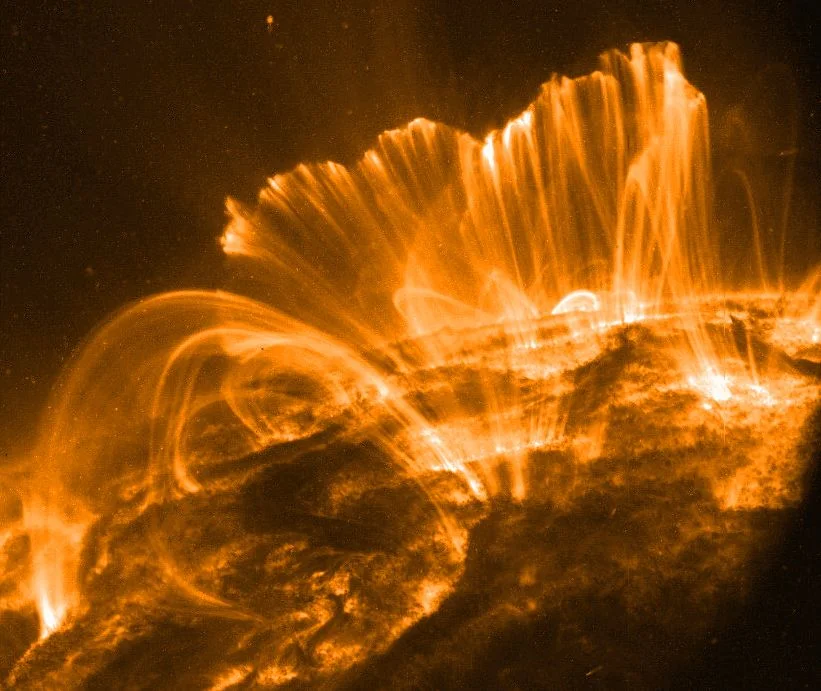
Solar flares are among the most powerful explosions in the solar system. They release energy equivalent to millions of hydrogen bombs detonating simultaneously. These events are not just astronomical curiosities. They have direct and measurable consequences for Earth’s technology, infrastructure, and environment. Understanding how do solar flares affect Earth requires a clear grasp of their origin, the physics that drives them, and the chain of effects that follow.
How do solar flares affect Earth and other phenomena?
Solar flares originate in the Sun’s atmosphere, specifically in regions of intense magnetic activity called active regions. These areas appear as dark patches on the Sun’s surface known as sunspots. The magnetic field lines in these regions become twisted and stressed as the Sun’s differential rotation pulls them in different directions.
How do solar flares affect Earth through magnetic reconnection as the trigger
The fundamental process that produces a solar flare is magnetic reconnection. When opposing magnetic field lines come into close proximity, they snap and reconnect into a new configuration. This violent rearrangement releases stored magnetic energy as heat, light, and accelerated particles. The energy can be released across the entire electromagnetic spectrum, from radio waves to gamma rays.
The reconnection process heats the local plasma to temperatures exceeding 10 million Kelvin. This superheated plasma emits intense X-ray and ultraviolet radiation that reaches Earth in about eight minutes. The sudden injection of radiation is the first observable effect on our planet.
How Do Solar Flares Affect Earth and Their Types
Scientists classify solar flares by their peak X-ray flux measured by the Geostationary Operational Environmental Satellites (GOES) operated by the National Oceanic and Atmospheric Administration (NOAA). The classification system uses letters A, B, C, M, and X. Each letter represents a tenfold increase in energy output.
A-class flares are the weakest and have little effect on Earth. B-class and C-class flares are minor. M-class flares are moderate and can cause brief radio blackouts near the poles. X-class flares are the strongest. They can trigger planet-wide radio blackouts, disrupt satellite communications, and endanger astronauts. The most powerful flares are designated X10 or higher.
How do solar flares affect Earth compared to coronal mass ejections
A common point of confusion is the difference between solar flares and coronal mass ejections (CMEs). While they often occur together, they are distinct phenomena with different consequences.
A solar flare is a burst of electromagnetic radiation. It travels at the speed of light and affects Earth within minutes. A coronal mass ejection, by contrast, is a massive cloud of magnetized plasma ejected from the Sun’s corona. It travels at speeds between 250 and 3,000 kilometers per second and takes 15 hours to several days to reach Earth.
CMEs carry a magnetic field and charged particles. When they collide with Earth’s magnetosphere, they can cause severe geomagnetic storms. These storms drive the most dangerous space weather events, including power grid failures and satellite damage. Not all flares produce CMEs, and not all CMEs produce flares. But when both occur together, the combined effect can be severe.
How do solar flares affect Earth: The Carrington Event of 1859

The most famous example of extreme space weather is the Carrington Event of September 1859. British astronomer Richard Carrington observed an exceptionally bright white-light flare on the Sun’s surface. About 17 hours later, a massive CME struck Earth’s magnetosphere.
The resulting geomagnetic storm was extraordinary. Auroras were seen as far south as Cuba and Mexico. Telegraph systems across Europe and North America failed. Some telegraph operators reported receiving electric shocks. Others found they could send messages with the batteries disconnected because the induced currents from the storm powered the lines.
A 2013 study by the Lloyd’s insurance market and Atmospheric and Environmental Research estimated that a similar event today would cause between 1 and 2.6 trillion dollars in damage. The study is titled “Solar Storm Risk to the North American Electric Grid” . The potential economic impact highlights why understanding how do solar flares affect Earth is not just an academic exercise. It is a matter of national security and economic stability.
How do solar flares affect Earth and disrupt satellites and GPS
Satellites in low Earth orbit and geostationary orbit are vulnerable to solar activity. The direct radiation from a flare can damage solar panels, degrade sensitive electronics, and cause computer glitches. During intense flares, satellites may enter safe mode to protect their systems.
Effects on GPS and Communications
GPS signals depend on precise timing signals from satellites. When a solar flare emits X-rays and ultraviolet light, it heats Earth’s upper atmosphere. This causes the ionosphere to expand and become more turbulent. Radio signals passing through this disturbed region experience delays, refraction, and absorption. This is one of the primary ways how do solar flares affect Earth on a daily basis.
For civilian GPS users, this can mean position errors of tens of meters. For aviation and maritime navigation, these errors can have serious safety implications. The Federal Aviation Administration monitors space weather to issue alerts for critical flight routes.
High-frequency radio communications are also disrupted. Flares produce sudden ionospheric disturbances that absorb radio waves in the 3 to 30 MHz band. This can break contact with aircraft flying over oceans, ships at sea, and emergency services in remote areas.
Power Grid Vulnerability
Geomagnetic storms caused by CMEs are the main threat to electrical infrastructure. When a CME reaches Earth, its magnetic field interacts with Earth’s own magnetic field. This interaction induces electric currents in long conductors like power lines and pipelines.
These geomagnetically induced currents flow into transformers. They cause half-cycle saturation, a condition that distorts the AC waveform and produces harmonics. This heating can destroy transformers within minutes. In severe cases, the entire grid can collapse.
The most recent major event occurred in March 1989 when a geomagnetic storm knocked out the Hydro-Québec power grid for nine hours. The storm left six million people without electricity. The cost in lost revenue and damage was estimated at several hundred million Canadian dollars. The storm also damaged transformers at nuclear power plants in New Jersey and the United Kingdom.
Why Auroras Form

Auroras are the most visible and beautiful consequence of solar activity. They occur when charged particles from the solar wind or CMEs travel along Earth’s magnetic field lines and collide with atoms in the upper atmosphere.
These collisions excite atoms of oxygen and nitrogen. When the atoms relax, they emit light in specific colors. Oxygen produces green and red light. Nitrogen produces blue and purple hues. The shape and color depend on the energy of the incoming particles and the altitude of the collisions.
During strong geomagnetic storms, the auroral oval expands toward the equator. People in mid-latitude regions like the northern United States or central Europe can see auroras on clear nights. The process is harmless to humans on the ground but is a direct indicator of space weather activity.
The Solar Cycle and Modern Monitoring
Solar activity follows an approximately 11-year cycle. This cycle is driven by the Sun’s magnetic field reversing polarity. The number of sunspots and the frequency of flares and CMEs rise and fall with this cycle. During solar maximum, the Sun can produce multiple X-class flares per month. During solar minimum, months may pass without any significant activity.
Monitoring Systems
Modern space weather monitoring relies on a network of satellites and ground-based instruments. The GOES series of satellites provides continuous X-ray and particle data. The Solar and Heliospheric Observatory (SOHO), a joint mission of NASA and the European Space Agency, observes the Sun’s corona and detects CMEs. The Deep Space Climate Observatory (DSCOVR) measures solar wind conditions at the L1 Lagrange point, giving forecasters about 30 to 60 minutes of warning before a CME arrives at Earth. For deeper context, explore our guide to Stars and Planets.
NOAA’s Space Weather Prediction Center (SWPC) in Boulder, Colorado, issues alerts and forecasts. The SWPC uses a five-level scale for geomagnetic storms, radio blackouts, and solar radiation storms. Level 1 is minor. Level 5 is extreme. These alerts allow power grid operators, satellite operators, and airlines to take protective measures.
What is the difference between a solar flare and a coronal mass ejection?
A solar flare is a burst of electromagnetic radiation from a magnetic reconnection event. It reaches Earth in eight minutes. A coronal mass ejection is a cloud of magnetized plasma ejected from the Sun. It takes 15 hours to several days to reach Earth. Flares cause radio blackouts. CMEs cause geomagnetic storms.
Can solar flares harm humans on the ground?
No. Earth's atmosphere and magnetic field block the harmful radiation from solar flares. Humans on the ground are safe. The danger is to astronauts in space, passengers on high-altitude flights, and sensitive electronic equipment.
How do solar flares affect GPS accuracy?
Solar flares heat and disturb the ionosphere. This causes GPS signals to slow and refract. The result is positioning errors that can reach tens of meters. Aviation, shipping, and surveying are most affected.
What happened during the Carrington Event of 1859?
A massive CME struck Earth about 17 hours after a bright solar flare was observed. The geomagnetic storm caused auroras visible near the equator. Telegraph systems failed and operators received electric shocks. A repeat event today could cause trillions of dollars in damage.
How do scientists predict solar flares?
Scientists monitor the Sun's magnetic field, sunspot groups, and X-ray flux using satellites like GOES and SOHO. They look for signs of magnetic complexity and energy buildup. Forecasts are probabilistic. They can predict the likelihood of a flare but not the exact timing or magnitude.
Sources & References
- National Oceanic and Atmospheric Administration, Space Weather Prediction Center. “Solar X-ray Flares.” https://www.swpc.noaa.gov/products/goes-x-ray-flux
- National Aeronautics and Space Administration. “Solar Flares: What Are They?” https://www.nasa.gov/mission_pages/sunearth/spaceweather/index.html
- National Oceanic and Atmospheric Administration. “Space Weather Scales.” https://www.swpc.noaa.gov/noaa-scales-explanation
- European Space Agency. “Solar and Heliospheric Observatory (SOHO).” https://soho.nascom.nasa.gov/
- Lloyd’s and Atmospheric and Environmental Research. “Solar Storm Risk to the North American Electric Grid.” https://www.lloyds.com/insights/risk-reports/solar-storm
Further reading: Solar flare on Wikipedia