The Science of Life – From Earth to the Stars

Artist impression of Proxima Centauri b, the nearest known exoplanet, orbiting the red dwarf star Proxima Centauri. Credit: ESO/M. Kornmesser

Proxima Centauri b: Our Nearest Known Exoplanet and What It Could Mean for Life

The nearest star to the Sun is Proxima Centauri, a red dwarf 4.24 light-years away in the constellation Centaurus. In 2016, astronomers announced that Proxima Centauri hosts a planet, Proxima Centauri b, orbiting squarely within the star’s habitable zone. No other confirmed exoplanet is closer to Earth. If any world beyond our solar system were to be visited or even contacted within any timeframe humans can meaningfully imagine, this is the most likely candidate. The discovery set off intense scientific debate that continues to this day. Does this planet have an atmosphere? Could it support liquid water? Does the violent activity of its host star sterilize its surface? And is Read more

super-earth habitable zone — NASA artist concept of the TOI-700 planetary system showing Earth-sized planets orbiting in the habitable zone of a red dwarf star

Super-Earths in the Habitable Zone: Why Kepler-22b Is the Benchmark for a New Class of Worlds

The first Earth-like world we found wasn’t Earth-like at all. It was called a super-Earth, though that classification would later prove contested, and it might not even be solid. Kepler-22b, discovered in 2011, was the first confirmed planet in the habitable zone of a Sun-like star. It has a radius 2.4 times that of Earth, placing it firmly in a category with no analogue in our solar system. That category has since become one of the most populated in exoplanet science. Super-Earths, loosely defined as planets with masses between roughly 1 and 10 Earth masses, are the most common type of planet in the galaxy, a prevalence thought to stem Read more

kepler-22b habitability — NASA artist’s concept of Kepler-22b, a 2.4 Earth-radius planet in the habitable zone of a Sun-like star, depicted as a blue-green world with possible ocean coverage

Kepler-22b Habitability: Why the Unknown Mass Is the Central Question

Of the thousands of exoplanets confirmed since the first detection in 1992, only a handful sit in the right place, around the right star, at the right distance to make the question worth asking seriously: could this world support life? Kepler-22b habitability is the question this article addresses: what do we actually know, and what does the science leave open? Kepler-22b is one of those handful. Discovered in 2011 by NASA’s Kepler Space Telescope, it was the first confirmed planet orbiting within the habitable zone of a Sun-like star. That distinction earned it headlines, scientific papers, and a permanent place in the public imagination of worlds beyond our own. But Read more

Size comparison between Earth, super-Earths, and mini-Neptunes

Kepler-22b vs Earth: A Side-by-Side Comparison of Two Worlds in the Habitable Zone

The Kepler-22b vs Earth comparison starts with a striking coincidence: both planets receive nearly identical amounts of starlight. Kepler-22b gets almost the same amount of starlight as Earth. It has a similar year and orbits a near-twin of our Sun. So why aren’t scientists calling it Earth 2.0? A Kepler-22b vs Earth comparison starts with the remarkable similarities, and ends with one unknown that changes everything. When NASA confirmed Kepler-22b in December 2011, the announcement came with a carefully chosen phrase: the first planet confirmed in the habitable zone of a Sun-like star. Not the first Earth-like planet. Not a confirmed second Earth. Just: in the habitable zone, around a Read more

how scientists detect exoplanets — Kepler K2 mission artist concept showing transit of exoplanet around star

How Scientists Detect Exoplanets: The Methods Behind the Discoveries

Understanding how scientists detect exoplanets is the foundation of the field — every confirmed world was found by measuring what a planet does to its star. The first confirmed exoplanet orbiting a Sun-like star was detected in 1995. By 2025, the count had surpassed 5,700 confirmed worlds. None of them can be visited. Most cannot even be seen. Every one of them was found by detecting a signal so subtle it would be invisible without purpose-built instruments and decades of refinement. Detecting a planet around another star is not like looking through a telescope and spotting something. It is inferential — scientists measure what a planet does to its star, Read more

Europa Clipper spacecraft flying over Europa surface in artist concept illustration

Europa Clipper: What NASA’s Nine-Instrument Mission Is Built to Find

Europa Clipper launched on October 14, 2024, riding a SpaceX Falcon Heavy into deep space on a course for Jupiter. It will not arrive until April 2030. That five-and-a-half-year journey reveals how far NASA will go to answer one question. Does the ocean beneath Europa’s ice shell have the conditions to support life? This is not a speculative mission. Europa has a confirmed liquid water ocean, a source of internal heat driven by Jupiter’s gravity, and chemistry that includes salts and possibly organics. What Europa Clipper is going to answer is not whether the ocean exists (that was settled by NASA’s Galileo spacecraft in the 1990s) but what kind of Read more

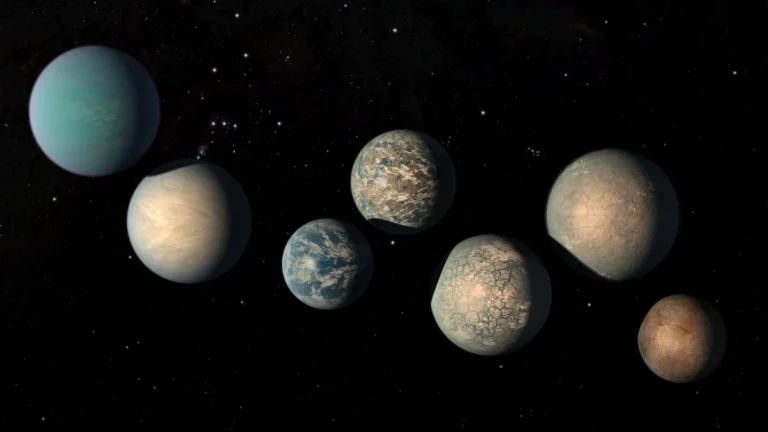
TRAPPIST-1 Planet Lineup showing all seven worlds to scale

TRAPPIST-1d: Why Scientists Are Rethinking Its Place in the Habitable Zone

Astronomers keep talking about TRAPPIST-1e. It sits in the middle of the system’s habitable zone, gets roughly Earth-like stellar flux, and appears in nearly every “best candidates for life” list published since 2017. But thirty-nine light-years away, a quieter world orbits just one slot inward — and in 2025, new modeling and fresh JWST data are forcing scientists to reconsider whether TRAPPIST-1d deserves that overlooked status. The answer is complicated. TRAPPIST-1d might be alive. It might be dead. Or it might be something stranger than either. To understand why, it’s necessary to look at the system more closely. The TRAPPIST-1 System: Seven Worlds Around a Dying Ember TRAPPIST-1 is not Read more

LHS 1140 b: Why Its Possible Nitrogen Atmosphere Matters

Forty-eight light-years away, a small, dim red star hosts a world that has quietly become the most promising place to search for life beyond Earth. Recent JWST observations of the LHS 1140 b nitrogen atmosphere have turned this overlooked contender into one of the most exciting targets in the quest to answer one of humanity’s biggest questions. While many other worlds attract attention, this planet has built the strongest scientific case in the search for life and yet remains largely unknown to most people, underscoring the importance of looking beyond the headlines. Understanding how life evolves on such distant worlds is now a primary goal for astronomers. LHS 1140 b Read more