
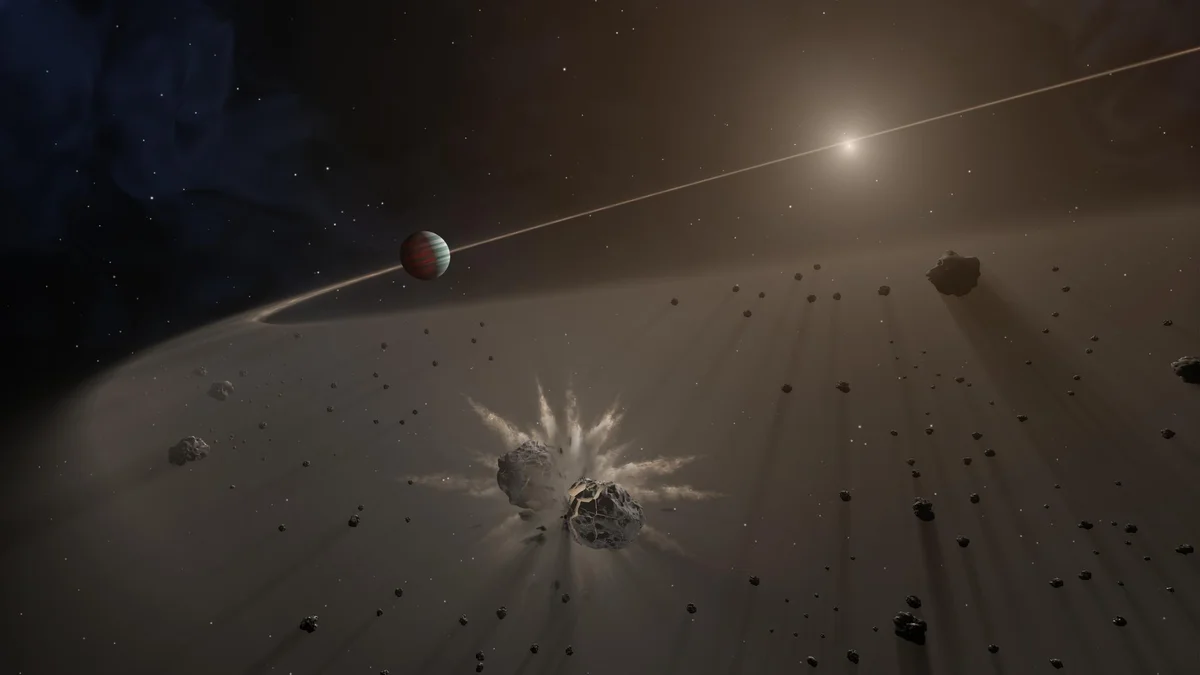
Just 10.5 light-years away in the constellation Eridanus, Epsilon Eridani is one of the closest planetary systems to our own, and one of the youngest yet found around a Sun-like star. At only a few hundred million years old, this orange dwarf is still encircled by dusty debris belts and shaped by at least one giant planet, giving astronomers a rare snapshot of what our own solar system may have looked like during its violent youth. Astronomers study the Epsilon Eridani exoplanet system as a nearby snapshot of how our own solar system may have looked in its youth.
Key Orbital and Physical Parameters
- Distance from Earth: 10.5 light-years
- Stellar type: K2V (orange dwarf)
- Planet mass: ~0.7 Jupiter masses
- Orbital period: ~7 years
- Semi-major axis: ~3.4 AU
- Eccentricity: ~0.25–0.35
The system likely contains more planets. Instruments have detected hints of a second, smaller planet closer to the star, provisionally designated Epsilon Eridani c (this remains an unconfirmed candidate as of 2024). It may be a super-Earth or a Neptune-class world. Confirmation awaits further observations.
The Debris Disks of the Epsilon Eridani Exoplanet System
A System That Mirrors Our Kuiper Belt and Asteroid Belt
Epsilon Eridani also stands out for its debris disk. This disk consists of two distinct belts: a warm inner belt and a cold outer belt. These belts resemble our own asteroid belt and Kuiper Belt. But they are much younger and more massive.
The inner belt orbits at roughly 3 AU from the star. It contains warm dust, likely produced by collisions between rocky bodies. The outer belt lies between 35 and 100 AU. It is a massive ring of icy debris. It contains many times more material than our Kuiper Belt.

Astronomers have imaged this outer belt using the Atacama Large Millimeter/submillimeter Array (ALMA) and the James Clerk Maxwell Telescope. The images show clumps and asymmetries. These features suggest that a planet, possibly Epsilon Eridani b, is sculpting the disk. The clumps may mark regions where dust is trapped in orbital resonances.
What the Disk Tells Us About the System
The structure of the disk provides direct evidence of planetary dynamics. The gaps between the inner and outer belts likely exist because planets cleared away the material in between. In our own solar system, the gap between the asteroid belt and Kuiper Belt is similarly maintained by Jupiter and Neptune.
Scientists estimate the outer belt contains a mass comparable to roughly 20 Earth masses. That is far more than the Kuiper Belt. This abundance reflects the system’s youth. Over time, collisions will grind down the debris. The belt will thin out, just as ours has.
What Epsilon Eridani Reveals About Early Solar System Dynamics
A Laboratory for Planet Migration
The eccentric orbit of Epsilon Eridani b is a critical clue. It suggests that the planet did not always follow its current path. Planetary migration models predict that giant planets often form farther out and then move inward. This inward migration scatters smaller bodies and can create eccentric orbits.
Our own solar system likely experienced such instability. The Nice model proposes that the giant planets once orbited in a more compact configuration. Gravitational interactions with a disk of planetesimals then caused them to migrate. Uranus and Neptune swapped places. Jupiter moved inward. This reshuffling destabilized the asteroid belt and triggered the Late Heavy Bombardment, a period of intense impacts roughly 700 million years after the solar system formed.
Epsilon Eridani may be capturing this process mid-stream. At an estimated age of roughly 500 million years, it may resemble our solar system just before the Late Heavy Bombardment began. The clumpy debris disk and the eccentric giant planet resemble snapshots from computer simulations of early solar system evolution. Every observation of this system helps refine those models.
How the System’s Youth Changes Perspective
Young stars are more active than old stars. Epsilon Eridani has strong magnetic fields and frequent flares. It emits high levels of X-ray and ultraviolet radiation. This radiation affects the chemistry and atmosphere of any surrounding planets. For a gas giant like Epsilon Eridani b, the effect is minimal. For any inner rocky planets, it could strip away atmospheres or inhibit the development of life.
The youth also means the system is still dynamic. Planet migration is ongoing. Debris collisions are frequent. The system has not yet settled into a stable, long-term configuration. This is both exciting and cautionary. It tells us that our own solar system’s calm state is the result of billions of years of gradual evolution.
Observational Challenges and Future Prospects
Why Direct Imaging Is Difficult

Epsilon Eridani b is a challenging target for direct imaging. It is relatively close to its star in angular terms. The star is also bright, overwhelming the planet’s faint reflected light. Most detections have come from radial velocity measurements or astrometry.
However, the debris disk is easier to image. Its cold outer belt shines brightly in millimeter wavelengths. ALMA and the James Clerk Maxwell Telescope have produced detailed maps. These maps reveal clumps and gaps that match predictions from dynamical simulations.
The Role of Upcoming Telescopes
The James Webb Space Telescope offers new capabilities. Its mid-infrared instrument could detect thermal emission from Epsilon Eridani b directly. This would allow astronomers to measure the planet’s temperature and composition. It could also reveal the presence of atmospheric molecules like water or methane.
The Nancy Grace Roman Space Telescope, planned for launch in the mid-2020s, will conduct wide-field surveys. It may detect Epsilon Eridani b using its coronagraph. The Extremely Large Telescope (ELT) in Chile, expected to begin operations around 2028, will also have the sensitivity to image the planet.
These instruments will turn speculation into data. They will confirm or rule out the existence of additional planets. They will map the debris disk in higher resolution. They may even reveal the system’s orbital architecture with precision.
Connecting to Our Own Solar System’s Past
Implications for the Late Heavy Bombardment
The Late Heavy Bombardment was a period roughly 700 million years after the solar system formed. During this time, a sudden spike in impacts scarred the Moon, Mercury, and Mars. The leading explanation is that the giant planets migrated and scattered thousands of asteroids and comets inward.
Epsilon Eridani, at roughly 400–800 million years old, may be at a similar stage. Its debris disk is still rich in material. If the giant planet migrates further, it could send a wave of debris hurtling toward the inner system. That would mimic the chaos our own inner planets endured.
What It Means for the Search for Habitable Worlds
The Epsilon Eridani system teaches an important lesson about habitability. A planetary system must reach a certain maturity before it becomes stable enough for life to emerge. Early on, the bombardment rate is too high. The radiation environment is too harsh. It takes billions of years for the dust to settle.
But Epsilon Eridani also shows that the building blocks of planets, dust, ice, and gas, were abundant in the early solar system. Those same ingredients eventually formed Earth and its neighbors. The system is not a nursery for life today. But it is a museum of the processes that made life possible in the first place.
1. How far away is Epsilon Eridani?
It is approximately 10.5 light-years from Earth. That makes it one of the closest exoplanet-hosting stars known.
2. Is Epsilon Eridani b a habitable planet?
No. It is a gas giant with no solid surface. It likely has a thick hydrogen-helium atmosphere. It orbits well outside the star’s habitable zone. Even if it has large moons, the planet’s distance from the star and elliptical orbit make temperate conditions highly unlikely.
3. How was Epsilon Eridani b discovered?
It was discovered in 2000 using the radial velocity method. This technique measures periodic shifts in the star’s spectrum caused by the planet’s gravitational pull.
4. Why does the debris disk matter so much?
The debris disk is a direct record of ongoing collisions and planetary dynamics. Its structure, two belts with gaps, mirrors our own solar system’s asteroid belt and Kuiper Belt. It provides real-time evidence of how young systems settle.
5. Will future telescopes be able to image Epsilon Eridani b directly?
Yes. The James Webb Space Telescope and the Extremely Large Telescope both have the sensitivity needed to detect the planet’s thermal emission. Direct imaging could reveal its temperature, atmosphere, and orbital tilt.
Sources & References
- Hatzes, A. P., et al. (2000). “Evidence for a Long-Period Planet Orbiting Epsilon Eridani.” The Astrophysical Journal Letters, 544, L145.
- Janson, M., et al. (2015). “Images of the Epsilon Eridani Debris Disk.” Astronomy & Astrophysics, 574, A70.
- NASA Exoplanet Archive: Epsilon Eridani b. Retrieved from https://exoplanetarchive.ipac.caltech.edu
- ALMA Observatory. “ALMA Reveals Planetary Building Blocks in Young Star System.” Retrieved from https://www.almaobservatory.org
- Wyatt, M. C. (2008). “Evolution of Debris Disks.” Annual Review of Astronomy and Astrophysics, 46, 339–383.
Further reading: Epsilon Eridani on Wikipedia