
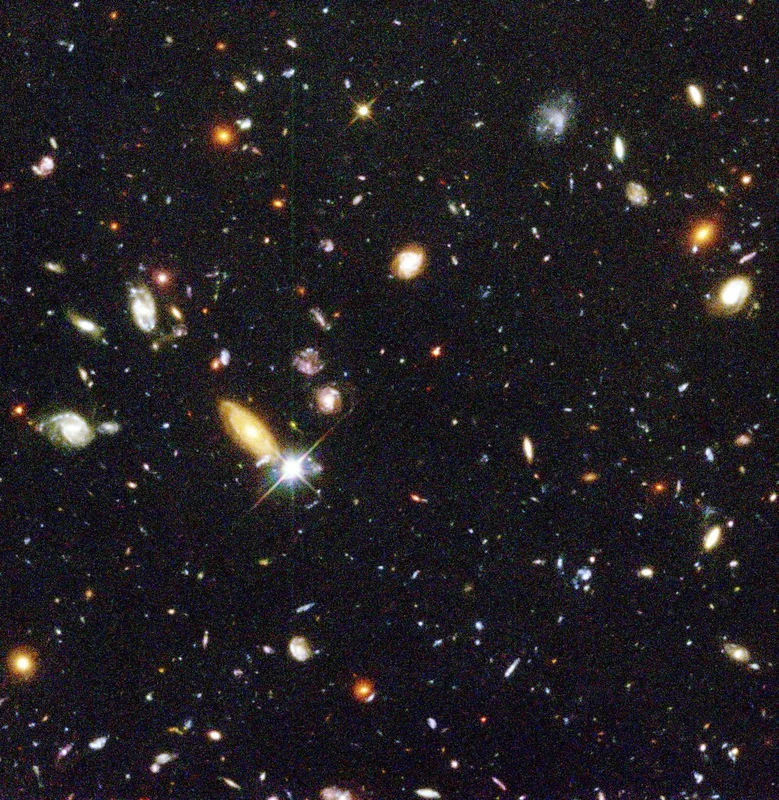
The fine-tuning problem is the observation that the universe‘s fundamental constants appear exquisitely balanced to allow life, raising questions about chance, multiverses, or design.
The universe didn’t have to be the way it is.
The strength of gravity, the fine-structure constant (α), the mass of the proton, the cosmological constant, and the initial conditions of the early universe: each of these fundamental quantities has a specific numerical value. Change any of them even slightly, and the universe becomes radically different.
Change gravity slightly stronger: in most toy models, stars burn too hot and too fast for planets to form and life to develop. Change it weaker: matter never clumps into stars at all. Change the cosmological constant (which drives cosmic expansion) even slightly larger: the universe expands too quickly for matter to clump into galaxies. Change the ratio of electromagnetic force to the strong nuclear force: atoms are unstable.
The universe appears, by any naive assessment, to be extraordinarily well-calibrated for the existence of complex chemistry, stars, planets, and life. This is the fine-tuning problem: one of the deepest puzzles at the intersection of physics, cosmology, and philosophy.
The Remarkable Numbers
The fine-tuning problem is not abstract. Specific, measurable numbers are involved. Imagine each constant as a separate dial on a giant radio, the chance of all being set correctly is roughly one in a googol.
Here are the key constants in play:
The cosmological constant (Λ): the energy density of empty space that drives cosmic acceleration, is measured to be approximately 10⁻¹²³ in natural units (Planck units). Quantum field theory gives a natural estimate of order 1 in those units, a discrepancy of 120 orders of magnitude. This is the largest qualitative mismatch between expectation and observation in physics history, often called the worst prediction problem. If Λ were just 10⁻¹²⁰ in natural units (a factor of ~1000 larger than observed), the universe would have expanded too quickly for galaxies to form before they were more than a few stellar masses. To understand why this matters for cosmic structure, see our article on What Is Dark Energy?
The fine-structure constant (α): which governs the strength of electromagnetic interactions, is approximately 1/137. Unlike the electron charge, which depends on your choice of units, α is dimensionless and universally meaningful. If it were even slightly different, atoms, and therefore chemistry – could not form in their current stable forms.
The proton-to-electron mass ratio is approximately 1836. If it were significantly different, stable atoms wouldn’t exist or molecular chemistry would be impossible. In particular, if protons were heavier than neutrons by a larger amount, hydrogen, the most common element, would be unstable.
The strength of the electromagnetic force relative to the strong nuclear force determines whether nuclei are stable. A small change in the ratio makes carbon, oxygen, or other complex nuclei impossible to form in stars.
The weak nuclear force also plays a critical role. Its strength relative to electromagnetism controls how much hydrogen versus helium was produced in the Big Bang. If the weak force were even weaker, too much helium would have formed, leaving insufficient hydrogen for water and long-lived stars. If it were stronger, supernovae would not produce the heavy elements necessary for rocky planets and life.
The triple-alpha resonance in carbon: a remarkable feature of nuclear physics. Carbon is produced in stars through the triple-alpha process: three helium-4 nuclei (alpha particles) collide to form carbon-12. For this to happen at the rate needed to produce cosmic abundances of carbon, carbon-12 must have an excited energy state (a resonance) at almost exactly the right energy. Fred Hoyle predicted this resonance in 1953 precisely because carbon exists – and it was subsequently measured, with remarkable precision, very close to the predicted 7.68 MeV (observed at ~7.65 MeV).
The initial density of the universe (Ω): the universe’s density right after the Big Bang had to be fine-tuned to within 1 part in 10⁶⁰ of the critical density. Any slight deviation would have caused the universe to either recollapse immediately (too dense) or expand too quickly for galaxies to form (too sparse). This is known as the flatness problem, and it was a key motivation for the theory of cosmic inflation.
Hoyle called the carbon resonance a “put-up job”: meaning something arranged by design. This process is part of How Stars Make Elements, the story of stellar nucleosynthesis that connects stars to the atoms in our bodies.
Imagine a radio with 10¹²⁰ dial settings, only one lets the universe play music. That is the kind of fine-tuning we are talking about for the cosmological constant alone.
The Anthropic Principle Explained
The first attempt to address fine-tuning is conceptually simple: the universe’s constants have to be compatible with the existence of observers, because if they weren’t, no one would be here to observe them.
This is the anthropic principle, articulated by Brandon Carter in 1973.
The weak anthropic principle (WAP) is a tautology: the observed values of physical constants must be consistent with the existence of observers. Of course: if the universe couldn’t support life, we wouldn’t be here asking the question.
The WAP explains why we find ourselves in a universe compatible with life: it has to be, given that we’re asking. But it doesn’t explain why such a universe exists.
The strong anthropic principle (SAP) is more controversial: the universe must be structured so as to produce observers at some point. This seems to imply teleology, purpose or design, which is philosophically contentious and most physicists don’t accept it.
Multiverse: A Scientific Response?
If our universe is one of many, if a multiverse of universes exists, each with different physical constants, then fine-tuning is no longer remarkable. It’s expected.
In a large enough multiverse with varying physical constants, some universes will have constants compatible with life. Observers can only exist in those universes. We necessarily find ourselves in one of the life-compatible universes, not because it was designed for us, but because we can only exist where we can exist.
This is the anthropic argument extended to a multiverse, and it is taken seriously by many physicists.
Eternal inflation: a leading version of the multiverse, predicts that cosmic inflation is an ongoing process that never fully stops. Different regions stop inflating at different times. The quantum fluctuations that cause each region to stop can give that region different values of the vacuum energy (and potentially other constants). If the landscape of string theory is correct, the vacuum energy alone can take an enormous number of different values (~10⁵⁰⁰) across different bubble universes. We live in a bubble where the cosmological constant happens to be small, because we have to.
The string theory landscape provides a theoretical basis for the multiverse. String theory predicts roughly 10⁵⁰⁰ possible configurations of compact extra dimensions, each giving different effective four-dimensional physical constants. If all these vacua are populated by eternal inflation, the anthropic explanation for the cosmological constant becomes plausible. This concept is explored further in Multiverse Theory.
The problem: the multiverse is not directly testable. We can’t observe other bubble universes. This makes many physicists uncomfortable: it seems to abandon the traditional scientific requirement that theories make testable predictions. As Karl Popper argued, falsifiability is what defines the boundary of science.
Defenders argue that the multiverse makes statistical predictions: we should find ourselves in a universe with the smallest cosmological constant compatible with galaxy formation (because galaxy-containing universes are the most numerous). This prediction is arguably satisfied by the observed value. But critics counter that this type of reasoning is not the same as a specific, falsifiable prediction. Furthermore, even within eternal inflation, the measure problem: different ways of counting universes – gives wildly different probabilities for the observed Λ, making the statistical predictions unreliable.
The Design Hypothesis
Fine-tuning is often cited as evidence for a cosmic designer. If the constants seem adjusted for life, perhaps they were adjusted by a creator.

This is not a scientific argument, it invokes an explanation outside of physics. But it’s worth addressing why most scientists find it unsatisfying even on its own terms.
The design hypothesis doesn’t explain the constants; it transfers the question. Why did the designer choose these particular values? What created the creator? This infinite regress problem means that design explanation simply pushes the mystery back one step, it doesn’t resolve it.
Furthermore, the constants are only “fine-tuned” relative to our universe’s specific version of physics. With different fundamental laws, other constants might work fine for life. Our evaluation of fine-tuning depends on treating our physics as the only option, which is not obviously correct.
Is the Universe Really Fine-Tuned?
Imagine a lottery with 10⁵⁰⁰ tickets. If you win, it seems astonishing: until you realize that someone had to win, and you are the one asking the question. This is the heart of the counter-argument to fine-tuning.
Several physicists and philosophers have challenged the premise:
The reference class problem: Fine-tuning arguments compare our universe to a hypothetical space of possible universes with different constants. But what defines this space? Without a well-defined probability distribution over possible universes, it’s not clear what it means to say that our universe is “improbable.” You can’t calculate the probability of our universe without knowing how universes are distributed, which is precisely what we don’t know.
Many “life-permitting” universes might exist: Some researchers have argued that the space of life-permitting universes is larger than commonly assumed. With different constants, life of different kinds, not carbon-based life as we know it, but some form of complexity and chemistry, might be possible. The fine-tuning argument assumes that only carbon-based life under conditions very similar to ours is “life,” which may be parochial. For example, cosmological natural selection (Lee Smolin’s fecund universes theory) suggests that black-hole-producing universes could reproduce and evolve, potentially making life a natural outgrowth of cosmic dynamics.
Some constants may not be independent: The constants of nature may not be freely variable. There might be a deeper theory that determines all constants from a smaller number of truly free parameters: or from no free parameters at all. If a “theory of everything” predicts all constants from first principles, fine-tuning is not a coincidence to be explained but a consequence to be derived.
String theorist Nima Arkani-Hamed and others have argued that the cosmological constant is not fine-tuned if the correct measure over the landscape is used: that our value is actually typical among observers, not special.
A Problem at the Boundary of Science
The fine-tuning problem sits uncomfortably at the boundary between science and philosophy. It involves real, measurable physical quantities, the constants of nature, but the proposed explanations (multiverse, design, deeper theory) range from scientifically productive to empirically unfalsifiable.
The most honest position: the fine-tuning of physical constants is a genuine puzzle, not yet satisfactorily resolved. The multiverse provides the most scientifically grounded response, but depends on theories (string theory, eternal inflation) that are not yet confirmed. A deeper theory that derives the constants from first principles would dissolve the problem entirely, but no such theory exists.
In the meantime, the remarkable compatibility of the universe with the existence of observers remains one of the most thought-provoking facts in all of science.
What do you think: chance, necessity, or design? The answer is not just a scientific question, it’s one of the deepest questions we can ask about our cosmic home.
Sources
- Carter, B. (1974). Large Number Coincidences and the Anthropic Principle in Cosmology. IAU Symposium, 63, 291–298.
- Barrow, J.D. & Tipler, F.J. (1986). The Anthropic Cosmological Principle. Oxford University Press.
- Weinberg, S. (1987). Anthropic Bound on the Cosmological Constant. Physical Review Letters, 59(22), 2607. Available at: NASA ADS
- Susskind, L. (2005). The Cosmic Landscape: String Theory and the Illusion of Intelligent Design. Little, Brown.
- Stenger, V.J. (2011). The Fallacy of Fine-Tuning: Why the Universe Is Not Designed for Us. Prometheus Books.
- The Nobel Prize in Physics 2011 for the discovery of the accelerating expansion of the Universe. Available at: Nobel Prize
What is the fine-tuning problem in physics?
The fine-tuning problem is the observation that the universe’s fundamental constants, such as gravity and the cosmological constant, have precise values that allow life to exist, with even slight changes making the universe uninhabitable.
What are some examples of fine-tuned constants in the universe?
Examples include the strength of gravity, the fine-structure constant, the mass of the proton, the cosmological constant, and the ratio of electromagnetic to strong nuclear force, all of which must be within narrow ranges for stars, planets, and life to form.
Why does fine-tuning suggest the universe might be designed for life?
Fine-tuning suggests design because the precise calibration of constants seems unlikely by chance, leading some to argue it implies a creator or purposeful arrangement, though this is a philosophical interpretation.
How does the multiverse theory explain fine-tuning?
The multiverse theory explains fine-tuning by proposing countless universes with different constants, so at least one universe would have the right conditions for life by random chance.
What happens if the cosmological constant is slightly larger?
If the cosmological constant is slightly larger, the universe expands too quickly for matter to clump into galaxies, preventing star and planet formation.
Further reading: Fine-tuned universe on Wikipedia