
If you think you are reading this sentence because you decided to, a 1983 experiment suggests your brain had already begun preparing the decision before you were aware of it. The question feels urgent in a way most philosophy does not. If free will is an illusion, then no one has ever truly chosen anything. Every decision, what to eat, who to love, whether to commit a crime, was already determined by prior causes stretching back before you were born. Moral responsibility, punishment, praise: all of it rests on a foundation that may not exist.
Neuroscience has not settled the debate. It has made it harder to ignore.
What Free Will Actually Means
The term covers at least three distinct claims, and conflating them causes most of the confusion.
Libertarian free will holds that some human choices are genuinely undetermined: not caused by prior physical events, not reducible to brain states, not predictable even in principle. This is what most people mean when they feel free. It is the hardest version to defend scientifically.
Hard determinism holds that all events, including human decisions, are fully caused by prior events according to physical laws. If you could know the complete state of the universe at any moment, you could predict every future decision. Free will in the libertarian sense does not exist.
Compatibilism holds that free will and determinism are not in conflict: that “free will” properly understood means something like acting according to your own reasons without coercion, and that this kind of freedom is real and important even if the brain is a deterministic system. Daniel Dennett, arguably the most influential living philosopher of mind, holds this position. So did Hume. So did Kant. This debate aligns with broader scientific questions about what makes a theory scientific and how we define explanatory frameworks.
The neuroscience is directly relevant to libertarian free will. It is largely irrelevant to compatibilism, which does not require decisions to be undetermined, only that they arise from the right kind of process.
The Libet Experiment
In 1983, neurophysiologist Benjamin Libet ran an experiment that rattled the intuition of everyone who encountered it.
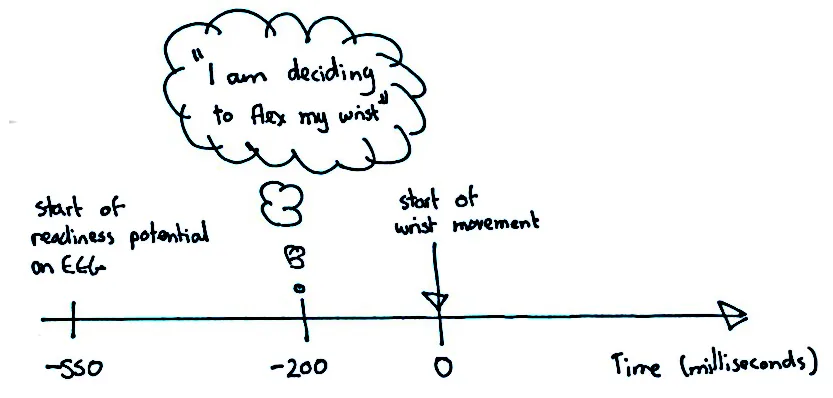
Subjects sat in front of a clock and were asked to flick their wrist whenever they felt like it. They reported the position of the clock hand when they first became aware of the urge to move. Electrodes on the scalp recorded a signal called the readiness potential, a buildup of electrical activity in the motor cortex that precedes voluntary movement.
The readiness potential began approximately 550 milliseconds before the movement. The subjects reported becoming conscious of their decision approximately 200 milliseconds before movement. The math is unambiguous: the brain was preparing the action 350 milliseconds before the person was aware of deciding to act.
The unconscious brain, it appeared, had already made the decision before the conscious mind knew anything about it.
Libet himself did not conclude that free will was dead. He noted that subjects could still veto the movement, they could feel the urge arising and suppress it. The “free won’t” might survive even if the “free will” did not initiate action. If vetoing itself is also determined, the problem simply recurs, but Libet argued that the gap between urge and action is where conscious influence might reside. This idea connects to broader questions about emergence, how complex properties like conscious control can arise from simpler neural processes.
Critics have raised legitimate methodological concerns. The readiness potential may reflect general motor preparation rather than a specific decision. Subjects’ clock readings are imprecise. The task, a spontaneous, meaningless wrist flick, may not generalize to real decisions. But the finding has been replicated and refined across decades.
The Ten-Second Window
In 2008, John-Dylan Haynes and colleagues at the Max Planck Institute used fMRI to extend Libet’s result dramatically. They showed subjects a sequence of letters and asked them to press a button with their left or right hand whenever they chose, then report which letter was showing when they decided.
Activity patterns in two brain regions, the frontopolar cortex and the precuneus, could predict which hand the subject would use up to 10 seconds before the subject was conscious of deciding. A neural bias toward the future choice could be decoded up to ten seconds before conscious awareness.
Ten seconds. The brain’s predisposition toward the decision was extractable by an outside observer a full ten seconds before the person experienced making it.
This does not prove determinism. Neural prediction is probabilistic, not certain, accuracy in Haynes’ study was above chance but not perfect. The brain regions involved may represent something more like a bias or a predisposition than a completed decision. But the implication that conscious experience sits downstream of the real computational work is difficult to dismiss.
Robert Sapolsky’s Case for Determinism
In Determined: A Science of Life Without Free Will (2023), Stanford neurobiologist Robert Sapolsky makes the most comprehensive recent case against libertarian free will from biology.
Every behavior, Sapolsky argues, is the product of what happened one second ago (nerve firing), one minute ago (hormone levels), one year ago (childhood experience), one million years ago (evolutionary history), and one billion years ago (the biochemistry of neurons). Peel back any behavior far enough and you find causes that were not chosen.
This is not a pessimistic conclusion for Sapolsky. He argues that abandoning libertarian free will should change how we think about punishment and reward, moving from retribution toward rehabilitation, without changing anything about how we make decisions. The decisions will still happen. We will still act as though they matter. We just should not add the fiction that they arose from nowhere.
Critics argue Sapolsky redefines free will in the most extreme way and then declares it non-existent: conflating causation with determinism and dismissing compatibilist distinctions as “word games.” This falsifiability issue is central: if the definition of free will is set so high that no measurable evidence could ever satisfy it, the claim becomes untestable rather than empirically settled.
The Compatibilist Response
Dennett’s response, developed across multiple books including Freedom Evolves (2003), is that Sapolsky and Libet are answering the wrong question.
When we say someone acted freely, we do not mean their action was uncaused. We mean it arose from their own deliberative processes, their values, their reasoning: rather than from coercion, addiction, neurological disorder, or external compulsion. A decision that emerges from who you are and what you care about is free in any sense that matters, even if it was physically determined.
Compatibilism is not a dodge. It points to a real distinction between a person acting from their own character and a person acting under the influence of a brain tumor that has altered their personality. Consider the difference between a Tourette’s tic (involuntary, compulsive, not reflective of character) and planning a vacation (deliberate, values-based, reflective of who you are). Neuroscience can distinguish these cases. The distinction matters for moral and legal responsibility even if libertarian free will is false.
Quantum Randomness Does Not Help
A common response to hard determinism is to invoke quantum mechanics. If the brain operates at scales where quantum indeterminacy is relevant, perhaps decisions are genuinely undetermined after all.
The problem is that quantum randomness, if present, produces random outcomes, not chosen ones. A decision arising from quantum noise is not more free than one arising from deterministic causes. It is less coherent. Randomness is not agency.
Penrose and Hameroff’s Orch OR theory attempts to connect quantum processes to consciousness in a more structured way. But quantum effects in warm, wet brains decohere too quickly to influence neural firing reliably: a problem known as the coherence objection. Even if the theory held, how quantum events in microtubules would constitute genuine agency remains unanswered.
What Neuroscience Actually Shows
Several findings are now well-established:
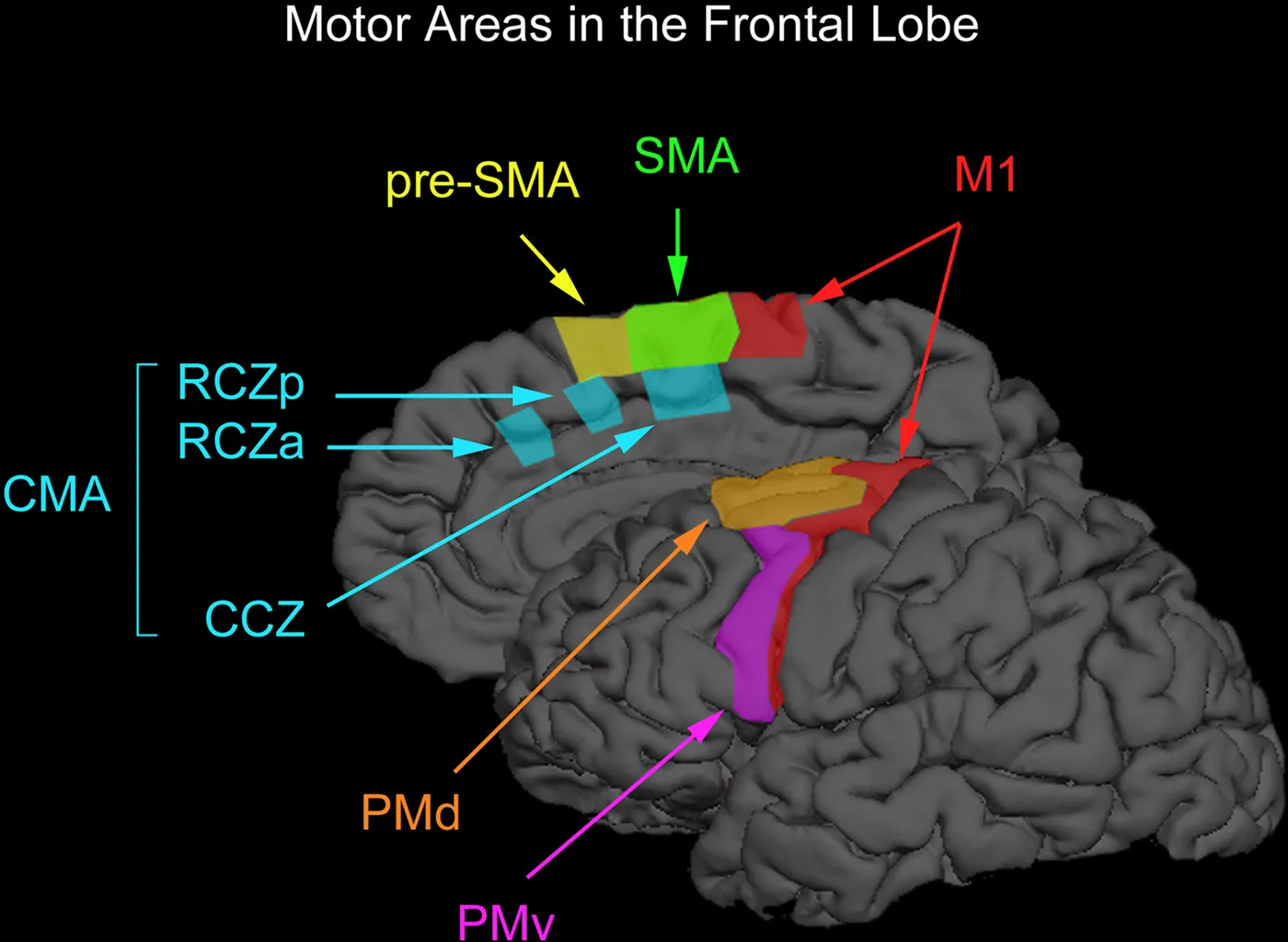
The supplementary motor area (SMA): a region that coordinates movement planning, is active before conscious awareness of a decision to move. Stimulating the SMA electrically produces the experience of an urge to move, subjects feel they want to act, though they have not decided to.
The prefrontal cortex is central to deliberate, values-based decision-making. Damage to the ventromedial prefrontal cortex impairs the ability to integrate emotional signals into decisions: patients can reason abstractly about choices but cannot decide effectively in real life. Antonio Damasio’s somatic marker hypothesis explains this: emotions tag options with felt valence, and without that signal, deliberation stalls.
The anterior cingulate cortex monitors conflict between competing responses and adjusts behavior accordingly. It is active when a decision is difficult, when reasons pull in different directions.
None of this requires libertarian free will to be real. All of it is consistent with compatibilism. The brain deliberates. It integrates past experience, current context, and projected consequences. The output of that deliberation is what we call a decision. Whether the deliberation was determined from the start does not change what it is.
The Cosmic Stakes
If libertarian free will does not exist, if decisions are fully determined by prior physical causes, then every conscious being in the universe, wherever it exists, is in the same position. There is no cosmic exception for humans. This raises questions similar to those explored in discussions of The Great Filter, why the universe may be silent despite the apparent probability of life.
If compatibilism is correct, then free will is a property of the kind of processing a system does, not a violation of physical law. Complex systems that deliberate, model futures, and act from internal values have free will in the sense that matters. That is a property an alien mind could have. Or an artificial one.
The question of whether free will exists turns out to be inseparable from questions about what kind of thing a mind is. That is not an accident.
Where the Science Stands
Libertarian free will, choices arising independently of prior physical causes, has no empirical support and faces substantial neuroscientific evidence against it. Hard determinism is consistent with the evidence but does not follow from it uniquely.
Compatibilism remains the most defensible position: free will properly understood is real, important, and fully consistent with what neuroscience shows about how decisions are made. For practical purposes, this means we can retain moral responsibility while acknowledging that neuroscientific findings refine, rather than eliminate, our understanding of agency. The distinction between a compulsive act and a considered choice matters, and it matters precisely because it grounds how we treat each other.
What is not in dispute: the conscious experience of choosing is real. The deliberation is real. The reasons that shape decisions are real. Whether the system that generates all of this was determined from the start is a deeper question, one that neuroscience has sharpened but not resolved.
Sources & References
- Libet, B., Gleason, C. A., Wright, E. W., & Pearl, D. K. (1983). “Time of conscious intention to act in relation to onset of cerebral activity (readiness-potential).” Brain, 106(3), 623-642. https://doi.org/10.1093/brain/106.3.623
- Soon, C. S., Brass, M., Heinze, H.-J., & Haynes, J.-D. (2008). “Unconscious determinants of free decisions in the human brain.” Nature Neuroscience, 11(5), 543-545. https://doi.org/10.1038/nn.2112
- Schurger, A., Sitt, J. D., & Dehaene, S. (2012). “An accumulator model for spontaneous neural activity prior to self-initiated movement.” PNAS, 109(42), E2904-E2913. https://doi.org/10.1073/pnas.1210467109
- Haggard, P. (2008). “Human volition: towards a neuroscience of will.” Nature Reviews Neuroscience, 9(12), 934-946. https://doi.org/10.1038/nrn2497
- Fried, I., Mukamel, R., & Kreiman, G. (2011). “Internally generated preactivation of single neurons in human medial frontal cortex predicts volition.” Neuron, 69(3), 548-562. https://doi.org/10.1016/j.neuron.2010.11.045
- Bechara, A., Damasio, H., & Damasio, A. R. (2000). “Emotion, decision making and the orbitofrontal cortex.” Cerebral Cortex, 10(3), 295-307. https://doi.org/10.1093/cercor/10.3.295
- Botvinick, M. M., Braver, T. S., Barch, D. M., Carter, C. S., & Cohen, J. D. (2001). “Conflict monitoring and cognitive control.” Psychological Review, 108(3), 624-652. https://doi.org/10.1037/0033-295X.108.3.624
- Sapolsky, R. M. (2023). Determined: A Science of Life Without Free Will. Penguin Press.
- Dennett, D. C. (2003). Freedom Evolves. Viking Press.
Further Reading
For those interested in exploring further, the primary sources cited include Daniel Dennett’s Freedom Evolves (2003), Robert Sapolsky’s Determined: A Science of Life Without Free Will (2023), and Libet’s original 1983 paper in Brain. Accessible overviews can be found in Nature’s free will collection and the Stanford Encyclopedia of Philosophy entry on compatibilism.
What did the 1983 experiment on free will and neuroscience show?
The 1983 experiment by Benjamin Libet showed that brain activity preparing a decision (the readiness potential) begins before a person becomes consciously aware of their intention to act, suggesting conscious choice may not initiate actions.
Does neuroscience prove free will is an illusion?
No, neuroscience has not settled the debate; it has only made the question harder to ignore by revealing neural activity that precedes conscious awareness of decisions.
What is libertarian free will?
Libertarian free will is the claim that some human choices are genuinely undetermined, not caused by prior physical events, not reducible to brain states, and not predictable even in principle.
What is hard determinism?
Hard determinism holds that all events, including human decisions, are fully caused by prior events according to physical laws, meaning libertarian free will does not exist.
What is compatibilism in the free will debate?
Compatibilism argues that free will and determinism can coexist, defining free will as the ability to act according to one’s own desires and intentions, even if those desires are caused by prior events.
Further reading: Neuroscience of free will on Wikipedia