

One of the most persistent questions in science is not about the smallest things or the largest ones. It is about the middle. It asks how collections of simple components, each obeying basic physical rules, can produce behavior that looks purposeful, adaptive, or even aware.
This phenomenon is known as emergence, and it sits at the boundary between reductionism and wonder.
Emergence describes situations in which the whole exhibits properties that do not exist in its isolated parts, even though no new fundamental laws are introduced. Nothing magical is added. Nothing supernatural intervenes. From the smallest particles to the vast structure of the cosmic web, emergence defines the architecture of our universe. Yet something genuinely new appears.
Understanding how this happens reshapes how we think about life, mind, and the structure of the universe itself.
From rules to patterns
Consider temperature. No individual atom has a temperature. An atom has mass, charge, and kinetic energy, but temperature only emerges when vast numbers of atoms interact. It is a statistical property, real and measurable, but dependent on scale.
The same is true for pressure, viscosity, and electrical conductivity. These are not properties of particles. They are properties of systems.
Emergence is therefore not about ignorance. It is about levels of description. Some truths do not exist at smaller scales, no matter how precisely those scales are described.

Weak emergence and strong emergence
Scientists often distinguish between two forms of emergence, and here the scientific consensus is more apparent than it is sometimes presented.
Weak emergence is the operational framework of most natural sciences. It describes complex behavior that arises from simple rules and, in principle, could be derived from them, even if the computation is intractable in practice. Turbulence in fluids, the formation of snowflakes, traffic jams, and flocking behavior all fall into this category.
These phenomena are ontologically dependent on their microscopic constituents but explanatorily autonomous. We understand hurricanes through meteorology, not particle physics. The higher-level description is real, helpful, and causally efficacious, even though it introduces no new forces.
Strong emergence is more controversial. It proposes that some higher-level phenomena possess genuinely novel causal powers that cannot, even in principle, be reduced to or explained by the laws governing their parts. This often implies downward causation, where a higher-level state influences lower-level physics in a way not captured by existing laws.
This is where objections arise. Many scientists and philosophers argue that strong emergence conflicts with the causal closure of the physical, the principle that physical events have sufficient physical causes. Consciousness is often proposed as a candidate for strong emergence, but critics argue that invoking downward causation risks introducing mystery rather than explanation.
Rejecting strong emergence does not trivialize consciousness. It places it firmly within nature rather than outside it.

Collective intelligence without leaders
Emergence becomes more intuitive when seen in action.
Consider the murmuration of starlings. Thousands of birds move as a single, fluid, shape-shifting entity. No bird leads. No global plan exists. Each individual follows a handful of local rules: avoid collisions, align with neighbors, and stay close to the group.
From these minimal instructions, breathtaking coordination emerges. The flock behaves as if it has intention, even though no individual bird possesses it.
Ant colonies provide another example. Individual ants follow simple chemical cues, yet collectively they build bridges, regulate traffic, and optimize foraging paths. The intelligence is not in the ant. It is in the network of interactions.
Life as an emergent process
Life offers one of the clearest demonstrations of emergence.
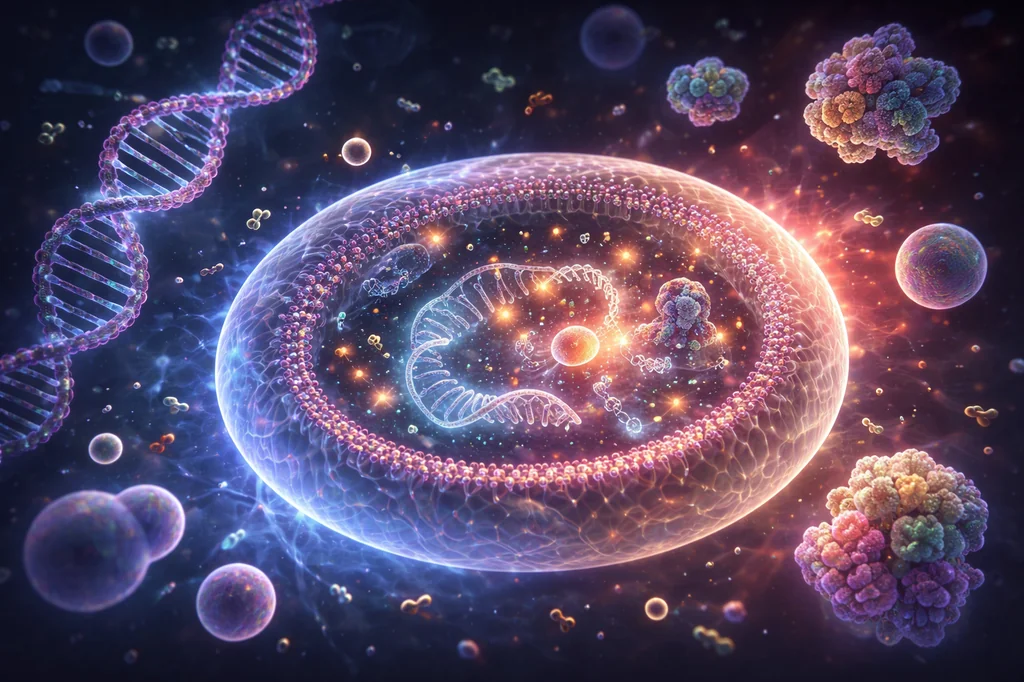
No molecule is alive. DNA is not alive. Proteins are not alive. Lipid membranes are not alive. But when these components interact under the right conditions, a system appears that can metabolize, reproduce, and evolve.
Life is not a substance. It is a process maintained far from equilibrium. It persists by continuously exchanging energy and matter with its environment, thereby resisting entropy.
From this perspective, life is not something that happens to matter. It is something matter does when constrained in the right way.
Phase transitions and new states of matter
Emergence is especially visible at phase transitions.
When water freezes, nothing new is added. The molecules are the same. Yet rigidity appears. Ice has properties that liquid water does not. The system undergoes a collective reorganization when a global parameter crosses a threshold.
Similar transitions occur in magnetism, superconductivity, and even neural activity. These moments reveal how new macroscopic order can arise abruptly from microscopic continuity.
The brain and the emergence of mind
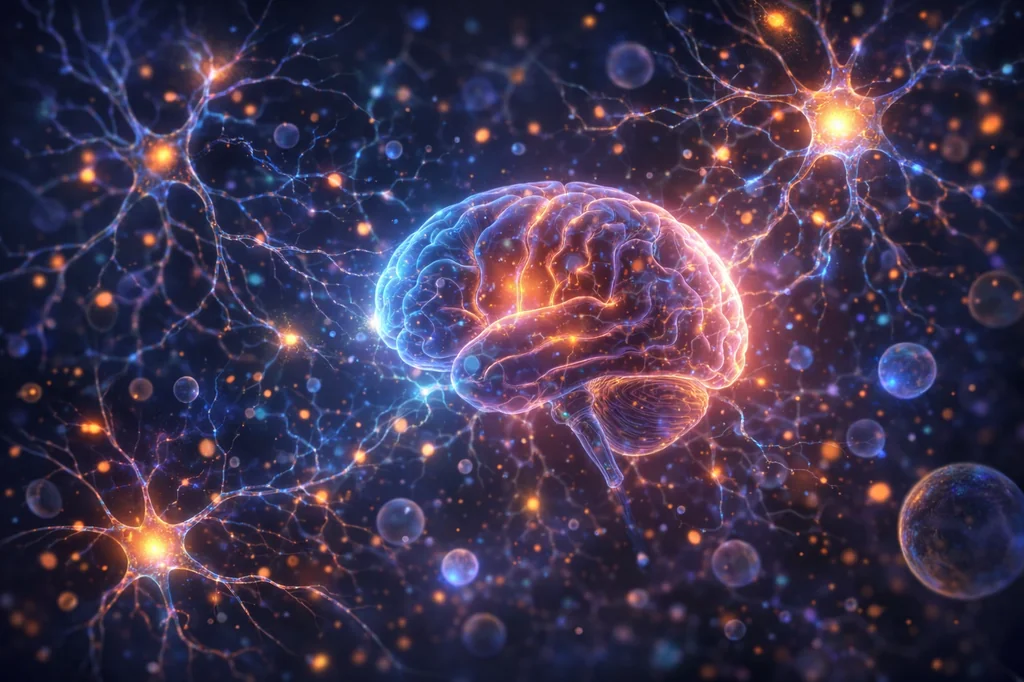
Neurons obey electrochemical rules. They transmit signals, integrate inputs, and modify their connections. None of them thinks. None of them feels.
Yet when billions of neurons interact in structured networks, mental states emerge. Memory, emotion, intention, and subjective experience arise without any single neuron containing them.
This does not make consciousness an illusion. Pain is real. Thoughts are real. Decisions are real. But their reality is organizational, not elemental.
Just as temperature is real without being fundamental, consciousness may be real without requiring new physics.
Why more really is different
Emergence challenges naive reductionism, the idea that understanding the smallest parts automatically explains everything above them.
At each new scale of complexity, new regularities appear that require their own concepts, models, and sciences. A useful way to think about this is coarse-graining, where higher-level theories deliberately ignore microscopic detail to capture stable, large-scale behavior.
Fluid dynamics does not track molecules. Evolutionary biology does not track atoms. These descriptions are not inferior approximations. They are autonomous explanations, consistent with lower-level laws but not reducible to them in practice.
Emergence without design
One of the most profound implications of emergence is that complexity does not require foresight.
Evolution does not plan. Natural selection has no goal. Yet over time, it produces organisms of astonishing sophistication. Order arises not because the process is clever, but because small advantages accumulate across immense spans of time.
Emergence shows how structure can arise without blueprints, novelty without violation of law, and meaning without external design.
Open questions at the edge
Emergence reframes questions rather than closing them.
How many levels of emergence exist in nature?
Is consciousness fully explainable as a weakly emergent phenomenon?
Does spacetime itself emerge from something deeper?
These are not questions of belief. They are questions of modeling, evidence, and explanation. Science has not finished answering them, and that openness is a feature, not a flaw.
A universe that builds itself
Emergence reveals a universe that is not static, brittle, or pre-scripted. It is a universe capable of generating complexity from simplicity, creativity from constraint, and richness from interaction.
Nothing is added from outside. The structure arises from relationships.
That insight, more than any single example, is what makes emergence one of the most powerful ideas in modern science.
Sources
• Stanford Encyclopedia of Philosophy – “Emergent Properties” https://plato.stanford.edu/entries/properties-emergent/
Santa Fe Institute (complex systems research) https://www.santafe.edu/
https://www.nobelprize.org/prizes/chemistry/1977/prigogine/facts/
Further reading: Emergence on Wikipedia