
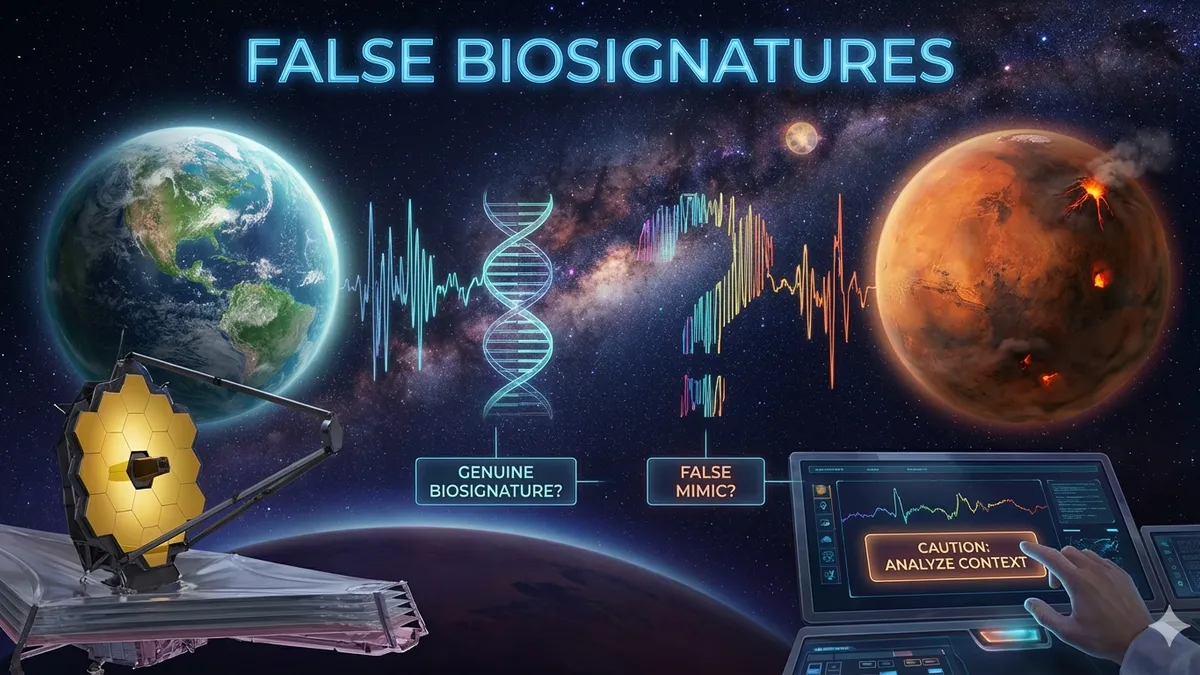
The search for life beyond Earth has entered a transformative era. Powerful observatories such as the James Webb Space Telescope (JWST) are now capable of performing JWST studies of exoplanet atmospheres, revealing the chemical fingerprints of worlds orbiting stars many light-years away. One of the central goals of this research is to identify alien biosignatures, measurable indicators that may suggest the presence of life.
Yet detecting life across interstellar distances is extraordinarily challenging. Many atmospheric signals that appear biological can also arise from non-biological processes. These misleading indicators, known as false biosignatures, represent one of the most important challenges in modern astrobiology.
Understanding false biosignatures is essential for interpreting exoplanet data responsibly. Without careful analysis, scientists could mistakenly conclude that a lifeless planet is inhabited. As observational technology improves and thousands of potentially habitable planets are discovered, distinguishing genuine biosignatures from abiotic chemistry will remain one of the defining scientific problems in the search for extraterrestrial life.
What Are False Biosignatures?
A false biosignature occurs when a planet displays chemical or physical signals that resemble those produced by life but are actually generated by abiotic processes, or non-living processes, such as volcanic activity, photochemistry, or atmospheric escape.
Many atmospheric gases considered promising for life detection are strongly associated with biology on Earth. Oxygen is produced by photosynthesis, methane often originates from methanogenic microbes, and nitrous oxide is generated through microbial metabolism. When astronomers detect these molecules in exoplanet atmospheres, they may initially appear to be strong indicators of biological activity.
Planetary environments can generate the same compounds through physical or chemical mechanisms. Geological reactions, stellar radiation, and atmospheric chemistry can produce gases that mimic biological signals, so interpreting these signals requires caution and detailed modeling.
For this reason, scientists rarely rely on a single biosignature gas. Instead, they evaluate the entire planetary environment, searching for combinations of gases that are difficult to maintain without biological activity.
Abiotic Oxygen: A Major Source of False Biosignatures
One of the most widely discussed biosignatures is molecular oxygen (O₂). On Earth, oxygen is primarily produced through photosynthesis, a biological process carried out by plants, algae, and cyanobacteria. Because oxygen is chemically reactive, it typically does not remain in large quantities in a planetary atmosphere unless it is replenished continuously.
For decades, scientists viewed oxygen as one of the strongest potential indicators of extraterrestrial life. However, research has shown that abiotic oxygen can accumulate on lifeless planets under certain conditions.
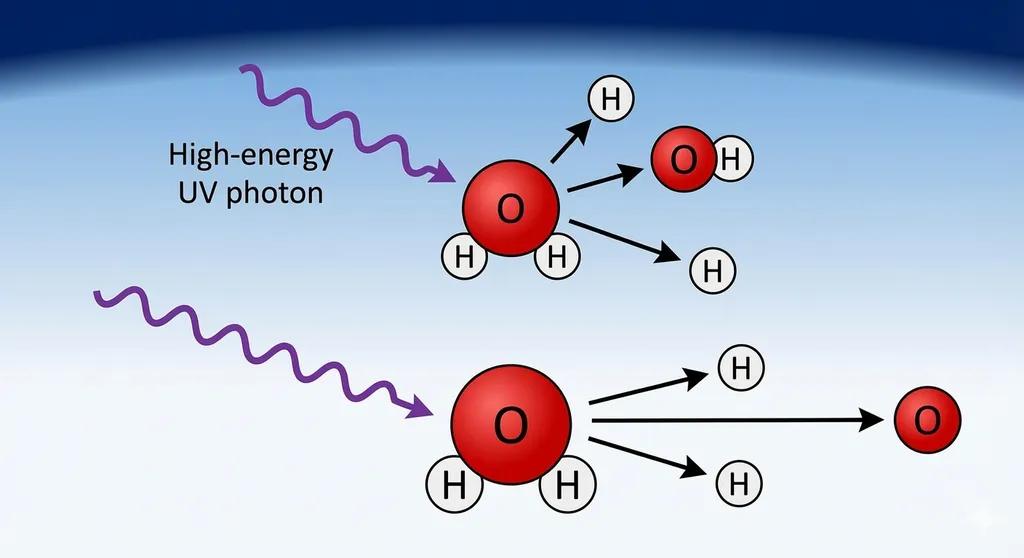
One important mechanism involves the photodissociation of water vapor. Photodissociation means breaking apart molecules with light. It occurs when high-energy ultraviolet radiation from a star splits water molecules into hydrogen and oxygen. Because hydrogen is extremely light, it can escape into space, leaving oxygen behind.
Over time, this process can produce oxygen-rich atmospheres without the need for biology.
Another scenario involves runaway greenhouse conditions, similar to those believed to have occurred on early Venus. In these environments, large amounts of water vapor enter the upper atmosphere, where ultraviolet radiation dissociates the molecules. Hydrogen escapes to space while oxygen accumulates.
These processes demonstrate that oxygen alone cannot serve as definitive proof of life.

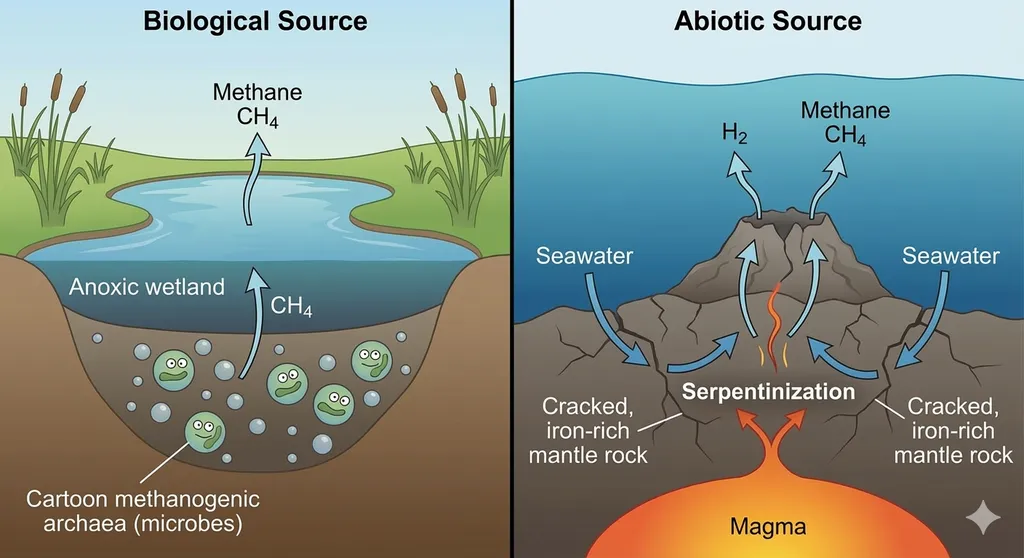
Another commonly discussed biosignature gas is methane (CH₄). On Earth, methane is produced primarily by microorganisms living in oxygen-poor environments such as wetlands, sediments, and the digestive systems of animals.
Methane attracts attention because it reacts with oxygen and gradually breaks down in planetary atmospheres. If both gases are detected together, the combination may indicate a chemical disequilibrium that requires continuous replenishment.
However, methane can also form through several abiotic geological processes.
One of the most important is serpentinization, a chemical reaction in which water interacts with certain iron-rich mantle rocks. Serpentinization produces hydrogen, which can combine with carbon compounds to form methane.
Hydrothermal systems on rocky planets or ocean worlds like Europa and Enceladus can generate methane abiotically. Methane may also come from volcanic outgassing, cometary delivery, or reactions in planetary interiors.
Because of these pathways, methane alone cannot confirm the presence of life.
Other Biosignature Gases and Their False Positives
Researchers are exploring many atmospheric compounds that could signal biological activity, but many also have non-biological sources.
| Potential Biosignature Gas | Possible Biological Source | Abiotic False Positive Mechanisms |
|---|---|---|
| Oxygen (O₂) | Photosynthesis | Water photodissociation, atmospheric escape |
| Methane (CH₄) | Methanogenic microbes | Serpentinization, volcanic chemistry |
| Nitrous oxide (N₂O) | Microbial metabolism | Lightning, photochemical reactions |
| Methyl chloride (CH₃Cl) | Marine microorganisms | Volcanic emissions, ocean chemistry |
| Phosphine (PH₃) | Microbial metabolism in anaerobic environments | Lightning, volcanism, photochemistry |
The 2020 phosphine debate involving Venus illustrates how complex biosignature interpretation can be. Initial observations suggested phosphine might exist in Venus’s atmosphere, potentially hinting at microbial life. Later studies questioned the detection and proposed alternative explanations.
Some researchers note that large amounts of phosphine may be difficult to produce by abiotic processes, making it a stronger biosignature candidate under certain planetary conditions. However, the debate highlights how extraordinary claims require extensive verification.
Atmospheric Disequilibrium as a Biosignature
Because individual gases often form abiotically, scientists search for atmospheric disequilibrium as a stronger biosignature.
Chemical disequilibrium occurs when gases that should rapidly react with each other coexist in significant quantities. On Earth, the simultaneous presence of oxygen and methane is a classic example. Without continuous biological replenishment, these gases would react and disappear over geological timescales.
However, disequilibrium signals can sometimes arise through non-biological atmospheric chemistry. Ultraviolet radiation from a star may drive photochemical reactions that generate unexpected gas mixtures, while volcanic activity and atmospheric circulation can also maintain unusual chemical combinations.
Researchers are also developing quantitative disequilibrium metrics that measure how far a planetary atmosphere deviates from chemical equilibrium. Large deviations from equilibrium may indicate continuous energy input into the atmosphere, which on Earth is largely driven by biological processes.
The Role of Host Stars

The type of star a planet orbits plays a major role in determining whether false biosignatures are likely to occur.
Many potentially habitable exoplanets orbit M-dwarf stars, which are smaller and cooler than the Sun yet extremely common. These stars emit bursts of ultraviolet radiation that influence atmospheric chemistry.
Ultraviolet radiation can accelerate the breakdown of water molecules, increasing the likelihood that abiotic oxygen accumulates in planetary atmospheres. At the same time, the spectral properties of M-dwarfs may influence biological processes such as photosynthesis.
Because of these factors, interpreting biosignatures on planets orbiting M-dwarfs requires particularly careful analysis.
False Negatives: When Life Leaves No Detectable Signal
While much attention focuses on false biosignatures, the opposite problem also exists. A planet with life may appear lifeless if its biosphere does not significantly alter the atmosphere.
Early Earth provides a striking example. For billions of years, microbial life thrived on our planet, yet the atmosphere contained little oxygen. If distant astronomers had observed Earth during this period, they might not have detected any clear biosignatures.
Other scenarios could also produce false negatives. A planet with a small biosphere might not generate detectable atmospheric changes. Thick global cloud layers could obscure atmospheric signals, and life confined to subsurface oceans might leave little trace in the atmosphere.
These possibilities mean even advanced telescopes may sometimes miss inhabited worlds.
How Scientists Confirm Biosignatures
Because both false positives and false negatives are possible, scientists rely on multiple lines of evidence before claiming to have discovered extraterrestrial life.
The process typically begins with spectroscopic observations, which identify atmospheric gases based on how they absorb or emit light. Researchers then examine the planet’s environmental context, including temperature, atmospheric pressure, and stellar radiation.
Next, scientists build atmospheric and climate models to determine whether abiotic processes could produce the observed gases. If plausible non-biological explanations exist, the biosignature claim becomes weaker.
Additional observations may search for multiple biosignature gases, seasonal variations, or atmospheric patterns consistent with biological activity.
Another powerful diagnostic involves isotopic ratios. Biological processes often prefer lighter isotopes of certain elements. For example, living organisms typically incorporate more carbon-12 than carbon-13, producing distinctive isotopic signatures. Detecting such patterns in exoplanet atmospheres could help distinguish biological processes from abiotic chemistry.
Instead of asking whether a signal simply resembles life, researchers evaluate whether life provides the most probable explanation given the available evidence.
Modeling Entire Planetary Systems
Modern astrobiology increasingly treats biosignatures as part of a complete planetary system.
Scientists simulate planetary climates, atmospheric chemistry, geological processes, and stellar radiation environments to determine whether a lifeless planet could produce the signals observed by telescopes. This approach often incorporates Bayesian reasoning, combining observational data with models of possible abiotic processes.
This Bayesian framework is powerful, but it depends partly on assumptions about how likely life is to arise on other worlds. Because the true cosmic probability of life remains unknown, different assumptions can lead to different interpretations of the same atmospheric signals.
The goal is therefore not simply to detect interesting gases, but to determine whether life provides the most plausible explanation for the observed chemistry.
Future Telescopes and the Search for Life
Next-generation observatories will significantly improve scientists’ ability to distinguish false biosignatures from genuine ones.
Ground-based facilities such as the Extremely Large Telescope (ELT) will allow astronomers to study exoplanet atmospheres with far greater sensitivity. Space missions such as the Nancy Grace Roman Space Telescope and the European ARIEL mission will expand atmospheric studies across large populations of exoplanets.
Future flagship missions such as HabEx or LUVOIR, if approved, could directly image Earth-like planets and analyze their atmospheres in unprecedented detail.
Future observations may also search for surface biosignatures. One widely discussed example is the vegetation red edge, a spectral signature produced by photosynthetic pigments that strongly reflect near-infrared light. Detecting such signals would require relatively cloud-free conditions and assumes that extraterrestrial photosynthetic organisms might use pigments with reflective properties similar to those on Earth.
Technological Activity and Anthropogenic False Positives
Another emerging consideration is whether technological activity might complicate biosignature detection. Advanced civilizations could alter their planet’s atmosphere through industrial processes, producing unusual gases not normally produced by natural planetary chemistry.
Compounds such as chlorofluorocarbons (CFCs) or unusually high concentrations of nitrogen dioxide (NO₂) might indicate technological activity rather than biological metabolism. In principle, these molecules could serve as technosignatures, indicators of advanced civilizations.
At the same time, natural processes might occasionally mimic technological signals. Volcanic chemistry, lightning-driven reactions, or unusual atmospheric dynamics could produce unexpected compounds resembling industrial pollutants.
Because of these possibilities, scientists increasingly consider both biological and technological explanations when interpreting unusual atmospheric chemistry on distant worlds.
Why False Biosignatures Matter
The discovery of life beyond Earth would be one of the most profound scientific achievements in human history. Because of the magnitude of such a claim, researchers must apply extremely rigorous standards when interpreting potential evidence.
False biosignatures demonstrate that planetary atmospheres are complex chemical systems shaped by geology, radiation, and atmospheric physics. Signals that appear biological at first glance may ultimately have purely physical explanations.
By studying false biosignatures, scientists strengthen the reliability of future discoveries. Careful skepticism ensures that when evidence for extraterrestrial life is eventually confirmed, it will rest on a solid scientific foundation.
Sources
Catling, D. C., and Kasting, J. F. (2017). Atmospheric Evolution on Inhabited and Lifeless Worlds. Cambridge University Press.
Schwieterman, E. W., et al. (2016). “False Positive Biosignatures on M-Dwarf Planets.” Astrophysical Journal Letters. https://doi.org/10.3847/2041-8205/819/1/L13
Meadows, V. S. (2017). “Reflections on O₂ as a Biosignature in Exoplanetary Atmospheres.” Astrobiology. https://doi.org/10.1089/ast.2016.1589
Krissansen-Totton, J., Bergsman, D. S., and Catling, D. C. (2018). “On Detecting Biospheres from Chemical Disequilibrium in Planetary Atmospheres.” Science Advances. https://doi.org/10.1126/sciadv.aao5747
Seager, S., Bains, W., and Hu, R. (2013). “Biosignature Gases in H₂-Dominated Atmospheres on Rocky Exoplanets.” Astrophysical Journal. https://doi.org/10.1088/0004-637X/777/2/95
Reinhard, C. T., Olson, S. L., Schwieterman, E. W., and Lyons, T. W. (2017). “False Negatives for Remote Life Detection on Ocean-Bearing Planets.” Astrobiology. https://doi.org/10.1089/ast.2017.1724
Further reading: Biosignature on Wikipedia