
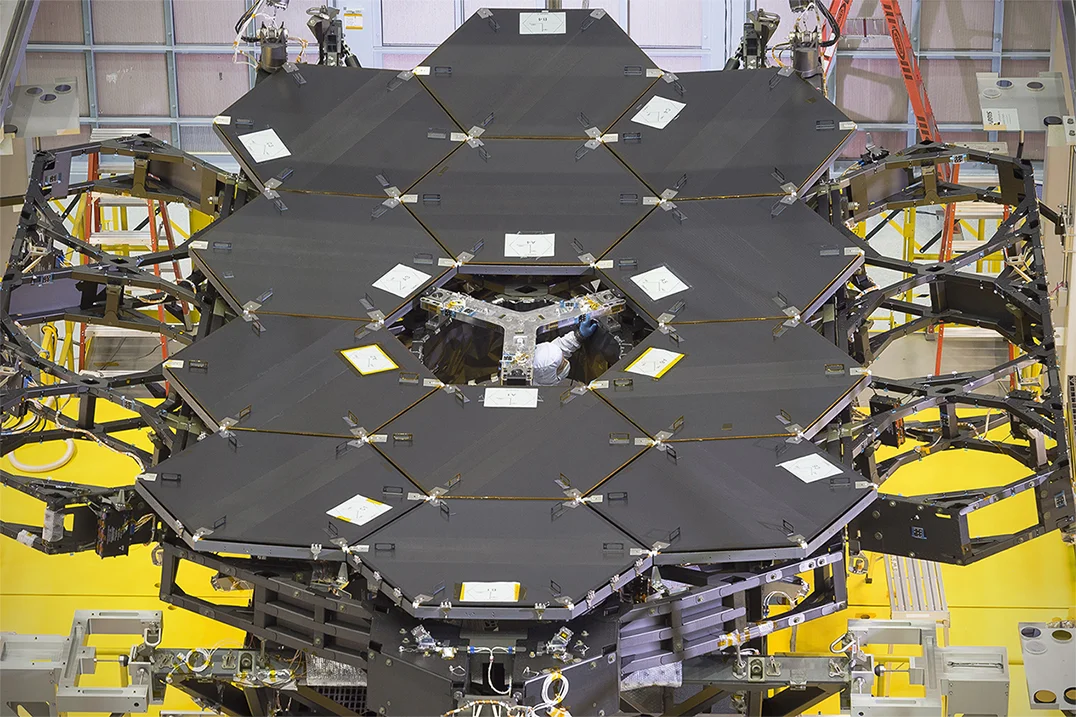
The JWST biosignature detection capability represents a monumental leap in humanity’s ability to search for life beyond Earth, yet the telescope operates within strict physical and observational limits that prevent definitive confirmation of life on exoplanets. Since its launch in December 2021, the James Webb Space Telescope has transformed exoplanet science by observing the chemical composition of distant worlds with unprecedented precision. However, understanding what JWST can actually detect, and what it cannot confirm, requires a grounded look at its observational methods, the gases it can identify, and the persistent problem of false positives that plague all biosignature science.
The Three Pillars of JWST Biosignature Detection
JWST does not take direct pictures of alien surfaces or capture microbial activity. Instead, it relies on three primary techniques to infer atmospheric composition: transmission spectroscopy, emission spectroscopy, and, in limited cases, direct imaging. Each method has distinct strengths and weaknesses in the search for biological markers.

Transmission Spectroscopy
Transmission spectroscopy is JWST’s most powerful tool for exoplanet atmosphere analysis. When a planet transits, passes in front of its host star, starlight filters through the planet’s upper atmosphere. Different gas molecules absorb specific wavelengths of light, leaving a chemical fingerprint in the transmitted spectrum. By comparing starlight before and during transit, astronomers can identify which gases are present.
JWST’s NIRSpec (Near-Infrared Spectrograph) and NIRISS (Near-Infrared Imager and Slitless Spectrograph) instruments are optimized for this technique, covering wavelengths from 0.6 to 5.3 microns. This range is particularly valuable because many key biosignature gases, including water vapor (H₂O), carbon dioxide (CO₂), methane (CH₄), and ozone (O₃), have strong absorption features in the near-infrared.
The method works best for planets with large scale heights (extended atmospheres) orbiting small stars. As NASA’s Exoplanet Exploration page notes, transmission spectroscopy has successfully characterized dozens of exoplanet atmospheres, though it is inherently limited to edge-on orbital geometries and requires multiple transits to achieve sufficient signal-to-noise.
Emission Spectroscopy
Emission spectroscopy, also called secondary eclipse spectroscopy, observes the planet’s own thermal radiation. When a planet passes behind its star (a secondary eclipse), JWST can measure the combined star-plus-planet light, then subtract the star’s light to isolate the planet’s emission spectrum. This technique reveals day-side atmospheric composition and temperature structure.

JWST’s MIRI (Mid-Infrared Instrument) is especially important here, covering 5 to 28 microns. Mid-infrared wavelengths contain spectral features of ozone, carbon dioxide, and phosphine – molecules that may signal biological or geological activity. Emission spectroscopy is less dependent on atmospheric scale height than transmission spectroscopy, making it useful for smaller, cooler planets. However, it requires brighter host stars and favorable orbital alignments.
Direct Imaging
Direct imaging remains JWST’s most challenging technique for biosignature detection. The telescope’s coronagraphs on NIRCam and MIRI can block starlight to reveal nearby planets, but this works only for young, self-luminous gas giants far from their stars. Terrestrial planets in habitable zones are typically too close to their host stars and too faint to image directly.
JWST’s direct imaging capabilities are best suited for studying planetary formation and atmospheric properties of young giant planets, such as those in the HR 8799 system. For biosignature searches on Earth-like worlds, direct imaging will likely remain beyond JWST’s reach unless future missions like the Habitable Worlds Observatory become operational.
Key Biosignature Gases: Detection Potential and False Positives
Not all biosignature gases are equal. Some are nearly unambiguous indicators of life if detected in sufficient quantities; others can be produced abiotically through geological or photochemical processes. JWST’s ability to detect each gas depends on its spectral features, abundance, and the observing conditions.
Oxygen (O₂) and Ozone (O₃)
Molecular oxygen (O₂) has long been considered a promising biosignature because on Earth, it is produced almost exclusively by photosynthesis. However, O₂ has weak spectral features in the near-infrared, making it difficult for JWST to detect directly. Ozone (O₃), a photochemical byproduct of O₂, is much easier to detect in the mid-infrared at 9.6 microns. MIRI can potentially observe O₃ in the atmospheres of temperate exoplanets.
The false-positive problem is significant. Abiotic oxygen can accumulate through photodissociation of water vapor followed by hydrogen escape, as may have occurred on early Mars and Venus. A 2021 study in Nature Geoscience demonstrated that even CO₂-rich atmospheres without life can generate detectable O₂ levels through UV starlight splitting CO₂. Thus, detecting O₂ or O₃ alone cannot confirm life.
Water Vapor (H₂O)
Water vapor is not a biosignature by itself, it is widespread throughout the galaxy on planets and moons, but it is essential context. Liquid water is a prerequisite for life as we know it, and detecting H₂O in a planet’s atmosphere suggests habitable conditions. JWST has already detected water vapor on WASP-39b, a hot Saturn-sized planet, and several other worlds.
Water absorbs strongly in multiple near-infrared bands, making it one of JWST’s easiest atmospheric detections. The challenge is distinguishing between atmospheric water vapor and water in clouds or hazes.
Carbon Dioxide (CO₂) and Methane (CH₄)
CO₂ and CH₄ together form a compelling, though not definitive, biosignature pair. On Earth, the coexistence of CO₂ and CH₄ in the atmosphere is maintained by biological production of methane from organic matter decomposition. JWST’s detection of CO₂ on WASP-39b in 2022 demonstrated its sensitivity to this molecule.
The false-positive issue: Methane can be produced abiotically through serpentinization – a geological process where water reacts with olivine rock, releasing H₂ that then reacts with CO₂ to form CH₄. This process occurs on Saturn’s moon Enceladus, where hydrothermal activity within the moon’s subsurface ocean drives serpentinization and produces methane, as confirmed by Cassini spacecraft measurements of plume material. It also likely occurs on many exoplanets. Additionally, the CH₄/CO₂ ratio matters: a high ratio suggests biological or geological activity, while equilibrium chemistry tends toward CO₂ dominance.
Nitrous Oxide (N₂O)
Nitrous oxide (N₂O) is produced on Earth primarily by microbial denitrification in soils and oceans. It has strong spectral features in the mid-infrared near 7.8 and 16.9 microns, potentially detectable by MIRI. A 2022 study in The Astrophysical Journal suggested that N₂O could be a promising biosignature because its abiotic production pathways are limited.
However, there are known false positives: Lightning in oxygen-rich atmospheres can produce N₂O, as can UV photochemistry from ammonia. The detection threshold remains high, and N₂O may be below JWST’s sensitivity for all but the most optimistic scenarios.
Phosphine (PH₃)
Phosphine (PH₃) gained notoriety following the 2020 claim of its detection in Venus’s atmosphere. On Earth, phosphine is produced by anaerobic microbial activity or industrial processes. It has strong absorption features in the millimeter and submillimeter range, but JWST can detect it in the mid-infrared via its 10-micron band.
The false-positive problem is severe for phosphine. A 2022 paper in Nature Communications showed that phosphine can be produced abiotically through volcanic activity or photochemical reactions in hydrogen-rich atmospheres. Moreover, phosphine is rapidly destroyed by oxygen, so its presence in an O₂-rich atmosphere would require continuous biological replenishment – making it a stronger biosignature in that specific context.
Current Results: K2-18b and WASP-39b
JWST has already produced headline-grabbing results, but careful parsing reveals what can and cannot be concluded.
K2-18b
In 2023, JWST detected methane and carbon dioxide in the atmosphere of K2-18b, a sub-Neptune planet in the habitable zone of a cool dwarf star, 120 light-years away. The detection of dimethyl sulfide (DMS) – a molecule produced by phytoplankton on Earth – was tentatively reported but not statistically confirmed. It is important to note that the robust, confirmed findings from these observations are methane and carbon dioxide, not DMS; the DMS signal remains a tentative, unconfirmed hint.
K2-18b illustrates JWST’s capabilities: the telescope can identify multiple carbon-bearing molecules in a single spectrum. However, the planet is likely a “hycean” world, a hydrogen-rich, water-covered planet, with extreme pressures and temperatures far different from Earth. Any inferred “biosignatures” remain entirely speculative without understanding the planet’s full atmospheric chemistry.
WASP-39b
JWST’s observations of WASP-39b, a hot Jupiter 700 light-years away, produced the most detailed exoplanet atmospheric spectrum ever obtained. The telescope detected water vapor, carbon dioxide, sodium, potassium, and sulfur dioxide (SO₂) – the latter from photochemical reactions driven by the host star’s UV radiation.
WASP-39b is not a candidate for life, given its ~900°C day-side temperature. But the results demonstrate JWST’s ability to measure elemental abundances, isotopic ratios, and photochemistry with astonishing precision. This proof of concept is critical for future biosignature searches on smaller, cooler planets.
Honest Limits: What Confirmation Actually Requires
JWST biosignature detection is fundamentally suggestive, not confirmatory. Definitive proof of extraterrestrial life would require:
- Multiple independent biosignatures: A single gas like oxygen or methane is insufficient. True confirmation would need simultaneous detection of several gases arranged in a thermodynamic disequilibrium. Thermodynamic disequilibrium means the gases present are chemically unstable together – they would normally react and deplete each other unless something continuously replenishes them. On Earth, the coexistence of molecular oxygen (O₂) and methane (CH₄) in our atmosphere is a classic example: these two gases rapidly react to form CO₂ and H₂O, yet both persist at stable levels, maintained by biological photosynthesis and microbial activity. This persistent imbalance is a strong, though not definitive, indicator of life.
- Systematic exclusion of false positives: Each detected biosignature gas must be modeled against all known abiotic production pathways. This requires understanding the planet’s stellar environment, geological activity, and atmospheric pressure-temperature profile.
- Phase-resolved observations: Measuring how spectra change as the planet rotates (phase curves) can reveal atmospheric circulation patterns, cloud distributions, and potential seasonal variations – all contextual clues for life.
- Transit timing and variability: Multiple repeated observations over months or years are needed to distinguish stable biological signals from transient geological events.
- Confirmation by independent instruments: Ultimately, JWST cannot confirm life alone. Future missions like the ESA’s ARIEL mission (planned for 2029) or NASA’s Habitable Worlds Observatory (concept phase) would need to verify any JWST detections with different wavelengths and techniques.
The National Academies’ Astrobiology Strategy emphasizes that no single observation will prove life. Instead, evidence will accumulate incrementally over decades, with each new detection increasing the Bayesian probability of a biological origin.
Q: Has JWST already found life on another planet?
A: No. JWST has identified interesting atmospheric chemistry on planets like K2-18b, but no definitive confirmation of biological activity exists. All detections so far have plausible alternative explanations.
Q: Can JWST see Earth-like planets directly?
A: Not with current instrumentation. Earth-sized planets in habitable zones are too faint and too close to their stars for JWST’s coronagraphs. Direct imaging of such worlds awaits future telescopes.
Q: What is the most promising biosignature JWST could detect?
A: A combination of oxygen (as ozone) and methane in the same atmosphere would be highly suggestive, as these gases rapidly react with each other. Their coexistence implies continuous replenishment, which on Earth comes from photosynthesis and microbial activity.
Q: How long does it take JWST to get a useful spectrum of an exoplanet?
A: For bright, frequently transiting planets like WASP-39b, a few hours of observation yield useful data. For smaller, cooler planets like K2-18b, tens of hours, sometimes spanning multiple transits, are required to achieve adequate signal.
Q: Could JWST find a false positive for life?
A: Absolutely. Many geochemical and photochemical processes can mimic biological signatures. The history of exoplanet science includes several suspected biosignatures that were later attributed to non-biological sources.
Sources & References
- NASA’s James Webb Space Telescope page
- Exoplanet Atmosphere Characterization with JWST – NASA Exoplanet Exploration
- K2-18b JWST Results – NASA
- WASP-39b Atmospheric Results – European Space Agency
- Phosphine False Positive Study – Nature Communications
- National Academies Astrobiology Strategy
- ARIEL Space Mission – ESA
- Abiotic Oxygen Production in CO₂ Atmospheres – Nature Geoscience
- N₂O as a Biosignature Candidate – The Astrophysical Journal
Further reading: James Webb Space Telescope on Wikipedia