
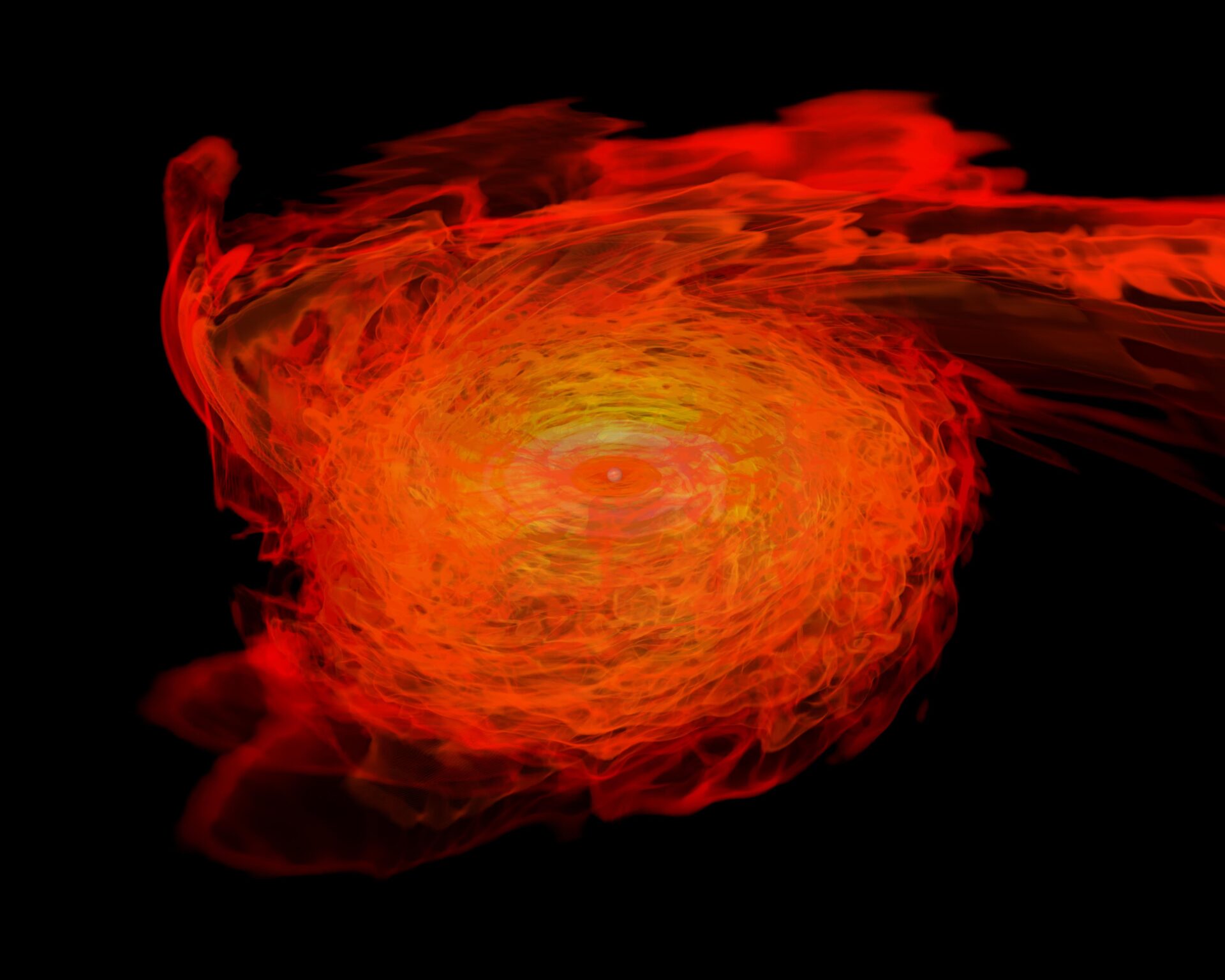
Imagine dropping an encyclopedia into a black hole. Every fact, every word, every bit of information encoded in its pages falls past the event horizon and is, apparently, lost forever. Not just inaccessible, erased from reality.
If that’s true, then one of the most fundamental principles of physics is wrong.
The black hole information paradox is one of the deepest unsolved problems in theoretical physics. It pits general relativity, Einstein’s description of gravity and spacetime, against quantum mechanics, the theory governing the behavior of particles. Both theories have been confirmed to extraordinary precision. Both can’t be entirely right.
The black hole information paradox is the conflict between quantum mechanics’ principle of unitarity and general relativity’s prediction that black holes destroy information.
The Principle of Information Conservation

To understand why this is a crisis, you need to understand what physicists mean by information and why they believe it must be conserved.
In physics, information is not the everyday meaning of the word. It refers to the precise quantum state of a physical system: every property of every particle, completely specified. The principle of unitarity in quantum mechanics states that the evolution of quantum states is always reversible in principle: given the final state of a system, you can always reconstruct its past state, and vice versa.
This isn’t a minor technical detail. Unitarity is the foundation of quantum mechanics’ predictive power. It means the universe keeps perfect records, nothing is ever truly lost, just transformed. The present state of the universe contains, in principle, the complete history of everything that ever happened, though such knowledge is practically impossible to obtain.
If information could be genuinely destroyed, the laws of physics would become irreversibly one-way. The past would become unrecoverable from the present. Causality itself would be threatened.
How Black Holes Seem to Destroy Information
General relativity predicts that black holes have event horizons: boundaries beyond which nothing, not even light, can escape. Anything that crosses an event horizon is effectively separated from the rest of the universe forever. As How Black Holes Form explains, these objects arise from stellar collapse, mergers, or processes in the early universe.
This seems to imply that information that crosses an event horizon is also lost, cut off from the observable universe irrecoverably.
For a long time, physicists assumed this was a philosophical problem rather than a physical one. Yes, information crossed the event horizon and was hidden: but it still existed inside the black hole. The universe still “knew” about it, even if we couldn’t access it.
Then Stephen Hawking complicated everything.
Hawking Radiation: Black Holes Aren’t Black
In 1974, Hawking made a stunning theoretical prediction: black holes aren’t perfectly black. They emit thermal radiation, now called Hawking radiation, as a quantum mechanical effect.
The mechanism involves quantum field theory near the event horizon. The vacuum of space seethes with quantum fluctuations: virtual particle-antiparticle pairs that arise and annihilate. Near a black hole’s event horizon, such a pair can form with one particle inside and one outside the horizon. The inside particle falls in; the outside particle escapes. To an outside observer, the black hole appears to emit radiation. (For more detail, see Hawking Radiation Explained.)
This is a profound result. It means black holes have temperatures (extremely low for stellar-mass black holes, but real) and they slowly lose mass by radiating. Over enormously long timescales, a black hole will evaporate completely, a solar-mass black hole takes roughly 10⁶⁷ years, far longer than the current age of the universe, shrinking and growing hotter as it loses mass, eventually expiring in a burst of high-energy radiation.

Hawking radiation is thermal radiation: it has the spectrum of a blackbody at a specific temperature, with no distinguishing features. It carries no information about what fell in.
And here the paradox strikes.
The Paradox: Where Did the Information Go?
If Hawking radiation carries no information, and the black hole eventually evaporates completely, then all the information about what fell in has been permanently destroyed. The encyclopedia you threw in is gone: not hidden, not encoded somewhere, genuinely erased.
This violates unitarity. It means quantum mechanical evolution is not reversible, that the laws of physics have a one-way direction: a clock that can’t be run backwards. It implies that quantum mechanics is fundamentally wrong, or at least incomplete.
Hawking himself initially accepted this conclusion. In his 1976 paper, he argued that black hole evaporation represents a genuine breakdown of quantum mechanics, a new phenomenon in which information is permanently lost.
This sent theoretical physicists into crisis.
The Proposed Solutions
For five decades, the best minds in theoretical physics have wrestled with this paradox. Several major proposals have emerged.
1. Hawking Radiation Is Not Truly Thermal (Information Escapes)
This is the current majority view among quantum gravity researchers. Many physicists, led most influentially by John Preskill and Leonard Susskind, argue that Hawking radiation must, somehow, carry information about what fell into the black hole. The radiation looks thermal to simple calculations, but a complete quantum gravitational calculation would reveal subtle correlations encoding the full quantum state of the infalling matter.
This view preserves unitarity at the cost of requiring a quantum gravity mechanism, not yet understood, that imprints information on the outgoing radiation.
In 1997, Juan Maldacena provided powerful indirect evidence for this view through the AdS/CFT correspondence: a mathematical duality showing that a black hole in a certain spacetime has an exact quantum mechanical description as a system on the boundary of that spacetime. The boundary theory is unitary, so the black hole in the bulk must obey unitarity as well, meaning information must escape somehow.
2. Black Hole Remnants
This view is now a minority position in the field. Perhaps black holes don’t evaporate completely. Perhaps the evaporation halts when the black hole reaches a certain minimum mass (the Planck mass, roughly 10⁻⁸ kg, about the mass of a bacterium but in a volume far smaller than a proton). The remaining stable remnant stores all the information that fell in.
This proposal faces problems: if a remnant can store arbitrary amounts of information, there must be an enormous number of possible internal states for Planck-mass objects, which would have strange consequences for quantum field theory.
3. Information Is Destroyed (Hawking Was Right)
This view is now held by a small minority. Perhaps information is genuinely lost, and we need to modify quantum mechanics to accommodate non-unitary evolution. This would be a revolution as profound as quantum mechanics itself, replacing the current framework with something even stranger.
The success of the AdS/CFT duality has made non-unitarity seem increasingly implausible to most researchers.
4. Black Hole Complementarity
Proposed by Susskind, Lenny Thorlacius, and John Uglum in the 1990s, black hole complementarity suggests the paradox involves conflating two observer perspectives that can never compare notes.
From outside the black hole, infalling information appears to Hawking-radiate back out, encoded in the radiation in a scrambled form. From inside the black hole, the information falls in normally. But no observer can be in both positions: no measurement can simultaneously confirm both descriptions. The two pictures are “complementary,” like wave-particle duality: both are valid descriptions, but no single observer can test both.
This seemed to resolve the paradox until Joseph Polchinski and colleagues (the “AMPS” team) pointed out a devastating problem in 2012.
5. Firewalls
This remains a major unresolved controversy. The AMPS paper (Almheiri, Marolf, Polchinski, Sully, 2012) showed that black hole complementarity leads to a contradiction. If Hawking radiation carries information (as unitarity requires), then the radiation emitted by an old black hole must be entangled with the black hole’s interior. But quantum mechanics forbids a particle from being maximally entangled with two separate systems simultaneously (the monogamy of entanglement).
The consequence: to resolve the entanglement inconsistency, the black hole must have a firewall at its event horizon, a wall of high-energy radiation that destroys anything trying to cross into the black hole. An infalling astronaut wouldn’t gently cross the event horizon (as general relativity predicts for large black holes), they’d be incinerated instantly.
This is deeply uncomfortable because it directly violates general relativity’s prediction that crossing the event horizon of a large black hole is, locally, unremarkable. The equivalence principle, the cornerstone of general relativity, would be violated.
The firewall controversy triggered intense debate and remains unresolved. Future observations, such as those from LIGO or the Event Horizon Telescope, might eventually constrain some of these scenarios.
6. The Page Curve and the Islands Proposal
This is currently the most actively developed approach. The most recent major development comes from calculations by Ahmed Almheiri, Netta Engelhardt, Geoffrey Penington, and others (2019–2020) involving a concept called entanglement islands.
In the 1990s, Don Page calculated that if information is to be preserved, the entropy of Hawking radiation should initially increase (as the black hole evaporates and radiation accumulates), then peak at the Page time (roughly halfway through the evaporation, when entropy reaches its maximum), and then decrease as information gradually leaks out. This is the Page curve.
The islands proposal provides a way to calculate the Page curve using an unexpected path: certain regions inside the black hole, called islands, must be included in the quantum gravitational calculation of the entropy of the radiation. When islands are included, the calculation correctly reproduces the Page curve, suggesting information is preserved.
Though a complete picture of the physical mechanism remains out of reach, this approach has generated enormous excitement and continues to be refined.
What’s Actually at Stake
The information paradox isn’t just an academic puzzle about black holes. It sits at the intersection of quantum mechanics and general relativity, the two pillars of modern physics that have never been successfully unified.
General relativity treats spacetime as a smooth, continuous fabric. Quantum mechanics treats reality as fundamentally discrete and probabilistic. At the event horizon of a black hole, both theories must apply simultaneously, and they give incompatible answers.
Resolving the information paradox would almost certainly require a complete theory of quantum gravity: a framework that subsumes both general relativity and quantum mechanics as limiting cases. String theory, loop quantum gravity, and related approaches all attempt to provide such a framework, but none has been confirmed experimentally.
The information paradox is one of the most powerful probes we have of the regime where quantum gravity matters. Its resolution will tell us something fundamental about the nature of spacetime, the meaning of information, and whether the universe truly keeps perfect records of everything that has ever happened.
Where the field stands today: Most physicists now believe information escapes black holes, preserving unitarity. The AdS/CFT correspondence, the Page curve calculations, and the islands proposal all point in this direction. But the exact physical mechanism, how information imprints itself on Hawking radiation, remains unknown. The paradox is not yet solved, but for the first time in decades, many researchers believe we are on the right track.
Sources
- Hawking, S.W. (1976). Breakdown of predictability in gravitational collapse. Physical Review D, 14(10), 2460.
- Maldacena, J. (1999). The large N limit of superconformal field theories and supergravity. International Journal of Theoretical Physics, 38(4), 1113–1133.
- Almheiri, A., Marolf, D., Polchinski, J. & Sully, J. (2013). Black holes: complementarity or firewalls? Journal of High Energy Physics, 2013(2), 62.
- Almheiri, A. et al. (2019). The entropy of bulk quantum fields and the entanglement wedge. Journal of High Energy Physics, 2019(12), 63.
- Preskill, J. (1992). Do black holes destroy information?. arXiv preprint.
What is the black hole information paradox?
It is a conflict between general relativity, which suggests black holes destroy information, and quantum mechanics, which requires information to be conserved.
Why is information loss in a black hole a problem for physics?
It violates the principle of unitarity in quantum mechanics, which states that quantum evolution must be reversible and information cannot be erased.
What does ‘information’ mean in the context of the black hole information paradox?
It refers to the precise quantum state of a physical system, including every property of every particle, not just everyday data like words or facts.
How does Hawking radiation relate to the information paradox?
Hawking radiation causes black holes to slowly evaporate, but it appears to carry no information about what fell in, leading to the paradox of lost information.
Is the black hole information paradox solved?
No, it remains an unsolved problem in theoretical physics, though proposed solutions include the holographic principle and modifications to general relativity or quantum mechanics.