
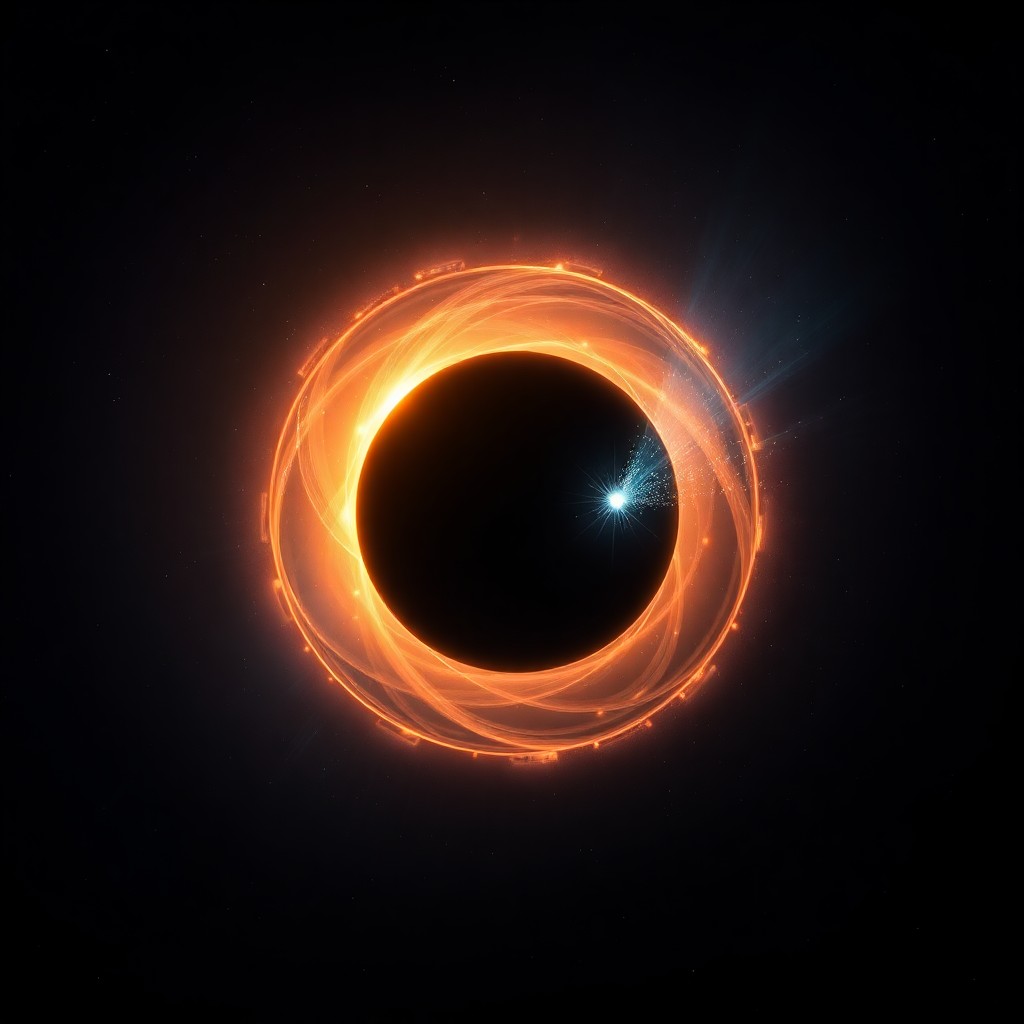
Black holes are defined by the impossibility of escape. Nothing that crosses the event horizon, the boundary of no return, can ever get out. That is the foundational property of a black hole, derived directly from general relativity. Yet in 1974, Stephen Hawking used quantum mechanics to show that black holes do emit radiation. They lose mass. They evaporate. And eventually, if left alone long enough, they disappear entirely.
This result, Hawking radiation, is one of the most profound in all of theoretical physics. It connects general relativity, quantum field theory, thermodynamics, and information theory in ways that still generate active debate nearly fifty years later.
The Vacuum Is Not Empty

To understand Hawking radiation, you first need to understand that in quantum field theory, empty space is not truly empty. The vacuum is filled with quantum fluctuations: pairs of virtual particles and antiparticles that continuously pop into existence and annihilate each other on timescales so short they cannot be directly detected. These virtual pairs are real in the sense that they affect measurable quantities (the Casimir effect, the Lamb shift in atomic spectra) but they borrow energy from the vacuum and return it almost immediately.
This vacuum fluctuation is happening everywhere, all the time, including near the event horizon of a black hole.
The Mechanism Near the Event Horizon
Hawking’s key insight was what happens when a virtual particle pair appears right at the event horizon. In ordinary space, the two particles annihilate each other before either can become real. But at the event horizon, the tidal gravitational field is strong enough to separate the pair before annihilation occurs.
One particle falls into the black hole. The other escapes into space. The escaping particle becomes real; it carries positive energy away from the black hole. But where does that energy come from? Conservation of energy requires that the particle falling into the black hole carries negative energy. The black hole absorbs the negative-energy particle, reducing its total mass-energy. Over time, this process removes mass from the black hole.
To a distant observer, the black hole appears to emit a stream of particles, Hawking radiation, with a thermal (blackbody) spectrum at a temperature inversely proportional to the black hole’s mass.
The Hawking Temperature Formula

The temperature of Hawking radiation is given by:
T = ℏc³ / (8πGMk_B)
Where ℏ is the reduced Planck constant, c is the speed of light, G is Newton’s gravitational constant, M is the black hole’s mass, and k_B is Boltzmann’s constant.
The crucial feature is the inverse proportionality to mass. Larger black holes are colder. Much larger black holes are much colder. A stellar-mass black hole (roughly 10 solar masses) has a Hawking temperature of about 6 × 10⁻⁹ Kelvin, billionths of a degree above absolute zero. The CMB temperature (2.725 K) is roughly 400 million times higher. A stellar-mass black hole absorbs far more energy from the CMB than it emits through Hawking radiation, so it currently grows rather than shrinks.
Only a black hole with a mass less than about 0.8% of the Moon’s mass would be hot enough to emit more Hawking radiation than it absorbs from the CMB, and therefore currently evaporate.
Evaporation Timeline
As a black hole loses mass, it gets hotter. As it gets hotter, it radiates more powerfully. As it radiates more powerfully, it loses mass faster. This runaway process accelerates until the black hole’s remaining mass is tiny and it evaporates in a final burst of high-energy radiation.
The evaporation time scales as M³. For a stellar-mass black hole (10 solar masses), the evaporation time is approximately 2 × 10⁶⁷ years, incomprehensibly longer than the current age of the universe (13.8 × 10⁹ years). No stellar-mass black hole will evaporate for an almost unimaginably long time. Only black holes much smaller than a proton, if any primordial black holes of that mass exist, would have evaporated by now.
Why It Has Never Been Directly Observed

Hawking radiation from astrophysical black holes is too cold and too faint to detect. A solar-mass black hole radiates at nanokelvin temperatures, buried under the much hotter background radiation of the universe. The signal would be completely undetectable with any conceivable present or near-future instrument.
The only way to observe Hawking-like radiation directly would require a black hole of incredibly small mass (and therefore high temperature): a primordial black hole with mass below about 10¹² kilograms would be evaporating right now and emitting gamma rays. Searches for such gamma-ray signals have found no confirmed primordial black hole evaporation events.
Indirect evidence for the underlying physics has come from analog experiments. In Bose-Einstein condensates and flowing fluids, researchers have created laboratory “horizons” that mimic the mathematics of a black hole event horizon. These analog systems do show an Unruh-Hawking-like radiation effect, providing experimental support for the theoretical framework, if not direct detection of astrophysical Hawking radiation.
The Black Hole Information Paradox
Hawking radiation raises one of the deepest unsolved problems in theoretical physics: the black hole information paradox. In quantum mechanics, information is conserved; the complete description of a physical system at one time can in principle be used to reconstruct it at any other time. No information is truly lost.
But when a black hole forms from matter and then evaporates through Hawking radiation, what happens to the information about the matter that fell in? If Hawking radiation is purely thermal, described entirely by the black hole’s mass, charge, and angular momentum, then it carries no information about the infalling matter. When the black hole evaporates completely, that information would be permanently lost.
Hawking initially argued that information was destroyed. Most quantum physicists found this unacceptable; it would violate unitarity, a foundational principle of quantum mechanics. The debate raged for decades.
Current theoretical work, particularly developments from string theory and the AdS/CFT correspondence (which equates a black hole in anti-de Sitter space to a quantum system on the boundary without gravity), strongly suggests that information is preserved; that Hawking radiation is not perfectly thermal but carries subtle correlations that encode the infalling information. Hawking himself eventually accepted this position before his death in 2018. The precise mechanism by which information escapes, and what it means for the physics near or beyond the event horizon, remains an active research area.
Black Hole Thermodynamics
Hawking radiation is inseparable from black hole thermodynamics, developed in parallel by Hawking, Jacob Bekenstein, and James Bardeen in the early 1970s. The four laws of black hole mechanics are formally identical to the four laws of thermodynamics, with surface gravity playing the role of temperature and event horizon area playing the role of entropy.
Bekenstein proposed that black holes have entropy proportional to their event horizon area. Hawking’s radiation gave this entropy a physical meaning: a black hole’s entropy is a measure of the information hidden inside it. The Bekenstein-Hawking entropy formula, S = A/4 in Planck units (where A is the horizon area), is one of the most important results in theoretical physics, because it requires that gravity, quantum mechanics, and thermodynamics must be unified in any complete theory of quantum gravity.
What is Hawking radiation?
Hawking radiation is the theoretical thermal radiation emitted by black holes due to quantum effects near the event horizon. Predicted by Stephen Hawking in 1974, it arises because quantum fluctuations near the event horizon allow one particle of a virtual pair to escape while the other falls into the black hole. The process slowly removes energy from the black hole, causing it to lose mass and eventually evaporate. It has never been directly observed from an astrophysical black hole.
Has Hawking radiation ever been detected?
Not directly from an astrophysical black hole. Stellar-mass and supermassive black holes radiate at temperatures billions of times colder than the cosmic microwave background, making their Hawking radiation undetectable. Analog experiments, using Bose-Einstein condensates and fluids to simulate event horizons, have observed the equivalent effect in laboratory settings, providing indirect experimental support for the physics.
Do black holes actually evaporate?
In theory, yes, over extraordinarily long timescales. A stellar-mass black hole would take approximately 10⁶⁷ years to evaporate through Hawking radiation, which is trillions of trillions of times longer than the current age of the universe. Hawking radiation is real according to the theory, but no black hole formed from a star has evaporated, and none will for an incomprehensibly long time.
What is the black hole information paradox?
The information paradox asks: when a black hole evaporates through Hawking radiation, what happens to the information about everything that fell into it? If Hawking radiation is purely thermal (random, encoding no information about the infalling matter), then that information is permanently lost, violating the quantum mechanical principle of unitarity. Most physicists now believe information is preserved, but the exact mechanism remains unresolved.
Why is Hawking radiation important if it can’t be detected?
Hawking radiation is important because of what it reveals about the structure of physics. It requires quantum mechanics, general relativity, and thermodynamics to all be operating simultaneously, something no other known phenomenon demands. It forced physicists to confront the information paradox and to realize that a complete theory of quantum gravity must explain how black holes can be both thermodynamic objects and quantum systems. It is a window into physics beyond the Standard Model.
What did Stephen Hawking discover exactly?
Hawking’s 1974 paper showed mathematically that black holes are not completely black; they emit thermal radiation due to quantum effects at the event horizon. This was unexpected and controversial because general relativity had established black holes as perfect absorbers. The result demonstrated that black holes have thermodynamic properties, including a temperature and entropy proportional to their event horizon area, connecting gravity and quantum mechanics in a way that still shapes theoretical physics today.
Sources
Hawking, S.W. (1974). Black hole explosions? Nature, 248(5443), 30–31. doi:10.1038/248030a0
Hawking, S.W. (1975). Particle creation by black holes. Communications in Mathematical Physics, 43(3), 199–220. doi:10.1007/BF02345020
Bekenstein, J.D. (1973). Black holes and entropy. Physical Review D, 7(8), 2333–2346. doi:10.1103/PhysRevD.7.2333
Steinhauer, J. (2016). Observation of quantum Hawking radiation and its entanglement in an analogue black hole. Nature Physics, 12(10), 959–965. doi:10.1038/nphys3863
Mathur, S.D. (2009). The information paradox: a pedagogical introduction. Classical and Quantum Gravity, 26(22), 224001. doi:10.1088/0264-9381/26/22/224001
Almheiri, A., Marolf, D., Polchinski, J., & Sully, J. (2013). Black holes: complementarity or firewalls? Journal of High Energy Physics, 2013(2), 62. doi:10.1007/JHEP02(2013)062
This article is part of our framework exploring Stars and Planets — how stars forge the elements of life and shape planetary systems.