
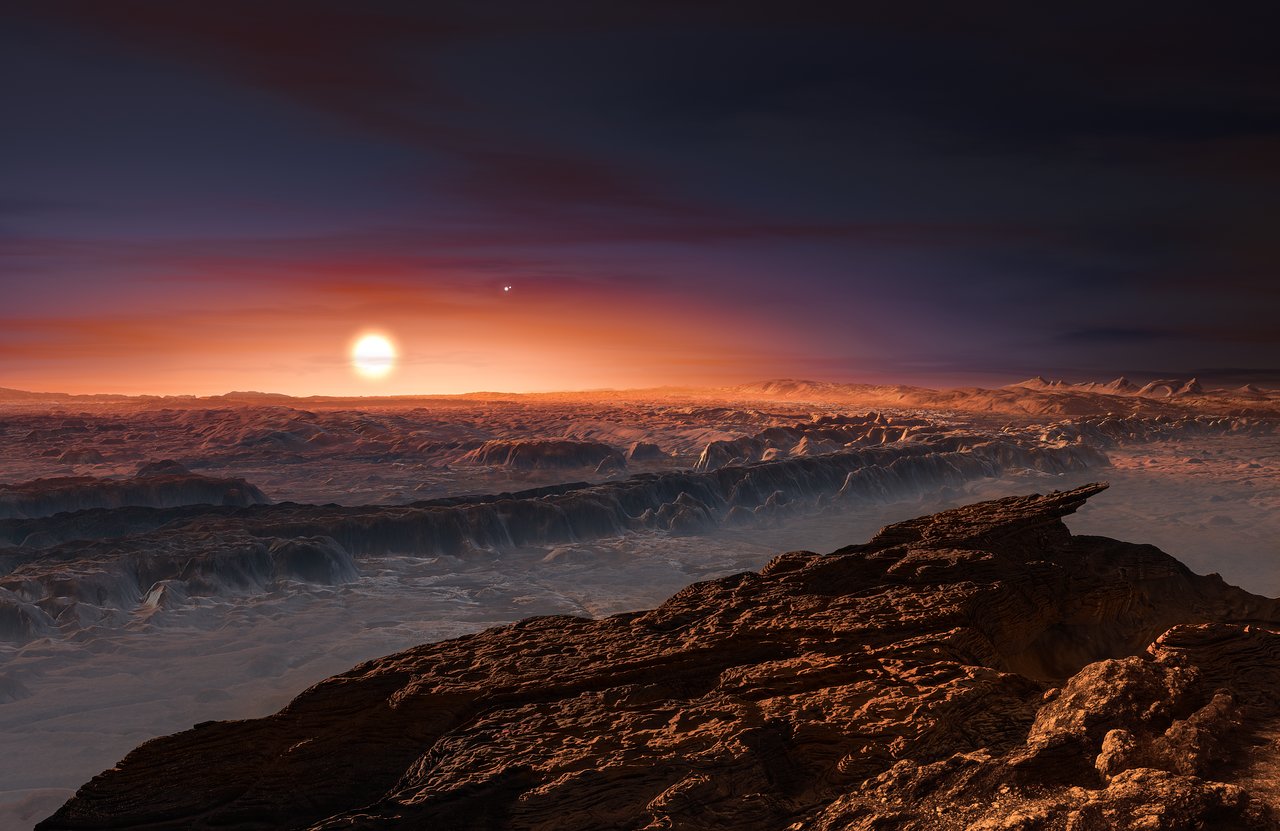
The nearest star to the Sun is Proxima Centauri, a red dwarf 4.24 light-years away in the constellation Centaurus. In 2016, astronomers announced that Proxima Centauri hosts a planet, Proxima Centauri b, orbiting squarely within the star’s habitable zone. No other confirmed exoplanet is closer to Earth. If any world beyond our solar system were to be visited or even contacted within any timeframe humans can meaningfully imagine, this is the most likely candidate.
The discovery set off intense scientific debate that continues to this day. Does this planet have an atmosphere? Could it support liquid water? Does the violent activity of its host star sterilize its surface? And is there even a planet there at all, or a stellar signal masquerading as one?
The Detection

Proxima Centauri b was discovered using the radial velocity method. As the planet orbits, it causes its star to wobble slightly toward and away from Earth. This wobble shifts the wavelengths of starlight in a regular pattern. The detected signal corresponds to an orbital period of 11.2 days and implies a minimum mass of about 1.07 Earth masses, making Proxima b the closest known Earth-mass planet beyond our solar system.
The discovery was made using ESO’s HARPS spectrograph and reported in Nature by Anglada-Escudé et al. in August 2016. The signal was found after careful reanalysis of archival data combined with new observations. The word “minimum” in “minimum mass” is important: the radial velocity method measures only the component of stellar motion along our line of sight. The planet’s true mass depends on its orbital inclination, which is unknown. If the orbit is edge-on, the minimum mass equals the true mass. If it is more face-on, the true mass could be higher, potentially much higher.
A subsequent study in 2020 using the ESPRESSO spectrograph at the VLT confirmed the 11.2-day signal with improved precision, strengthening the case that the signal is planetary in origin. However, a 2022 study re-examined the data and found evidence that the signal may partially or wholly be caused by stellar activity (spots and magnetic regions on Proxima’s surface rotating into and out of view). The debate is unresolved. Proxima b’s existence as a planet, while still the most favored interpretation, remains under active investigation.
Proxima Centauri: A Challenging Host Star
Understanding Proxima Centauri b requires understanding its star. Proxima Centauri is an M-dwarf, the smallest and most common type of star in the galaxy. It is about one-eighth the mass of the Sun, about one-seventh the radius, and far dimmer: roughly 0.17% of the Sun’s luminosity.
Because Proxima is so dim, its habitable zone (the range of orbital distances where liquid water could exist on a planet’s surface) is much closer in than the Sun’s. Proxima b orbits at just 0.0485 AU, compared to Earth’s 1 AU. At that distance, Proxima b completes an orbit every 11.2 days.
This proximity creates problems. M-dwarfs are known for stellar flares (sudden releases of energy from magnetic reconnection events on the stellar surface). Proxima Centauri is particularly active. In 2019, astronomers detected an extreme ultraviolet flare from Proxima that was roughly 10 times more energetic than the most powerful solar flares ever recorded from our Sun, and the star produces several such events per year. At Proxima b’s close orbit, these flares would bombard its surface with intense ultraviolet and X-ray radiation far exceeding what Earth experiences.
Whether an atmosphere could survive this environment is a key uncertainty. Several modeling studies suggest that a planet without a magnetic field would lose its atmosphere to stellar wind stripping on geological timescales. A planet with a sufficiently strong magnetic field might retain its atmosphere, but whether rocky planets around M-dwarfs commonly maintain strong magnetic fields is uncertain.
Tidal Locking

At Proxima b’s orbital distance, gravitational interactions with the star likely force the planet into tidal locking (the same side always facing the star, just as the Moon always shows the same face to Earth). A tidally locked planet would have a permanent dayside and nightside, with extreme temperature gradients between them.
Whether tidal locking eliminates habitability is debated. Early models suggested that a tidally locked world would have most of its water frozen on the nightside and a scorched, airless dayside. More sophisticated atmospheric circulation models suggest that a planet with a substantial atmosphere (greater than roughly 0.1 bar) could redistribute heat sufficiently to maintain moderate temperatures across much of the surface. On Earth-like timescales, a thick atmosphere acts like a global radiator, moving warmth from day to night.
Can We Detect Its Atmosphere?
Proxima Centauri b does not transit its star from Earth’s vantage point, at least not with a measurable transit probability given its orbital parameters. Without transits, the standard method of characterizing exoplanet atmospheres through transmission spectroscopy is unavailable.
Direct imaging of the planet itself would require resolving it from its star at an angular separation of about 37 milliarcseconds, extremely challenging but not impossible for the next generation of telescopes. The Extremely Large Telescope (ELT), currently under construction in Chile with a 39-meter primary mirror, may be able to directly image Proxima b in reflected starlight and obtain a crude spectrum revealing whether it has an atmosphere and what gases are present.
The Breakthrough Starshot initiative, funded in part by Yuri Milner, has proposed sending a fleet of gram-scale lightsail probes to the Alpha Centauri system at 20% the speed of light. At that speed, the probes would arrive in approximately 20 years. Whether the technology is feasible, and whether such probes could transmit data back to Earth, remains speculative, but Proxima b’s existence has given the project a concrete scientific target.
Additional Planets in the System
Proxima Centauri may have more than one planet. A second candidate, Proxima c, was proposed in 2020, a super-Earth orbiting at about 1.5 AU with an orbital period of roughly 1,900 days. Proxima c would be far outside the habitable zone, too cold for surface liquid water, but its existence (also contested) would add complexity to the system’s dynamics.
A third candidate, Proxima d, with a mass as low as 0.26 Earth masses and an orbital period of about 5 days, was reported in 2022 using ESPRESSO data. If confirmed, Proxima d would be one of the least massive exoplanets detected by radial velocity. It would orbit interior to Proxima b, closer to the star and well outside any habitable zone.
How far away is Proxima Centauri b?
Proxima Centauri b orbits Proxima Centauri, the nearest star to the Sun at 4.24 light-years from Earth. At that distance, a signal sent at the speed of light would take 4.24 years to arrive. The Voyager 1 spacecraft, traveling at its current speed, would take approximately 73,000 years to reach the Proxima Centauri system, illustrating the immense challenge of interstellar travel even to our nearest neighbor.
Is Proxima Centauri b habitable?
Unknown. Proxima b orbits within its star’s habitable zone, where liquid water could theoretically exist on the surface. But habitability depends on many factors beyond orbital distance: whether the planet has an atmosphere, whether that atmosphere has survived the star’s intense flares, whether the planet is tidally locked, and whether it has liquid water. None of these are known. Proxima b is a high-priority target for characterization, not a confirmed habitable world.
What type of star is Proxima Centauri?
Proxima Centauri is an M-dwarf (red dwarf), the most common stellar type in the Milky Way. It is about 0.12 solar masses, 0.15 solar radii, and only 0.17% as luminous as the Sun. M-dwarfs have very long lifespans (trillions of years) but are prone to powerful stellar flares that can strip planetary atmospheres and irradiate surfaces with ultraviolet and X-ray radiation.
Was Proxima Centauri b definitively confirmed?
Not with absolute certainty. The radial velocity signal was first reported in 2016 and confirmed by a 2020 follow-up study. However, a 2022 analysis raised the possibility that the signal is partially due to stellar activity rather than a planet. The debate is ongoing. The planetary interpretation remains most likely, but independent confirmation (ideally through another detection method) would firmly establish the planet’s existence.
Could we travel to Proxima Centauri b?
Not with any current or near-future technology. The Proxima Centauri system is 4.24 light-years away. With current propulsion technology, a spacecraft would require tens of thousands of years to reach it. Breakthrough Starshot proposes sending lightweight probes at 20% the speed of light using ground-based laser arrays, which could reach the system in about 20 years, but this technology does not yet exist and would require significant engineering breakthroughs.
Is Proxima b an Earth twin?
Not necessarily. Proxima b has a minimum mass close to Earth’s, but mass alone does not determine composition or habitability. The planet could be rocky like Earth or could be a denser, water-rich world — a u0022water world.u0022 It orbits a very different type of star in a very different radiation environment. Without atmospheric characterization, we cannot know whether its surface conditions bear any resemblance to Earth’s.
Sources
Anglada-Escudé, G. et al. (2016). A terrestrial planet candidate in a temperate orbit around Proxima Centauri. Nature, 536(7617), 437–440. doi:10.1038/nature19106
Suárez Mascareño, A. et al. (2020). Revisiting Proxima with ESPRESSO. Astronomy & Astrophysics, 639, A77. doi:10.1051/0004-6361/202037745
Howard, W.S. et al. (2018). The Astro-comb on HARPS: Measuring the radial velocity of stellar flares. The Astrophysical Journal Letters, 860(2), L30. doi:10.3847/2041-8213/aacaf3
Shields, A.L., Ballard, S., & Johnson, J.A. (2016). The habitability of planets orbiting M-dwarf stars. Physics Reports, 663, 1–38. doi:10.1016/j.physrep.2016.10.003
Turbet, M. et al. (2016). The habitability of Proxima Centauri b. Astronomy & Astrophysics, 596, A112. doi:10.1051/0004-6361/201629577
Lustig-Yaeger, J., Meadows, V.S., & Lincowski, A.P. (2019). The Detectability and Characterization of the TRAPPIST-1 Exoplanet Atmospheres with JWST. The Astronomical Journal, 158(1), 27. doi:10.3847/1538-3881/ab21e0
This article is part of our framework exploring Life — the origin of life, astrobiology, and the search for life beyond Earth.