
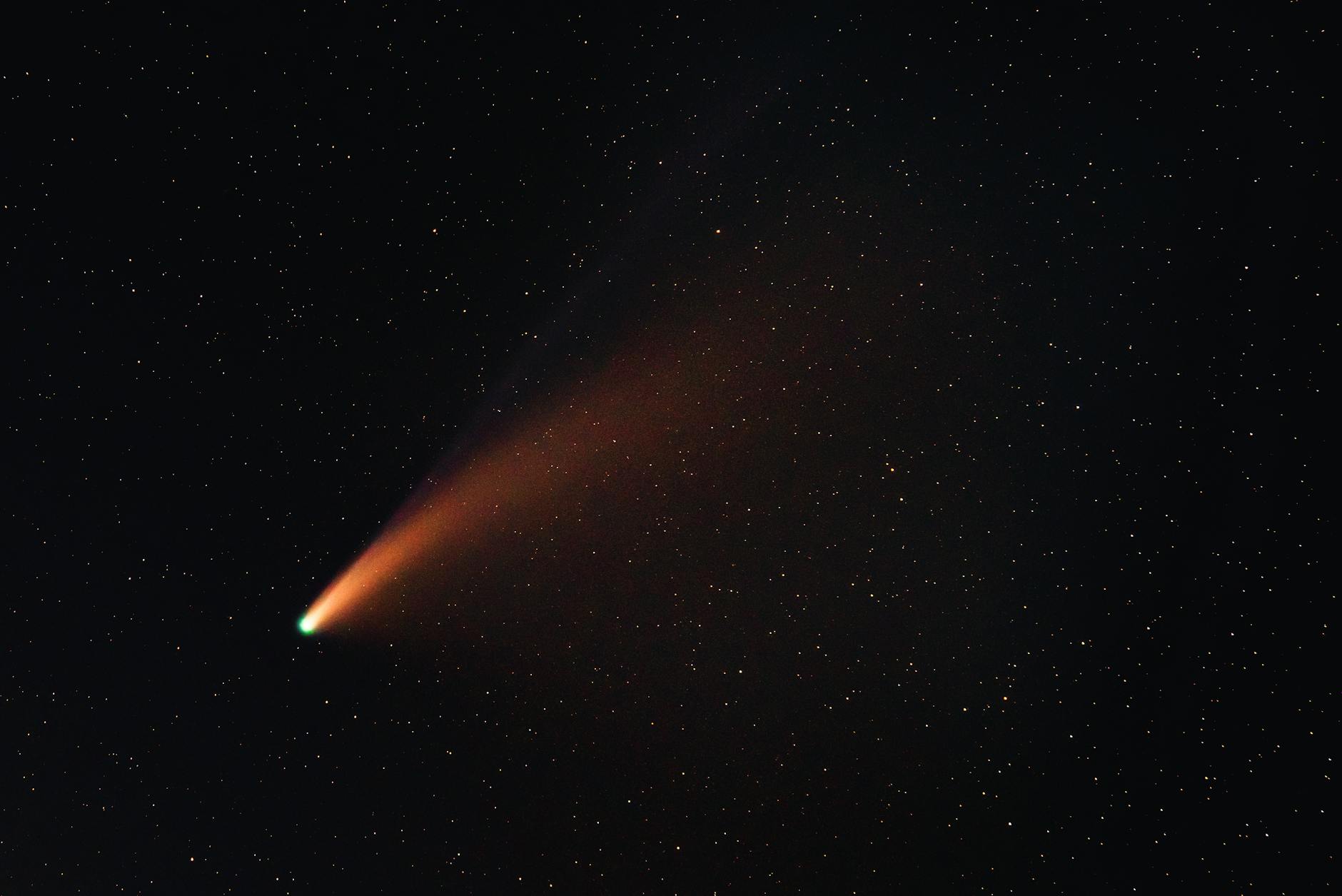
The solar system does not end at Neptune. Beyond the eight known planets, beyond Pluto and the Kuiper Belt, there lies an enormous spherical cloud of icy bodies extending to perhaps a quarter of the way to the nearest star. This is the Oort Cloud — the most distant region of the solar system, the source of the long-period comets that occasionally sweep through the inner solar system, and a structure so vast and sparse that it has never been directly observed.
Everything we know about the Oort Cloud is inferred from the comets it sends toward us. Yet the inferences are compelling, and the Oort Cloud plays a central role in our understanding of the solar system’s formation, the origin of comets, and the long-term dynamical history of the solar neighborhood.
The Discovery: Inferred from Comets

The concept of the Oort Cloud was proposed in 1950 by Dutch astronomer Jan OortOort analyzed the orbital data of known long-period comets (those with orbital periods exceeding 200 years) and noticed something remarkable. The aphelia (farthest points) of these comets were distributed roughly isotropically; they came from all directions in the sky, not preferentially from the ecliptic plane where most solar system objects are found. And their aphelia clustered at distances between roughly 10,000 and 100,000 AU from the Sun.
Oort concluded that these comets originated in a spherical reservoir at enormous distances, too far to be part of the flattened disk structure of the inner solar system. He proposed that this shell was populated by icy bodies left over from the solar system’s formation, stored in nearly circular orbits at great distance, and occasionally nudged by gravitational perturbations into elongated orbits that brought them sunward.
The gravitational perturbers Oort identified were passing stars and, later extended by other astronomers, the tidal force of the Milky Way‘s galactic disk. As the solar system bobs up and down through the galactic plane during its ~225-million-year orbit of the galaxy, the tidal force of the galaxy’s mass distribution periodically squeezes the Oort Cloud, dislodging comets and sending them toward the Sun.
Structure: Inner and Outer Oort Cloud
Modern models distinguish two components of the Oort Cloud:
The outer Oort Cloud (sometimes called the “Oort Cloud” proper) extends from roughly 10,000 AU to perhaps 100,000–200,000 AU. For reference, one AU is the Earth-Sun distance (about 150 million kilometers); 100,000 AU is about 1.6 light-years. The outer cloud is thought to be roughly spherical, reflecting the isotropic distribution of long-period comet aphelia. It is estimated to contain hundreds of billions to possibly a trillion or more icy objects, but this number is highly uncertain.
The inner Oort Cloud (also called the Hills Cloud, after Jack Hills who proposed its existence in 1981) extends from roughly 2,000–3,000 AU to 10,000–20,000 AU. Unlike the outer cloud, it retains some disk-like structure, a remnant of its formation from the protoplanetary disk. The inner cloud is thought to be much denser than the outer cloud, containing perhaps ten or more times as many objects, but it is largely immune to stellar perturbations and rarely contributes comets to the inner solar system.
The population of both clouds combined may total several trillion icy bodies. The total mass is highly uncertain but is estimated at a few Earth masses at most; the Oort Cloud is extremely sparse despite its enormous volume.
How the Oort Cloud Formed

The Oort Cloud is a byproduct of the formation of the giant planets. In the early solar system, the region between the giant planets (Jupiter, Saturn, Uranus, and Neptune) was rich in icy planetesimals. As the giant planets grew, their gravitational fields scattered most of these planetesimals outward through gravitational slingshot interactions.
Most of the scattered planetesimals were ejected entirely from the solar system on hyperbolic trajectories. But a fraction were scattered into very elongated but still bound orbits at great distances, between 1,000 and 100,000 AU. At these distances, gravitational perturbations from passing stars and the galactic tide “circularized” the orbits, reducing the eccentricity and turning the elongated ellipses into more nearly circular orbits at large distance. This process stabilized the population at Oort Cloud distances, storing it as a frozen reservoir.
The relative contributions of the four giant planets to Oort Cloud population are debated. Jupiter and Saturn, being the most massive, ejected most of their scattered material out of the solar system entirely. Neptune and Uranus, being less massive, were more effective at scattering material to Oort Cloud distances without total ejection. Recent dynamical models suggest that a significant fraction of the Oort Cloud may have been captured from other stars during the Sun’s formation in a dense stellar cluster, rather than being purely solar in origin. The Sun likely spent its first few hundred million years in a stellar nursery where stellar encounters were common enough to exchange Oort Cloud material between solar systems.
Sedna and the Scattered Disk
One of the most intriguing objects illuminating Oort Cloud formation is Sedna, discovered in 2003 by Michael Brown, Chad Trujillo, and David Rabinowitz. Sedna is a large trans-Neptunian object with a perihelion of about 76 AU, far too distant to have been scattered there by Neptune, and an aphelion of about 975 AU. Its orbit cannot be explained by the current solar system’s planets.
Sedna appears to occupy the “inner Oort Cloud” region, or a transition zone between the Kuiper Belt and the inner cloud. Its anomalous orbit suggests it was influenced either by a passing star in the early solar system’s birth cluster, by an as-yet-undiscovered massive planet in the outer solar system (“Planet Nine” hypotheses), or by gravitational effects of the dense stellar environment in which the Sun formed. Sedna is the best observational evidence we have for the inner Oort Cloud, which otherwise contains no objects bright enough to have been discovered yet.
Long-Period Comets: Visitors from the Outer Limits
Long-period comets are the most visible evidence of the Oort Cloud. When a gravitational perturbation sends an Oort Cloud object toward the inner solar system, it approaches the Sun on a highly elongated orbit. As it enters the warmer inner solar system (roughly inside 3–5 AU), solar radiation heats the icy nucleus, sublimating volatile materials and producing the spectacular coma and tail we observe.
Famous long-period comets include: – Comet Hale-Bopp (visible in 1997), which came from approximately 50,000 AU and had a period of roughly 4,000 years in its post-encounter orbit. – Comet Hyakutake (1996), one of the brightest comets of the 20th century. – Comet C/2020 F3 (NEOWISE) (2020), visible to the naked eye, originating from the outer Oort Cloud.
Some long-period comets have retrograde orbits; they orbit the Sun in the opposite direction from the planets. Retrograde comets can only arrive from an isotropic reservoir like the Oort Cloud, since all the material in the original protoplanetary disk orbited in the same prograde direction.
Interstellar Visitors: Beyond the Oort Cloud
The solar system is not the only source of cometary material. In 2017, the detection of ‘Oumuamua (an elongated object moving through the solar system on a hyperbolic trajectory) marked the first confirmed interstellar object detected passing through the solar system. In 2019, comet 2I/Borisov became the second confirmed interstellar visitor.
These objects are presumably Oort Cloud material ejected from other star systems. Their existence confirms that planetary systems eject icy material during formation, just as ours did, and that interstellar space between stars contains a low-density population of such wandering bodies. The Oort Cloud, in a sense, is a shared cosmic inheritance: our cloud was built partly from other stars’ material, and our ejected material contributes to other clouds.
What is the Oort Cloud?
The Oort Cloud is a vast, roughly spherical shell of icy objects surrounding the solar system at distances of roughly 10,000 to 200,000 AU from the Sun (up to about 3 light-years). It contains hundreds of billions to trillions of icy bodies, though it has never been directly observed. Everything we know about it is inferred from the orbits of long-period comets, which originate in the Oort Cloud and are dislodged by gravitational perturbations from passing stars and the Milky Way’s tidal force. It was proposed by Dutch astronomer Jan Oort in 1950.
How far away is the Oort Cloud?
The outer Oort Cloud extends from roughly 10,000 AU to approximately 100,000–200,000 AU from the Sun. At its outer edge, it reaches about 1–3 light-years, roughly a quarter to half the distance to the nearest star system (Alpha Centauri, at 4.24 light-years). The inner Oort Cloud begins at about 2,000–3,000 AU, well beyond the Kuiper Belt (which ends at roughly 50 AU). Voyager 1, the most distant human-made object, is currently at about 165 AU, still far short of the inner Oort Cloud.
Has the Oort Cloud ever been directly observed?
No. The Oort Cloud has never been directly observed. Individual objects within it are too small and too far away to detect with current telescopes. The best candidate for an inner Oort Cloud object is Sedna, discovered in 2003, which has an orbit taking it out to about 975 AU, the farthest known perihelion of any solar system body. Future large telescopes and space-based surveys may detect additional inner Oort Cloud objects over time.
Where do long-period comets come from?
Long-period comets (those with orbital periods greater than 200 years) originate in the Oort Cloud. Gravitational perturbations from passing stars, molecular clouds, or the tidal force of the Milky Way occasionally disturb Oort Cloud objects, sending them into elongated orbits that bring them into the inner solar system. The isotropic distribution of long-period comet aphelia (they come from all directions in the sky) is the primary evidence for the Oort Cloud’s spherical, non-disk geometry.
What is the difference between the Oort Cloud and the Kuiper Belt?
Both are reservoirs of icy bodies in the outer solar system, but they are at very different distances and have different structures. The Kuiper Belt extends from roughly 30 to 50 AU and is a flattened disk in the plane of the solar system, similar in shape to the asteroid belt. It is the source of short-period comets (those with periods under 200 years). The Oort Cloud begins at roughly 2,000 AU and extends to tens of thousands of AU; it is roughly spherical and is the source of long-period comets. The two structures may overlap somewhat in the region of the scattered disk (50–1,000 AU).
Could there be a Planet Nine in the outer solar system near the Oort Cloud?
Possibly. The unusual clustering of orbital poles among extreme trans-Neptunian objects (those with perihelion beyond 30 AU) has been interpreted by some astronomers as the gravitational signature of an undetected planet — u0022Planet Nineu0022 — of roughly 5–10 Earth masses at approximately 400–800 AU. If confirmed, Planet Nine would orbit in the inner Oort Cloud region. As of 2024, no direct detection has been made. The Vera Rubin Observatory, expected to begin full survey operations in the mid-2020s, will significantly constrain or potentially detect such an object through its deep, wide-field sky survey.
Sources
Oort, J.H. (1950). The structure of the cloud of comets surrounding the solar system and a hypothesis concerning its origin. Bulletin of the Astronomical Institutes of the Netherlands, 11(408), 91–110.
Hills, J.G. (1981). Comet showers and the steady-state infall of comets from the Oort cloud. The Astronomical Journal, 86, 1730–1740. doi:10.1086/113058
Brown, M.E., Trujillo, C., & Rabinowitz, D. (2004). Discovery of a candidate inner Oort cloud planetoid. The Astrophysical Journal, 617(1), 645–649. doi:10.1086/422095
Dones, L. et al. (2004). Oort cloud formation and dynamics. Comets II, 153–174.
Meech, K.J. et al. (2017). A brief visit from a red and extremely elongated interstellar asteroid. Nature, 552(7685), 378–381. doi:10.1038/nature25020
Gisler, G., & Marsden, B.G. (1981). Passage of the solar system through the galactic plane and its effect on the Oort comet cloud. Monthly Notices of the Royal Astronomical Society, 197(3), 711–721. doi:10.1093/mnras/197.3.711