
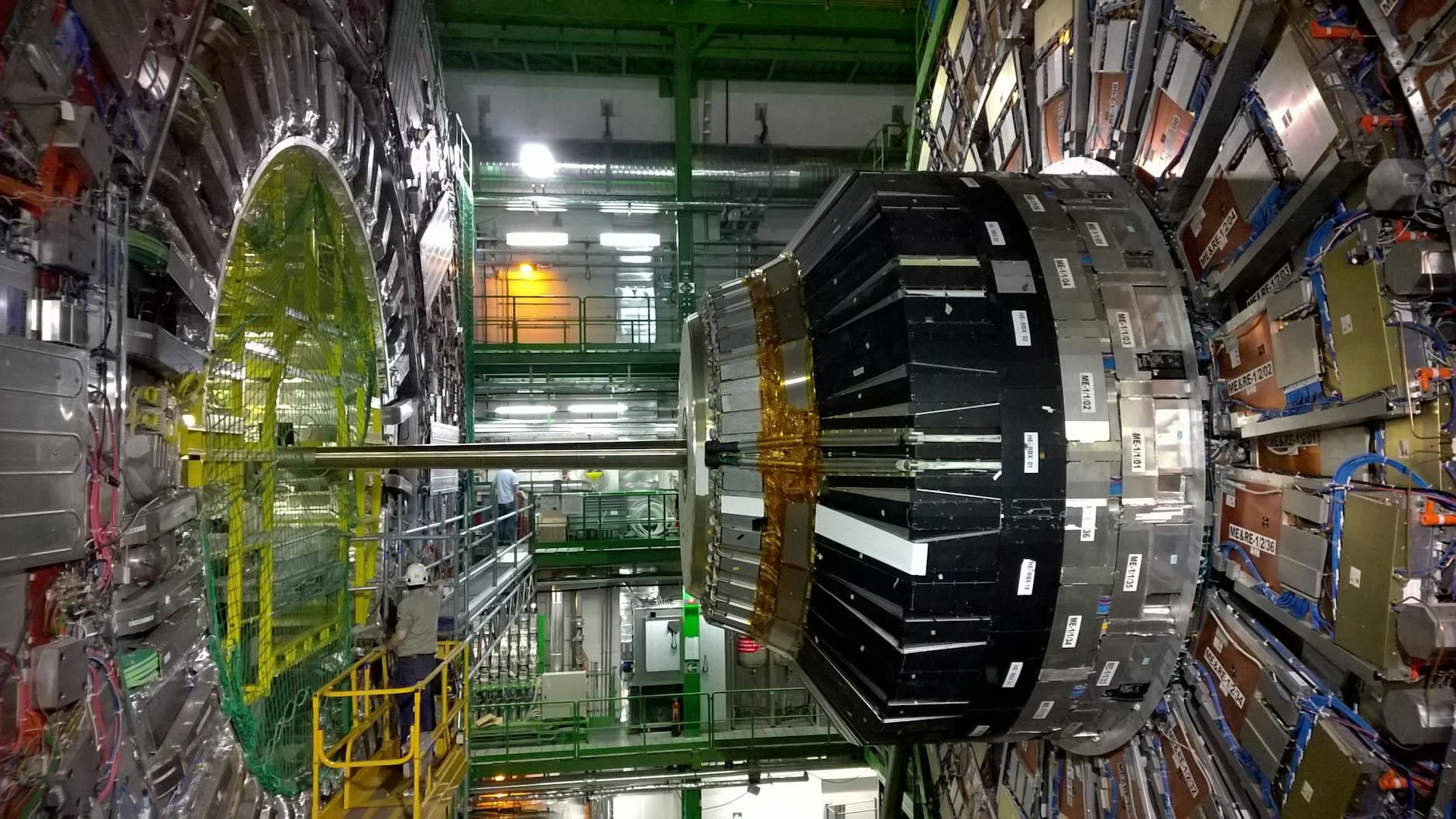
On September 14, 2015, at 5:51 a.m. Eastern time, two black holes collided 1.3 billion light-years away. Seven milliseconds later, a signal arrived at the LIGO detector in Livingston, Louisiana, and then at the Hanford, Washington detector: a pattern of stretching and squeezing in spacetime so tiny that it displaced the detectors’ mirrors by a fraction of a proton’s diameter. It lasted one-fifth of a second.
That event, GW150914, was the first direct detection of gravitational waves. It confirmed a prediction of Einstein’s general relativity that had waited a century for experimental verification. It demonstrated that black holes merge. It opened an entirely new window on the universe: a window not made of light, but of spacetime itself.
What Gravitational Waves Are
General relativity describes gravity not as a force pulling masses together, but as the curvature of spacetime caused by mass and energy. Massive objects warp the four-dimensional fabric of spacetime around them; other objects move along the curved paths this creates: what we experience as gravitational attraction.
When massive objects accelerate asymmetrically (not just any acceleration, but a changing quadrupole moment (the way mass is distributed is shifting non-uniformly)), they generate ripples in spacetime that propagate outward at the speed of light. These are gravitational waves.
A gravitational wave passing through space alternately stretches space in one direction and compresses it perpendicular to that direction, then reverses. The effect is a strain: a dimensionless ratio of the change in length to the original length. For GW150914, the peak strain was about 10⁻²¹. This means that, for a detector arm 4 kilometers long, the displacement was about 4 × 10⁻¹⁸ meters: roughly one-thousandth the diameter of a proton.
The stretching and compressing is not illusory: it is a real change in the geometry of spacetime. Light also stretches and compresses as it travels through the wave, but the light in LIGO’s arms is timed against itself, and the change in travel time for each arm is what LIGO detects.
Einstein’s Prediction and the Long Wait
Einstein published his general theory of relativity in 1915 and derived the existence of gravitational waves in 1916. But he was deeply uncertain whether they were a physical reality or a mathematical artifact of his coordinate system. He twice submitted papers arguing that gravitational waves did not carry energy and were therefore not real: and twice was persuaded he was wrong.
The first strong indirect evidence came in 1974. Russell Hulse and Joseph Taylor discovered a binary pulsar system: two neutron stars in close orbit, one of which is a pulsar whose radio pulses arrive with clockwork precision. Over years of observation, Taylor and colleagues found that the orbital period was decreasing; the two neutron stars were spiraling together: at exactly the rate predicted if they were losing energy by radiating gravitational waves. Hulse and Taylor received the Nobel Prize in Physics in 1993. The binary pulsar provided compelling indirect evidence that gravitational waves were real and carried energy as predicted.
But direct detection required an entirely different scale of engineering: interferometers sensitive enough to detect a strain of 10⁻²¹ across a 4-kilometer arm.
How LIGO Works
LIGO (Laser Interferometer Gravitational-Wave Observatory) is a Michelson interferometer taken to extreme precision. A laser beam is split and sent down two perpendicular arms, each 4 kilometers long. The beams bounce off mirrors (technically, suspended test masses) at the ends of each arm and return to the beamsplitter, where they interfere. When the arms are exactly equal length, the beams cancel (destructive interference) at the output port: no light reaches the photodetector.

When a gravitational wave passes, one arm stretches while the other compresses, breaking the perfect cancellation. A tiny amount of light reaches the photodetector: but so tiny that extraordinary engineering is required to detect it.
The challenges are immense:
- Thermal noise: The mirrors, suspended by glass fibers, vibrate due to thermal motion. LIGO uses seismic isolation stacks and pendulum suspensions to reduce this below the signal level.
- Seismic noise: Earthquakes, ocean waves, traffic, even a person walking nearby create noise. LIGO uses active seismic isolation to suppress this at low frequencies.
- Quantum noise: At high frequencies, the shot noise of individual photons becomes limiting. LIGO uses high-laser-power and, in recent upgrades, squeezed light (a quantum optics technique) to reduce this.
- Environmental noise: Lightning, aircraft, and ocean microseisms all create signals. LIGO runs two widely separated detectors specifically so that coincident signals can be distinguished from local noise.
After a decade of R&D and construction, LIGO achieved its first observing run (O1) in 2015: and detected GW150914 in the first days of operation.
What Gravitational Waves Reveal
Gravitational waves carry information that light cannot. They pass through matter essentially unimpeded (the interaction with matter is absurdly weak: a feature that makes them hard to detect but makes them extraordinarily clean messengers). Where electromagnetic observations of black hole mergers are impossible (black holes emit no light), gravitational waves directly encode the masses, spins, and orbital parameters of the merging objects.
Binary black hole mergers. Before LIGO, the existence of stellar-mass binary black hole systems was not confirmed. GW150914 revealed two black holes of approximately 36 and 29 solar masses merging to form a 62-solar-mass black hole, with roughly 3 solar masses radiated as gravitational wave energy in a fraction of a second. The luminosity of that event briefly exceeded the combined light output of all stars in the observable universe. LIGO and Virgo have now detected dozens of binary black hole mergers, revealing a population of black holes more massive than expected from stellar evolution models.

Neutron star mergers. On August 17, 2017, LIGO/Virgo detected GW170817: the merger of two neutron stars. This event was simultaneously observed across the electromagnetic spectrum: gamma rays arrived 1.7 seconds after the gravitational wave signal (constraining the difference in propagation speed between gravitational waves and light to less than one part in 10¹⁵, a powerful test of general relativity). Optical and infrared telescopes observed a kilonova: the burst of heavy elements synthesized by rapid neutron capture (the r-process) during the merger. GW170817 confirmed that neutron star mergers are a major source of elements heavier than iron (gold, platinum, uranium), answering a decades-old question in nuclear astrophysics.

Tests of general relativity. Every gravitational wave detection is also a test of general relativity. The waveform shape, the post-merger ringdown of the final black hole, the propagation speed, and the polarization of the waves all constrain potential deviations from general relativity. So far, every observation is consistent with Einstein’s theory.
The Future of Gravitational Wave Astronomy
LIGO, Virgo, and KAGRA (Japan’s detector) represent the first generation of gravitational wave observatories. Several advances are underway or planned:
Einstein Telescope (Europe) and Cosmic Explorer (US): Next-generation ground-based detectors with 10–40 kilometer arm lengths, expected to detect binary black hole mergers throughout most of the observable universe and resolve the neutron star population in detail.
LISA (Laser Interferometer Space Antenna): A space-based detector with arm lengths of 2.5 million kilometers, approved by ESA and targeting launch in 2037. LISA will observe gravitational waves at much lower frequencies than ground-based detectors, sensitive to supermassive black hole mergers, compact binary systems in our galaxy, and possibly primordial gravitational waves from the early universe.
Pulsar Timing Arrays (PTAs): Networks of millisecond pulsars whose pulse arrival times are monitored with nanosecond precision. The NANOGrav collaboration and international partners reported in 2023 strong evidence for a gravitational wave background: a low-frequency hum of gravitational waves pervading the universe, likely from the superposition of thousands of supermassive black hole binary systems in the early universe. This represents a third distinct frequency band of gravitational wave detection.
Sources
Abbott, B.P. et al. (LIGO Scientific Collaboration and Virgo Collaboration) (2016). Observation of gravitational waves from a binary black hole merger. Physical Review Letters, 116(6), 061102. doi:10.1103/PhysRevLett.116.061102
Abbott, B.P. et al. (LIGO Scientific Collaboration and Virgo Collaboration) (2017). GW170817: Observation of gravitational waves from a binary neutron star inspiral. Physical Review Letters, 119(16), 161101. doi:10.1103/PhysRevLett.119.161101
Taylor, J.H. & Weisberg, J.M. (1982). A new test of general relativity: Gravitational radiation and the binary pulsar PSR 1913+16. The Astrophysical Journal, 253, 908–920. doi:10.1086/159690
Hulse, R.A. & Taylor, J.H. (1975). Discovery of a pulsar in a binary system. The Astrophysical Journal Letters, 195, L51–L53. doi:10.1086/181708
Agazie, G. et al. (NANOGrav Collaboration) (2023). The NANOGrav 15-year data set: Evidence for a gravitational-wave background. The Astrophysical Journal Letters, 951(1), L8. doi:10.3847/2041-8213/acdac6
Punturo, M. et al. (2010). The Einstein Telescope: A third-generation gravitational wave observatory. Classical and Quantum Gravity, 27(19), 194002. doi:10.1088/0264-9381/27/19/194002
Further reading: Gravitational wave on Wikipedia