
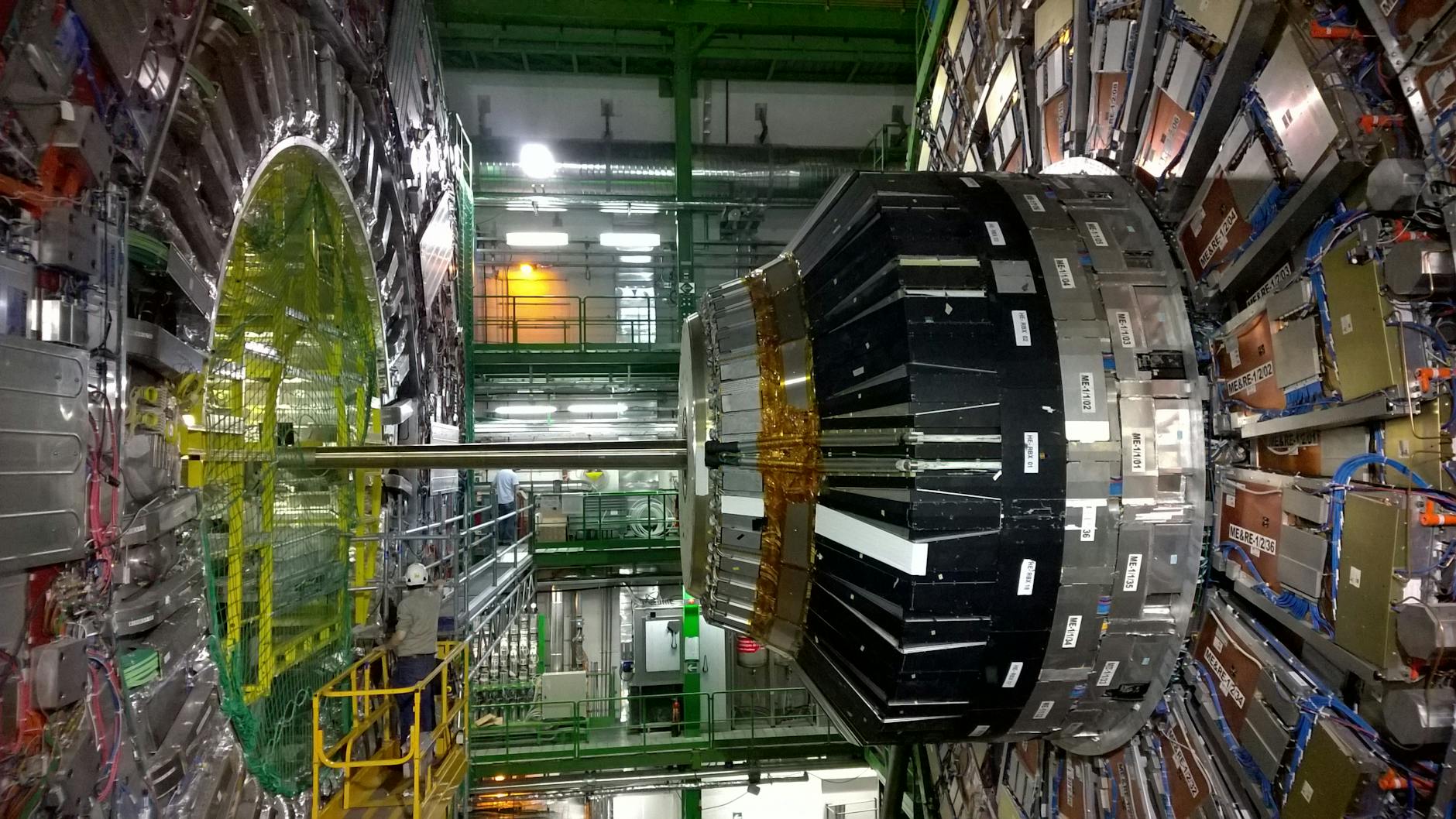
Every particle of matter has an antimatter twin, identical in mass, opposite in charge and certain other quantum properties. When matter and antimatter meet, they annihilate each other completely, converting all of their mass into pure energy. This is not science fiction. Antimatter is real, it has been produced and studied in laboratories for decades, and it is central to one of the deepest unsolved mysteries in physics: why does the universe exist at all?
The Big Bang should have produced equal amounts of matter and antimatter. Equal amounts would have annihilated each other completely, leaving a universe of pure radiation with no atoms, no stars, and no life. Yet here we are. Something (some subtle asymmetry between matter and antimatter) tipped the scales in matter’s favor. Finding that asymmetry is one of the primary goals of modern physics.
What Antimatter Is

Antimatter particles are predicted by combining quantum mechanics with special relativity. In 1928, Paul Dirac wrote an equation describing the relativistic behavior of the electron, now called the Dirac equation. The equation had two solutions: one for the electron, and one for a particle with the same mass but opposite electric charge. Dirac initially interpreted this as a proton, but the mathematics was clear. It was predicting a new kind of particle.
In 1932, Carl Anderson discovered this particle, the positron, in cosmic ray tracks passing through a cloud chamber. The positron is the antielectron: same mass as the electron, positive charge. Anderson received the Nobel Prize in Physics in 1936 for this discovery.
The antiparticles of other particles followed: the antiproton (discovered at Berkeley in 1955), the antineutron (1956), and eventually antihydrogen (a positron orbiting an antiproton), first produced at CERN in 1995 and stably trapped in sufficient quantities for spectroscopic study starting in 2010.
Every known particle has an antiparticle. Quarks have antiquarks. Even neutral particles like the neutron have antiparticles (though for a few particles, like the photon, the particle and antiparticle are identical; the photon is its own antiparticle).
Annihilation and Energy Release
When a particle meets its antiparticle, they annihilate. The entire mass of both particles converts to energy, typically as high-energy photons (gamma rays). This is governed by Einstein’s equation E = mc². Because mass is such a concentrated form of energy, annihilation releases an enormous amount of energy per unit mass, far more than any chemical or even nuclear reaction.
One gram of antimatter meeting one gram of matter would release approximately 1.8 × 10¹⁴ joules, the equivalent of roughly 43 kilotons of TNT, comparable to a large nuclear weapon. This makes antimatter fascinating to speculate about as a fuel source. But the difficulty is that producing antimatter requires far more energy than is recovered from its annihilation, and containment is extraordinarily challenging.
Electron-positron annihilation produces two gamma rays, each with energy equal to the electron’s rest-mass energy (0.511 MeV). This process is actually used in medical imaging: positron emission tomography (PET) scans work by injecting a radioactive tracer that emits positrons. The positrons annihilate with nearby electrons, producing gamma ray pairs that are detected by the scanner to produce three-dimensional images of metabolic activity.
CP Violation and the Matter-Antimatter Asymmetry

The reason the universe is made of matter rather than equal parts matter and antimatter is called the baryon asymmetry problem. For every billion antiparticles in the early universe, there were approximately one billion and one particles of matter. All the billion pairs annihilated. The one-in-a-billion excess became everything we see.
This asymmetry requires physics that distinguishes matter from antimatter. In 1964, James Cronin and Val Fitch discovered that certain particle decays (specifically the decays of neutral kaons) violate CP symmetry, a symmetry that relates matter and antimatter. CP stands for charge-parity: the combination of replacing all particles with antiparticles (charge conjugation, C) and flipping spatial coordinates (parity, P). A universe symmetric under CP would be indistinguishable from its mirror-image antimatter version.
The 1964 experiment showed that the universe is not fully CP-symmetric. The CP violation in kaon decays is real but tiny, far too small to account for the observed matter-antimatter imbalance in the universe. Subsequent experiments at B-meson factories (BaBar at SLAC and Belle in Japan) found larger CP violation in B meson decays, but still insufficient.
Where the full explanation lies remains unknown. The Standard Model does contain CP violation in the quark sector, but the amount is orders of magnitude too small to explain baryogenesis (the process by which the asymmetry was generated). There may be additional sources of CP violation in the lepton sector (involving neutrinos), or in new physics beyond the Standard Model.
The T2K experiment in Japan and the NOvA experiment in the United States are currently measuring CP violation in neutrino oscillations (the process by which neutrinos change type as they travel). Early T2K results hint at significant CP violation in the neutrino sector, which could point toward leptogenesis (the idea that the matter-antimatter asymmetry originated in the lepton sector and was transferred to baryons (protons and neutrons) through high-energy processes in the early universe).
Antimatter in Nature
Antimatter is not only produced in laboratories. It appears naturally throughout the universe:
Cosmic rays: High-energy protons and atomic nuclei raining down from space produce showers of secondary particles in Earth’s atmosphere, including positrons and antiprotons.
Radioactive decay: Many naturally occurring and artificial radioisotopes undergo beta-plus decay, emitting a positron. This is the basis of PET scanning.
Gamma-ray bursts: These extreme astrophysical events can produce electron-positron pair creation (the reverse of annihilation) when gamma rays interact with strong magnetic fields or with each other.
Galactic center: NASA’s INTEGRAL satellite and the Fermi Gamma-ray Space Telescope have detected a strong 511 keV gamma-ray signal from the center of our galaxy (the signature of electron-positron annihilation). The positron source is not fully identified but may include low-mass X-ray binaries, millisecond pulsars, or dark matter decay.
Trapping and Studying Antihydrogen

One of the most ambitious programs in antimatter research is the study of antihydrogen at CERN’s ALPHA experiment. Antihydrogen (an antiproton orbited by a positron) is the simplest antiatom. If matter and antimatter truly are symmetric (as the Standard Model predicts for their basic properties), then antihydrogen should emit and absorb exactly the same wavelengths of light as ordinary hydrogen.
Producing antihydrogen is straightforward in principle: mix antiprotons from CERN’s Antiproton Decelerator with positrons from a radioactive source. The challenge is keeping the resulting antiatoms from touching the walls of their container (which are made of matter) before they can be studied. Magnetic traps confine antihydrogen atoms using their tiny magnetic moments.
By 2023, the ALPHA collaboration had made spectroscopic measurements of antihydrogen with sufficient precision to test whether the 1S-2S transition (one of the most precisely measured transitions in ordinary hydrogen) matches between matter and antimatter. Within measurement precision (about 2 parts per trillion), it does. Any deviation would require new physics. The search continues with increasing precision.
Antimatter as a Fuel Source
Antimatter is the most energy-dense fuel possible by mass, a property that makes it a perennial subject of speculation for spacecraft propulsion. The energy density of matter-antimatter annihilation is about 90 petajoules per kilogram, compared to about 16 terajoules per kilogram for nuclear fission, and roughly 50 megajoules per kilogram for chemical reactions.
The problem is production cost. CERN produces antiprotons at enormous energy expense: approximately 10⁻¹⁶ grams per second at full operation, at an energy cost that means producing one gram of antimatter would require on the order of 25 million billion dollars using current technology. The efficiency of current accelerators for antimatter production is extremely low. Unless radically different production methods are developed, antimatter fuel remains firmly in the domain of science fiction.
What is antimatter?
Antimatter consists of particles with the same mass as their matter counterparts but opposite quantum numbers, including electric charge. When matter and antimatter particles meet, they annihilate completely, converting their mass into energy (usually gamma rays). Every known particle of matter has an antimatter counterpart. The existence of antimatter was predicted by Paul Dirac in 1928 and confirmed with the discovery of the positron in 1932.
What happens when antimatter meets matter?
They annihilate, converting all of their combined mass into energy, usually gamma ray photons. The energy released is described by E = mc². A gram of antimatter meeting a gram of matter would release energy equivalent to roughly 43 kilotons of TNT. In practical situations, antimatter annihilation is used in PET medical imaging, where positrons from a radioactive tracer annihilate with electrons to produce detectable gamma rays.
Why does the universe have more matter than antimatter?
This is one of the deepest unsolved problems in physics. The Big Bang should have produced equal amounts of matter and antimatter, which would have annihilated each other. The fact that matter dominates requires a process that distinguishes matter from antimatter, called CP violation. Small amounts of CP violation have been observed in laboratory experiments, but not enough to explain the observed imbalance. The full explanation for why matter survived is unknown.
How is antimatter produced in laboratories?
Antimatter is produced by high-energy particle collisions. In particle accelerators like the LHC, protons are accelerated to near the speed of light and collided. The energy of the collision can create particle-antiparticle pairs. Antiprotons are slowed down and collected in CERN’s Antiproton Decelerator. Positrons are produced by radioactive sources undergoing beta-plus decay. These are combined to make antihydrogen, which is then trapped for study.
Could antimatter power a spacecraft?
In principle, matter-antimatter annihilation is the most energy-dense reaction possible and could in theory drive a spacecraft. In practice, antimatter is extraordinarily expensive to produce (far more energy goes in than comes out), difficult to store, and only producible in microscopic quantities. Producing enough antimatter for practical propulsion would require breakthroughs in accelerator technology that do not currently exist. It remains a theoretical possibility, not an engineering prospect.
Is there an anti-universe made of antimatter?
Some cosmological models propose a “CPT mirror” universe made of antimatter expanding backward in time, mathematically symmetric with our own. This remains highly speculative. Observations show no large regions of antimatter in the observable universe: contact between a matter region and an antimatter region would produce an unmistakable gamma-ray signal at their boundary, none of which has been observed. The universe appears to be overwhelmingly matter-dominated throughout the observable volume.
Sources
Dirac, P.A.M. (1928). The quantum theory of the electron. Proceedings of the Royal Society A, 117(778), 610–624. doi:10.1098/rspa.1928.0023
Anderson, C.D. (1933). The positive electron. Physical Review, 43(6), 491–494. doi:10.1103/PhysRev.43.491
Christenson, J.H., Cronin, J.W., Fitch, V.L., & Turlay, R. (1964). Evidence for the 2π decay of the K₂⁰ meson. Physical Review Letters, 13(4), 138–140. doi:10.1103/PhysRevLett.13.138
ALPHA Collaboration. (2023). Laser spectroscopy of antihydrogen and the test of CPT symmetry. Nature, 613(7944), 268–272. doi:10.1038/s41586-022-05608-z
T2K Collaboration. (2020). Constraint on the matter-antimatter symmetry-violating phase in neutrino oscillations. Nature, 580(7803), 339–344. doi:10.1038/s41586-020-2177-0
Ade, P.A.R. et al. (Planck Collaboration). (2016). Planck 2015 results. XIII. Cosmological parameters. Astronomy & Astrophysics, 594, A13. doi:10.1051/0004-6361/201525830
Further reading: Antimatter on Wikipedia