
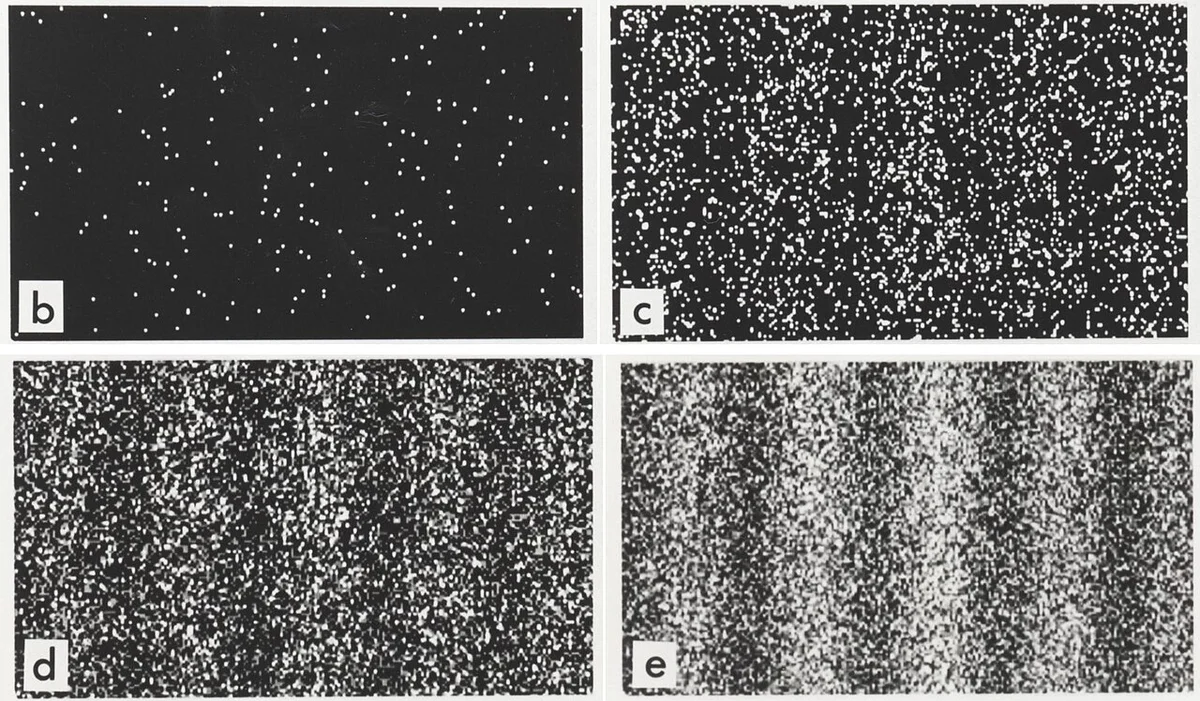
The quantum measurement problem is the paradox that quantum particles exist in multiple states simultaneously until measured, yet always appear in a single definite state upon observation. This transition from indefinite superposition to definite outcome has no satisfactory explanation within standard quantum mechanics, making it the deepest unresolved conceptual puzzle in physics.
Bottom line: Quantum mechanics gives two different rules (unitary evolution via the Schrödinger equation vs. wave function collapse) for the same system, with no agreed-upon boundary between them. The measurement problem is not about disturbance, it’s about why a system in a superposition of states ever appears in only one state. (The “observer effect,” where measuring a particle necessarily disturbs it, is a separate classical issue.)
In the microscopic world, particles do not have definite properties until they are measured. An electron doesn’t have a specific position until you look for it. A photon doesn’t have a definite polarization until you measure it. A radioactive atom’s exact moment of decay is not determined until a measurement or interaction occurs that effectively “asks” the atom when it decayed.
Before measurement, a quantum particle exists in a superposition: a mathematical combination of multiple possible states simultaneously. The iconic example: Schrödinger’s cat, in a sealed box linked to a radioactive trigger, is simultaneously alive and dead until the box is opened (according to the wave function description).
After measurement, the particle appears in one definite state. The quantum fuzziness collapses.
This transition, from superposition to definite state, is the quantum measurement problem. It is the deepest unresolved conceptual puzzle in all of physics, and physicists have been arguing about it since quantum mechanics was formulated in the 1920s. It’s important to clarify that “observation” here does not require a conscious mind, any physical interaction that entangles a measuring device with the system suffices.
The Double-Slit Experiment: The Heart of the Mystery
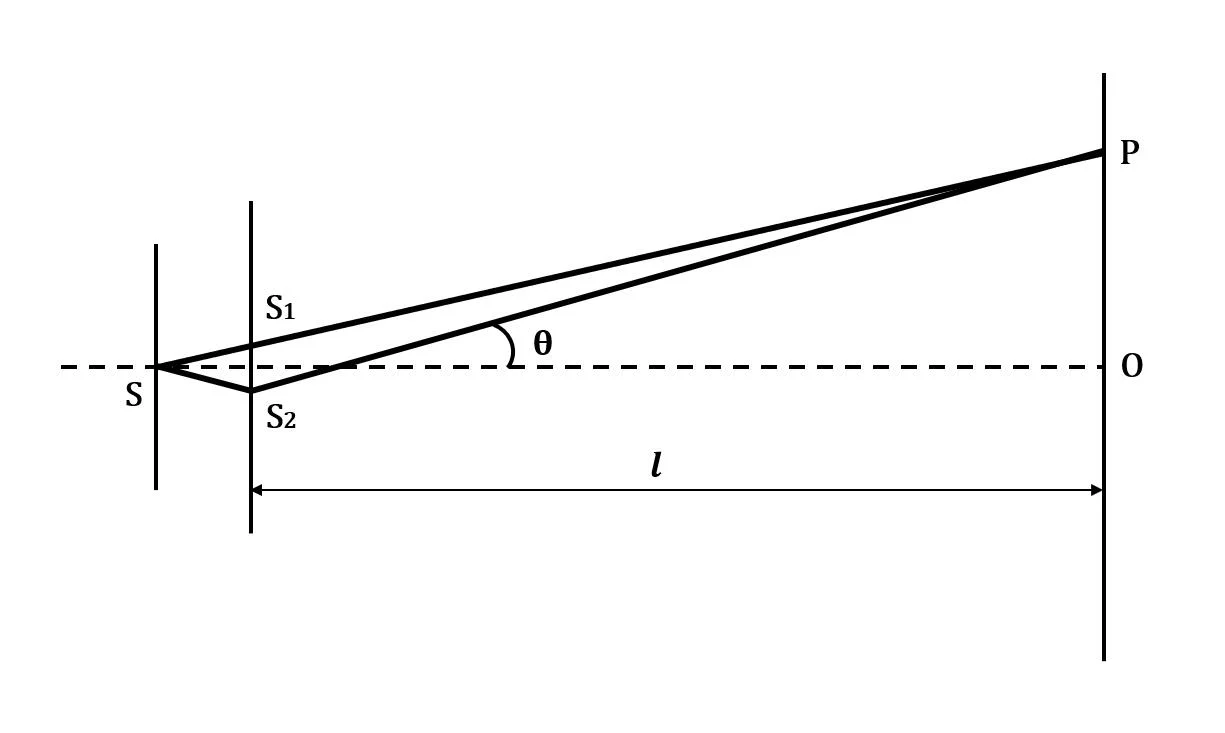
The quantum measurement problem is perfectly illustrated by the double-slit experiment.
Shine a beam of light (or electrons, or atoms) at a barrier with two narrow slits. On the other side, you’d expect to see two bright lines, the shadow of the two slits. But instead you see an interference pattern, alternating bright and dark bands: proving that the quantum particles pass through both slits simultaneously and interfere with themselves, like waves.
Now add a detector at one of the slits to determine which slit the particle went through. The interference pattern disappears. The particles now behave like ordinary bullets, going through one slit or the other, leaving two bands.
The act of measurement, of extracting “which path” information, destroys the quantum superposition. If the which-path information is recorded and becomes inescapably entangled with the particle’s state, even if we never look at it, the interference pattern is destroyed. This is not a non-local effect; rather, the two paths become distinguishable, so the quantum superposition decoheres and interference no longer occurs. (The “spooky action at a distance” Einstein criticized refers to EPR correlations, not this distinguishability effect.)
A particularly striking variant is the delayed-choice quantum eraser, where the decision to measure which-path information is made after the particle has already passed through the slits. In that setup, the interference pattern can be recovered or erased in the correlated subset of data, depending on which measurement is later performed on the idler photon – highlighting the role of entanglement, not retrocausality.
The Wave Function and the Schrödinger Equation

Quantum mechanics describes the state of a physical system using a wave function: a mathematical object (written as ψ, “psi”) that encodes the probability amplitude for every possible outcome of every possible measurement.
The wave function evolves according to the Schrödinger equation: a smooth, deterministic, reversible equation. Between measurements, the Schrödinger equation dictates how the wave function evolves. Nothing surprising here.
But the Schrödinger equation never produces definite outcomes on its own. A superposition, evolved by the Schrödinger equation, remains a superposition forever. The equation describes a quantum particle spreading out and interfering with itself: it cannot account for the sudden, random jump to a definite outcome that measurement produces.
The collapse of the wave function, the sudden change from superposition to definite outcome, is the measurement problem. It has no satisfactory description within the Schrödinger equation. It seems to require something extra: an observer, a classical world, a special role for measurement. But quantum mechanics is supposed to be a complete theory, and a theory that requires mysterious exceptions for “observers” feels fundamentally unsatisfying.
Proposed Solutions to the Measurement Problem
Physicists and philosophers of physics have been wrestling with this problem for nearly a century. The major interpretations of quantum mechanics are, in large part, different ways of addressing the measurement problem.
1. The Copenhagen Interpretation: Don’t Ask
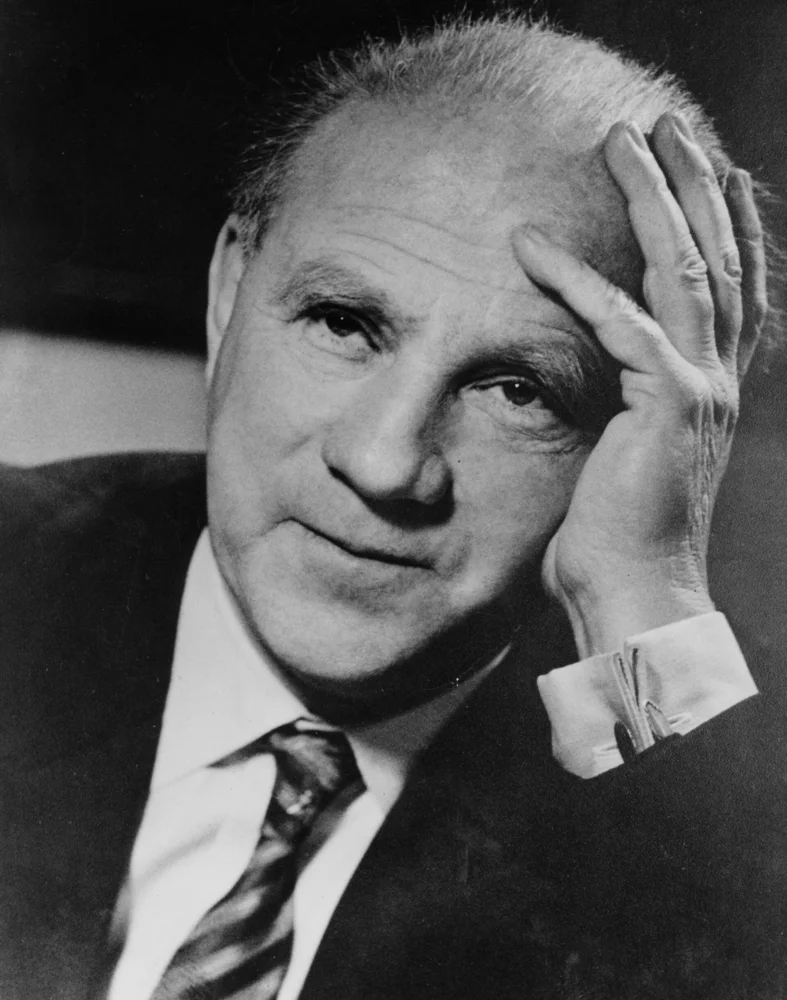
The Copenhagen interpretation, developed by Niels Bohr and Werner Heisenberg in the late 1920s, was the first systematic response. Its core move is a kind of philosophical agnosticism: quantum mechanics correctly predicts the probabilities of measurement outcomes, and that’s all we should ask of it.
In the Copenhagen view, questions about what the particle was “really doing” before measurement are meaningless. There is no deeper reality behind the wave function. The wave function is a tool for calculating probabilities, not a description of something physically real. In strict Copenhagen, the wave function is not a physical object but a tool; collapse is merely the transition from the quantum formalism to classical experimental outcomes.
Wave function collapse is just the updating of our information when a measurement is made, like how a classical probability distribution “collapses” when you learn an outcome. The quantum world and the classical measurement apparatus are categorically different, and the dividing line between them is the Heisenberg cut, a fuzzy but practically useful boundary.
What is the Heisenberg cut? The Heisenberg cut is the arbitrary dividing line between the quantum system (described by the wave function) and the classical measuring apparatus (described by definite outcomes). It is not fixed by the theory; a major source of dissatisfaction.
Copenhagen has been the pragmatic workhorse of physics: “shut up and calculate.” It works beautifully for making predictions. But it is fundamentally silent about ontology, about what is actually happening in the world.
2. Many-Worlds Interpretation: All Outcomes Happen
Hugh Everett proposed in 1957 that there is no wave function collapse. The Schrödinger equation always holds, always exactly. When a measurement is made, the universe branches: every possible outcome occurs, in a separate branch of a universal wave function.
When you open Schrödinger’s cat’s box, the universe splits. In one branch, you find a live cat. In another, a dead cat. Both are equally real. You only experience one branch because you (and your measuring apparatus) become entangled with the cat, your branch and the cat’s branch are the same branch.
The many-worlds interpretation is mathematically clean: it adds nothing to quantum mechanics, removes nothing. There is no collapse, no observer-dependence, no mysterious exceptions. The Schrödinger equation is everything.
The price is ontological extravagance: an unimaginably vast multiplicity of parallel universes, branching every time a quantum event occurs anywhere. This interpretation aligns naturally with the mind-bending implications of quantum entanglement, where correlations between particles persist across vast distances.
Many-worlds has gained traction among physicists and philosophers of physics, particularly because it aligns naturally with quantum cosmology (applying quantum mechanics to the universe as a whole). The probability problem: deriving the Born rule (why probabilities equal the modulus squared of the wave function amplitude) from branching – remains a challenging technical issue. However, significant progress has been made via decoherence and decision-theoretic arguments, which show that observers in different branches naturally experience outcomes with frequencies matching the Born rule.
In this view, the appearance of randomness comes from the observer being unaware of which branch they are in – but every branch is real.

3. Pilot Wave Theory (de Broglie-Bohm)
Pilot wave theory, proposed by Louis de Broglie and developed fully by David Bohm, takes a different approach: particles have definite positions at all times. The wave function is a real physical field that guides particle motion, a “pilot wave.”
Measurement outcomes are determined by the actual (hidden) positions of particles, which we don’t know precisely. The apparent randomness of quantum mechanics comes from our ignorance of initial positions, not from fundamental indeterminacy. Like a deterministic clockwork whose gears are hidden from view.
Pilot wave theory is fully deterministic and reproduces all predictions of standard quantum mechanics. There is no measurement problem: measurement outcomes are determined by the particles’ actual positions.
The trade-offs: pilot wave theory is explicitly non-local: the pilot wave spans all space instantaneously, and the wave function guiding one particle can depend on what’s happening far away. Extending it to relativistic quantum field theory has proven enormously difficult.
4. Quantum Bayesianism (QBism)
QBism (Quantum Bayesianism), developed by Christopher Fuchs, Rüdiger Schack, and Carlton Caves, treats the wave function as a personal belief, not a physical object, dissolving the measurement problem by denying it is about external reality.
The wave function represents an agent’s beliefs about what measurements will yield. Wave function collapse is just belief updating, like a Bayesian prior updating to a posterior after new evidence. There is no objective physical fact about what the wave function “really is.”
Think of it like odds before and after a horse race: before the race, you have probabilities for each horse winning; after the race, your odds “collapse” to 100% for the winner. QBism says the wave function works the same way, it’s your personal betting odds on experimental outcomes, not a description of the horse itself. There is no objective physical fact about what the wave function “really is”, it’s a user’s manual for navigating experience. Two agents can hold different wave functions for the same system, because wave functions represent personal beliefs, not objective facts.
QBism neatly dissolves many measurement problem puzzles by denying they are about physical reality. Critics find it too radical: it seems to abandon the project of physics as a description of the world. But is physics about describing reality, or about predicting experience?
5. Objective Collapse Theories
Perhaps wave function collapse is real and physical: not a subjective updating of information but an actual physical process. Objective collapse theories (like the GRW theory by Ghirardi, Rimini, and Weber, or the CSL model) add a new physical mechanism to quantum mechanics: spontaneous, random collapses of the wave function, occurring at a very low rate for individual particles but happening so rapidly for macroscopic objects (which contain ~10²³ particles) that they never develop macroscopic superpositions.
In GRW theory, the wave function for a single particle spontaneously localizes (collapses) about once every 10¹⁶ seconds: far too rarely to affect individual quantum experiments. But for a system of 10²³ particles, collapses occur billions of times per second, keeping macroscopic objects in definite states.
Objective collapse theories are empirically distinguishable from standard quantum mechanics in principle: they predict tiny deviations from quantum predictions for large systems. Experiments with molecules like C₆₀ (buckyballs) and CsI (cesium iodide) have pushed toward the regime where GRW-style collapses might be detected, and non-observation of spontaneous radiation has placed constraints on collapse parameters.
Decoherence: Progress Without a Solution
Quantum decoherence has transformed understanding of the quantum-to-classical transition without fully solving the measurement problem.
When a quantum system interacts with its environment, billions of air molecules, photons, thermal vibrations, the different components of its superposition become entangled with the environment in distinct, distinguishable ways. This entanglement effectively suppresses the interference between different outcomes. The superposition still exists in principle, but its quantum behavior is practically unobservable.
Decoherence explains why we never see macroscopic superpositions in everyday life: the macroscopic world decoheres extraordinarily rapidly, in times far shorter than any possible observation time. It explains why the quantum-classical boundary is where it is.
But decoherence doesn’t fully solve the measurement problem. After decoherence, the system still exists in a superposition: entangled with the environment. All the outcomes are still there, weighted by their amplitudes. Decoherence explains why different outcomes don’t interfere, but not why one outcome occurs rather than another.
To go from “many outcomes, no interference” to “one outcome occurs,” you still need either many-worlds (all occur in branches), hidden variables (outcomes determined by variables we can’t see), or some form of collapse.
Why the Measurement Problem Matters
The measurement problem might seem like a purely philosophical concern, quantum mechanics works perfectly well for all practical purposes regardless of which interpretation is correct. Predictions are the same; experiments come out the same.
But interpretations of quantum mechanics make a difference in several ways:
Quantum computing: The design of quantum computers and the analysis of what they can and can’t do depends on precise understanding of quantum states, entanglement, and what happens during measurement. The philosophical questions become practical engineering questions. For instance, in quantum key distribution systems, the measurement problem directly determines how securely information can be transmitted, because any attempt to eavesdrop inevitably disturbs the quantum state, revealing the intrusion. (For more, see our piece on quantum cryptography.) In quantum error correction, the measurement problem forces engineers to design “non-demolition” measurements that extract information without fully collapsing the state, a direct engineering consequence of the conceptual puzzle.
Quantum gravity: Any theory of quantum gravity must be consistent with quantum mechanics. Different interpretations suggest different approaches to quantizing gravity and treating time and observers in a fundamental theory. The measurement problem also raises questions about what is spacetime itself, whether it emerges from quantum processes or is fundamental.
Foundations of physics: The measurement problem points to a gap at the heart of our most successful physical theory. If quantum mechanics is truly fundamental, it should apply to everything, including observers and measuring apparatus. The fact that the theory seems to require an outside “observer” is a sign that something is missing or misunderstood.
Quick Comparison: Key Interpretations at a Glance
| Interpretation | Collapse? | Realism? | Locality? | Testable? |
|---|---|---|---|---|
| Copenhagen | Yes (subjective) | No | Yes | No |
| Many-Worlds | No | Yes (many worlds) | Yes | No¹ |
| Pilot Wave | No | Yes (particles + wave) | No (non-local) | No |
| QBism | Yes (personal belief) | No | Yes | No |
| Objective Collapse | Yes (physical) | Yes | Yes | In principle |
¹Decoherence itself is testable; Many-Worlds is the interpretation that decoherence replaces collapse without new parameters.
The Uncomfortable Truth
After nearly a century, physicists and philosophers don’t agree on the solution to the measurement problem. The three most defensible interpretations, many-worlds, pilot wave, QBism, each buy their consistency at a steep philosophical price: ontological extravagance (many worlds), non-locality (pilot wave), or radical subjectivism (QBism).
Copenhagen remains popular by essentially refusing to answer the question. Decoherence explains part of the story but not all. Objective collapse is in principle testable but hasn’t been confirmed.
The measurement problem is not an embarrassment to quantum mechanics, it is a profound question about the structure of reality. It asks: what does it mean for something to be definite? What is an observer? Is the universe described from the inside or the outside?
Those are not merely physics questions. They are some of the deepest questions in all of human thought. The measurement problem forces us to ask: is physics about describing an objective reality, or only about predicting our observations? No other question in science cuts so deep into the nature of existence.
Sources
- Bell, J.S. (1987). Speakable and Unspeakable in Quantum Mechanics. Cambridge University Press.
- Everett, H. (1957). ‘Relative state’ formulation of quantum mechanics. Reviews of Modern Physics, 29(3), 454.
- Bohm, D. (1952). A suggested interpretation of the quantum theory in terms of ‘hidden’ variables. Physical Review, 85(2), 166.
- Ghirardi, G.C., Rimini, A. & Weber, T. (1986). Unified dynamics for microscopic and macroscopic systems. Physical Review D, 34(2), 470.
- Schlosshauer, M. (2007). Decoherence and the Quantum-to-Classical Transition. Springer.
- Stanford Encyclopedia of Philosophy: Quantum Mechanics
- Nature: The quantum measurement problem
What is the quantum measurement problem?
The quantum measurement problem is the paradox that quantum particles exist in multiple states simultaneously (superposition) until measured, yet always appear in a single definite state upon observation, with no agreed-upon explanation for this transition.
Does observation really change reality in quantum mechanics?
Yes, in quantum mechanics, measurement forces a particle in a superposition of states to ‘collapse’ into one definite state, meaning properties like position or polarization are not fixed until observed.
What is the difference between the observer effect and the measurement problem?
The observer effect is a classical idea where measuring disturbs a system, while the measurement problem is about why a superposition ever yields a single outcome, not about disturbance.
How does Schrödinger’s cat illustrate the measurement problem?
Schrödinger’s cat is a thought experiment where a cat in a sealed box is simultaneously alive and dead due to a quantum trigger, showing the paradox of superposition until the box is opened and measured.
Why is the quantum measurement problem considered unresolved?
It remains unresolved because quantum mechanics uses two different rules (unitary evolution and wave function collapse) for the same system, with no clear boundary between them, and no consensus on how or why collapse occurs.
Further reading: Measurement problem on Wikipedia