The Science of Life – From Earth to the Stars

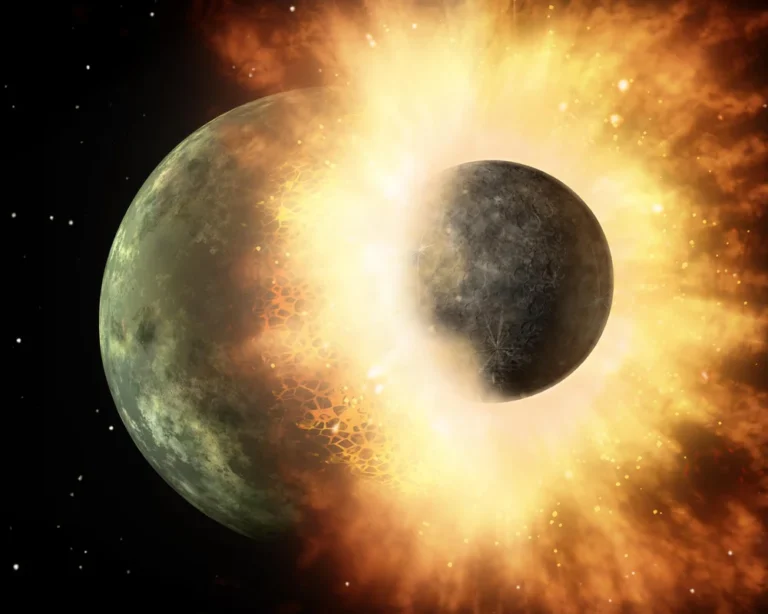
Artist's concept of a catastrophic collision between two rocky planetary bodies, like the giant impact that formed the Moon.

The Origin of the Moon: Earth’s Giant Impact Story

The Moon hangs in the night sky so familiarly that it’s easy to forget it’s bizarre. It’s unusually large for a moon, proportionally, it is the largest major moon in the solar system (only Pluto’s Charon, relative to Pluto, is larger, and Pluto is classified as a dwarf planet). Its composition closely mirrors Earth’s mantle but is depleted in volatile elements. It rotates at exactly the rate needed to keep one face permanently toward Earth, tidally locked. The origin of the Moon turns out to be stranger than that familiarity suggests. The Moon formed when a Mars-sized protoplanet called Theia struck the proto-Earth 4.5 billion years ago, ejecting mantle debris that Read more

how supernovas work — A glowing supernova remnant nebula, the aftermath of a massive stellar explosion in space.

How Supernovas Work: The Deaths and Afterlives of Stars

For a few weeks, a single star can outshine an entire galaxy of 200 billion stars. This is a supernova: the most energetic explosion in the observable universe, a stellar death so violent it briefly rivals the combined light output of 10 billion suns. Supernovas are not just spectacular. They are essential. Every atom of iron in your blood, every atom of calcium in your bones, every atom of oxygen you breathe was forged inside a star and scattered through the galaxy by one of these explosions. We are, in the most literal sense, made of stardust. Understanding how supernovas work, the core-collapse supernova mechanism and the other pathways, is Read more

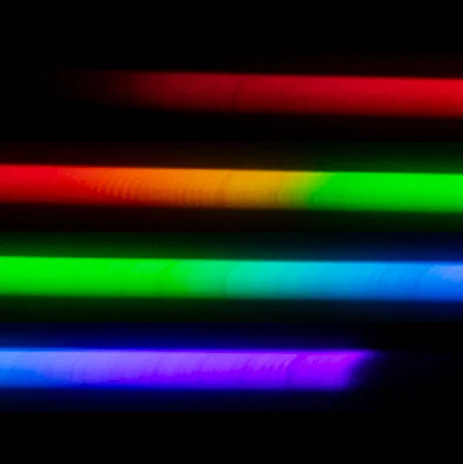
The solar spectrum with dark Fraunhofer absorption lines

How We Know What Stars Are Made Of: The Science of Stellar Spectroscopy

In 1835, the French philosopher Auguste Comte made a confident claim about the limits of human knowledge. Stars, he said, are forever beyond our reach. We can measure their distances and movements, but one thing we can never know: “the true nature of the fixed stars, their chemical composition or even their density is for us forever unknown.” Stellar spectroscopy would soon prove him wrong. Within 30 years, Comte was wrong. The development of spectroscopy: the analysis of light broken into its component wavelengths – opened the most productive window in the history of astronomy. Without launching a single spacecraft or touching a single atom of starlight, scientists can determine Read more

how stars are born — A glowing nebula — a stellar nursery where new stars are being born from collapsing clouds of gas and dust.

How Stars Are Born: From Nebula to Nuclear Fire

Every star you see in the night sky was once a cold, dark cloud of gas drifting through space. Over millions of years, gravity pulled that cloud together, compressed it, heated it, until the temperature and pressure at the center reached a critical threshold, and nuclear fusion ignited. This is how stars are born. Understanding how stars form connects the largest structures in the universe (giant molecular clouds hundreds of light-years across) to the smallest scales of physics (quantum tunneling between hydrogen nuclei in nuclear fusion). It’s one of the most important processes in cosmic history. How Stars Are Born: The Raw Material Stars form from molecular clouds: vast, cold Read more

how galaxies form — A stunning view of a spiral galaxy, showing the grand structure that emerges from billions of years of cosmic evolution.

How Galaxies Form: From the Big Bang to the Milky Way

Look up on a clear, dark night and the Milky Way arches overhead: 200–400 billion stars, bound together by gravity into a structure 100,000 light-years across, slowly rotating through the universe. Below it, through a telescope, lie billions more galaxies, each an island universe of stars. Understanding how galaxies form means tracing this structure back to the early universe. How did this come to be? How did the smooth, nearly uniform plasma of the early universe give rise to the extraordinary structures we observe today: spiral galaxies, elliptical giants, the vast cosmic web of filaments and voids? The answer is a cosmic game of gravity and gas, played over nearly Read more

dark matter candidates — Gravitational lensing around a galaxy cluster reveals the presence of invisible dark matter, which bends light from background galaxies.

Dark Matter Candidates: What Could Dark Matter Actually Be?

Something invisible holds galaxies together. Identifying the dark matter candidates behind it is one of physics’ biggest goals. We can’t see it, can’t touch it, and can’t detect it with any conventional instrument. But we know it’s there because its gravity shapes everything we can observe: the rotation curves of galaxies, the bending of light around galaxy clusters, the large-scale structure of the universe. Dark matter makes up approximately 27% of the universe’s total energy content: about five times the amount of ordinary matter. Every atom, every star, every planet, every person is built from what amounts to a minor impurity in a cosmos dominated by matter we cannot directly Read more

what is time physics — An hourglass measuring time against a cosmic background, representing the mystery of time in physics.

What Is Time? The Physics and Philosophy of Our Strangest Dimension

Key takeaway: Time is a dimension we experience through the relentless increase of entropy and the expansion of spacetime, yet its ultimate nature remains one of science’s deepest mysteries. Yet what is time at its core still eludes us. You are moving through it right now, at the same rate as everyone else on Earth, irresistibly, in only one direction. You remember yesterday but not tomorrow. You age. Things wear out. Causes precede effects. Time seems obvious. Then you try to define it. Augustine of Hippo, writing in the 4th century, captured the problem perfectly: “What then is time? If no one asks me, I know what it is. If Read more

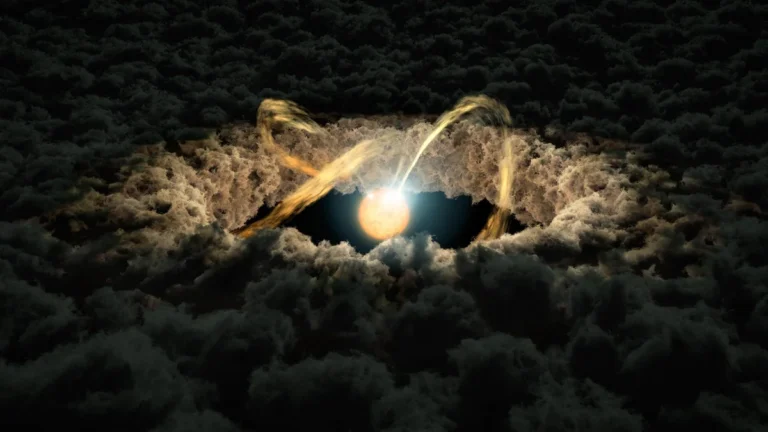
A protoplanetary disk of gas and dust around a young star

How Planets Form: From Dust to Worlds

Every rocky mountain, every ocean, every atom in your body was once a grain of dust floating in a cold disk around a young star. Over millions of years, gravity, chemistry, and the physics of collisions transformed those grains into pebbles, boulders, and eventually planets massive enough to hold atmospheres. This is how planets form: dust becoming worlds over millions of years. Planet formation is one of the most active areas in modern astrophysics. New observations from ALMA (the Atacama Large Millimeter/submillimeter Array) and JWST are revealing protoplanetary disks in stunning detail, and new planetary systems discovered by Kepler and TESS challenge our theoretical models. We’re in the middle of Read more