
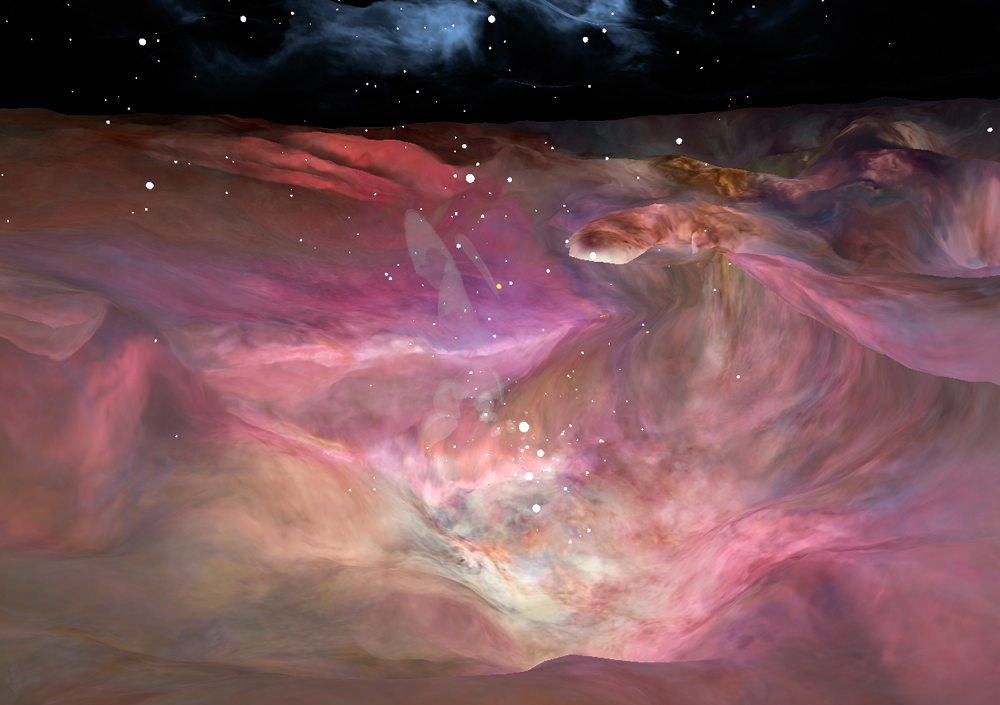
Every star you see in the night sky was once a cold, dark cloud of gas drifting through space. Over millions of years, gravity pulled that cloud together, compressed it, heated it, until the temperature and pressure at the center reached a critical threshold, and nuclear fusion ignited. This is how stars are born.
Understanding how stars form connects the largest structures in the universe (giant molecular clouds hundreds of light-years across) to the smallest scales of physics (quantum tunneling between hydrogen nuclei in nuclear fusion). It’s one of the most important processes in cosmic history.
How Stars Are Born: The Raw Material

Stars form from molecular clouds: vast, cold concentrations of gas and dust in the interstellar medium. Molecular clouds are among the largest distinct structures in galaxies: they can span hundreds of light-years and contain millions of solar masses of material.
The gas in molecular clouds is predominantly hydrogen, mostly molecular hydrogen (H₂), with helium (about 25% by mass) and a sprinkling of heavier elements (carbon, oxygen, nitrogen, silicon, iron) left over from previous generations of stars via stellar nucleosynthesis. Mixed with the gas is interstellar dust: tiny solid particles (silicates, carbonaceous compounds, ice-coated grains) that block visible light, making molecular clouds appear as dark patches against the background of stars.
Molecular clouds are extraordinarily cold by terrestrial standards: typically 10–30 Kelvin (minus 243 to minus 263 degrees Celsius). At these temperatures, atoms and molecules move slowly, and gas pressure is low. This is important: for star formation to occur, gravity must overcome the pressure support that would otherwise prevent collapse.
The Jeans Criterion: When Gravity Wins
A cloud of gas is stable against collapse if its thermal pressure (the outward push from particle motion) balances gravity (the inward pull from the cloud’s own mass). Sir James Jeans worked out the critical mass and size in 1902, the Jeans mass and Jeans length.
If a cloud region is more massive than the Jeans mass (for its temperature and density), gravity overwhelms pressure and collapse begins. Colder, denser cloud regions are more susceptible: which is why molecular clouds are the nurseries of star formation (they’re cold), not warm diffuse gas clouds.
In practice, molecular clouds are not uniform. Turbulence, magnetic fields, and the pressure waves from nearby supernovas or stellar winds create dense clumps and filaments within the cloud. When a dense enough clump exceeds the Jeans mass, it begins to collapse.
Triggering Star Formation
What tips a clump over the stability threshold? Several mechanisms have been identified.
Spontaneous collapse: In sufficiently dense, cold regions, star formation can initiate without an external trigger. The initial density fluctuation grows under self-gravity.
Supernova shockwaves: Nearby supernova explosions send shockwaves through the interstellar medium, compressing molecular cloud material and triggering collapse in regions that were marginally stable. The Sun’s formation may have been triggered by a supernova, isotopic anomalies in meteorites suggest an injection of freshly synthesized supernova material just before the solar system formed.
Galaxy spiral arms: As molecular clouds pass through the density wave of a spiral arm, they are compressed, often triggering star formation bursts. The bright blue stars that trace spiral arms are the short-lived massive stars born in these triggered bursts.
Cloud-cloud collisions: When molecular clouds collide, the compressed interface can trigger star formation at rates much higher than in isolated clouds.

Free-Fall Collapse
Once a region exceeds the Jeans threshold, it begins to collapse. The collapse is initially isothermal: the cloud is transparent and can radiate away the heat of compression efficiently, staying cool. During this phase, the cloud collapses freely, roughly in free-fall time – the timescale for unimpeded gravitational collapse.
As the central density rises, the cloud becomes opaque to its own radiation. Heat can no longer escape freely; the core heats up rapidly. The collapse slows as pressure builds, and a quasi-static structure called a protostar forms at the center.
Fragmentation into Clusters
During collapse, a key process occurs: fragmentation. As the cloud contracts, it becomes denser, which lowers the Jeans mass, causing the cloud to break into smaller and smaller collapsing sub-clumps. This hierarchical fragmentation naturally produces clusters of hundreds or thousands of protostars: and because most stars are born in multiple systems, fragmentation often yields binary or triple-star systems. It is rare for stars to form in complete isolation.
The Protostellar Phase: Accretion and Jets
A protostar is not yet a star: it has no nuclear fusion yet. It is a hot, contracting ball of gas sustained by gravitational contraction: the release of gravitational potential energy as material compresses, heating the interior.
The protostar is surrounded by an accretion disk, a rotating disk of gas and dust feeding material onto the central object. The disk forms because the infalling gas has angular momentum; it can’t fall directly to the center without first spreading into a disk that slowly drains inward.
Protostars are associated with spectacular bipolar jets: narrow streams of gas ejected perpendicular to the disk at velocities of hundreds of kilometers per second. The jets carry away angular momentum, allowing accretion to continue. They plow into the surrounding cloud, creating shock fronts that glow in radio and infrared.
The protostellar phase lasts roughly 100,000 years for a solar-mass star, during which it accretes most of its final mass from the surrounding envelope and disk.
T Tauri Stars: Almost There
As the protostar clears its surrounding envelope (by accreting it and driving it away with winds), it becomes visible as a T Tauri star (for solar-mass stars) or a Herbig Ae/Be star (for more massive ones).
T Tauri stars are young stellar objects that have not yet begun hydrogen fusion in their cores, they are still contracting and heating. They are luminous (from gravitational contraction), variable (their brightness fluctuates on timescales of days to weeks), highly magnetically active (producing X-ray flares and powerful stellar winds), and surrounded by protoplanetary disks, the material that will eventually form planets.
The classical T Tauri phase (accreting from a disk) lasts roughly 1–2 million years for a solar-mass star, after which the star enters a weak-lined T Tauri phase with the disk dissipated. The total pre-main-sequence contraction to the main sequence takes approximately 10 million years. During this time, the disk loses mass through accretion onto the star, photo-evaporation by the star’s UV and X-ray emission, and incorporation into planetesimals and planets.
Ignition: The Main Sequence
As the protostar contracts, its core temperature rises steadily. The key threshold is approximately 10 million Kelvin, the temperature at which the proton-proton chain can begin converting hydrogen into helium through nuclear fusion.
At this temperature, quantum tunneling allows hydrogen nuclei to overcome their electrostatic repulsion and fuse. The energy released by fusion provides an outward pressure that exactly balances gravity, the star achieves hydrostatic equilibrium.
The star has arrived on the main sequence: the long, stable phase of hydrogen burning that occupies most of a star’s life. For the Sun, this phase lasts about 10 billion years. Massive O and B stars burn through their hydrogen in millions of years; small red dwarf stars (M dwarfs) will burn hydrogen for trillions of years – far longer than the current age of the universe.
The Role of Stellar Mass
The mass a protostar accretes determines essentially everything about the star it becomes. The distribution of stellar masses at birth, the initial mass function (IMF), is heavily skewed toward low masses: red dwarfs (M dwarfs) are by far the most common stars in the galaxy, forming in vastly greater numbers than their massive counterparts.

High-mass stars (>8 solar masses): Extremely luminous (L ~ M³⁻⁴), burning hot and blue. They ionize the surrounding gas into an H II region (a cloud of ionized hydrogen glowing in Hα red light, like the Orion Nebula). Their strong radiation and winds, along with eventual supernova feedback, drive out the remaining molecular cloud material, effectively shutting off further star formation in the vicinity. They live for only millions of years, ending as supernovas.
Solar-mass stars (0.5–2 M☉): The Sun’s class. Yellow or white. Moderate temperature and luminosity. Live billions of years on the main sequence.
Low-mass stars (0.1–0.5 M☉): Red dwarfs, the most common type of star in the galaxy. Cool, dim, but extraordinarily long-lived, burning hydrogen so slowly they will survive for tens to hundreds of billions of years.
Brown dwarfs (13–80 Jupiter masses): Not quite massive enough to sustain hydrogen fusion. They glow from gravitational contraction and deuterium burning, then cool slowly over billions of years into dark, Jupiter-like objects.
How We Study Star Birth
Much of what we know about star formation comes from observations at wavelengths that can pierce dusty molecular clouds. Radio and submillimeter telescopes like the Atacama Large Millimeter/submillimeter Array (ALMA) map the cold gas and dust in collapsing cores. Infrared telescopes like Spitzer and JWST reveal protostars hidden inside their dusty cocoons. These tools let astronomers catch star formation in the act, confirming the theoretical picture at every stage.
The Stellar Nurseries We Can See
Star formation is happening right now, nearby.
The Orion Nebula (M42) is a stellar nursery 1,344 light-years away, containing the Trapezium cluster: four bright young O and B stars whose UV radiation ionizes the surrounding gas, creating the glowing cloud we see. Hidden within the nebula are hundreds of protostars in various stages of formation.
The Eagle Nebula (M16) hosts the famous “Pillars of Creation”: towering columns of gas and dust eroding slowly under UV radiation from nearby hot stars, with dense knots at their tips sheltering protostars forming within.
JWST has imaged stellar nurseries in unprecedented detail, revealing hundreds of newly-formed protostars, protoplanetary disks, and jets embedded in molecular clouds, showing the star formation process in action with a clarity impossible from ground-based telescopes.
Every star in the night sky began its journey in a cold, dark cloud like these. Each one crossed the threshold from chemistry to nuclear physics. Each one became, for millions or billions of years, a furnace that would eventually scatter its elements back into space for the next generation.
The cycle of stars and molecular clouds is the engine that enriches the galaxy, one generation at a time.
Key Takeaways
- Star formation begins when a cold molecular cloud fragment exceeds the Jeans mass and collapses under gravity.
- The collapse is initially free-fall and isothermal, but the core heats up as it becomes opaque, forming a protostar.
- Most stars are born in clusters of hundreds to thousands, often in binary or multiple systems.
- Low-mass red dwarfs are vastly more common than massive stars, a pattern known as the initial mass function.
- Feedback from massive stars, UV radiation, stellar winds, and supernovas, eventually shuts off star formation in the cloud.
Sources
- McKee, C.F. & Ostriker, E.C. (2007). Theory of star formation. Annual Review of Astronomy and Astrophysics, 45, 565–687.
- André, P. et al. (2014). From filamentary networks to dense cores to protostars. Protostars and Planets VI, University of Arizona Press.
- NASA Hubble Space Telescope. (2022). Pillars of Creation. NASA.
- NASA James Webb Space Telescope. (2022). Cosmic Cliffs in the Carina Nebula. NASA/STScI.
- Offner, S. S. R., et al. (2014). The Origin and Universality of the Stellar Initial Mass Function. Protostars and Planets VI, University of Arizona Press.
What is a molecular cloud?
A molecular cloud is a vast, cold region of gas and dust in space, composed mostly of molecular hydrogen and helium, where stars are born.
How does gravity cause a star to form?
Gravity pulls the gas and dust in a molecular cloud together over millions of years, compressing and heating it until the core reaches the temperature and pressure needed for nuclear fusion.
What triggers nuclear fusion in a star?
Nuclear fusion ignites when the core temperature and pressure become high enough for hydrogen nuclei to overcome their repulsion and fuse into helium, releasing enormous energy.
What is a protostar?
A protostar is the earliest stage of stellar formation, where a dense core of gas and dust has collapsed under gravity but has not yet begun nuclear fusion.
What role does interstellar dust play in star formation?
Interstellar dust helps cool the molecular cloud and provides surfaces for molecules to form, aiding in the collapse and fragmentation that leads to star birth.