
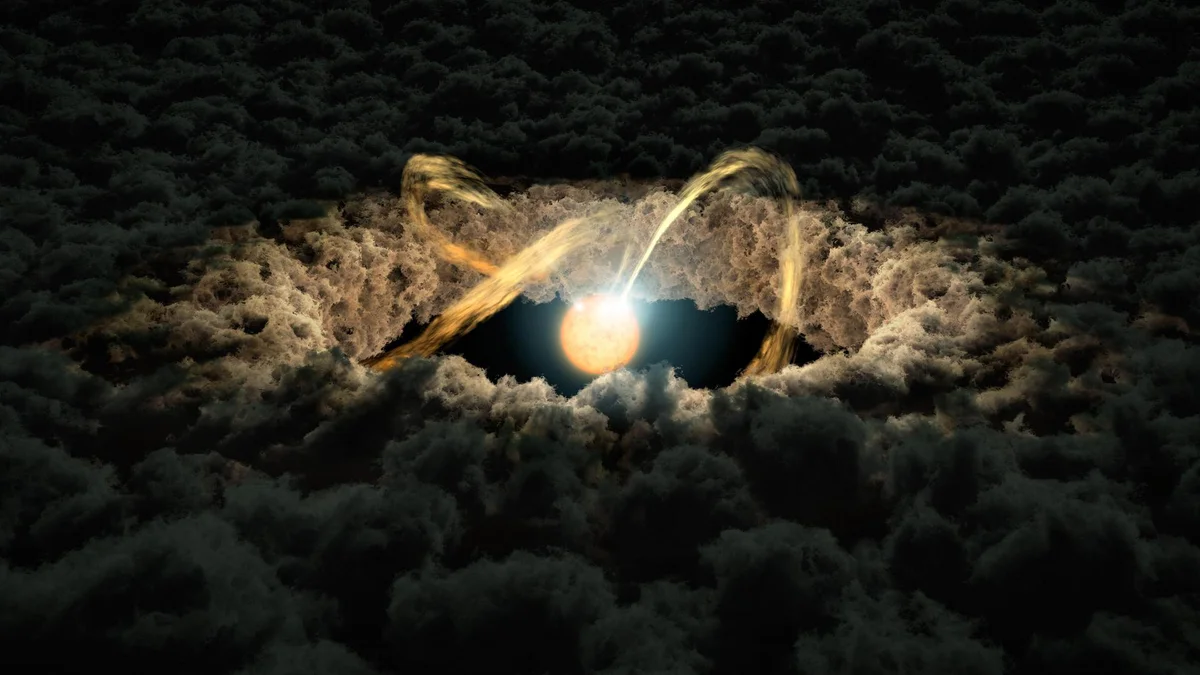
Every rocky mountain, every ocean, every atom in your body was once a grain of dust floating in a cold disk around a young star. Over millions of years, gravity, chemistry, and the physics of collisions transformed those grains into pebbles, boulders, and eventually planets massive enough to hold atmospheres. This is how planets form: dust becoming worlds over millions of years.
Planet formation is one of the most active areas in modern astrophysics. New observations from ALMA (the Atacama Large Millimeter/submillimeter Array) and JWST are revealing protoplanetary disks in stunning detail, and new planetary systems discovered by Kepler and TESS challenge our theoretical models. We’re in the middle of a revolution in understanding how planets, including our own, came to be.
The stages of planet formation at a glance:
- Stage 1: Microscopic dust → pebbles (microns to centimeters)
- Stage 2: Pebbles → planetesimals, then planetary embryos (kilometers to Moon-sized)
- Stage 3: Giant impacts → terrestrial planets (Moon-sized to Earth-sized)
- Stage 4: Core accretion → gas giants (Earth-sized cores → Jupiter analogs)
Timeline of planet formation:
| Time (millions of years) | Key events |
|---|---|
| 0–1 Myr | Dust grows to pebbles; streaming instability forms planetesimals |
| 1–10 Myr | Runaway growth produces planetary embryos; giant planet cores form |
| 10–100 Myr | Giant impacts build terrestrial planets; gas disk disperses |
How Planets Form: Starting With Protoplanetary Disks

Planets form in protoplanetary disks: flattened, rotating structures of gas and dust that form around stars during their birth. When a molecular cloud collapses to form a star, angular momentum conservation prevents all the material from falling directly onto the forming star. Instead, most of it forms an orbiting disk.
A typical protoplanetary disk:
- Extends from a few astronomical units (AU) to hundreds of AU from the star
- Contains 0.1–10% of the stellar mass in gas and dust
- Is mostly gas (hydrogen and helium), with roughly 1% solid material (dust)
- Has a temperature gradient from hot (~1,500 K near the star) to cold (~10 K at the outer edge)
- Survives for roughly 3–10 million years before being dispersed
These disks have been imaged in extraordinary detail. ALMA’s 2014-2015 image of the disk around the young star HL Tau revealed concentric rings and gaps at only 1 million years old: suggesting planets had already begun forming. This kind of observation is one way scientists test their models; as the Cosmic Microwave Background provides a snapshot of the early universe, ALMA provides snapshots of young planetary systems.
Stage 1: The Meter-Size Barrier and Pebble Streaming Instability
The first step of planet formation involves microscopic dust grains, typically submicron silicate and carbon particles, sticking together through electrostatic forces and Van der Waals interactions. In the turbulent disk environment, dust grains collide frequently. Slow, gentle collisions allow grains to stick (coagulate). Over thousands of years, dust grows from submicron grains to millimeter-sized aggregates, the “pebbles” revealed by ALMA’s millimeter-wavelength radio observations.
The dust growth problem: At centimeter to meter sizes, collisions become more destructive rather than constructive. Simulations and experiments show that centimeter-sized pebbles often fragment or bounce when they collide, rather than sticking. This “meter-size barrier” has been a long-standing challenge in planet formation theory.
Several mechanisms have been proposed to overcome it:

Pebble streaming instability: When pebbles concentrate in regions of reduced gas pressure, their collective gravity overcomes the aerodynamic forces that would otherwise scatter them. Dense clumps of pebbles can collapse gravitationally to form planetesimals: kilometer-sized solid bodies, directly, skipping the problematic intermediate stages. This mechanism, proposed by Anders Johansen and colleagues in 2007, is now widely favored. It’s similar in concept to how genetic drift can amplify random variations, except here, the “drift” is driven by gas dynamics rather than heredity.
Ice as glue: Beyond the snow line (the distance from the star where water ice can condense: roughly 2.7 AU in the early Solar System, though this value varied as the young Sun brightened), icy coatings on dust grains make them stickier. Gas giants in our solar system are all beyond the original snow line, possibly because more efficient grain growth in this region led to faster core formation.
Stage 2: Runaway Growth; Planetesimals to Planetary Embryos
Once km-sized planetesimals exist, gravity takes over from surface forces. Planetesimals attract each other gravitationally, and larger ones grow faster, a process called runaway growth. A planetesimal’s gravitational cross-section is larger than its physical cross-section because it can gravitationally attract particles from a wider area. Larger planetesimals attract more, growing faster, and becoming even larger. This runaway growth quickly produces a population of planetary embryos, Moon- to Mars-sized bodies that have consumed most of the solid material in their orbital zone.
This stage is relatively rapid: runaway growth can produce Mars-sized embryos in the inner solar system within 100,000 to 1 million years.
How we know this: Astronomers don’t directly observe planetesimals forming: they’re too small and distant. Instead, ALMA observes gaps and rings in protoplanetary disks that mark where growing planets sweep up material. JWST detects hot gas around young stars, revealing the chemical signature of planet formation. And surveys from Kepler and TESS, which have now confirmed more than 5,000 exoplanets, provide a statistical sample that tests whether theoretical models predict the right numbers and sizes of planets. As How Scientists Detect Exoplanets explains, each detection method reveals different parts of the formation story.
Stage 3: Giant Impacts; How Earth Got Its Moon
The final stage of rocky planet formation is the most violent: giant impacts between Moon-sized and Mars-sized embryos. This phase is chaotic and stochastic, the exact outcome depends on the details of individual collisions and is partly random.
Giant impacts can:
- Merge embryos, building planets to larger masses
- Strip away mantles, enriching the collisional fragments in iron (forming iron-rich bodies like Mercury)
- Produce moons by ejecting material into orbit (the leading theory for Earth’s Moon: a Mars-sized impactor called Theia struck early Earth, ejecting the material that coalesced into the Moon)
- Shape the final spin axes, orbital inclinations, and water budgets of terrestrial planets
This chaotic phase lasted roughly 100 million years in the inner Solar System. Earth reached its final mass approximately 50-100 million years after solar system formation. The stochastic nature of giant impacts explains the diversity of terrestrial planets. Venus and Earth are similar in size and distance from the Sun, yet Venus has no moon, rotates retrograde (backward), and has a thick CO₂ atmosphere. Mars has two tiny moons (Phobos and Deimos, likely captured asteroids), a thin atmosphere, and a tilted axis. Mercury is unusually iron-rich. All these differences can be traced to the accidents of individual giant impacts.
Giant Planet Formation: The Race Against Time
Imagine trying to build a house while a demolition crew is scheduled to arrive in just 10 million years. That’s the challenge for gas giants, they must form before the gas disk vanishes. Giant planets, Jupiter, Saturn, and their analogs, form differently from terrestrial worlds. Their formation must be faster: the gas disk that provides the hydrogen-helium envelope exists for only 3-10 million years. Gas giants must form before the disk dissipates.
The dominant model is core accretion vs disk instability:
- Solid material in the outer disk (beyond the snow line, where icy material makes cores easier to build) forms a solid core of ~10 Earth masses.
- The core’s gravity is large enough to begin accreting gas from the surrounding disk.
- Initially, the gas accretes slowly as the envelope adjusts to the added energy.
- When the core reaches a critical mass (~10–20 Earth masses), the accretion rate accelerates dramatically: runaway gas accretion, and the planet rapidly gains a thick hydrogen-helium envelope.

Jupiter is thought to have formed this way. Its core (if it has a distinct core, internal structure models are debated) formed within the first few million years, and runaway gas accretion followed before the disk dissipated. The processes building Jupiter’s core share physical principles with how neutron stars accumulate matter, though on vastly different scales and in different environments.
The alternative model, disk instability, proposes that sufficiently massive, cold regions of the outer disk can collapse gravitationally to directly form gas giants, without first building a solid core. This mechanism may operate in extreme cases but is thought to be less common.
Hot Jupiters: Jupiter-mass planets orbiting within 0.1 AU of their stars, far inside the snow line – can’t have formed where they’re found. They must have formed in the outer system, then migrated inward through interaction with the gas disk (Type II migration). This gas-disk migration is now understood as a common feature of planetary systems, explaining why planetary architectures often differ dramatically from our own solar system.
The Role of Jupiter: Guardian or Disruptor?
Jupiter’s gravitational influence has profoundly shaped the inner Solar System. The traditional view, “Jupiter as shield”, holds that Jupiter deflects or captures many objects that might otherwise collide with Earth, reducing the impact rate on the inner planets. Modern simulations complicate this picture. Jupiter’s early migration (the Grand Tack hypothesis proposes Jupiter migrated inward to ~1.5 AU then back out) may have scattered material throughout the inner solar system, possibly delivering water and organic material to Earth.
Where did Earth’s oceans come from? Scientists compare the deuterium-to-hydrogen (D/H) ratio in Earth’s water to that in comets and asteroids. Most comets have D/H ratios significantly higher than Earth’s ocean water, while carbonaceous chondrite asteroids match much more closely. This suggests that asteroids, not comets, delivered most of Earth’s water during the late heavy bombardment, though a cometary contribution may have been minor. Jupiter’s early dynamics likely played a key role in scattering these water-rich bodies inward.
Jupiter’s early dynamics may also have stunted Mars, which is much smaller than expected from standard models, and sculpted the asteroid belt between Mars and Jupiter. The giant planet’s ring system, meanwhile, may be a transient byproduct of moon disruption, a reminder that planetary systems are dynamic across all time scales.
Planetary Systems Are Diverse
The ~5,000 confirmed exoplanets show that our solar system’s architecture is not the standard. Many planetary systems have:
- Hot Jupiters, gas giants in very tight orbits (no analog in the Solar System)
- Super-Earths, planets 1–10 Earth masses, highly common, absent in our system
- Multi-planet systems in compact configurations, multiple planets closer to their star than Mercury is to the Sun
- Retrograde planets; orbiting against their star’s rotation, suggesting violent migration
This diversity confirms that giant impacts, disk instabilities, and orbital migrations all play important roles, and that the details of any individual system depend sensitively on early conditions.
The fact that Earth formed in the habitable zone, avoided inward migration, acquired water through impacts, and avoided being ejected by Jupiter’s early dynamics may be somewhat exceptional, or it may be more common than it seems. Will we find a twin Earth? Follow the latest discoveries from TESS and the upcoming Nancy Grace Roman Space Telescope to find out.
Sources
- Johansen, A. et al. (2007). Rapid planetesimal formation in turbulent circumstellar disks. Nature, 448, 1022–1025.
- ALMA Partnership. (2015). ALMA Partnership: The 2014 ALMA Long Baseline Campaign. Astrophysical Journal Letters, 808, L3.
- Raymond, S.N. & Morbidelli, A. (2014). The Grand Tack Model: a critical review. Proceedings of the International Astronomical Union, 9(S310), 194–203.
- NASA Exoplanet Archive. (2024). Confirmed Planets. NASA/Caltech.
- National Aeronautics and Space Administration. How Do Planets Form? NASA Exoplanet Exploration.
How do planets form from dust?
Planets form from microscopic dust grains in a protoplanetary disk around a young star, where gravity, collisions, and chemistry gradually build them into pebbles, boulders, and eventually planet-sized bodies over millions of years.
What are the stages of planet formation?
The stages are: dust to pebbles, pebbles to planetesimals and planetary embryos, giant impacts forming terrestrial planets, and core accretion forming gas giants.
How long does it take for a planet to form?
Planet formation takes about 10 to 100 million years, with dust growing to pebbles in the first million years, planetary embryos forming by 10 million years, and giant impacts building terrestrial planets by 100 million years.
What is a protoplanetary disk?
A protoplanetary disk is a rotating disk of dense gas and dust surrounding a young star, where planets are born through accretion and collision processes.
How do gas giants like Jupiter form?
Gas giants form via core accretion, where a solid core of rock and ice grows to about 10 Earth masses, then rapidly pulls in gas from the surrounding disk to form a thick atmosphere.
Further reading: Nebular hypothesis on Wikipedia