
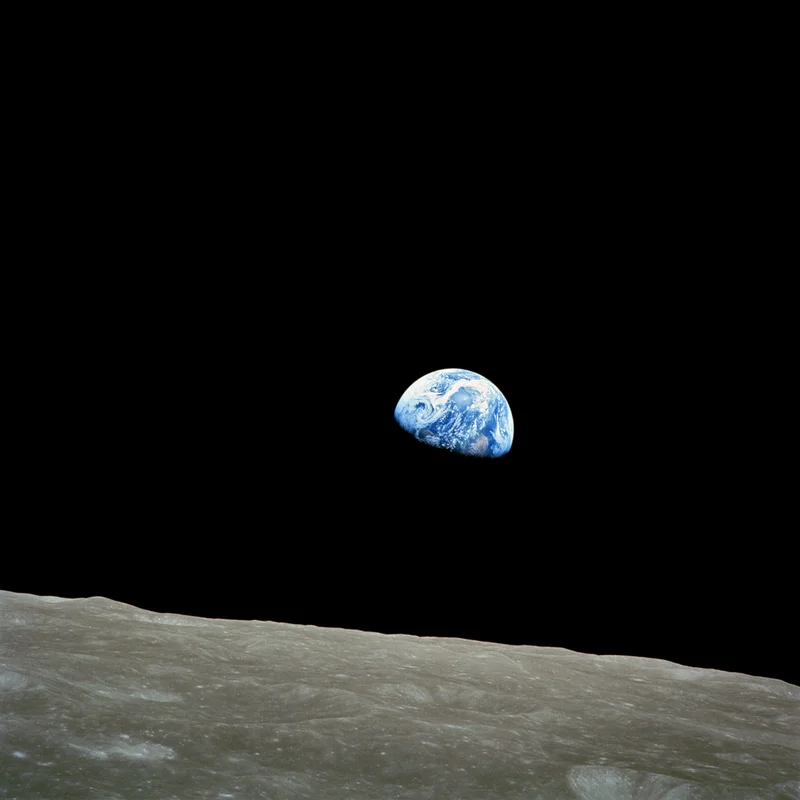
The Moon hangs in the night sky so familiarly that it’s easy to forget it’s bizarre. It’s unusually large for a moon, proportionally, it is the largest major moon in the solar system (only Pluto’s Charon, relative to Pluto, is larger, and Pluto is classified as a dwarf planet). Its composition closely mirrors Earth’s mantle but is depleted in volatile elements. It rotates at exactly the rate needed to keep one face permanently toward Earth, tidally locked. The origin of the Moon turns out to be stranger than that familiarity suggests.
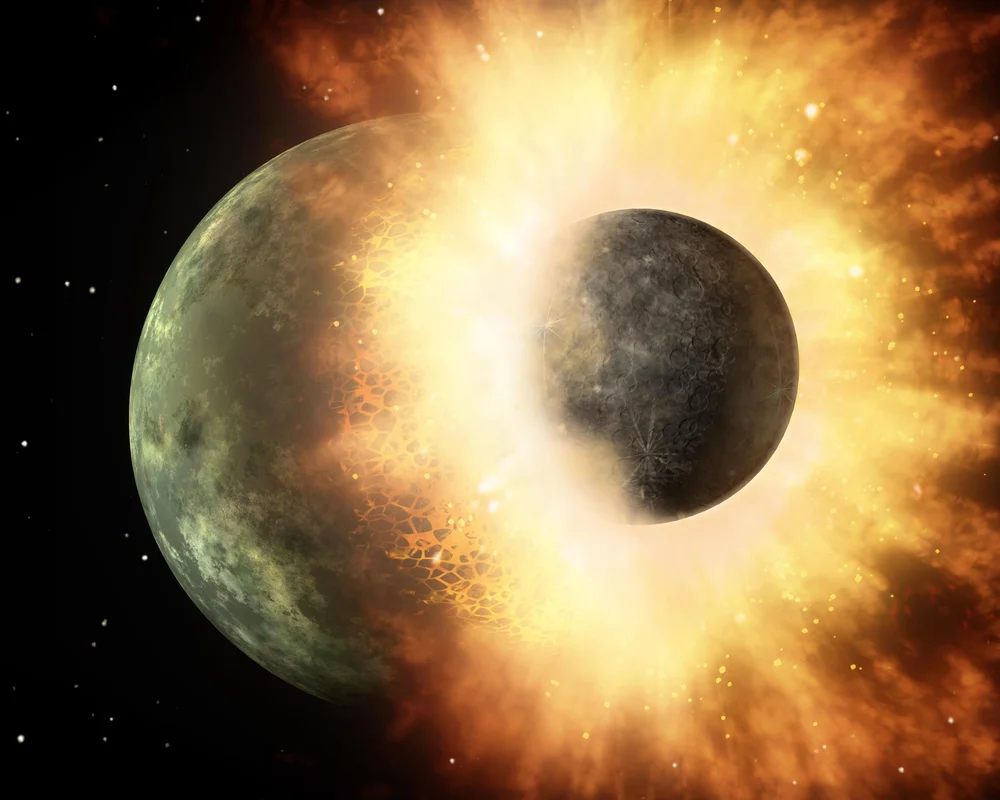
The Moon formed when a Mars-sized protoplanet called Theia struck the proto-Earth 4.5 billion years ago, ejecting mantle debris that coalesced into our lunar companion.
This answer emerges from one of the most violent events in Earth’s history: a catastrophic collision with a planet the size of Mars, approximately 4.5 billion years ago.
The Origin of the Moon: Why Early Theories Failed
Before the giant impact hypothesis was proposed, three alternative theories competed:
Co-formation (sister hypothesis): The Moon formed from the same solar nebula material as Earth, at roughly the same time and location. Problem: if this were true, the Moon should have a very similar bulk composition to Earth, including similar iron content. But the Moon has a very small iron core (Earth’s core is about 32% of its mass; the Moon’s is only about 2-3%). The Moon is also severely depleted in volatile elements (water, sulfur, lead) relative to Earth, which co-formation can’t explain.
Fission hypothesis: The Moon split off from a rapidly spinning early Earth. George Darwin (son of Charles) proposed in 1879 that centrifugal force flung off part of the molten Earth. Problem: for this to work, Earth would have needed to be spinning impossibly fast: a complete rotation in about 2 hours. There is no mechanism to spin up Earth that fast, and no explanation for what slowed it back down afterward.
Capture hypothesis: The Moon formed elsewhere in the solar system and was gravitationally captured by Earth. Problem: gravitational capture of an object in a close encounter is extremely improbable: the geometry almost always results in escape or collision, not stable orbit. And a captured Moon would likely be in a retrograde or highly inclined orbit, not the nearly circular, prograde orbit we observe.
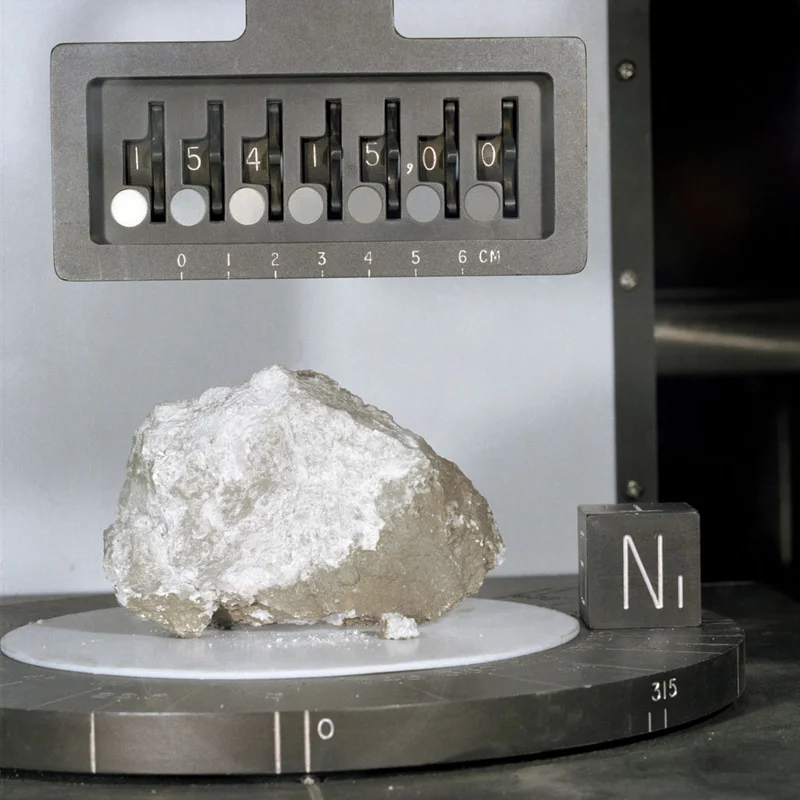
None of these theories survived close scrutiny of the Apollo samples returned from 1969–1972. The samples transformed lunar science and pointed toward a fourth option.
The Giant Impact Hypothesis
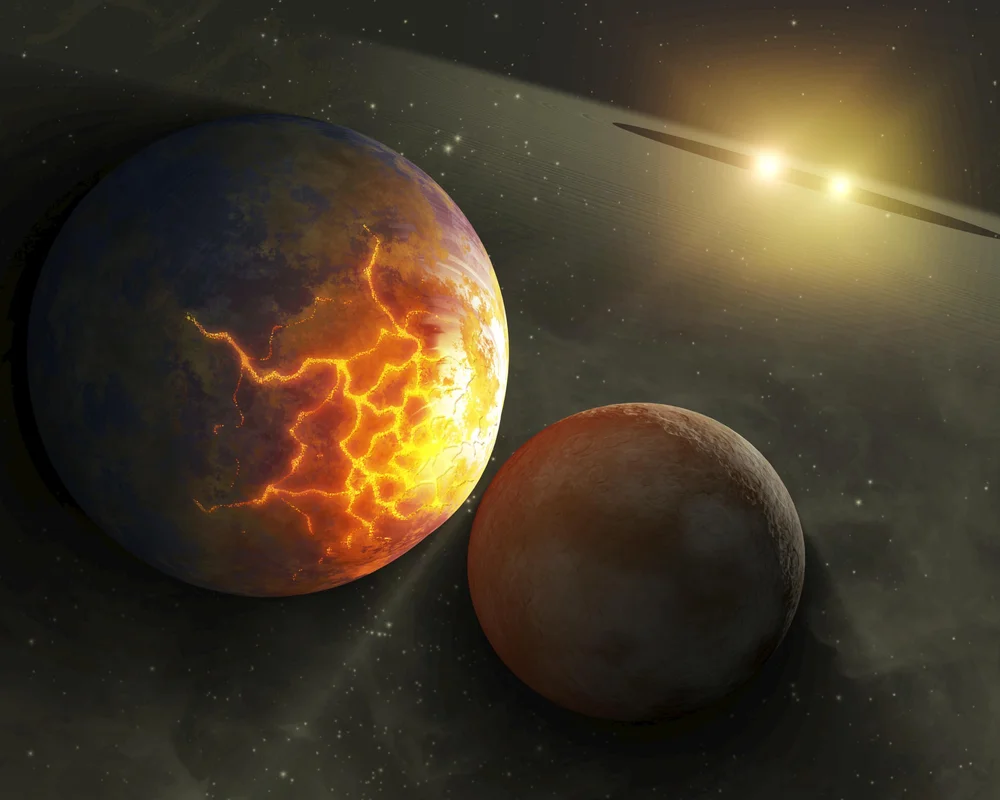
In 1975 and 1976, independent papers by William Hartmann and Donald Davis, and by Alastair Cameron and William Ward, proposed the giant impact hypothesis: a Mars-sized protoplanet, named Theia in later discussions, struck the proto-Earth at an oblique angle approximately 4.5 billion years ago, shortly after the solar system formed.
The collision was not head-on but a glancing blow. The resulting destruction vaporized and ejected enormous quantities of material from both objects, primarily from Earth’s mantle (already molten in this era of giant impacts) rather than its iron core. This ejected material, a mix of Earth mantle and Theia fragments, formed an orbiting debris disk around the remaining proto-Earth. Within perhaps 1,000 years, cosmically instantaneous, this debris coalesced into the Moon.
Why the Giant Impact Hypothesis Fits the Evidence
The giant impact hypothesis is compelling because it explains several otherwise mysterious lunar properties:
The Moon’s small iron core: Both Theia and the proto-Earth had already differentiated within the first 10–50 million years of solar system formation, iron had sunk to their cores. The oblique impact preferentially ejected mantle material from both, leaving the iron cores largely intact (Theia’s merged with Earth’s core, Earth’s core survived the impact). The Moon formed predominantly from mantle ejecta, explaining its low iron content.
The Moon’s composition similarity to Earth’s mantle: Apollo samples showed that the Moon’s oxygen isotope ratio (Δ¹⁷O) matches Earth’s mantle nearly identical within analytical uncertainty, far more similar than to meteorites from other solar system bodies. This is consistent with the Moon forming largely from Earth’s mantle material.
The Moon’s depletion in volatiles: The giant impact generated an enormous amount of heat, temperatures of thousands of Kelvin. This heat vaporized volatile elements (water, sulfur, etc.) from the ejecta, which then escaped to space rather than condensing into the Moon. The Moon should be, and is, depleted in volatiles relative to Earth.
The Earth-Moon angular momentum: The current Earth-Moon system has a specific angular momentum that is consistent with a giant oblique impact of a Mars-sized body at a specific angle and speed. No other proposed mechanism naturally produces this angular momentum.
The Moon’s near-circular, prograde orbit: Material ejected into orbit and then coalescing into a moon naturally ends up in a prograde, low-inclination orbit, consistent with observation. A single large impact best explains the precise angular momentum constraints.
Complications: The Isotope Problem
For decades, the giant impact hypothesis faced one nagging inconsistency: the isotope problem.
If Theia was a separate planet with a different formation location, its oxygen, silicon, and other isotope ratios should differ from Earth’s. The Moon, formed partly from Theia’s mantle, should show intermediate or mixed isotope ratios. But the Moon’s isotope ratios for oxygen, silicon, tungsten, and other elements are essentially identical to Earth’s, within measurement precision.
This is hard to reconcile with a canonical giant impact where Theia had different isotopic composition. Several solutions have been proposed:
Theia formed at the same distance from the Sun as Earth (L4 or L5 Trojan position), giving it the same isotopic composition as Earth. This is not impossible but requires specific orbital conditions.
The giant impact was much more energetic than the canonical model, essentially vaporizing and thoroughly mixing both objects so that the Moon ended up with Earth-like composition regardless of Theia’s original composition. Matija Cuk and Sarah Stewart proposed a “high-spin” giant impact in 2012 that does this but requires a subsequent resonance to bleed off the excess angular momentum.
Multiple smaller impacts rather than one large one also remain possible, though they struggle to match the angular momentum of the Earth-Moon system as well as a single oblique impact can. More recently, the “synestia” model (Lock, Stewart, et al., 2017) proposed that the impact created a massive, donut-shaped cloud of vaporized rock (a synestia) that extends beyond the classical Roche limit, which allowed thorough mixing of Earth and Theia material before the Moon formed.
No single version of the giant impact hypothesis satisfies all constraints simultaneously, but all competing models have larger problems. The giant impact hypothesis remains the consensus theory. This is a good example of what it means when scientists say a theory is well-supported: as explored in detail in What Makes a Theory Scientific?, a hypothesis must withstand ongoing testing and revision to remain credible.
What the Moon Did for Earth
The Moon’s formation was not just an interesting event, it had profound consequences for Earth’s habitability.
The Moon stabilizes Earth’s axial tilt: Earth’s axis is tilted 23.4° relative to its orbital plane, giving us seasons. Without the Moon, gravitational perturbations from Jupiter and other planets would cause Earth’s axial tilt to vary chaotically over millions of years: from near 0° to near 85°. Such extreme tilt variations would cause dramatic climate swings potentially inimical to complex life. The Moon acts as a stabilizing gyroscope, damping these oscillations.
Tides drove intertidal ecosystems: Tidal mixing of the oceans (driven by the Moon’s gravity) may have played a role in the origin of life, concentrating chemicals in intertidal zones and driving daily wet-dry cycles important for prebiotic chemistry. The early Moon was much closer to Earth and drove much larger tides. For a broader look at how the Moon fits into the search for life, see Beyond the Habitable Zone: Ocean Worlds and the New Search for Life.
The Moon slowed Earth’s rotation: Tidal friction from the Moon, which transfers angular momentum from Earth’s rotation to the Moon’s orbit, has been gradually slowing Earth’s rotation since formation. Early in the solar system, Earth rotated much faster, a day was perhaps 6 hours. This same tidal friction is why the Moon is receding from Earth at about 3.8 cm per year. The Moon has braked this rotation to 24 hours. Faster rotation would drive stronger Coriolis-influenced weather systems.
Lunar Exploration and the Far Future
Fifty years after Apollo, human exploration of the Moon is resuming with the Artemis program. The scientific goals are significant: sampling the lunar south pole (where ice is confirmed in permanently shadowed craters), placing seismometers to detect “moonquakes” that probe interior structure, and returning samples from the lunar far side (never sampled). New samples from the Moon’s south pole may finally settle the isotope debate by providing pristine material from regions not yet analyzed.
The Moon is also gradually moving away from Earth: receding at about 3.8 cm per year, a rate precisely measured by Lunar Laser Ranging experiments using retroreflectors placed on the Moon by Apollo astronauts. In about 50 billion years (assuming the Earth–Moon system were isolated from the Sun’s eventual expansion), the Moon will reach a maximum distance and begin slowly returning.
The Moon is not just Earth’s companion. It is, in a real sense, part of Earth: formed from our planet’s substance, shaped by our gravity, shaping our climate and tides in return. Understanding where it came from is understanding a piece of what made Earth habitable.
Sources
- Hartmann, W.K. & Davis, D.R. (1975). Satellite-sized planetesimals and lunar origin. Icarus, 24(4), 504–515.
- Cameron, A.G.W. & Ward, W.R. (1976). The origin of the Moon. Lunar and Planetary Science Conference, 7, 120–122.
- Canup, R.M. (2012). Forming a Moon with an Earth-like Composition via a Giant Impact. Science, 338(6110), 1052–1055.
- Cuk, M. & Stewart, S.T. (2012). Making the Moon from a Fast-Spinning Earth. Science, 338(6110), 1047–1052.
- Lock, S.J., Stewart, S.T., et al. (2017). The Structure of Terrestrial Bodies: Impact Heating, Corotation, and the Synestia. Journal of Geophysical Research: Planets, 122(8), 950–982.
- NASA Lunar Reconnaissance Orbiter. NASA Goddard Space Flight Center.
- Lunar Laser Ranging Experiment. Wikipedia.
What is the giant impact hypothesis for the Moon’s formation?
The giant impact hypothesis proposes that the Moon formed 4.5 billion years ago when a Mars-sized protoplanet called Theia struck the proto-Earth, ejecting mantle debris that coalesced into the Moon.
Why is the Moon’s composition similar to Earth’s mantle?
The Moon’s composition mirrors Earth’s mantle because it formed from debris ejected from Earth’s mantle after the giant impact, which explains why it is depleted in volatile elements and has a small iron core.
What is the Moon’s largest moon status in the solar system?
The Moon is proportionally the largest major moon in the solar system, with only Pluto’s Charon being larger relative to its planet, but Pluto is classified as a dwarf planet.
Why does the Moon always show the same face to Earth?
The Moon rotates at exactly the rate needed to keep one face permanently toward Earth due to tidal locking, a result of gravitational interactions over billions of years.
What were the alternative theories to the giant impact hypothesis?
Alternative theories included co-formation, where the Moon formed from the same material as Earth, but this failed because the Moon has a much smaller iron core than Earth.