
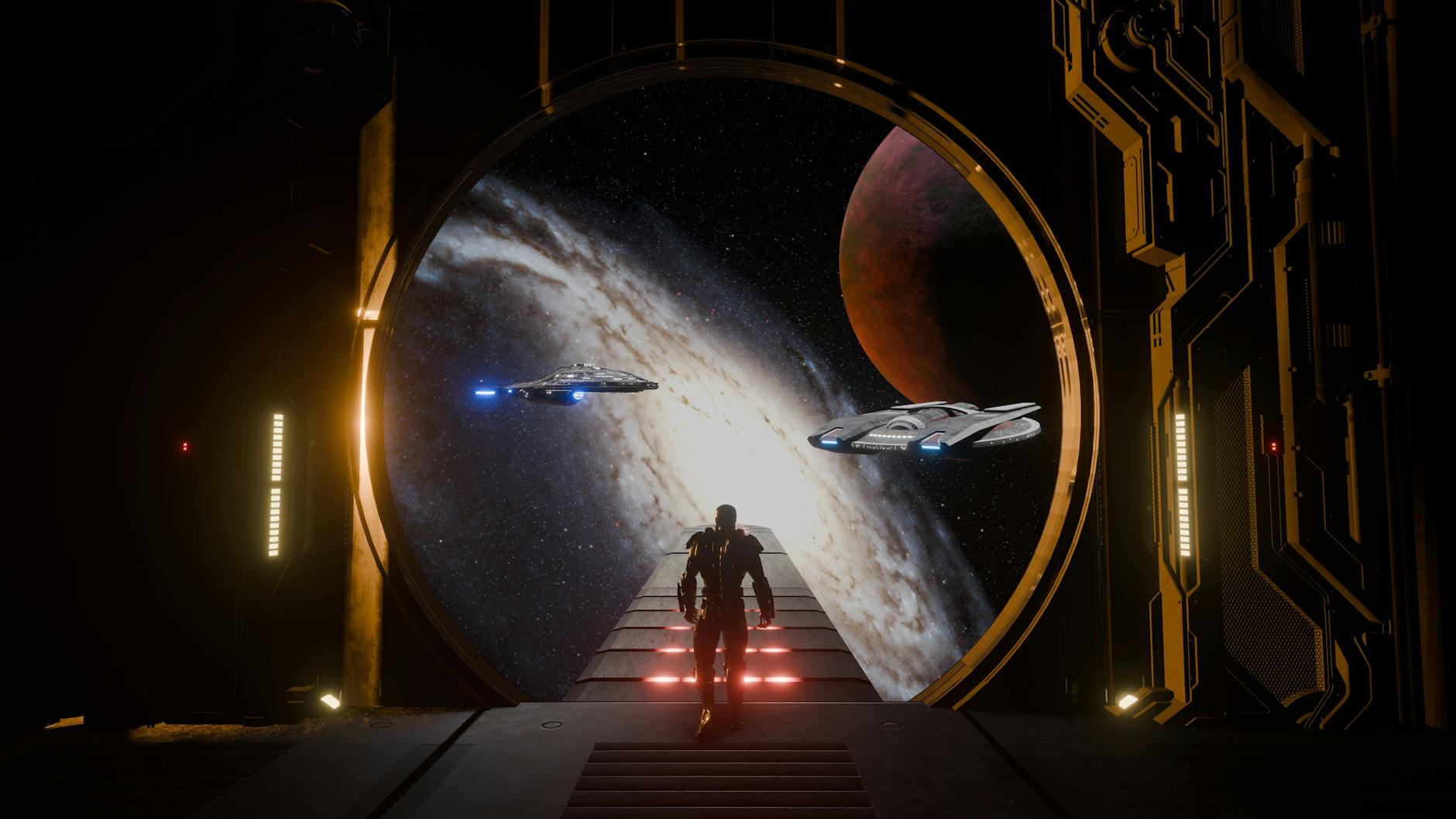
The universe is 13.8 billion years old and contains perhaps 2 trillion galaxies, each with hundreds of billions of stars. Even by conservative estimates, the conditions for life should have arisen in many places long before Earth existed. Some of those civilizations, given billions of years of development, should be capable of technologies we can’t imagine. One proposed answer is the zoo hypothesis.
So where is everybody?
This is the Fermi paradox: the apparent contradiction between the high probability of extraterrestrial intelligence and the complete absence of evidence for it. Many solutions to the Fermi paradox have been proposed: life is rare (the Rare Earth hypothesis), intelligence is an improbable evolutionary fluke, civilizations tend to destroy themselves (the Great Filter). The Great Filter framework asks whether the challenge lies in our past or our future.
One of the most provocative solutions is the zoo hypothesis: advanced civilizations know about us and have deliberately chosen not to make contact, observing us from a distance like animals in a zoo or nature reserve, protected but not interfered with.
The Origin of the Hypothesis

The zoo hypothesis was first formalized by astronomer John Ball in a 1973 paper titled “The Zoo Hypothesis” in Icarus. Ball argued that if the galaxy is inhabited by advanced civilizations, the most parsimonious explanation for our isolation might be a deliberate policy of non-contact.
Ball drew on an analogy from wildlife management: when scientists study wild animal populations, they go to considerable lengths to avoid disturbing the subjects, precisely because human contact changes the behavior being observed. A civilization advanced enough to detect Earth and understand our situation might adopt a similar policy, a galactic version of the Prime Directive from Star Trek.
The hypothesis doesn’t require malevolence. The motives for non-contact could be:
- Scientific: to observe the natural development of intelligence without contamination
- Ethical: to respect our autonomy and right to develop independently
- Practical: contact might be overwhelming or dangerous for a civilization at our technological stage
- Legalistic: a galactic convention or treaty governing contact with emerging civilizations
The Galactic Club

The zoo hypothesis is often extended into the concept of a Galactic Club, an advanced community of civilizations that has reached consensus about how to treat younger civilizations like ours.
John Billingham and others at NASA further developed this idea, building on earlier work by Ronald Bracewell in the 1960s: if civilizations survive long enough to become truly advanced, they accumulate wisdom as well as technology. A civilization millions of years old has presumably solved its existential risks, developed sophisticated ethical frameworks, and reached consensus about how to interact with the universe around it.
If such a club exists and has agreed on a non-interference policy, it would explain why we don’t hear from any civilization individually, they all follow the same protocol.
The hypothesis implies that the zoo’s borders are enforced. Any civilization that tries to break the protocol and contact us would be stopped. The silence would be uniform because it is maintained collectively.
Why the Hypothesis Is Hard to Test
The zoo hypothesis is frustratingly difficult to falsify. This is both its weakness and its resilience.
Any observation consistent with alien silence is also consistent with the zoo hypothesis. We detect no signals? They’re hiding their signals. We see no megastructures? They’re keeping them out of our view. We receive no messages? They’ve agreed not to send them.
In principle, a detection, a clear signal from an advanced civilization, would falsify the zoo hypothesis only if it was inconsistent with zoo behavior (e.g., if aliens contacted us directly rather than us discovering them independently). But even a detected signal could be reinterpreted as a deliberate exposure chosen by the galactic club at the moment they judged us ready.
This unfalsifiability makes the zoo hypothesis scientifically unsatisfying to many researchers. A hypothesis that cannot in principle be disproved is not a scientific hypothesis in the strict Popperian sense, as defined by philosopher Karl Popper, it’s closer to a metaphysical proposition.
Criticisms: Why the Zoo Hypothesis Strains Credulity
Several lines of argument challenge the zoo hypothesis.
The Coordination Problem
For the zoo hypothesis to explain the Fermi paradox, all technological civilizations in the galaxy must agree to the same non-contact policy and all must successfully enforce it over millions or billions of years.
This is extraordinarily demanding. Human history suggests that no policy, no matter how broadly held, is observed by absolutely everyone. Even if 99.9% of civilizations respected a galactic quarantine protocol, the remaining 0.1%, potentially thousands of independent civilizations – would be enough to make contact over galactic timescales.
The more civilizations exist, the harder perfect coordination becomes. The zoo hypothesis essentially requires either a totalitarian galactic government (unlikely and unsettling) or an astonishingly uniform consensus across entirely independent civilizations.
The Evolutionary Arms Race
Advanced civilizations are unlikely to be monolithic. A civilization millions of years old may have spawned divergent factions, uploaded minds, post-biological entities, and artificial intelligences with different values and goals. The idea that all of these would consistently honor the same protocol seems implausible.
If even one faction or individual among the trillions of entities in an advanced civilization decided to break the protocol, out of curiosity, dissent, or different values, we would expect to see evidence of contact over the relevant timescales.
Why Would They Care?
Even granting good intentions, it’s unclear why advanced civilizations would care about preserving our “natural” development. The concept of a pristine, uncontacted cultural development may be an anthropocentric projection, a specifically human concern about authenticity and autonomy that may not translate to fundamentally alien minds.
And what would “natural development” even mean once self-directed genetic engineering, artificial intelligence, and technological enhancement have transformed civilizations beyond recognition? The very concept of a non-interfered-with “natural” civilization may be incoherent.
Related Hypotheses
The zoo hypothesis is one member of a family of “deliberate non-contact” solutions to the Fermi paradox.
The Planetarium Hypothesis: Proposed by astronomer Stephen Baxter, this suggests we might live in a simulated environment, or at least a carefully managed one, in which the universe appears empty because advanced civilizations have arranged for us to see a false sky. This is similar to the zoo hypothesis but implies more direct control of our surroundings, making it even harder to test. Like the zoo hypothesis, it explains the silence by positing active manipulation of our perception.
The Interdict Scenario (Quarantine Hypothesis): Rather than studying us as a nature reserve, advanced civilizations may have quarantined us out of caution: not wanting to make contact with a civilization that might be dangerous, unstable, or carrying “cultural pathogens.” We’re not in a zoo; we’re in isolation.
The Dark Forest: Chinese science fiction author Liu Cixin proposed the chilling inverse: in a universe of scarce resources, every civilization is a potential threat. Advanced civilizations stay silent precisely to avoid detection, knowing that contact leads to annihilation. And they destroy any civilization that reveals itself: including us, eventually. This is not the zoo hypothesis (deliberate protection) but its opposite (deliberate extermination). Importantly, Liu’s Dark Forest is a consequence of the coordination problem: if civilizations cannot trust each other, the safest strategy is to destroy any emerging civilization before it becomes a threat. Liu Cixin’s The Dark Forest and The Three-Body Problem develop this idea fictionally but it has been taken seriously as a Fermi paradox solution.
What the Zoo Hypothesis Does Well
Despite its criticisms, the zoo hypothesis captures something important that many other Fermi paradox solutions miss: agency.
Most Fermi paradox solutions invoke impersonal barriers: life is hard to start, complex organisms are rare, intelligence doesn’t reliably evolve, civilizations inevitably destroy themselves. These are passive filters.
The zoo hypothesis suggests an active choice: civilizations survive and choose silence. This is actually a comparatively optimistic solution to the Fermi paradox. In the Great Filter framework, it implies the filter is behind us: intelligent life is not rare, civilizations do survive their technological adolescence, and advanced societies develop ethical frameworks sophisticated enough to respect the autonomy of younger civilizations.
If the zoo hypothesis is correct, we live in a galaxy teeming with ancient, wise, cautious minds: all watching, waiting for the moment when we join them.
The Wait for Contact
SETI (the Search for Extraterrestrial Intelligence) has now been listening for over 60 years, without a confirmed detection. Some scientists have attempted indirect tests of the zoo hypothesis: for instance, searching for infrared signatures of Dyson swarms that might reveal hidden civilizations, or monitoring for interstellar probes that could be “park rangers” in the solar system’s vicinity. So far, these searches have yielded nothing. But the absence of evidence is, of course, exactly what the zoo hypothesis predicts.
The ongoing absence of contact can be interpreted either as evidence against the zoo hypothesis (if the galactic club existed, wouldn’t they eventually make themselves known?) or as evidence for it (we haven’t passed whatever threshold triggers first contact).
The Active SETI (METI) debate adds urgency to this question. Scientists like the late Stephen Hawking have warned that broadcasting our presence into the galaxy could be catastrophically dangerous: if the zoo hypothesis is wrong and the Dark Forest is right, we might be announcing our location to hostile civilizations. Proponents of METI argue that listening alone has failed and that a deliberate signal might be the only way to prompt contact from a patient, waiting galactic club. This tension makes the zoo hypothesis not just a scientific curiosity but a practical consideration in how we choose to behave.
Whether it’s wise to send messages, given our uncertainty about who might be listening and why they’re silent, is one of the most consequential debates in astrobiology. Perhaps the silence is not emptiness, but patience.
Sources
- Ball, J.A. (1973). The Zoo Hypothesis. Icarus, 19(3), 347–349.
- Hart, M.H. (1975). Explanation for the Absence of Extraterrestrials on Earth. Quarterly Journal of the Royal Astronomical Society, 16, 128–135.
- Cirkovic, M.M. (2018). The Great Silence: Science and Philosophy of Fermi’s Paradox. Oxford University Press.
- Liu Cixin. (2008). The Dark Forest (Translated by Joel Martinsen, 2015). Tor Books.
- SETI Institute. (2023). Search for Extraterrestrial Intelligence.
- NASA Exoplanet Exploration. (2024). Are We Alone? The Search for Life in the Galaxy.
What is the zoo hypothesis?
The zoo hypothesis is a proposed solution to the Fermi paradox suggesting that advanced extraterrestrial civilizations deliberately avoid contact with Earth, observing humanity from a distance like animals in a nature reserve.
Who proposed the zoo hypothesis?
The zoo hypothesis was first formalized by astronomer John Ball in a 1973 paper titled ‘The Zoo Hypothesis’ published in the journal Icarus.
How does the zoo hypothesis explain the Fermi paradox?
It resolves the Fermi paradox by arguing that the absence of evidence for extraterrestrial intelligence is due to advanced civilizations intentionally hiding their presence from us, not because they don’t exist.
What is the difference between the zoo hypothesis and the Rare Earth hypothesis?
The Rare Earth hypothesis suggests intelligent life is extremely rare, while the zoo hypothesis assumes intelligent life is common but advanced civilizations choose not to interfere with or contact less advanced ones like humanity.
Is the zoo hypothesis considered a scientific theory?
The zoo hypothesis is a speculative idea rather than a testable scientific theory, as it cannot be easily proven or disproven with current technology or observations.
Further reading: Zoo hypothesis on Wikipedia