

Latest Articles

Occam’s Razor: The Principle That Guides Scientific Thinking
“Entities should not be multiplied beyond necessity.” When you have two explanations for a mystery, which one should you trust first? This 14th-century maxim, attributed to the English friar William of Ockham, became one of the most influential principles in the history of science. Known as Occam’s razor: the principle that simpler explanations are preferred…

The Black Hole Information Paradox: What Happens When Data Disappears?
Imagine dropping an encyclopedia into a black hole. Every fact, every word, every bit of information encoded in its pages falls past the event horizon and is, apparently, lost forever. Not just inaccessible, erased from reality. If that’s true, then one of the most fundamental principles of physics is wrong. The black hole information paradox…

How JWST Detects Biosignatures: What the Telescope Can and Cannot Confirm
The JWST biosignature detection capability represents a monumental leap in humanity’s ability to search for life beyond Earth, yet the telescope operates within strict physical and observational limits that prevent definitive confirmation of life on exoplanets. Since its launch in December 2021, the James Webb Space Telescope has transformed exoplanet science by observing the chemical…

Methane as a Biosignature: Why It Hints at Alien Life
The search for life beyond Earth hinges on identifying biosignatures – chemical markers in a planet’s atmosphere that are best explained by biological processes. Among the most compelling candidates is methane biosignature exoplanets, a topic that has gained urgency with the launch of the James Webb Space Telescope (JWST). Methane alone is not proof of…

How White Dwarfs Cool: The Slow Dance of Stellar Remnants
Understanding how white dwarfs cool over time is essential for using these dense stellar remnants as cosmic clocks that measure the age of the Milky Way and the history of nearby star populations. White dwarfs are the final evolutionary stage of stars like our Sun – objects that have shed their outer layers and left…
Epsilon Eridani: A Young Planetary System That Mirrors Our Solar System’s Past
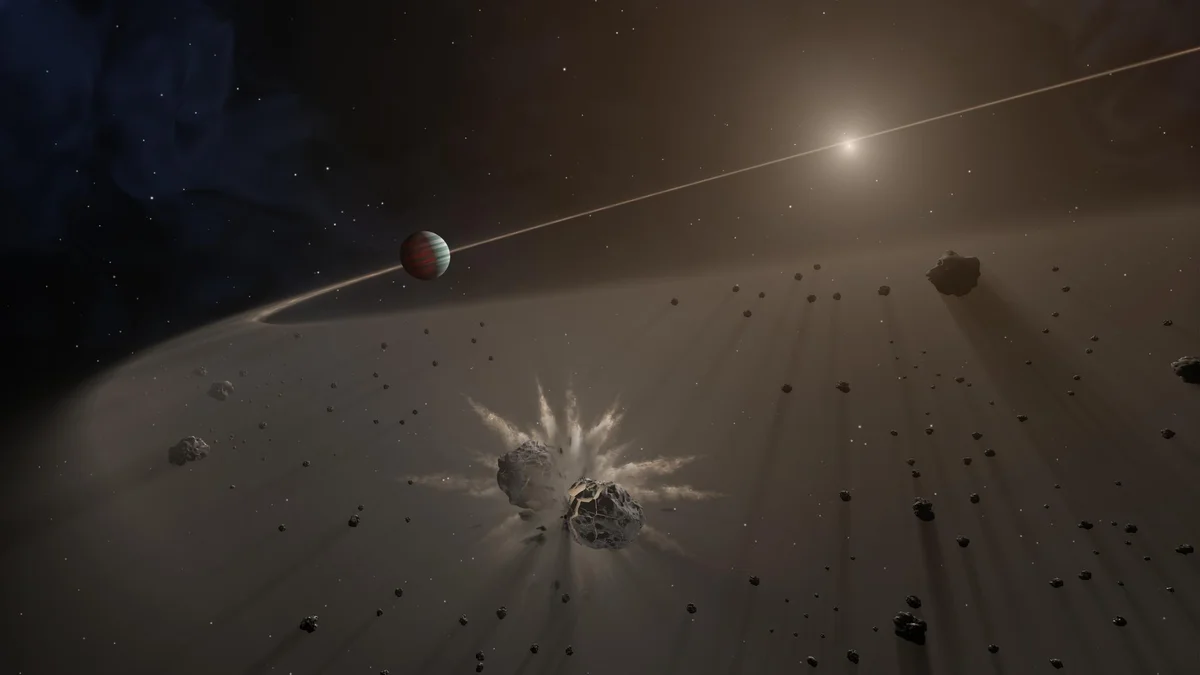
Just 10.5 light-years away in the constellation Eridanus, Epsilon Eridani is one of the closest planetary systems to our own, and one of the youngest yet found around a Sun-like star. At only a few hundred million years old, this orange dwarf is still encircled by dusty debris belts and shaped by at least one…