
In 1998, two independent teams of astronomers studying distant supernovae made a discovery that upended cosmology. They expected to find that the universe‘s expansion was slowing down, pulled back by the gravity of all the matter within it. Instead, they found the opposite: the expansion of the universe is accelerating. Something is pushing space apart faster and faster. That something is what we now call dark energy. What is dark energy? That question, unanswered since the discovery of cosmic acceleration in 1998, may be the most important open problem in cosmology.
Dark energy is the name for whatever is causing the accelerating expansion. It makes up approximately 68% of the total energy content of the universe, the single largest component. And despite decades of study, we do not know what it is.
The Discovery: Supernovae as Cosmic Rulers
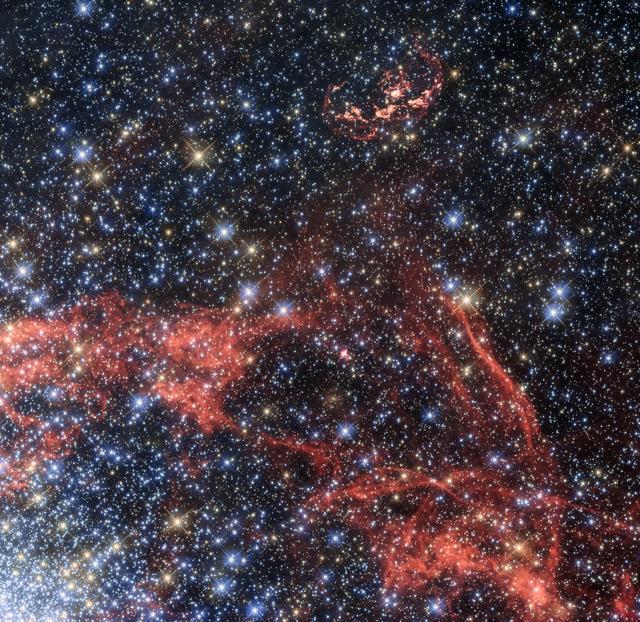
The 1998 discovery came from studying Type Ia supernovae, stellar explosions with a remarkably consistent peak brightness. Because their intrinsic luminosity is known, measuring how bright they appear tells astronomers how far away they are. Comparing that distance to the supernova’s redshift (how much its light has been stretched by the universe’s expansion) reveals how fast the universe was expanding when the light was emitted.
Saul Perlmutter led one team (the Supernova Cosmology Project) and Brian Schmidt and Adam Riess led the other (the High-Z Supernova Search Team). Both found that distant supernovae were dimmer than expected, meaning they were farther away than a decelerating or even constant-rate expansion would produce. The universe is not slowing down. It is speeding up. Perlmutter, Schmidt, and Riess shared the Nobel Prize in Physics in 2011 for this discovery.
Since 1998, additional observations have confirmed the accelerating expansion. The CMB power spectrum measured by WMAP and Planck, baryon acoustic oscillations in the distribution of galaxies, and the large-scale structure of the cosmic web all independently require dark energy to fit the data.
The Cosmological Constant: Einstein’s “Greatest Blunder” Revived
The simplest explanation for what is dark energy? It is Einstein’s cosmological constant, denoted Λ (lambda). Einstein introduced it in 1917 to make his general relativity equations describe a static universe, the assumption of the time. When Hubble confirmed the universe was expanding in 1929, Einstein reportedly called the cosmological constant his “greatest blunder” and abandoned it.
The cosmological constant represents a constant energy density of empty space, the vacuum itself has energy. In quantum field theory, this is expected: virtual particles constantly pop in and out of existence in the vacuum, contributing energy. A cosmological constant corresponds to this vacuum energy.
There is, however, a massive problem. When physicists calculate the expected vacuum energy density from quantum field theory, the answer is approximately 10¹²⁰ times larger than the observed value of dark energy. This discrepancy, the cosmological constant problem, is one of the most profound unsolved problems in physics. Something must be canceling almost all of the predicted vacuum energy, leaving only the tiny remainder we observe. No convincing mechanism for this cancellation is known.
Alternative Explanations

Because the cosmological constant problem is so severe, physicists have proposed alternatives to simple vacuum energy.
Quintessence is a class of models in which dark energy is a dynamic scalar field, similar in concept to the inflaton of cosmic inflation , rather than a fixed constant. Unlike a true cosmological constant, quintessence can evolve over time and may vary across regions of space. If dark energy is quintessence, the equation of state parameter w (which relates dark energy pressure to density) would deviate from exactly −1. Current measurements are consistent with w = −1 but do not rule out small deviations.
Modified gravity theories propose that general relativity is not the correct description of gravity at cosmic scales, and that what appears to be dark energy is actually a modification of how gravity behaves over large distances. These are constrained by gravitational wave observations and the large-scale structure of the universe.
The anthropic argument , in versions of eternal inflation, the cosmological constant takes different values in different bubble universes. The anthropic principle suggests we observe a small but nonzero cosmological constant because only such universes can form galaxies, stars, and observers. Most physicists find this unsatisfying as a physical explanation, but it cannot be easily dismissed.
What Dark Energy Does, and Does Not, Do
Dark energy operates only at cosmic scales. Its effect is to add a repulsive term to gravity that grows in proportion to distance. On the scale of galaxies, galaxy clusters, and the solar system, the dark energy density is too dilute to compete with the gravitational binding of matter. Dark energy does not affect orbits, the structure of galaxies, or any process below roughly tens of millions of light-years.
At the largest scales, the expansion of the universe as a whole, dark energy dominates. Its density remains constant as space expands (unlike matter, which thins out as volume increases), so its influence grows relative to matter over time. The universe became dark-energy-dominated roughly 5 billion years ago.
The ultimate fate of the universe depends on dark energy’s future behavior. If it remains constant, the universe will expand forever, growing increasingly cold and empty, the “Big Freeze.” If dark energy strengthens over time, the expansion could eventually tear apart galaxies, solar systems, and atoms, the “Big Rip.” Current observations favor the cosmological constant scenario.
2024: Cracks in the Cosmological Constant?

In 2024, the Dark Energy Spectroscopic Instrument (DESI) released its first major results, the largest three-dimensional galaxy survey ever made. The data showed mild hints that dark energy may not be exactly constant, that w may be evolving slightly over cosmic time. The statistical significance was not sufficient to claim a definitive detection of deviation, but the hint was enough to generate considerable attention. Follow-up observations over the coming years will clarify whether dark energy is truly evolving or whether the DESI hint fades with more data.
If dark energy is changing, it would rule out the cosmological constant as the explanation and point toward quintessence or a modification of gravity, fundamentally changing our picture of the universe’s ultimate fate.
Current and Future Probes
The Euclid satellite, launched in 2023 by the European Space Agency, will map more than a billion galaxies over six years, measuring the universe’s expansion history and the growth of cosmic structure with precision sufficient to detect small deviations from a cosmological constant.
The Vera C. Rubin Observatory in Chile will observe 20 billion galaxies over a decade, including a supernova survey providing thousands of precision distance measurements.
Resolving the nature of dark energy, whether it is a cosmological constant, a dynamic field, or a failure of general relativity, is the defining challenge of 21st-century cosmology. The Nancy Grace Roman Space Telescope, planned for launch in the late 2020s, will conduct a supernova survey and a weak lensing survey specifically optimized for dark energy constraints. What is dark energy, ultimately? Physicists have several leading hypotheses but no confirmed answer.
What is dark energy in simple terms?
Dark energy is the name given to whatever is causing the universe’s expansion to accelerate. It makes up about 68% of the total energy content of the universe and is distributed uniformly throughout space. The simplest explanation is that it is the energy of empty space, a cosmological constant. Its physical nature is unknown. It does not interact with matter in any observed way except through its effect on the large-scale expansion of the universe.
Is dark energy the same as dark matter?
No. They are completely different. Dark matter is an unknown form of matter that exerts gravitational attraction, holding galaxies and clusters together. Dark energy is an unknown form of energy that drives the accelerating expansion of space, working against gravity at cosmic scales. They share only the word “dark” because neither emits, absorbs, nor reflects light.
Who discovered dark energy?
Dark energy was discovered in 1998 through supernova observations by two independent teams. Saul Perlmutter led the Supernova Cosmology Project; Brian Schmidt and Adam Riess led the High-Z Supernova Search Team. All three received the 2011 Nobel Prize in Physics for this discovery.
Will dark energy destroy the universe?
Not under the most likely scenario. If dark energy is a cosmological constant, stable at its current value, the universe will expand forever but not be torn apart. If dark energy strengthens over time (a scenario called phantom energy or the Big Rip), it could eventually rip apart galaxies, atoms, and spacetime itself. Current observations are most consistent with a stable cosmological constant, making the Big Rip unlikely but not definitively ruled out.
How much of the universe is dark energy?
Approximately 68% of the universe’s total energy content is dark energy. Dark matter accounts for about 27%. All ordinary matter, every star, planet, gas cloud, and galaxy, makes up only about 5%. The universe we can see and touch is a small fraction of what actually exists.
What is the cosmological constant problem?
Quantum field theory predicts that empty space should have an enormous intrinsic energy density, roughly 10¹²⁰ times greater than the observed value of dark energy. Why the actual value is so extraordinarily small compared to the prediction is one of the most severe unsolved problems in all of theoretical physics. Any theory that explains dark energy must also explain why this cancellation is so nearly perfect.
Sources
Riess, A.G. et al. (1998). Observational Evidence from Supernovae for an Accelerating Universe and a Cosmological Constant. The Astronomical Journal, 116(3), 1009–1038. doi:10.1086/300499
Perlmutter, S. et al. (1999). Measurements of Omega and Lambda from 42 High-Redshift Supernovae. The Astrophysical Journal, 517(2), 565–586. doi:10.1086/307221
Planck Collaboration. (2020). Planck 2018 results. VI. Cosmological parameters. Astronomy & Astrophysics, 641, A6. doi:10.1051/0004-6361/201833910
Carroll, S.M. (2001). The Cosmological Constant. Living Reviews in Relativity, 4(1), 1. doi:10.12942/lrr-2001-1
DESI Collaboration. (2024). DESI 2024 VI: Cosmological Constraints from the Measurements of Baryon Acoustic Oscillations. arXiv:2404.03002.
Weinberg, S. et al. (2013). Observational Probes of Cosmic Acceleration. Physics Reports, 530(2), 87–255. doi:10.1016/j.physrep.2013.05.001
Further reading: Dark energy on Wikipedia