
Introduction: The Overlooked Frontier
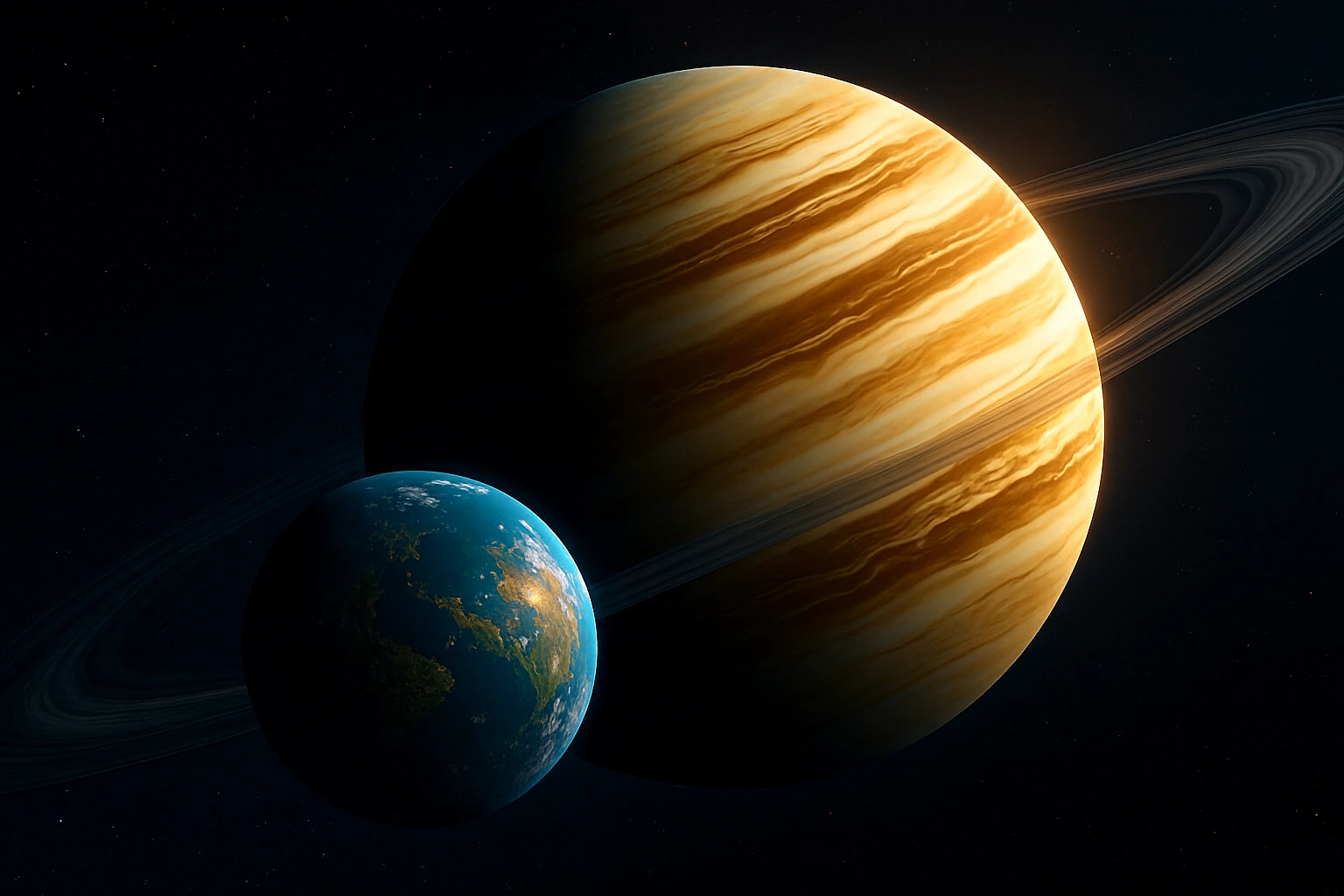
In this article on exomoon frontier hidden worlds, we explore how unseen moons could outshine their host planets. Astronomers have cataloged over five thousand confirmed exoplanets, yet not a single exomoon has been indisputably found. That may soon change, and when it does, the discovery could reshape our understanding of where life thrives. Every gas giant detected by missions like Kepler or TESS might host a system of moons, each one a potential world. In our own Solar System, Jupiter and Saturn boast more than a hundred moons between them. Scale that up to the Milky Way’s hundreds of billions of stars, and exomoons could easily outnumber planets by an order of magnitude or more.
For decades, the search for life beyond Earth has focused on planets orbiting inside their star’s “habitable zone,” where sunlight allows liquid water to exist. Yet that focus may have closed our eyes to a far richer landscape. Moons orbiting giant planets could be habitable in ways Earth never was, powered by tides, warmed by reflected starlight, and protected by magnetic fields. If even a fraction of them sustain oceans, forests, or alien biospheres, they may represent the true majority of living worlds in the galaxy.
Two candidates already tease us from the data: Kepler-1625 b-i and Kepler-1708 b-i, both objects whose transits show hints of an orbiting moon roughly Neptune-sized. Whether those are real or not, their existence would prove that large moons can form around gas giants far from their stars. Such moons could be massive enough to hold thick atmospheres, sustain long-term volcanism, and nurture life above or below their surfaces. In short, the first exomoon discovery might also mark the first evidence for another habitable world.
The Energy Problem: Why Moons Might Stay Alive Longer
A planet’s warmth fades with distance from its star, but a moon’s warmth can come from within. The gravitational tug-of-war between a giant planet and its satellites produces tidal heating, the exact mechanism that keeps Jupiter’s moon Io in a constant state of volcanic fury and warms Enceladus enough to vent plumes of water into space. That frictional energy arises because the moon’s orbit is slightly elliptical; the planet’s gravity stretches and flexes its interior like a kneaded ball of dough, converting motion into heat.
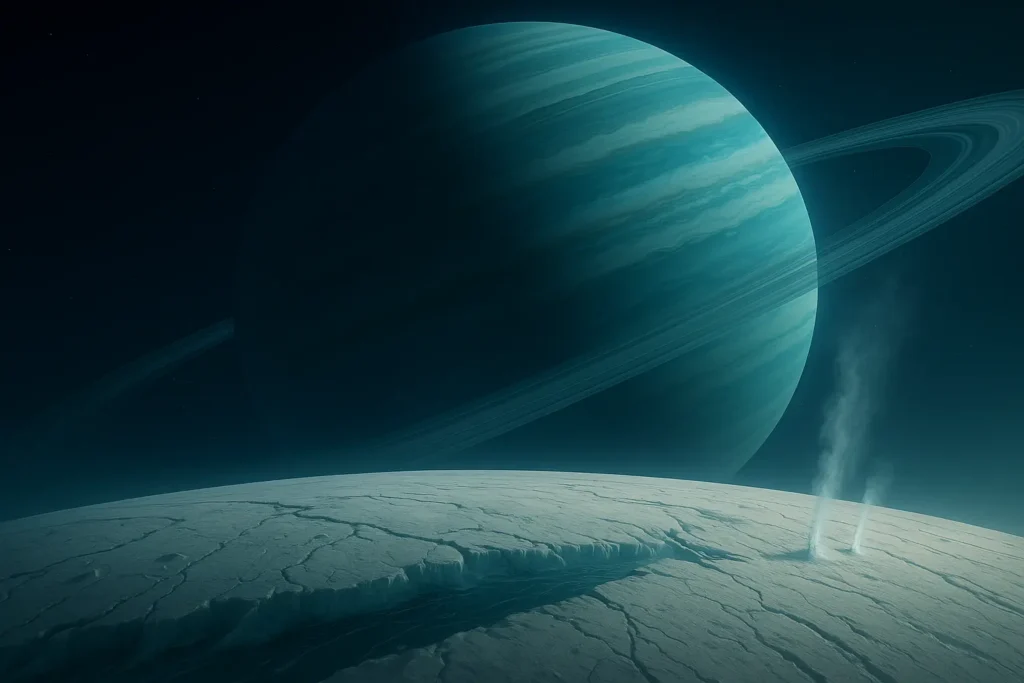
For a large rocky moon orbiting a gas giant, tidal heating can be immense, sometimes rivaling the heat a planet receives from sunlight. It is a power source independent of the star, meaning life could persist long after stellar conditions deteriorate. A planet’s gradual drift outward as its star ages would freeze its surface; a moon, however, could remain geothermally active for billions of years, running on gravitational energy alone.
In addition to tides, moons benefit from planetary illumination. Gas giants like Jupiter and Saturn reflect enormous amounts of sunlight; their reflected light, or “planetshine,” can gently warm nearby moons. Add the planet’s infrared glow (especially if it is a young, still-hot giant) and you get a second layer of environmental stability. In specific configurations, calculations indicate that a moon orbiting a warm, Jupiter-like planet could maintain Earth-like surface temperatures even beyond the traditional habitable zone.
Together, tidal and planetary heating address one of astrobiology’s most significant challenges: maintaining energy continuity. Planets can lose habitability as their stars brighten or dim, but moons tethered to their giant hosts may endure. Some researchers now suspect that such moons could represent the longest-lived habitable environments in the galaxy, tiny oases that never freeze, orbiting worlds that themselves wander the darkness.
The Exomoon Frontier: Breaking the Ice on Hidden Worlds
The conventional picture of habitable moons is one of frozen landscapes: ice crusts, buried oceans, and hydrothermal vents in eternal darkness. That vision borrows from Europa and Enceladus, but it is hardly the whole story. Not every exomoon would live under a frozen ceiling. Some could orbit close enough to their host planet to bask in constant illumination, maintain a thick atmosphere, and even sustain liquid water lakes or oceans on their surface.
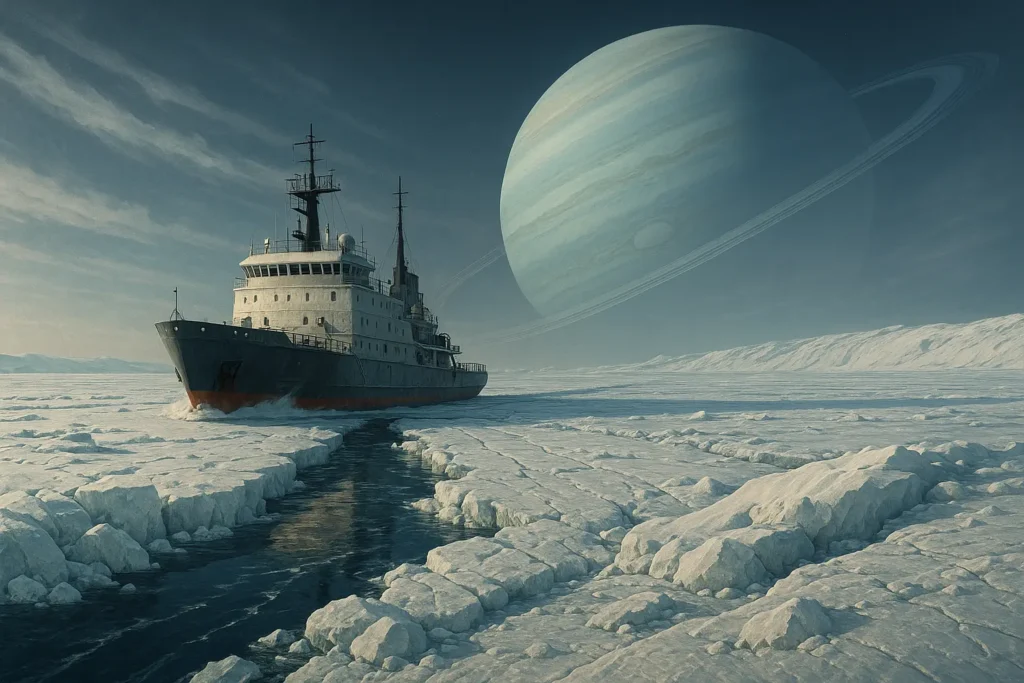
A moon massive enough (say, approaching Mars or Earth in size) could hold onto an atmosphere for billions of years. The moon’s gravity would keep volatiles like nitrogen and carbon dioxide from escaping, and its magnetospheric link to a parent gas giant could add protection from stellar wind. On such a world, air might shimmer with charged aurora that dance across the sky in tune with its planet’s magnetic field. Nights would be short and filled with the reflected glow of the primary world looming large in the sky, brighter than any full Moon on Earth.
Some of these moons might orbit gas giants that lie just inside or slightly beyond their star’s habitable zone. They would receive light directly from the star and additional warmth from their host planet’s reflected and emitted radiation, a combined energy budget capable of supporting liquid surface water. Models of exomoon climates suggest that a dense carbon dioxide atmosphere could maintain surface temperatures between 0°C and 40°C even several astronomical units farther from the star than Earth sits from the Sun. Such conditions could foster cloud cover, rainfall, and long-term climate cycles.
Volcanism could make these worlds even more dynamic. As on Io, continuous tidal flexing drives mantle circulation, creating volcanoes that recycle gases and nutrients into the atmosphere. Periodic eruptions could inject aerosols, moderating the climate over geologic timescales. Imagine a temperate world where volcanic ash fertilizes alien forests beneath a copper-tinted sky. At the same time, a ringed gas giant rises enormous on the horizon, a scene equal parts exotic and plausible.
Habitability on these worlds would not depend solely on starlight. Photosynthesis analogs could adapt to dimmer illumination by using pigments tuned to redder wavelengths, perhaps harvesting both stellar and planetary infrared photons. If such life evolved, its biochemistry might leave spectral fingerprints (odd combinations of oxygen, methane, or organic hazes) that telescopes like JWST could someday detect.
In short, “habitable” does not necessarily mean “icy.” A large, atmosphere-rich moon orbiting a bright gas giant could host open skies, flowing water, and seasons, not just an ocean locked beneath miles of ice. These potential paradises widen the meaning of habitability far beyond the star’s traditional Goldilocks zone.
How We’ll Find Them
Detecting an exomoon is like spotting a firefly beside a floodlight. The light from the parent star overwhelms everything, and even the planet’s own signal is faint. Yet astronomers have devised ingenious ways to tease out these elusive companions using patterns in starlight.
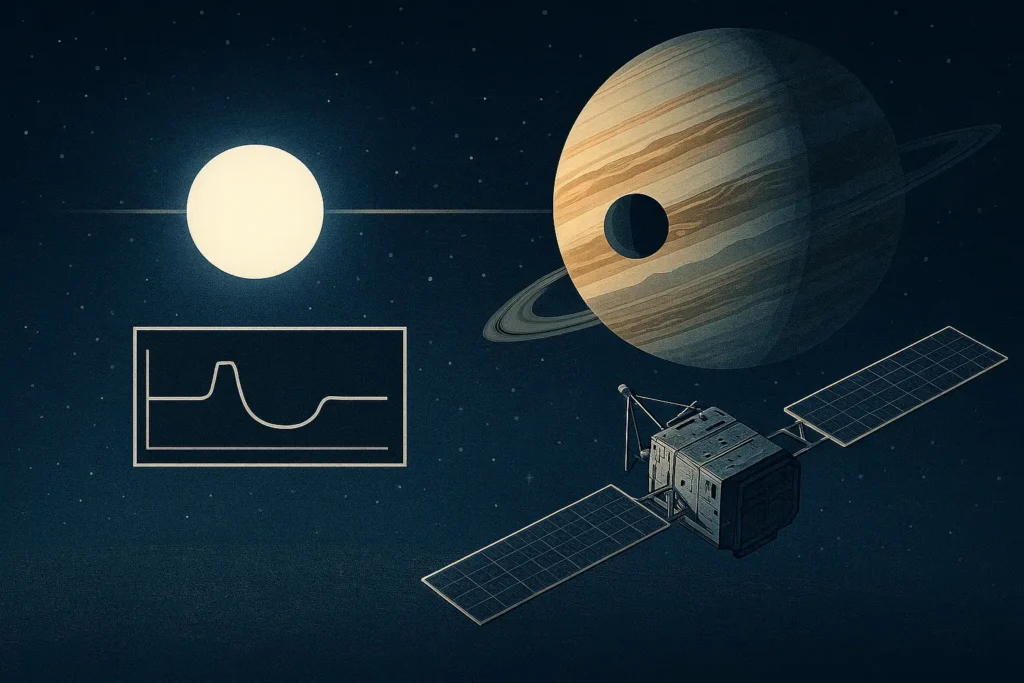
The first technique is transit timing variation (TTV). When a planet passes in front of its star, it produces a slight dip in brightness. If that planet has a moon, the system’s center of mass wobbles, causing the planet’s transits to occur a little earlier or later than expected. By measuring these minute shifts (sometimes just a few seconds) astronomers can infer the tug of an unseen satellite. A related effect, transit duration variation (TDV), measures how long the transit lasts, since a moon’s pull can subtly speed up or slow down the planet during its crossing. Together, TTV and TDV are the most promising techniques for existing data from Kepler and TESS.
A few tantalizing candidates have already emerged. Kepler-1625 b-i, for instance, produced timing irregularities that suggest a Neptune-sized moon orbiting a Jupiter-sized planet. Another candidate, Kepler-1708 b-i, shows a similar signature. Both remain unconfirmed, but they hint at what is possible. As instruments improve, smaller moons should become detectable, potentially down to Earth-sized companions around nearby stars.
Beyond transit data, the next generation of telescopes will open new windows of opportunity. The James Webb Space Telescope can measure subtle variations in infrared light, making it possible to detect the spectral influence of a moon’s atmosphere during a planetary transit. Future observatories, such as ESA’s PLATO and NASA’s Nancy Grace Roman Space Telescope, will refine light curves to unprecedented precision, potentially even revealing multiple moons orbiting a single planet.
Another avenue is direct imaging. When astronomers isolate the light of a planet itself (using instruments such as SPHERE on the Very Large Telescope or NASA’s upcoming Habitable Worlds Observatory) slight variations in brightness may indicate orbiting moons reflecting light differently as they move around their host. A large moon with clouds or oceans could modulate the planet’s brightness in predictable rhythms, offering a new type of photometric signature
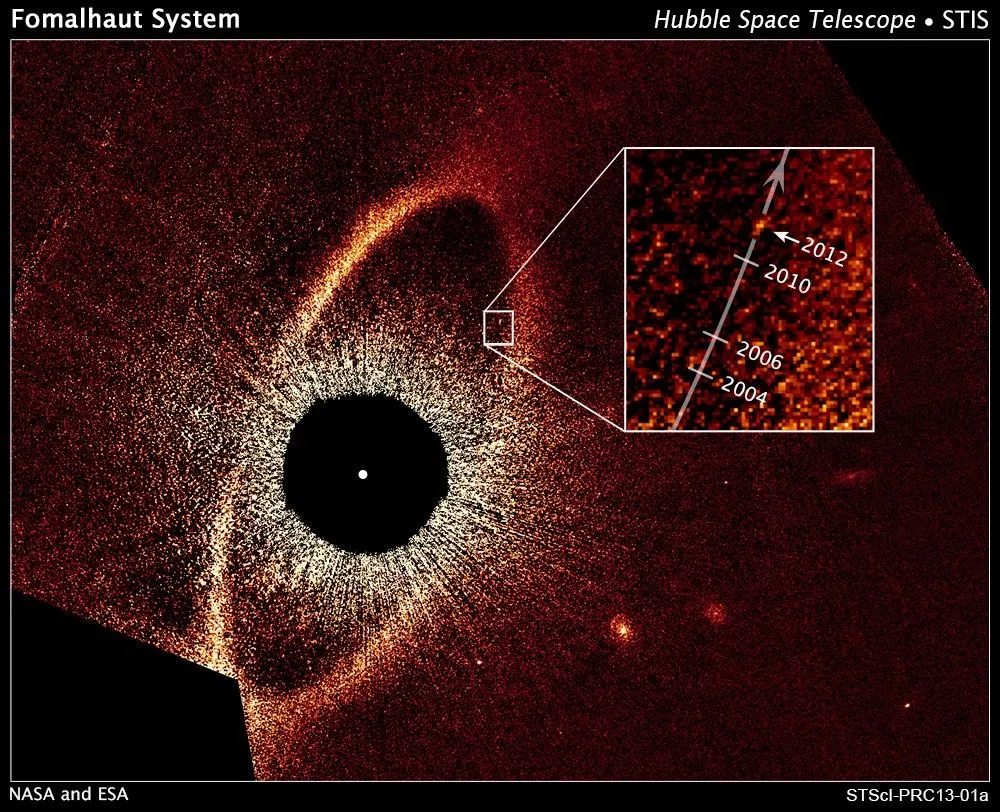
Even more subtle methods lie ahead. As a moon moves in front of or behind its planet, the combined brightness changes slightly, producing secondary eclipses that reveal temperature or albedo contrasts. Precise spectroscopy could detect these shifts as distinct chemical fingerprints: a faint hint of water vapor, methane, or oxygen separated from the planet’s own spectral lines.
Detecting an exomoon will be one of astronomy’s most complex observational challenges, but also one of its most rewarding. The first confirmed example will not only prove that these worlds exist; it will dramatically expand the inventory of potentially habitable environments. Once we know where to look, the number of candidate worlds could skyrocket from thousands to millions, transforming our cosmic map almost overnight.
Chemistry, Magnetism, and the Potential for Life
Habitability is never just about warmth; it is about stability. To sustain life, a world needs an atmosphere that lasts, chemistry that cycles, and protection from cosmic hazards. Exomoons may meet all three criteria and, in some cases, outperform planets.
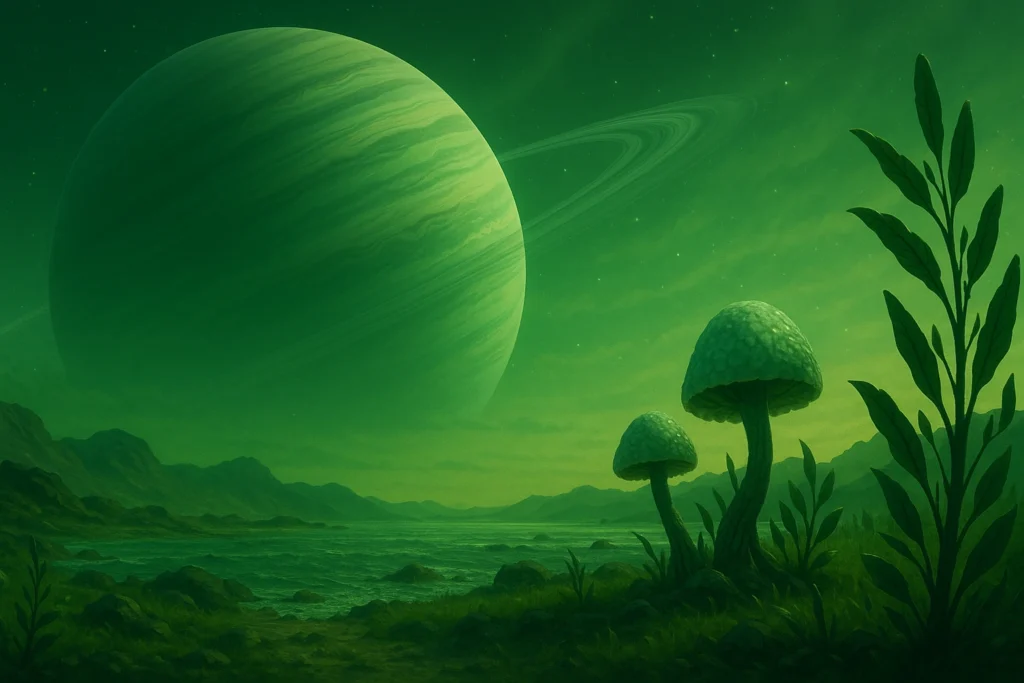
The most critical factor is atmospheric retention. Small moons would struggle to hold air, but anything with at least one-third Earth’s mass could maintain a dense atmosphere for billions of years. The combination of gravity and colder temperatures reduces gas loss to space. Moreover, a moon orbiting within a gas giant’s magnetic field could enjoy shielding from stellar radiation that even Earth lacks. The planet’s magnetosphere would act like a giant umbrella, deflecting charged particles and preserving atmospheric chemistry.
The same magnetic environment could also drive spectacular auroral activity. Charged particles trapped in the planet’s magnetotail could bombard the moon’s upper atmosphere, energizing molecules and producing glowing curtains of light. For surface life, this would be less a danger than a light show, especially if the moon’s own magnetic field provided an additional protective layer.
Internal activity also plays a role. Tidal heating not only warms interiors; it drives geological recycling. Volcanism could return carbon and sulfur to the atmosphere, creating a dynamic climate system. On Earth, plate tectonics stabilizes temperature by cycling carbon through rocks and oceans. A tidally flexed moon could achieve a similar balance using gravitational energy rather than radioactive decay.
Biochemically, such moons might be ideal laboratories for alternative biospheres. Life could evolve in shallow seas illuminated by dim starlight and the reflected glow of a ringed planet. Organisms might use pigments that harvest both visible and infrared wavelengths. Others could thrive near volcanic vents, feeding on chemical gradients. Because tidal energy is predictable and long-lasting, evolution could proceed under relatively constant conditions: a slow, stable rhythm that fosters complexity.
If we ever detect an exomoon’s atmospheric spectrum, scientists will look for biosignatures, combinations of gases that should not coexist unless something replenishes them. Oxygen and methane, for example, destroy each other quickly in a sterile atmosphere. Their simultaneous presence implies metabolism. Other indicators include nitrous oxide, sulfur compounds, or haze-forming organics. A confirmed biosignature from a moon’s atmosphere would be one of the most transformative discoveries in science, a sign that life does not just find planets; it finds niches wherever gravity and chemistry permit.
The Sociological and Philosophical Implications
When the first exomoon is confirmed, the consequences will extend far beyond astronomy. Humanity’s mental model of “worlds” will have to stretch. For centuries, planets were the archetype of habitability; moons were secondary. Yet nature may have written a different script, one in which the true abundance of living worlds circles other worlds, not stars.
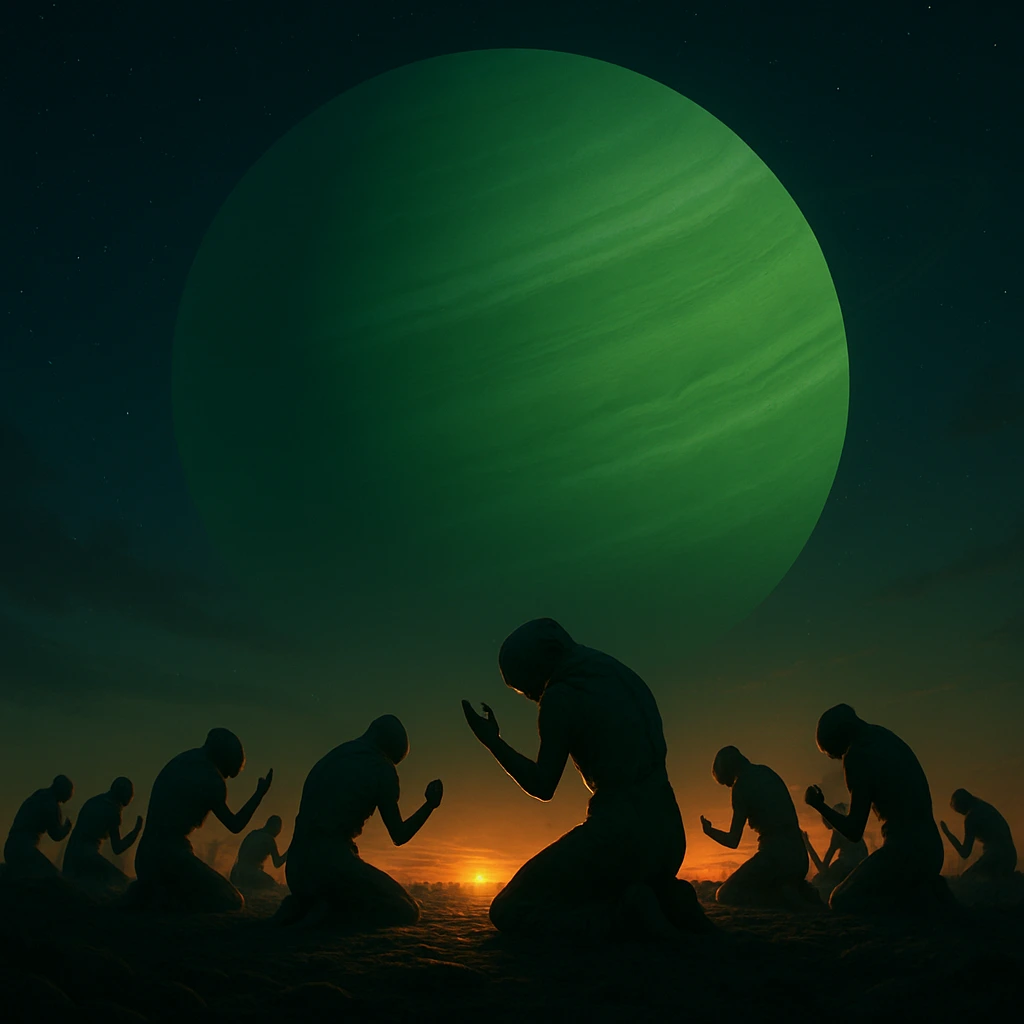
This shift carries philosophical weight. It challenges heliocentrism, the idea that meaningful warmth and energy must come from a central star. Exomoons demonstrate that habitability can arise from mechanics rather than sunlight, from gravity’s invisible hand rather than stellar radiation. If life thrives in such places, existence itself becomes more flexible and adaptable than our biology suggests.
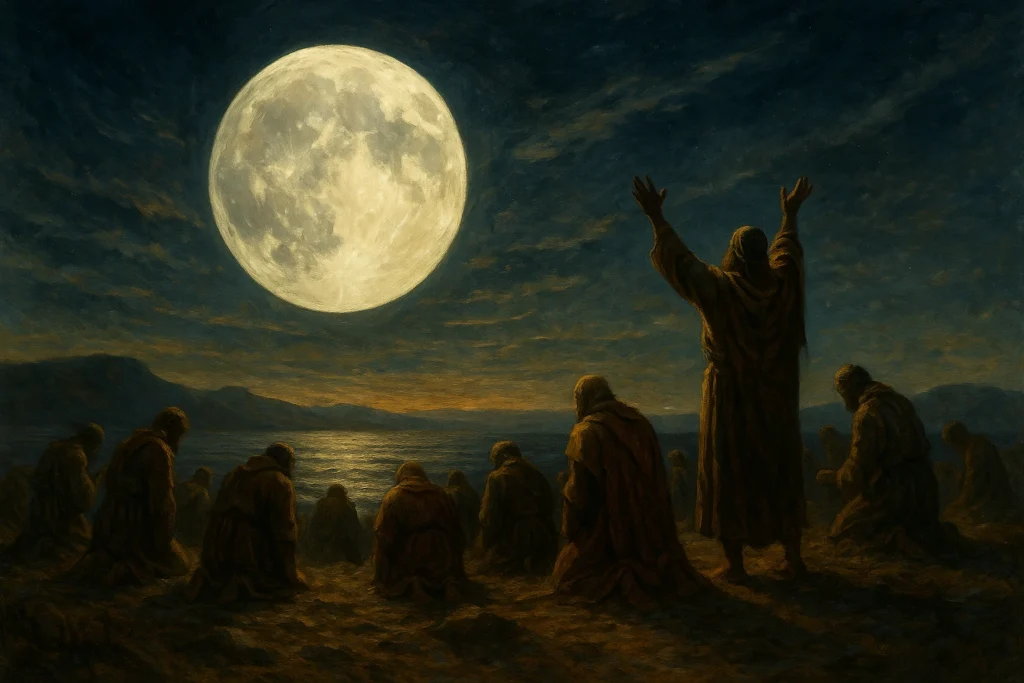
There is cultural resonance as well. Myths have long portrayed the moon as a symbol of reflection and transformation. If one of these worlds truly harbors life, that symbolism becomes literal: life emerging in the mirror-glow of a giant planet overhead. A civilization growing beneath such a sky might evolve a radically different sense of scale and dependence. To them, the parent planet could serve as sun, god, and guardian.
For humans, discovering such a place would blur the line between “planetary” and “satellite.” We would see that the universe’s creativity is not confined to orbits like ours. The diversity of life-bearing environments could span blazing deserts on tidally locked worlds, icy oceans under crusts of ammonia, and cloud-veiled green moons circling massive ringed giants bathed in twilight. Each would rewrite a fragment of life’s cosmic story.
Conclusion: The Hidden Majority of Habitable Worlds
If even a fraction of the galaxy’s giant planets host large, warm moons, then the Milky Way may hold trillions of potential habitats. Some would contain icy oceans; others would have temperate skies wrapped around volcanic continents. Their longevity, powered by tidal energy rather than fragile stellar balance, could outlast planetary biospheres by billions of years.
The first confirmed exomoon will mark more than a detection; it will signal a new chapter in cosmic biology. It will show that life’s home field is wider than the traditional habitable zone, deeper than sunlight, and far more inventive than our narrow expectations. When that discovery comes (and it will) it will not simply expand the map of the universe. It will remind us that Earth is not the template for habitability, but one variation in a much richer cosmic spectrum of living worlds.
SOURCES
- Teachey, A., Kipping, D. M., & Schmitt, A. R. (2018). HEK VI: On the Dearth of Galilean Analogs in Kepler, and the Exomoon Candidate Kepler-1625b I.
The Astronomical Journal, 155(1). https://doi.org/10.3847/1538-3881/aa9f2a - Kipping, D. M. (2021). The Hunt for Exomoons with Kepler (HEK): Recent Progress and Future Prospects.
Publications of the Astronomical Society of the Pacific. https://doi.org/10.1088/1538-3873/abf96c - Heller, R., & Barnes, R. (2013). Tidal heating and habitability of exomoons.
Astrobiology, 13(1), 18–46. https://doi.org/10.1089/ast.2012.0859 - Lammer, H. et al. (2014). Origin and evolution of planetary atmospheres.
Astronomy & Astrophysics Review, 22, 1. https://doi.org/10.1007/s00159-014-0078-2 - Reynolds, R. T., et al. (1987). Europa, Tidally Heated Oceans, and Habitable Zones Around Giant Planets.
Icarus, 71(1), 95–112. - JWST Science Team. (2023). Infrared Spectroscopy Techniques for Exoplanet Atmospheres.
NASA Technical Documents. https://www.jwst.nasa.gov - TESS Mission Overview – NASA (2020).
https://tess.mit.edu - PLATO Mission – European Space Agency.
https://www.cosmos.esa.int/web/plato - Nancy Grace Roman Space Telescope – NASA.
https://roman.gsfc.nasa.gov - SPHERE Instrument, Very Large Telescope – ESO.
https://www.eso.org/sci/facilities/paranal/instruments/sphere.html
Further reading: Exomoon on Wikipedia