
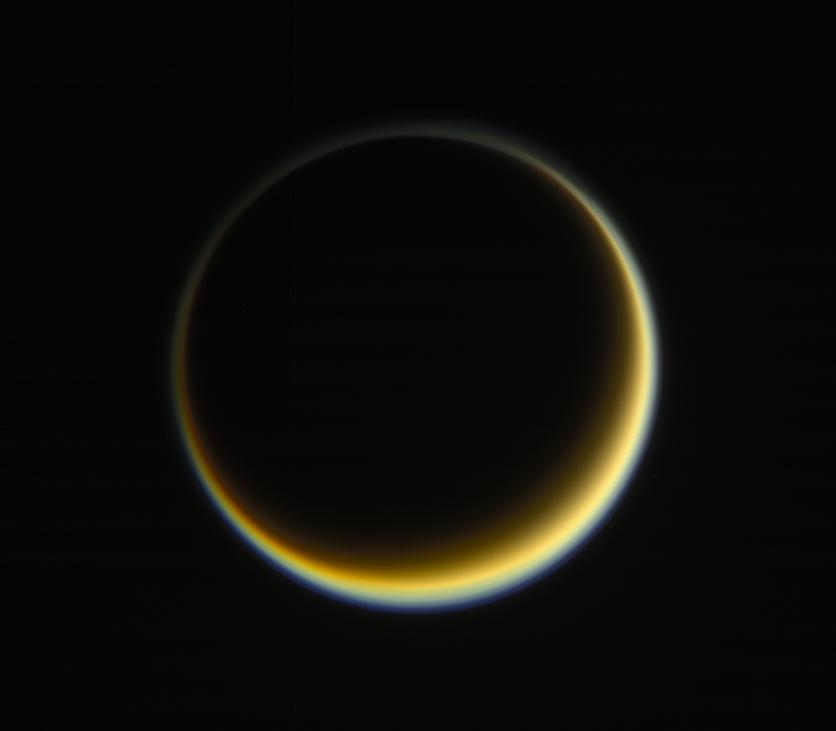
If you could stand on Titan and look up, you would see a thick orange haze blocking all but a faint glow from the distant Sun. The air pressure around you would be about 1.5 times that of Earth at sea level (comfortable, in a sense), but the temperature would be around −179°C (−290°F), cold enough to liquefy natural gas. Below your feet, the ground might be dusted with organic particles. In the distance, a river channel carved by liquid methane winds toward a vast methane lake. Titan (Saturn’s largest moon) is one of the most compelling destinations in the search for life beyond Earth.
Titan is Saturn’s largest moon and the second-largest moon in the solar system. It is the only moon known to have a dense atmosphere, the only world beyond Earth known to have stable liquid on its surface, and one of the most compelling targets in the search for extraterrestrial life, despite conditions utterly unlike anything on Earth.
A World Wrapped in Haze

Titan was discovered by the Dutch astronomer Christiaan Huygens in 1655. For nearly three centuries, astronomers knew little about it beyond its size and orbit. Its thick atmosphere prevented surface observation. It was not until the Voyager 1 flyby in 1980 that scientists got a clearer picture of Titan’s nitrogen-rich atmosphere and its surprising density. When the Cassini-Huygens mission arrived at Saturn in 2004, our understanding of Titan transformed.
Titan’s atmosphere is roughly 95% nitrogen and 5% methane, with trace amounts of other hydrocarbons. It is the only other body in the solar system with an atmosphere dominated by nitrogen, as Earth’s is. But the similarities diverge quickly. Titan’s surface temperature is −179°C, placing it far outside any conventional habitable zone. Methane plays the role that water does on Earth: it evaporates, forms clouds, falls as rain, and flows in rivers and lakes.
The orange-brown haze that gives Titan its color is made of complex organic molecules called tholins, produced when ultraviolet radiation from the Sun breaks apart methane and nitrogen in the upper atmosphere and the fragments recombine into complex chains. Tholins rain down onto Titan’s surface, potentially building up layers of organic material. Some astrobiologists have noted that tholins produced in laboratory simulations include amino acid precursors, the chemical building blocks relevant to life as we know it.
Methane Lakes and Hydrocarbon Seas
One of the most extraordinary discoveries of the Cassini mission was the confirmation of liquid methane and ethane lakes and seas at Titan’s poles. The largest, Kraken Mare, is estimated to be roughly 400,000 square kilometers in area, comparable to the Caspian Sea and Earth’s five Great Lakes combined. A second large body, Ligeia Mare, is about 126,000 square kilometers. Dozens of smaller lakes dot the polar regions.
The lakes exist because Titan’s atmospheric temperature and pressure allow methane to exist as a liquid at the surface. Titan has a complete methane cycle (analogous to Earth’s water cycle) with evaporation, cloud formation, precipitation, and surface flow. Cassini’s radar detected river channels carved by methane rain, deltas where those rivers emptied into lakes, and shoreline features remarkably similar to those carved by water on Earth.
The Huygens probe, released by Cassini on Christmas Day 2004 and arriving at Titan on January 14, 2005, descended through the atmosphere by parachute and transmitted 72 minutes of data from the surface before its battery died. It measured temperature and pressure profiles, photographed channels and pebble-like rounded rocks (almost certainly made of water ice, not silicate), and detected the chemical composition of the surface and atmosphere. The surface appeared to be damp, possibly saturated with liquid methane.
Interior: A Water Ocean Beneath the Ice?

Titan is not just an atmospheric wonder. Gravity measurements from Cassini suggest that Titan’s interior may harbor a liquid water ocean beneath its icy outer crust, similar to the subsurface oceans inferred for Europa, Enceladus, and Ganymede.
The evidence is indirect: Titan flexes slightly as it orbits Saturn under gravitational tides, and the magnitude of this flexing (its “tidal Love number”) is consistent with a liquid layer deep within the moon, somewhere between 100 and 500 kilometers below the surface. This liquid layer could be water, possibly mixed with ammonia, which acts as an antifreeze lowering the melting point.
If such an ocean exists, it would be an entirely different potential habitat from the surface hydrocarbon lakes. While the surface lakes are based on entirely non-aqueous chemistry (methane and ethane, not water), a subsurface ocean would be liquid water, potentially in contact with rocky material providing chemical energy. This scenario places Titan in a similar category to Europa and Enceladus as ocean worlds of astrobiological interest.
Could Life Exist on Titan?
The question of life on Titan falls into two separate categories.
Surface life in liquid methaneTitan’s surface lakes and seas are composed of liquid methane and ethane, not water. Life as we know it requires water as a solvent. But some chemists and astrobiologists have proposed that exotic chemistries based on non-aqueous solvents might sustain a different kind of life. A 2015 Cornell study proposed a theoretical membrane (a “azotosome”) made of nitrogen-containing molecules that could form stable structures in liquid methane, functioning analogously to cell membranes. This is highly speculative, but it demonstrates that the question of methane-based life is at least chemically conceivable.
If life of this kind existed in the methane lakes, it would metabolize hydrogen and acetylene rather than oxygen and glucose. In 2010, scientists noted that Cassini data showed hydrogen depletion near Titan’s surface (consistent with hydrogen consumption) and an absence of acetylene on the surface (which was predicted to accumulate from atmospheric chemistry). These observations were presented as cautious, possible biological interpretations (not detections of life) and are consistent with non-biological explanations such as unknown surface chemistry.
Subsurface life in liquid water: If Titan has a subsurface ocean, life there would be more analogous to deep subsurface life on Earth or the putative life in Europa’s ocean. This requires water, chemical gradients, and a source of energy. A water-ammonia ocean beneath Titan’s icy crust might provide these conditions.
Dragonfly: NASA’s Mission to Titan

NASA’s Dragonfly mission, scheduled for launch in 2028 and arrival at Titan in 2034, will send a rotorcraft lander to explore Titan’s surface. Titan’s thick atmosphere and low gravity (about 1/7th of Earth’s) make it an ideal environment for rotorcraft, a vehicle that wouldn’t be practical on Mars or the Moon. Dragonfly will fly from site to site, covering hundreds of kilometers over several years, something no wheeled rover could accomplish on a world where the terrain is diverse and the surface may be composed of soft organic sediment.
Dragonfly’s primary scientific goals include: – Characterizing the complex organic chemistry in Titan’s atmosphere and on its surface – Searching for evidence of water-based chemistry that might indicate past (or present) water-mediated reactions – Studying the methane cycle and its role in shaping the landscape – Assessing the habitability of Titan’s surface and near-surface environment
The mission was selected as part of NASA’s New Frontiers program. Its science goals place it squarely at the intersection of planetary science and astrobiology.
Titan in Context: Comparing Ocean Worlds
Titan is one of several “ocean worlds” in the outer solar system that have become central targets in the search for life beyond Earth. Europa is believed to have a subsurface ocean in contact with a rocky seafloor, providing chemical energy from hydrothermal activity. Enceladus actively vents water vapor and organic molecules from its south pole, and its interior ocean has been confirmed through direct sampling by Cassini. Ganymede has a subsurface ocean detected by magnetic measurements.
Future Titan missions like NASA’s Dragonfly will test whether prebiotic chemistry has advanced to complex organic molecules in the haze and lakes. Titan’s surface is shaped by methane rain, ethane rivers, and nitrogen winds, a hydrological cycle running on chemistry utterly unlike Earth’s. Titan is unique in the solar system: it is the only body besides Earth known to have stable liquid on its surface today. Titan differs from these moons in one crucial respect: it has both a surface reservoir (the methane lakes) and a potential subsurface ocean. Its surface organics may be some of the most complex found anywhere in the solar system outside of Earth. Titan sits at the intersection of every interesting question in astrobiology: non-aqueous solvents, organic synthesis, ocean worlds, and atmospheric chemistry.
What makes Titan unique among moons?
Titan is the only moon in the solar system with a dense atmosphere. Its atmosphere is primarily nitrogen and methane, with a pressure about 1.5 times Earth’s at sea level. It is also the only world beyond Earth known to have stable liquid on its surface, lakes and seas of liquid methane and ethane. These two properties, combined with an enormous inventory of organic molecules and a possible subsurface water ocean, make Titan one of the most scientifically interesting worlds in the solar system.
What are Titan’s methane lakes?
Titan’s polar regions host lakes and seas of liquid methane and ethane, the largest of which (Kraken Mare) is roughly the size of the Caspian Sea. These are not water lakes; the temperature on Titan’s surface is −179°C, cold enough to liquefy natural gas. Methane cycles on Titan much as water does on Earth: it evaporates, forms clouds, rains down, carves river channels, and pools in depressions at the poles. The Cassini spacecraft mapped these lakes in detail using radar during its 13-year Saturn mission.
Could there be life on Titan?
Possibly, in two different ways. On the surface, speculative but theoretically plausible life might exist in the methane and ethane lakes using exotic non-water chemistry. Cassini data showed some anomalies (hydrogen depletion, acetylene absence) that could be interpreted as biological activity, though non-biological explanations are also viable. In the subsurface, if Titan has a liquid water ocean beneath its icy crust (as gravity data suggest), it would be a candidate for more conventional water-based life, similar to the proposed subsurface ocean of Europa.
What is the Dragonfly mission?
Dragonfly is a NASA rotorcraft lander mission to Titan, scheduled to launch in 2028 and arrive in 2034. It will fly from location to location across Titan’s surface using helicopter-style rotors, which are practical on Titan due to its thick atmosphere and low gravity. Dragonfly will study Titan’s organic chemistry, search for signs of water-mediated chemistry, and assess the habitability of its surface and atmosphere. It was selected as part of NASA’s New Frontiers program.
How was Titan discovered?
Titan was discovered by Dutch astronomer Christiaan Huygens in March 1655, making it one of the first moons discovered after Galileo’s discovery of Jupiter’s four large moons in 1610. Huygens used a 57-millimeter refracting telescope he built himself. For nearly three centuries, Titan was known only as a point of light. The Voyager 1 flyby in 1980 revealed its thick atmosphere, and the Cassini-Huygens mission (2004–2017) provided the detailed understanding we have today.
What is the atmosphere of Titan made of?
Titan’s atmosphere is approximately 95% nitrogen and 5% methane, with trace amounts of ethane, propane, acetylene, hydrogen cyanide, and dozens of other organic compounds. The orange haze that gives Titan its characteristic color is made of complex organic molecules called tholins, produced when solar ultraviolet radiation breaks apart and recombines nitrogen and methane in the upper atmosphere. Tholins are also found elsewhere in the outer solar system, but nowhere in such abundance as on Titan.
Sources
Stofan, E.R. et al. (2007). The lakes of Titan. Nature, 445(7123), 61–64. doi:10.1038/nature05438
Fulchignoni, M. et al. (2005). In situ measurements of the physical characteristics of Titan’s environment. Nature, 438(7069), 785–791. doi:10.1038/nature04314
Iess, L. et al. (2012). The tides of Titan. Science, 337(6093), 457–459. doi:10.1126/science.1219631
Lorenz, R.D. et al. (2008). Titan’s inventory of organic surface materials. Geophysical Research Letters, 35(2), L02206. doi:10.1029/2007GL032118
Stevenson, J. et al. (2015). Membrane alternatives in worlds without oxygen: creation of an azotosome. Science Advances, 1(1), e1400067. doi:10.1126/sciadv.1400067
NASA Dragonfly Mission. (2024). Dragonfly: A Rotorcraft Lander for Titan. NASA New Frontiers Program. Retrieved from nasa.gov/dragonfly
This article is part of our framework exploring Life: the origin of life, astrobiology, and the search for life beyond Earth.
Further reading: Titan on Wikipedia