
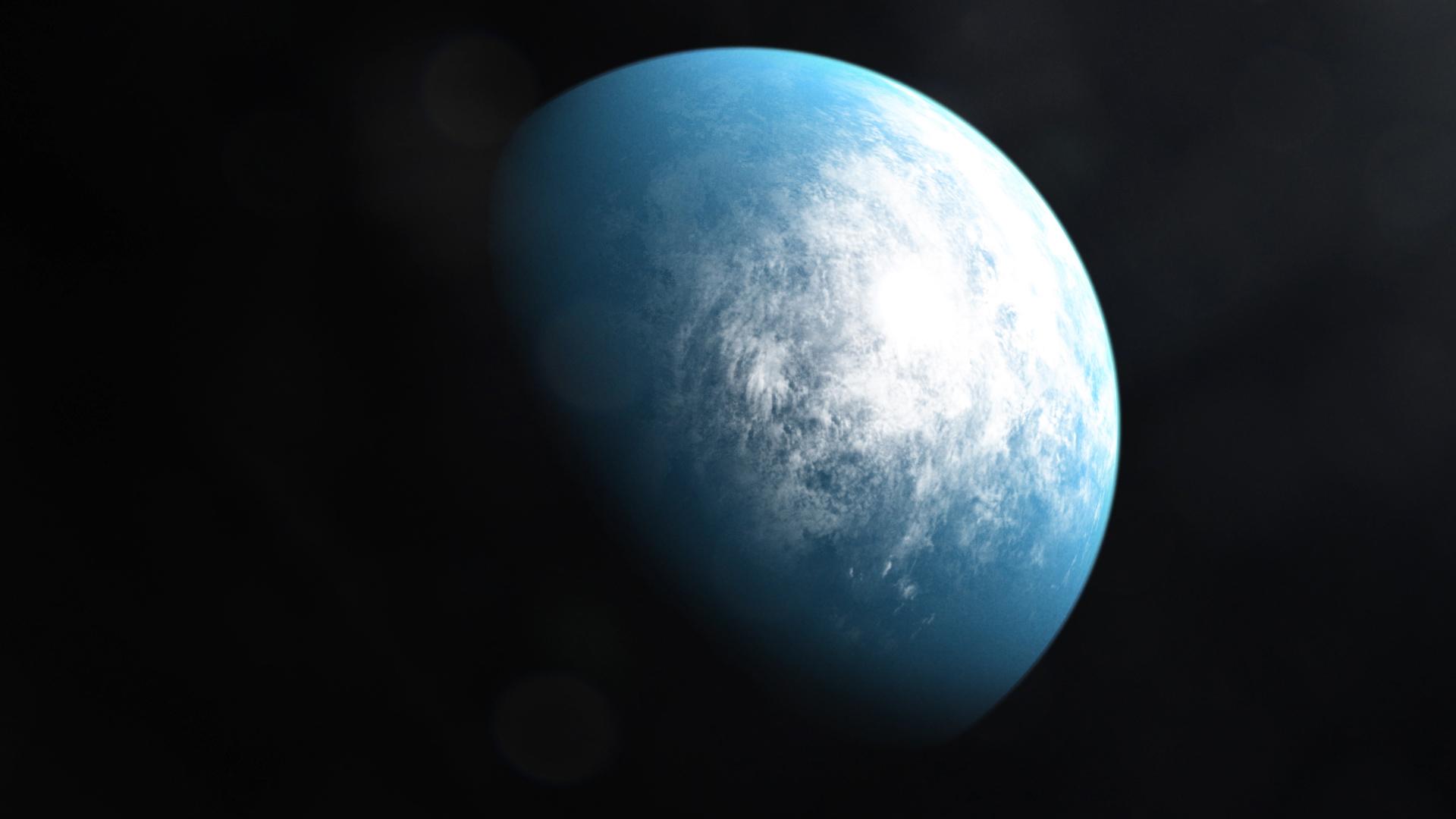
The first Earth-like world we found wasn’t Earth-like at all. It was called a super-Earth, though that classification would later prove contested, and it might not even be solid. Kepler-22b, discovered in 2011, was the first confirmed planet in the habitable zone of a Sun-like star. It has a radius 2.4 times that of Earth, placing it firmly in a category with no analogue in our solar system.
That category has since become one of the most populated in exoplanet science. Super-Earths, loosely defined as planets with masses between roughly 1 and 10 Earth masses, are the most common type of planet in the galaxy, a prevalence thought to stem from the abundant material in this mass range within protoplanetary disks. They are also among the most debated when it comes to habitability.
Whether they can actually support life depends on a set of interacting properties: their composition, their atmosphere, their relationship to their host star, and whether they fall above or below a critical size boundary that separates rocky worlds from gaseous ones.
What Is a Super-Earth Habitable Zone Candidate?
The term “super-Earth” refers to mass and radius, not to any particular similarity to Earth in composition or habitability. A super-Earth may be:
- A rocky world with a denser interior and stronger surface gravity than Earth, potentially with oceans, a solid surface, and active geology. On such a world, a 150 lb person would feel like 300 lbs, and mountains would be lower and wider due to increased lithostatic stress.
- A water world with a deep global ocean and little or no exposed land
- A mini-Neptune with a thick hydrogen-helium envelope surrounding a small rocky or icy core, and no accessible surface at all
The naming convention has caused persistent confusion in science communication. A super-Earth is not necessarily Earth-like. It is simply a planet that falls in a mass and radius range that has no solar system analogue, smaller than Uranus and Neptune, larger than Earth and Venus.
This is why the habitable zone, while necessary, is not sufficient for predicting habitability. A super-Earth habitable zone candidate may be a rocky world with surface liquid water, or a gaseous mini-Neptune with no surface at all.
The Radius Valley: The Line That Separates Rocky from Gaseous

The most important structural insight about super-Earths came from statistical analysis of the Kepler planet catalog. In 2017, Benjamin Fulton and collaborators published what became known as the California-Kepler Survey, identifying a gap in the radius distribution of small planets.
Below approximately 1.5 to 1.7 Earth radii, planets are predominantly rocky, dense, with iron and silicate interiors, compositionally similar to Earth at larger scale.
Above approximately 1.7 to 2.0 Earth radii, planets are predominantly mini-Neptunes, lower density worlds with substantial gas envelopes that dramatically increase their radius without proportionally increasing their mass.
Between those boundaries (the radius gap, or Fulton gap), very few planets exist. Think of the radius valley as a planetary sieve. Stellar radiation acts like wind, blowing away the puffy hydrogen-helium atmospheres of smaller, closer planets. What’s left behind are the dense, rocky cores (super-Earths), while the larger planets (mini-Neptunes) are heavy enough to hold onto their gas blankets. This process, known as photoevaporation, occurs over hundreds of millions of years.
The implication for habitability is direct: a super-Earth with a radius below about 1.6 Earth radii is statistically likely to be rocky, making the habitable-zone question meaningful. A planet above about 1.7 Earth radii is probably a mini-Neptune, and the question of surface habitability largely does not apply. It’s crucial to note that this ~1.6 Earth radii figure is a probabilistic boundary based on the radius valley, not a strict definition; some sources define the super-Earth category as extending up to ~1.75-2.0 Earth radii, acknowledging an overlap with mini-Neptunes.
Kepler-22b, at 2.4 Earth radii, sits well above the gap. It is statistically more likely to be a mini-Neptune than a rocky super-Earth, which is why its status as the benchmark habitable-zone planet comes with significant caveats.
What Makes a Super-Earth in the Habitable Zone Potentially Habitable?
For super-Earth habitable zone candidates that fall below the radius valley, several properties could enhance or hinder their habitability:
Greater mass and stronger gravity. A larger super-Earth holds its atmosphere more tenaciously. Atmospheric escape, driven by stellar radiation and solar wind, strips atmospheres over geological time. Higher gravity resists this process. Mars lost most of its atmosphere partly because its low gravity allowed volatile escape; a super-Earth faces this problem less acutely. However, this stronger gravity (e.g., 2x Earth’s) could potentially reshape familiar ecosystems, making vertebrate-like organisms stockier and limiting mountain height.
More geothermal heat. Larger planets cool more slowly. A super-Earth may have a hotter, longer-lived interior, sustaining plate tectonics and volcanic outgassing for billions of years longer than Earth. Plate tectonics regulate the carbon-silicate cycle, the long-term geological thermostat that has kept Earth in the liquid water zone for 4 billion years.
Potentially deeper oceans. Water delivered during formation may be distributed across a larger surface, or concentrated in deep global oceans. Some models predict water layers hundreds of kilometers thick on massive super-Earths, far beyond Earth’s ocean depth of roughly 4 kilometers. At such immense pressures, high-pressure ices like Ice VI could form at the ocean floor, creating a “water world” with no silicate seabed, which might inhibit geochemical cycles important for life.
These are also, in some cases, liabilities. High gravity makes vertical biological structures energetically expensive. A superheated, geologically active interior could produce more volatile geology. A global ocean with no continental land prevents geochemical cycling between crust and atmosphere in ways that may matter for long-term habitability.
Kepler-22b as the Canonical Case
Kepler-22b became the historical reference point for habitable-zone super-Earths for several reasons, though at 2.4 Earth radii it likely sits above the radius gap, making it a probable mini-Neptune rather than a confirmed rocky world. Its significance is as the first such discovery, not the best current habitability candidate:
It orbits a G-type star, the same spectral class as the Sun, with relatively stable output over long timescales. The vast majority of confirmed habitable-zone planets orbit smaller M-type red dwarf stars, which have more active flare behavior and may tidally lock their planets in close-in orbits.
Its orbit is nearly circular, with an eccentricity of approximately 0.016. Low eccentricity means consistent seasonal energy input, no extreme swings between a scorching close approach and a freezing distant one.
Its equilibrium temperature, approximately 262 K (−11°C), is close to Earth’s (255 K). With a moderate greenhouse effect, surface temperatures could fall in the liquid water range.
What it lacks is the one thing that would confirm its habitability: a measured mass. Obtaining mass via the radial velocity method is exceptionally challenging for distant planets like Kepler-22b, requiring precision to detect the star’s tiny wobble. Without this data, the composition remains ambiguous. The planet could be anywhere from a dense rocky world at around 10 Earth masses (which would have a radius larger than 1.6 R🜨) to a gas-rich mini-Neptune at 35 Earth masses. Those scenarios describe fundamentally different planets.
The Best-Case Super-Earths: Below the Gap

The candidates most likely to be habitable among confirmed super-Earths are those below the radius gap, in the habitable zones of their host stars. Several are known:
Kepler-442b has a radius of 1.34 Earth radii (below the Fulton gap), orbiting a K-type star in the conservative habitable zone. Its mass is estimated at around 2.3 Earth masses. At that size, it is almost certainly rocky. It is one of the more credible habitable candidates known.
LHS 1140 b has a radius of 1.73 Earth radii, placing it near the upper edge of the radius gap. Recent analysis using the James Webb Space Telescope suggests it may have retained a nitrogen-dominated atmosphere, a significant finding, as nitrogen is a marker of secondary atmospheres produced by geological rather than primordial outgassing.
TOI-700 e has a radius of 0.95 Earth radii (essentially Earth-sized), orbiting in the conservative habitable zone of an M-dwarf. It is one of the smallest confirmed habitable-zone planets and avoids the mini-Neptune ambiguity entirely.
These planets illustrate the range: from Earth-sized to just below the gap, orbiting stars from M-type to K-type, with varying degrees of atmospheric characterization.
What Determines Habitability Beyond Size
Size and position in the habitable zone are starting conditions. Actual habitability depends on additional factors that are difficult or impossible to measure for most known exoplanets:
Atmospheric composition. An atmosphere with the right mix of greenhouse gases can warm a planet well above its equilibrium temperature. Too much greenhouse gas and the planet cooks; too little and it freezes. The composition depends on geological history, outgassing rates, and whether life (if present) has modified it. This search for atmospheric clues is central to the modern hunt for alien biosignatures.
Magnetic field. A global magnetic field deflects charged particles from the stellar wind that would otherwise erode the upper atmosphere. Earth’s magnetic field is generated by convection in a liquid iron outer core. Whether a given super-Earth has a similar dynamo depends on its interior structure and cooling history.
Stellar activity. G-type stars like Kepler-22 are relatively calm compared to M-dwarfs. But even G-type stars produce flares and coronal mass ejections. Over billions of years, cumulative radiation can strip atmospheres from planets with weak magnetic fields.
Geological cycling. The carbon-silicate cycle (the exchange of carbon between the atmosphere, ocean, and crust through volcanism and subduction) acts as a climate thermostat over millions of years. Planets without plate tectonics may not sustain this cycle, potentially leading to runaway greenhouse or runaway glaciation.
Time. Life on Earth took hundreds of millions of years to emerge after conditions became suitable. A planet’s star must remain stable long enough, and the planet itself must maintain habitable conditions long enough, for biology to get started.
The Future of Super-Earth Discovery
The super-Earth habitable zone category will grow substantially over the next decade. TESS (the Transiting Exoplanet Survey Satellite) is identifying candidates around bright, nearby stars, the targets most amenable to follow-up characterization. The James Webb Space Telescope is already producing atmospheric data for the most favorable cases, such as its landmark detection of CO₂ in exoplanet atmospheres.
The Habitable Worlds Observatory, a NASA mission currently in planning, would be designed specifically to directly image Earth-sized planets in the habitable zones of Sun-like stars and search for atmospheric biosignatures. It represents the technology level at which the habitable-zone super-Earth question begins to have real answers rather than statistical inferences.
Kepler-22b will likely never be directly characterized by any near-term observatory. At 620 light-years, it is too far. But it remains the archetype: the planet that first confirmed that super-Earth habitable zone worlds around Sun-like stars are real, detectable, and worth the centuries of telescope development it will take to understand them. So while Kepler-22b itself may remain a mystery, it defined the category that future missions like the Habitable Worlds Observatory will now work to solve.
What is a super-Earth?
A super-Earth is a planet with a mass between approximately 1 and 10 Earth masses. The term refers only to size, not to any particular similarity to Earth in composition, atmosphere, or habitability. Super-Earths may be rocky, water-covered, or gaseous mini-Neptunes with no surface. A radius below about 1.6 Earth radii makes a rocky composition statistically likely, but the category can include planets with radii up to approximately 1.75-2.0 Earth radii, acknowledging the fuzzy boundary with mini-Neptunes.
Can super-Earths in the habitable zone support life?
Some may be able to. Rocky super-Earths below about 1.6 Earth radii in the habitable zone are the most plausible candidates; they likely have solid surfaces, can retain atmospheres, and may have active geology. Larger super-Earths above 1.7 Earth radii are more likely to be mini-Neptunes with no accessible surface, making Earth-like habitability unlikely even if they sit in the habitable zone.
What is the radius gap and why does it matter for habitability?
The radius gap (or Fulton gap) is a statistical shortage of planets between about 1.5 and 2.0 Earth radii, identified from the Kepler planet catalog. Below the gap, planets are predominantly rocky; above it, they are predominantly gaseous mini-Neptunes. The gap forms because stellar radiation strips gas envelopes from mid-sized close-in planets. For habitability, whether a planet is above or below this boundary largely determines whether it has a surface at all.
Why is Kepler-22b considered a benchmark habitable-zone super-Earth?
Kepler-22b was the first confirmed planet in the habitable zone of a G-type (Sun-like) star. It has a nearly circular orbit, an equilibrium temperature comparable to Earth’s, and a host star similar to the Sun in stability and spectral type. These properties make it the canonical reference case for what a potentially habitable super-Earth might look like. Its main uncertainty (whether it is rocky or gaseous) has not been resolved because its mass has not been precisely measured.
What is the difference between a super-Earth and a mini-Neptune?
Super-Earths and mini-Neptunes overlap in size but differ in composition. Super-Earths (typically below ~1.6 Earth radii) are predominantly rocky, with dense silicate-iron interiors. Mini-Neptunes (typically above ~1.7 Earth radii) have thick hydrogen-helium envelopes that inflate their radius and lower their density. The distinction matters enormously for habitability: rocky super-Earths may have surfaces and atmospheres compatible with life; mini-Neptunes have no accessible surface.
Sources
- Fulton, B.J. et al. (2017). The California-Kepler Survey. III. A Gap in the Radius Distribution of Small Planets. The Astronomical Journal, 154(3), 109.
- Rogers, L.A. (2015). Most 1.6 Earth-radius Planets are Not Rocky. The Astrophysical Journal, 801(1), 41.
- Owen, J.E. & Wu, Y. (2017). The Evaporation Valley in the Kepler Planets. The Astrophysical Journal, 847(1), 29.
- Borucki, W.J. et al. (2012). Kepler-22b: A 2.4 Earth-radius Planet in the Habitable Zone of a Sun-like Star. The Astrophysical Journal, 745(2), 120.
- Kopparapu, R.K. et al. (2013). Habitable Zones around Main-sequence Stars: New Estimates. The Astrophysical Journal, 765(2), 131.
- Cadieux, C. et al. (2024). Transmission spectroscopy of LHS 1140 b with JWST: Evidence for a secondary atmosphere. arXiv, 2406.07277.
- NASA Exoplanet Archive. Confirmed Planets Overview. exoplanetarchive.ipac.caltech.edu
- National Academies of Sciences, Engineering, and Medicine. (2023). Pathways to Discovery in Astronomy and Astrophysics for the 2020s. nationalacademies.org
Further reading: Super-Earth on Wikipedia