

Forty-eight light-years away, a small, dim red star hosts a world that has quietly become the most promising place to search for life beyond Earth. Recent JWST observations of the LHS 1140 b nitrogen atmosphere have turned this overlooked contender into one of the most exciting targets in the quest to answer one of humanity’s biggest questions.
While many other worlds attract attention, this planet has built the strongest scientific case in the search for life and yet remains largely unknown to most people, underscoring the importance of looking beyond the headlines. Understanding how life evolves on such distant worlds is now a primary goal for astronomers.
LHS 1140 b is rocky, about 5.6 times Earth’s mass, and 1.73 times Earth’s radius, indicating a dense, silicate-iron planet. Located in its star’s habitable zone, it is massive enough to likely retain an atmosphere and orbits a steady, quiet host star. In 2024, JWST data hinted that its atmosphere could be rich in nitrogen.
On Earth, nitrogen makes up 78 percent of the air we breathe. It is also deeply tied to life. Our nitrogen cycle (the process by which nitrogen moves through soil, organisms, and atmosphere) is largely biological. A nitrogen-rich atmosphere on another world would not prove the presence of life, but it would be among the most consequential alien biosignatures we have ever detected.
The data are not confirmed. The signal sits at about 2 sigma (around 95 percent confidence), which scientists see as suggestive rather than conclusive. While other candidates often turn out to be gas giants, scorched rocks, or worlds orbiting active stars, LHS 1140 b continues to stand out.

This artist’s concept illustrates a super-Earth, a category of planet that includes LHS 1140 b. Observations suggest such worlds may range from rocky and desolate to lush and potentially habitable. Credit: NASA/JPL-Caltech.
Analyzing the LHS 1140 b Nitrogen Atmosphere Signal
To understand why this hint is so exciting, it helps to go back to the planet’s discovery and the unusual combination of properties that make it stand apart.
LHS 1140 b was discovered in 2017 by the MEarth Project, a ground-based survey designed specifically to find planets around small red dwarf stars. The detection used the transit method: watching for the characteristic dimming that occurs when a planet crosses in front of its star. The dip was small but unmistakable, repeating every 24.7 days. This geometry (the planet passing directly between its star and Earth) turns out to be essential, because it is precisely what makes the planet accessible to atmospheric study by instruments like JWST.
Follow-up observations refined LHS 1140 b’s mass and radius, confirming it is a rocky planet, larger and denser than Earth or Mars. Its surface gravity would be stronger, but it remains recognizably Earth-like in structure.
LHS 1140 b is a super-Earth, likely with an iron core and rocky mantle. Its atmosphere probably formed from volcanic outgassing, resembling Earth’s process more than Jupiter’s.
That distinction matters enormously for habitability.
Why the Star Is Half the Story

LHS 1140 b orbits a small, cool M-dwarf star, much like the one depicted in this artist’s illustration. These stars are the most common in our galaxy and may be the most likely places to find habitable worlds. Credit: NASA/Ames Research Center/Daniel Rutter.
Before asking whether LHS 1140 b could support life, you have to ask whether its star would allow it to. Red dwarfs (officially M-dwarf stars) are the most common type of star in the galaxy, making up roughly 70 percent of all stars. They are also frequently terrible hosts for habitable planets. Young M-dwarfs are prone to violent flares that can blast away planetary atmospheres in geologically short timescales. Some emit so much UV radiation that they would sterilize any surface within the habitable zone.
LHS 1140 is not one of those stars.
LHS 1140 is an M4.5 dwarf: cool, dim, and unusually calm. Its slow rotation correlates with low flare activity. The star’s quiet nature is crucial to a planet retaining its atmosphere over the course of billions of years.
This is one reason LHS 1140 b attracts attention that other habitable-zone planets do not. It is not just in the right location. It has the right landlord.
Transmission Spectroscopy and the Hint That Changed Everything
When JWST turned its instruments toward LHS 1140 b in 2024, the goal was to read the atmosphere (if one existed).
The technique is called transmission spectroscopy. Because LHS 1140 b transits its star (crossing directly in front of it from Earth’s perspective), some starlight passes through the planet’s atmosphere before reaching the telescope. The atmosphere adds subtle “colors” to the starlight: different molecules absorb different wavelengths, leaving chemical fingerprints in the spectrum. A bare rock leaves no fingerprint. A thick hydrogen atmosphere leaves a very obvious one. A thin, dense atmosphere like Earth’s is harder to see, but it is still detectable in principle.
The team led by Charles Cadieux at the Université de Montréal compared the JWST data against a range of models: a bare rock (no atmosphere), a hydrogen-dominated atmosphere (like that of Neptune), a water-dominated atmosphere, a CO₂-dominated atmosphere, and a nitrogen-dominated atmosphere with trace CO₂ (essentially an Earth-like composition).
The bare rock model fit poorly. The hydrogen-dominated model also fit poorly. The best-fitting scenario was the nitrogen-rich atmosphere with trace carbon dioxide.
The result is tentative at the 2-sigma level and requires follow-up. Future JWST observations are planned to further test these results, with each transit adding more data. Among all scenarios, LHS 1140 b’s atmosphere appears most likely to resemble Earth’s.
The Nitrogen Question
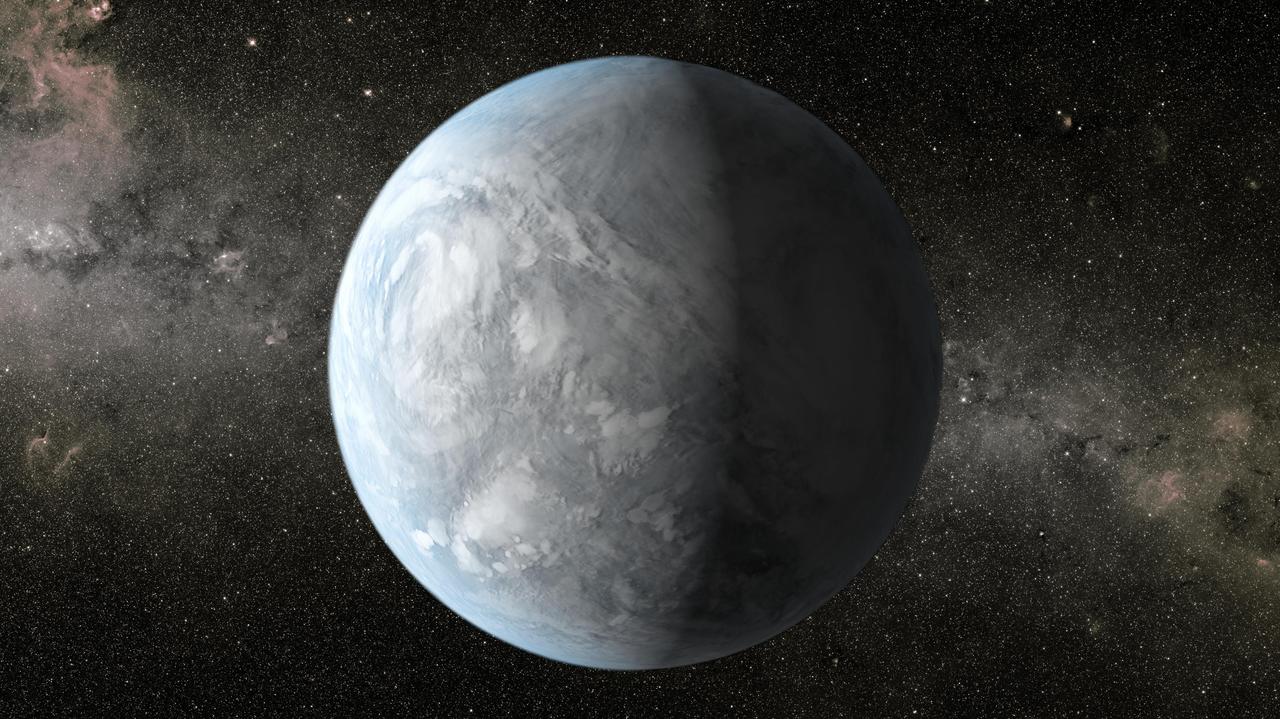
Like Kepler-62e shown here, LHS 1140 b is a “super-Earth”: a world larger than Earth but sitting in its star’s habitable zone. Such worlds are prime targets for finding potential signs of life. Credit: NASA/JPL-Caltech.
Why does that matter? Because nitrogen is not easy to come by, and the ways it does accumulate are telling.
The dominant atmospheric gases on most known rocky planets are carbon dioxide (as on Venus and Mars) or hydrogen (as on mini-Neptunes). Nitrogen is chemically inert (it does not react easily with other molecules), which creates a puzzle: how does it accumulate to dominate an atmosphere? Several abiotic pathways exist. On a planet with a reducing volcanic interior rich in ammonia-bearing compounds, prolonged outgassing over geological timescales could release and convert substantial nitrogen into molecular N₂. Photochemical reactions in the upper atmosphere can also influence nitrogen abundance. On a more massive world with an unusually active geological history, the sheer volume of outgassing might sustain higher nitrogen levels than would otherwise be possible.
Yet maintaining a nitrogen-dominated atmosphere over billions of years is a significant challenge without a continuous replenishment mechanism. On Earth, the most important such mechanism is biological. Bacteria fix atmospheric nitrogen into compounds used by living organisms. Organisms die, decompose, and release nitrogen back into the air. Without this cycle, nitrogen would gradually be drawn down into the geosphere. Earth’s nitrogen-dominated atmosphere is, in a direct sense, a product of life reinforcing an inorganic background.
This does not mean a nitrogen-rich atmosphere requires life. But it means a nitrogen-rich atmosphere is the kind of evidence that demands a full accounting of its origin, and on the one world where we have the most detailed data, that origin is deeply intertwined with living processes.
The 2024 JWST results do not confirm the presence of a nitrogen-rich atmosphere. They show that, among the models tested, a nitrogen-rich atmosphere fits the data better than the alternatives. That is very different from detection. But it is also not nothing. It is a set of observations pointing in a specific direction, toward a scenario that on one known world (ours) has a well-understood and partly biological origin.
How LHS 1140 b Differs from K2-18 b
When JWST detected dimethyl sulfide and other potential biosignature molecules in the atmosphere of K2-18 b in 2023, it briefly became the most-discussed exoplanet on Earth. But the excitement was complicated by what K2-18 b actually is.
K2-18 b is about 8.6 times Earth’s mass, sitting in a size regime where the planet is likely a “Hycean world”: a planet with a deep liquid water ocean beneath a thick hydrogen-helium envelope. This is scientifically fascinating, but evaluating it for life is genuinely difficult. Under the crushing pressures of a deep high-gravity water ocean, and within an atmosphere dominated by hydrogen rather than nitrogen and oxygen, the physical and chemical rules that govern biology on Earth may not apply. Molecules that on Earth would indicate life could form through non-biological pathways in such an unusual chemical regime, and we lack the baseline to cleanly distinguish the two.
There is also a technical dimension to this contrast. A Hycean world’s extended, hydrogen-rich atmosphere produces large, easily readable spectral signals that JWST can detect with relatively few transits. In contrast, LHS 1140 b’s thin, dense secondary atmosphere is much harder to detect (the signal is subtler and requires more observations to accumulate). The fact that a tentative detection is possible at all is a testament to JWST’s sensitivity.
LHS 1140 b is different in a way that cuts to the heart of the habitability question. It is rocky. Whatever atmosphere it has, it is built on a substrate we understand: a planet with a solid surface and a secondary atmosphere produced by geology. We have well-tested models for how rocky planets build and lose atmospheres, how their climates evolve, and what their surface conditions might look like. That familiarity makes the science more tractable.
This does not make LHS 1140 b more likely to harbor life than K2-18 b (we have no idea what the probability of life looks like on either world). But it makes LHS 1140 b a cleaner scientific target for the specific question of Earth-like habitability. If you want to know whether a rocky planet in a habitable zone can sustain the conditions for life, LHS 1140 b is the sharpest instrument we currently have for testing that.
What Comes Next
More JWST time has been allocated to LHS 1140 b. Future observations will stack additional transit spectra and employ multiple instrument modes (including NIRSpec) to cross-validate the atmospheric signal from different angles. The observations needed to strengthen or refute the nitrogen atmosphere hint are within reach: not decades away, but potentially years. Each transit is another data point pushing the evidence toward or away from significance.
If the signal strengthens and a nitrogen-rich atmosphere is confirmed, the implications are hard to overstate. It would not prove life. But it would place a rocky, habitable-zone planet with an Earth-like atmospheric composition on the map, and it would change the probability estimates that inform everything from telescope design to the search for radio signals from intelligent civilizations.
If the signal dissolves (if more data reveals it was instrument noise or a poorly constrained model), that too is useful. A bare rock at 48 light-years with a quiet stellar host and a 24.7-day year would remain a fascinating world, just one without the atmosphere that makes life as we know it possible. The universe is under no obligation to give us an easy answer.
The deeper point is that we are living in a moment where such questions stop being philosophical and start being empirical. For most of human history, the question of whether life exists on other worlds was unanswerable in principle. Today, a team at a telescope in space is measuring starlight filtered through the atmosphere of a world 280 trillion miles away, trying to detect nitrogen.
Whatever LHS 1140 b turns out to be, the fact that we are asking the question (and that the question now has a real answer approaching from the data) is its own kind of extraordinary.
Sources
- Cadieux, C., et al. (2024). Transmission Spectroscopy of the Habitable Zone Exoplanet LHS 1140 b with JWST/NIRISS. The Astrophysical Journal Letters, 970, L2. https://doi.org/10.3847/2041-8213/ad5afa
- Dittmann, J. A., et al. (2017). A temperate rocky super-Earth transiting a nearby cool star. Nature, 544, 333–336. https://doi.org/10.1038/nature22055
- Ment, K., et al. (2019). A Second Transiting Planet Around LHS 1140. The Astronomical Journal, 157(1), 32. https://doi.org/10.3847/1538-3881/aaf1b1
- Winters, J. G., et al. (2022). Revised Stellar Properties for LHS 1140 and Implications for Its Planetary System. The Astrophysical Journal, 927(1), 32.
- NASA James Webb Space Telescope Mission. https://science.nasa.gov/mission/webb/
- NASA Exoplanet Archive: LHS 1140 b entry. https://exoplanetarchive.ipac.caltech.edu
Further reading: LHS 1140 b on Wikipedia