
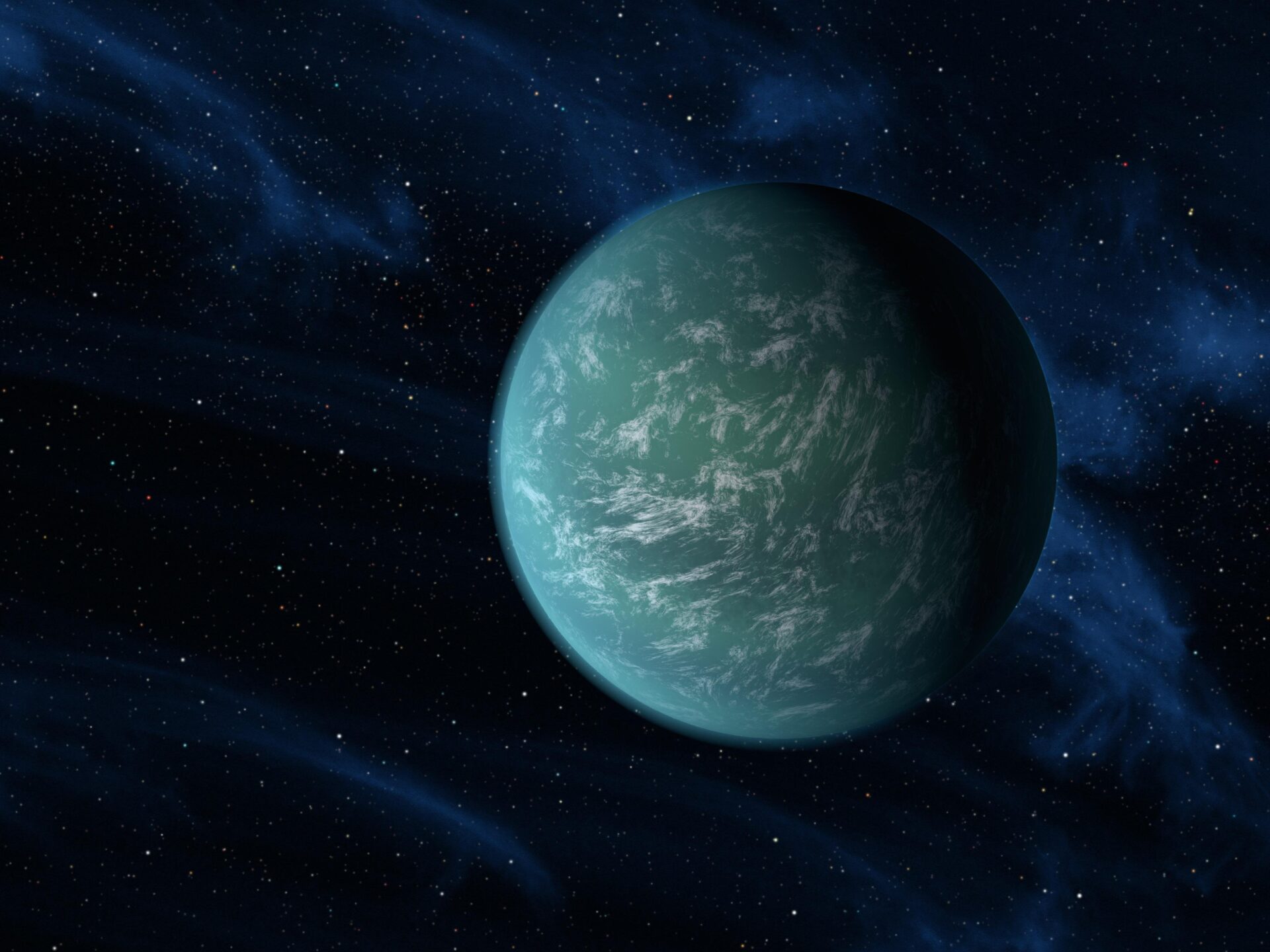
Of the thousands of exoplanets confirmed since the first detection in 1992, only a handful sit in the right place, around the right star, at the right distance to make the question worth asking seriously: could this world support life? Kepler-22b habitability is the question this article addresses: what do we actually know, and what does the science leave open?
Kepler-22b is one of those handful. Discovered in 2011 by NASA’s Kepler Space Telescope, it was the first confirmed planet orbiting within the habitable zone of a Sun-like star. That distinction earned it headlines, scientific papers, and a permanent place in the public imagination of worlds beyond our own.
But headlines compress. The real question, what do we actually know about Kepler-22b’s habitability, and what do we not know, is more interesting and more complicated than any summary can capture.
Kepler-22b Habitability Basics: Discovery and Habitable Zone
Kepler-22b was detected using the transit method. As the planet passed between its host star and the Kepler telescope, which stared at a fixed patch of sky in the Cygnus-Lyra region, it blocked a tiny fraction of the star’s light. By measuring the depth of that dimming and its periodicity, astronomers calculated the planet’s orbital period (289.9 Earth days) and its radius (approximately 2.4 times Earth’s).
The host star, Kepler-22, is a G-type star, the same class as the Sun, though slightly smaller and cooler, with about 97% of the Sun’s radius and 79% of its luminosity. Kepler-22b orbits at 0.849 AU, slightly closer to its star than Earth orbits the Sun, but because Kepler-22 is dimmer, the energy received is comparable.
The resulting equilibrium temperature, assuming an Earth-like albedo, is approximately 262 K (−11°C). With a greenhouse effect comparable to Earth’s, surface temperatures could be comfortable. Without one, the planet is frozen. The greenhouse effect is unknown.
These are the established facts. They are the foundation on which the habitability question rests.
The Mass Problem: We Do Not Know What Kepler-22b Is Made Of

Here is the central uncertainty that every discussion of Kepler-22b eventually reaches: we do not know the planet’s mass.
The transit method reveals radius. To determine mass, astronomers need radial velocity measurements, detecting the tiny wobble the planet’s gravity induces in its host star. For Kepler-22b, those measurements have not been precise enough to pin down the mass. Estimates range from roughly 10 to 35 Earth masses.
That range spans two fundamentally different kinds of planet.
At the low end, Kepler-22b could be a super-Earth: a rocky world with a substantial but not crushing surface gravity, a solid surface, and the potential for surface liquid water if temperatures are right. This is the habitable scenario.
At the high end, it could be a mini-Neptune: a world with a thick hydrogen and helium envelope surrounding a small rocky or icy core. Mini-Neptunes do not have accessible surfaces. Their atmospheres are crushing, and the distinction between “atmosphere” and “ocean” becomes meaningless at the pressures involved. Life as we understand it could not exist there.
Radius alone does not resolve this. Planets of 2.4 Earth radii can be either type. The boundary between super-Earths and mini-Neptunes, sometimes called the radius gap or Fulton gap, identified through statistical analysis of Kepler data, sits near 1.7 Earth radii. At 2.4 radii, Kepler-22b sits above the gap in territory where mini-Neptune compositions are more common. Think of it like identifying an animal from a silhouette: at this size, it’s statistically more likely to be a bear (a mini-Neptune) than a very large dog (a super-Earth), but we can’t be sure without more details.
This is not a definitive conclusion. It is a statistical tendency. Individual planets cross the gap. But the honest assessment is that the mini-Neptune scenario is at least as likely as the super-Earth scenario, and possibly more so.
The Habitable Zone: What “Habitable” Actually Means
The term habitable zone carries precision in its scientific definition and ambiguity in its common use.
The habitable zone is the range of distances from a star at which a rocky planet with a sufficiently dense atmosphere could maintain liquid water on its surface. It is defined by modeling, not by observation. It assumes a planet has: a solid surface, an atmosphere, and properties somewhere in the range of Earth’s.
Kepler-22b satisfies the distance criterion. It does not automatically satisfy the others.
The habitable zone is also wider than intuition suggests. The inner edge is where a runaway greenhouse effect renders water vapor a net warming agent, eventually boiling off all surface water (Venus exceeds this boundary). The outer edge is where CO₂ clouds begin to reflect so much sunlight that temperatures plummet regardless of atmospheric density.
Within that range, a planet still needs: – Sufficient mass to retain an atmosphere Kepler-22b almost certainly clears this bar given its size Geological activity to cycle carbon and regulate long-term climate, unknown for Kepler-22b A magnetic field to shield the surface from stellar radiation, unknown Liquid water which requires the right atmospheric composition, unknown A stable orbit Kepler-22b’s nearly circular orbit is encouraging here
Being in the habitable zone is necessary but far from sufficient.
If It Is Rocky: The Best Case
If Kepler-22b turns out to be a rocky super-Earth, the habitability prospects improve substantially. A rocky world of that size would likely have:
Surface Gravity and Atmosphere
Stronger Gravity, Denser Air Higher surface gravity than Earth, perhaps 1.5 to 2 times greater, assuming rocky composition. This affects what organisms could evolve (taller, more vertical structures become energetically expensive) but is not a barrier to life itself. A denser atmosphere, retained more efficiently by stronger gravity, could support a more vigorous greenhouse effect, warming a planet that would otherwise be slightly cold at its orbital distance.
Geology and Climate
Potentially More Vigorous Tectonics Potentially more vigorous plate tectonics, driven by a larger and possibly hotter interior. Plate tectonics on Earth regulate the carbon cycle over geological timescales, preventing the runaway greenhouse and runaway glaciation scenarios that have threatened habitability on Venus and Mars. A more geologically active Kepler-22b could be more climatically stable than Earth, or more volatile.
The Ocean World Possibility
Deep Global Oceans The oceans, if they exist, could be deep. Very deep. Some models of super-Earth interior structures predict water layers hundreds of kilometers thick, forming a global ocean with no continental land at all, what researchers have called ocean planets or water worlds. Life might exist in such oceans, but the absence of land would prevent certain geochemical cycles that may be important for sustaining a biosphere over billions of years. This concept is part of the broader search for life beyond the traditional habitable zone.
The Star Factor: Kepler-22 Is Not the Sun

Kepler-22 is slightly smaller, cooler, and less luminous than the Sun. For habitability, this cuts both ways.
On the positive side, Kepler-22 is likely more stable than the Sun in terms of flare activity. G-type stars are generally less prone to the violent stellar flares common in smaller M-type stars, which can strip planetary atmospheres and bombard surfaces with radiation. Given its orbital distance and a likely circular orbit, Kepler-22b is unlikely to be tidally locked, it probably rotates independently, avoiding the extreme day-night temperature contrasts of tidally locked worlds.
On the less positive side, Kepler-22 is an aging star, and its spectral output has changed over billions of years. Whether Kepler-22b has been continuously within the habitable zone throughout its history, or whether it passed through uninhabitable periods, is unknown.
What Would Confirm or Rule Out Habitability
The James Webb Space Telescope cannot observe Kepler-22b. At 620 light-years distance, it is too far for JWST’s spectroscopic capabilities to characterize its atmosphere. The telescope is focused on much closer targets, TRAPPIST-1 planets at 39 light-years, for instance,, where transmission spectroscopy can extract atmospheric composition from starlight filtered through the planet’s atmosphere during transits.
What would actually resolve the Kepler-22b question:
Mass measurement. More precise radial velocity data would pin down the mass and help distinguish rocky from gaseous composition. Next-generation spectrographs on extremely large telescopes, like the upcoming Extremely Large Telescope (ELT), may achieve this in the 2030s.
Atmospheric characterization. Detecting specific gases, water vapor, carbon dioxide, oxygen, ozone, would transform the probability assessment dramatically. This is not achievable with current technology at 620 light-years but may be possible with future space telescopes. For a closer look at how such atmospheric studies work, see our article on JWST’s detection of CO₂ in exoplanet atmospheres.
Radius refinement. More precise radius measurements could shift Kepler-22b’s position relative to the radius gap and update compositional probabilities.
Until those measurements exist, Kepler-22b sits in a scientifically honest limbo: a planet in the right place around the right kind of star, with an unknown composition that makes it either one of the most promising known exoplanets or a world completely inhospitable to life as we know it.
So, can it support life? Based on current data, the odds are against a habitable surface, but the possibility remains tantalizingly open. For now, astronomers are focusing characterization efforts on nearer, more promising systems, placing Kepler-22b as a historic milestone in the ongoing search.
Is Kepler-22b habitable?
We do not know. Kepler-22b orbits within the habitable zone of a Sun-like star, and its equilibrium temperature is consistent with liquid water under certain atmospheric conditions. However, its mass is unknown, and at its size (2.4 Earth radii) it may be a rocky super-Earth or a gaseous mini-Neptune. If it is a mini-Neptune, it has no accessible surface and is almost certainly not habitable. If it is rocky, it is one of the more promising known candidates.
How far away is Kepler-22b?
Kepler-22b is approximately 620 light-years from Earth, in the constellation Cygnus. At that distance, it would take a spacecraft traveling at current speeds hundreds of thousands of years to reach it, and it is too far away for current telescopes to characterize its atmosphere.
What is the size of Kepler-22b?
Kepler-22b has a radius of approximately 2.4 times Earth’s. Its mass is not precisely known, estimates range from about 10 to 35 Earth masses. The combination of radius and uncertain mass means astronomers cannot confidently determine whether it is a rocky planet or a gaseous one.
Could Kepler-22b have liquid water?
Possibly. If Kepler-22b has a rocky surface and an atmosphere with a greenhouse effect similar to Earth’s, its surface temperatures could allow liquid water. Its equilibrium temperature (without greenhouse warming) is approximately −11°C, which would be frozen, but a moderate greenhouse effect could warm it to habitable temperatures. Whether such an atmosphere exists is unknown.
Why can’t we see Kepler-22b better?
At 620 light-years, Kepler-22b is far beyond the range of current spectroscopic characterization. The James Webb Space Telescope is focused on much closer planetary systems. Future extremely large ground-based telescopes and next-generation space observatories may eventually achieve the measurements needed to characterize Kepler-22b’s atmosphere and constrain its mass.
Sources
- Borucki, W.J. et al. (2012). Kepler-22b: A 2.4 Earth-radius Planet in the Habitable Zone of a Sun-like Star. The Astrophysical Journal, 745(2), 120. doi:10.1088/0004-637X/745/2/120
- Fulton, B.J. et al. (2017). The California-Kepler Survey. III. A Gap in the Radius Distribution of Small Planets. The Astronomical Journal, 154(3), 109. doi:10.3847/1538-3881/aa80eb
- Kasting, J.F., Whitmire, D.P. & Reynolds, R.T. (1993). Habitable Zones around Main Sequence Stars. Icarus, 101(1), 108–128. doi:10.1006/icar.1993.1010
- Rogers, L.A. (2015). Most 1.6 Earth-radius Planets are Not Rocky. The Astrophysical Journal, 801(1), 41. doi:10.1088/0004-637X/801/1/41
- Kopparapu, R.K. et al. (2013). Habitable Zones around Main-sequence Stars: New Estimates. The Astrophysical Journal, 765(2), 131. doi:10.1088/0004-637X/765/2/131
- NASA Exoplanet Archive. Kepler-22 b. exoplanetarchive.ipac.caltech.edu
- Perryman, M. (2018). The Exoplanet Handbook. Cambridge University Press. ISBN 9781108419772.
Further reading: Kepler-22b on Wikipedia