

Around 541 million years ago, something extraordinary happened. In what amounts to a geological blink of an eye, animal life diversified into forms so strange and inventive that, even today, they look like science fiction. Within roughly 20 million years, the oceans filled with trilobites, armored worms, the first large predators, and the earliest ancestors of vertebrates. Darwin himself, whose work laid the foundation for understanding human evolutionary history and the rise of the genus Homo, worried that such a rapid appearance of complexity might threaten his theory.
This was the Cambrian Explosion, a pivotal moment that followed the genesis of life on our planet. What caused it? For the full scientific analysis of competing hypotheses, see What Triggered the Cambrian Explosion?
But it was not a magical appearance of animals from nothing. It was a threshold moment, when environmental permissiveness, ecological escalation, and developmental possibility synchronized. The result was not simply more life, but a new mode of evolution. Life learned to experiment with architecture. It learned to draw edges.
A World Before Animals Had Edges
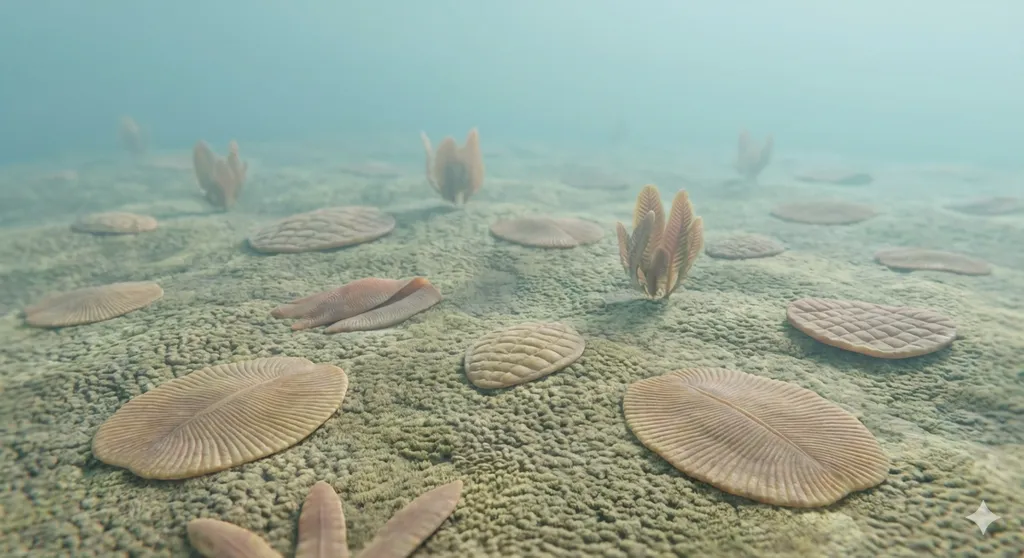
To understand the Cambrian, we must first imagine the world before it.
The late Ediacaran seas, between about 635 and 541 million years ago, were populated by organisms that seemed almost alien. Fossils reveal quilted fronds, ribbed ovals, and disk-shaped forms resting quietly on microbial mats. Many lacked clear heads, tails, limbs, or internal organs recognizable to us. They were soft, flattened, and often radially organized.
These were animals without armor, claws, or sharp front-and-back orientation. They had no mineralized skeletons, piercing mouthparts, or burrowing limbs. They left few traces of active predation.
In a literal sense, they lacked edges.
The sediment surface beneath them was largely undisturbed. Microbial mats formed stable carpets across the seafloor. Ecosystems were simple and relatively quiet.
Then, in the latest Ediacaran, the first deep burrows appear. Organisms began moving through sediment, mixing it, oxygenating it, and destabilizing the microbial mats that had structured ecosystems for millions of years.
The seafloor changed, and when the seafloor changes, everything changes.
The Cambrian Surge
By the early Cambrian, roughly 520 million years ago, the fossil record reveals a radically different marine world.
Trilobites with jointed exoskeletons scuttled across the seabed. Worm-like priapulids bore rows of teeth. Early mollusks secreted shells. Spiny lobopodians crawled over sediments. And predators like Anomalocaris, equipped with grasping appendages and large compound eyes, hunted actively in open water.
Much of our understanding of this explosion comes from exceptional fossil deposits known as Lagerstätten, rare geological windows where soft tissues are preserved. The Burgess Shale in Canada, the Chengjiang and Qingjiang biotas in China, Sirius Passet in Greenland, and Emu Bay in Australia have revealed anatomical details that ordinary fossils erase.
These fossils reveal something crucial: many Cambrian animals do not belong neatly to modern phyla. They are stem groups, early branches related to modern lineages but not yet part of the crown group, which includes all living members and their last common ancestor.
The Cambrian Explosion was not the sudden appearance of modern animals. It was a period of morphological experimentation. Many designs were evolutionary side paths. Most went extinct.
The explosion was not about invention from nothing. It was about exploration.
Was It Really Sudden?
For decades, the Cambrian Explosion was framed as a puzzle. How could complex animals appear so abruptly in the fossil record?
Two lines of research have softened that apparent abruptness.
First, molecular clock studies, which estimate divergence times using genetic differences, suggest that many animal lineages split before the Cambrian boundary. The genetic groundwork for modern animals likely extends into the Ediacaran.
Second, fossil discoveries have pushed trace fossils and small shelly fossils back into the late Ediacaran, revealing that behavioral and skeletal innovations began earlier than once thought.
At the same time, recent methodological critiques show that deep molecular divergence dates can be highly sensitive to model assumptions and prior distributions. Some early clock estimates may have overstated the depth of divergence.
The gap between genes and fossils is narrowing from both sides.
The Cambrian Explosion now looks less like a sudden origin and more like a threshold crossing, the visible ecological consequence of processes that had been accumulating beneath the surface.
Oxygen: A Dial, Not a Switch
Oxygen has long been a prime suspect.
Complex animals require oxygen for sustained metabolism, muscle activity, and nervous systems. Geochemical proxies, including molybdenum and uranium isotopes, indicate a rise in marine oxygenation across the Ediacaran–Cambrian boundary.
But the timing is messy. Oxygen levels had risen before without triggering comparable radiation. Some early Cambrian animals thrived in oxygen conditions that would stress modern marine vertebrates.
Oxygen was not a switch that flipped complexity on.
It was a dial.
Increasing oxygen likely expanded the metabolic ceiling for active animals. It permitted larger body size, sustained movement, and predation. But permissive conditions alone do not cause evolutionary innovation. They create space for other forces to operate.
Oxygen opened ecological possibilities. It did not dictate how that possibility would be used.
The Ecological Arms Race
Predation may have supplied the missing escalation.
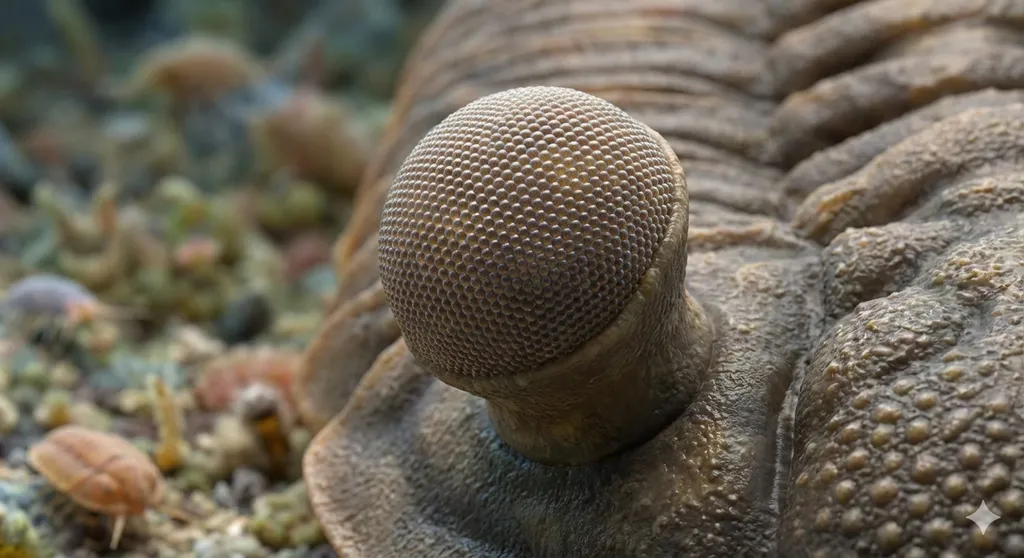
The early Cambrian fossil record shows drill holes in shells, defensive spines, burrowing behavior, and the widespread emergence of eyes. Once some animals began efficiently eating others, selection pressures intensified.
Armor invites sharper teeth. Burrowing invites stronger claws. Camouflage invites better vision.
Vision transforms ecology.
The Cambrian marks the first widespread appearance of eyes capable of forming images. A predator that can see can stalk, chase, and choose targets. A prey animal that can see can detect danger before contact. Neural systems expand under such pressures.
These interactions form feedback loops. Once escalation begins, change can accelerate.
The Cambrian seas entered such a feedback regime. Evolution was no longer exploring passive morphologies resting on microbial mats. It was navigating a landscape shaped by competition, avoidance, and pursuit.
Developmental Architecture: The Hidden Constraint
Ecology and oxygen explain why selection intensified. They do not explain why so many radically different body architectures became accessible at once.
For that, we must look at developmental biology.
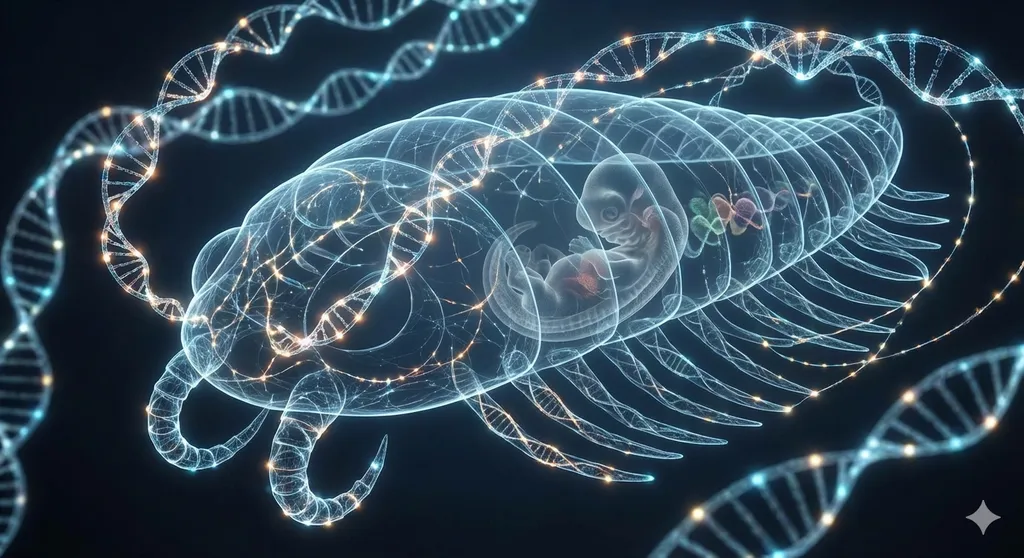
By the Cambrian, animals possessed complex gene regulatory networks, including Hox genes that pattern the body axis. These genes did not suddenly appear in the Cambrian; their origins trace deeper.
What mattered was how those networks were structured.
Developmental systems are hierarchical. Deeply conserved regulatory “kernel” genes control major body axes and organ systems. Mutations in these kernels are often catastrophic. But beneath them lie modular networks that regulate appendages, sensory organs, and skeletal elements.
By the Cambrian, the deep kernels were already established. What expanded was the downstream modular regulatory apparatus. Small changes in regulatory sequences could alter limbs, eyes, and armor without destabilizing the entire organism.
Evolution gained access to architectural variation without breaking the underlying blueprint.
This modularity made experimentation safer.
When ecological pressures intensified, developmental systems were ready to respond.
Biomineralization: Constraint Removed, Motive Supplied
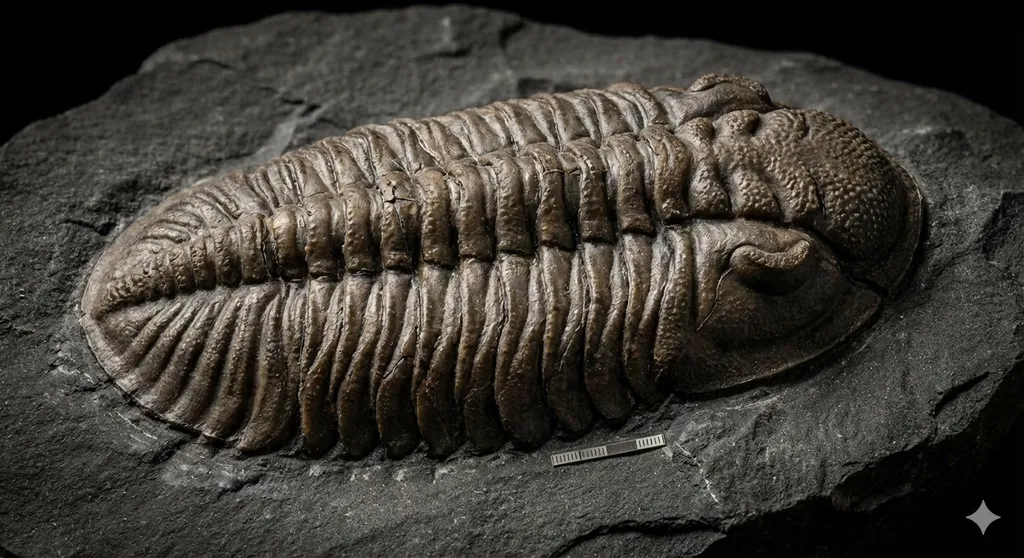
Hard skeletons appear near the base of the Cambrian in the form of small shelly fossils, followed by trilobites, brachiopods, and early mollusks.
Did animals evolve skeletons because seawater chemistry changed? Or because predators forced them to?
Geochemical evidence suggests that seawater composition shifted during the late Neoproterozoic, making calcium carbonate precipitation energetically more favorable. But there was a lag. Animals did not immediately mineralize when chemistry permitted it.
The chemistry removed a constraint.
Predation supplied the motive.
Once skeletons evolved, they enabled new ecological roles, including larger size, more powerful muscles, burrowing, and structural support. They also improved fossil preservation, amplifying the apparent explosion in the record.
Biomineralization was not the sole driver. But once it appeared, it permanently altered the evolutionary landscape.
Edges hardened.
The Disappearance of the Ediacaran
As Cambrian ecosystems intensified, most classic Ediacaran forms vanished.
Whether this represents competitive displacement, environmental change, or genuine extinction remains debated. Some Ediacaran lineages may have been evolutionary dead ends, poorly equipped to survive in predation-dominated systems. Others may have simply been outcompeted.
What is clear is that the Cambrian world was not a gentle transition.
It was a restructuring.
Why No Second Explosion?
If the Cambrian Explosion was a threshold event, why has nothing comparable occurred since?
Several possibilities present themselves.
First, ecological saturation. By the end of the Cambrian, most major ecological roles were occupied. Later radiations, such as the Ordovician diversification, expanded biodiversity but largely within established architectural frameworks.
Second, developmental canalization. As gene regulatory networks stabilized, radical body-plan experimentation may have become increasingly constrained.
Third, environmental contingency. The Neoproterozoic–Cambrian transition involved unusual tectonic configurations, ocean chemistry shifts, and oxygen transitions that may not easily recur.
Evolution has continued to innovate, including flowers, flight, and intelligence. But the foundational architectural space of animal body plans may have been largely mapped early.
The Cambrian was not the only radiation.
It was the one that defined the rules of the game.
What the Cambrian Explosion Really Means
The Cambrian Explosion does not undermine evolutionary theory. It demonstrates its dynamism.
It reveals that evolution is not always gradual and uniform. Systems can exist in relatively stable states for tens of millions of years, then reorganize rapidly when constraints relax and feedback loops intensify.
It also reveals the interplay between contingency and inevitability. Oxygen rose. Developmental networks matured. Predators appeared. None alone forced the explosion. Together, they created a regime in which experimentation accelerated.
The Ediacaran animals without edges were not failures. They were early experiments in multicellular life. The Cambrian was the moment when evolution learned to build armor, to burrow, to see, and to carve boundaries in flesh and mineral.
Those boundaries persist inside us.
Our segmented bodies, our bilateral symmetry, and our image-forming eyes all trace back to that interval when life learned to draw edges and explore what those edges made possible.
The Cambrian Explosion was not merely a burst of forms.
It was a transition in how evolution operates when constraints loosen and feedback intensifies.
It was the moment the experiment became ambitious.
And we are one of its surviving designs.
Sources & References
Budd, G. E. (2024). Molecular clocks and the timing of animal origins. Biological Reviews. doi:10.1111/brv.13049
Erwin, D. H., et al. (2011). Science The Cambrian conundrum: Early divergence and later ecological success in the early history of animals. Science, 334(6059), 1091–1097.
Marshall, C. R. (2006). Annual Review of Earth and Planetary Sciences Explaining the Cambrian “explosion” of animals. Annual Review of Earth and Planetary Sciences, 34, 355–384.
Porter, S. M. (2007). Seawater chemistry and early carbonate biomineralization. Science, 316(5829), 1302–1304. doi:10.1126/science.1132485
Butterfield, N. J. (2011). Nature Oxygen, animals, and oceanic ventilation: An alternative view. Nature, 475, 45–48.
Knoll, A. H. (2003). Life on a Young Planet: The First Three Billion Years of Evolution on Earth. Princeton University Press.
Gould, S. J. (1989). Wonderful Life: The Burgess Shale and the Nature of History. W. W. Norton.
Conway Morris, S. (1998). The Crucible of Creation: The Burgess Shale and the Rise of Animals. Oxford University Press.
Briggs, D. E. G., Erwin, D. H., & Collier, F. J. (1994). The Fossils of the Burgess Shale. Smithsonian Institution Press.
Fu, D., et al. (2019). Science The Qingjiang biota and the early Cambrian diversification of animals. Science, 363(6433), 1338–1342.
Bengtson, S. (2004). Early skeletal fossils and the evolution of biomineralization. Paleontological Society Papers, 10, 67–78.
Further reading: Cambrian explosion on Wikipedia