
How the edges of the observable universe define, limit, and shape our understanding of the cosmos
What Is the Cosmic Horizon?
When you stand at the ocean’s edge and gaze toward the distant line where sky meets water, you are looking at a horizon, a boundary set not by a physical wall, but by the geometry of your vantage point. The cosmic horizon works in much the same way, only on a scale so vast it staggers the imagination. In cosmology, the cosmic horizon refers to the ultimate boundary of the observable universe, the farthest distance from which light has had time to travel to Earth since the Big Bang roughly 13.8 billion years ago. However, cosmologists distinguish several types of this boundary, each with profound implications for what we can see, what we could eventually see, and what is forever out of reach.
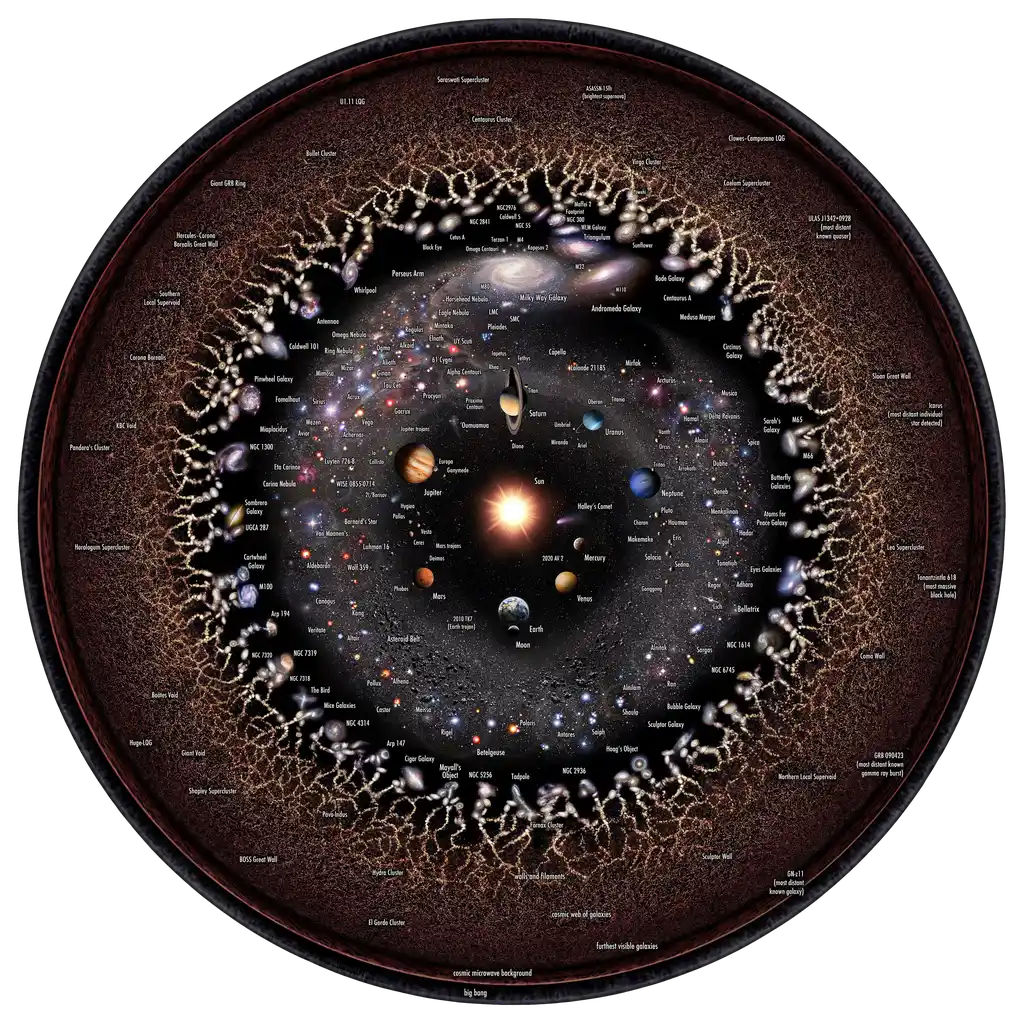
But here is where things become wonderfully counterintuitive. Because the universe has been expanding throughout its entire history, and that expansion has been accelerating, the cosmic horizon does not sit at a distance of 13.8 billion light-years. Instead, according to our current best cosmological models, the observable universe stretches approximately 46.5 billion light-years in every direction, giving it a diameter of about 93 billion light-years. The extra distance is a consequence of the stretching of space itself. Objects that emitted the light we detect today were much closer when that light began its journey; cosmic expansion has since carried them far beyond where a simple age × speed-of-light calculation would place them.
Understanding the cosmic horizon is not just an exercise in big numbers. It fundamentally shapes what we can know about reality. Everything we have ever observed (every galaxy catalogued, every supernova measured, every faint whisper of background radiation mapped) lies within this boundary. Beyond it lies the unobservable universe, a region whose contents we can only infer, never directly detect.
The Different Types of Cosmic Horizons
As noted above, cosmologists distinguish between several different cosmic horizons. The distinction matters because each one answers a slightly different question about what we can observe and interact with across the vast reaches of spacetime.
The Particle Horizon
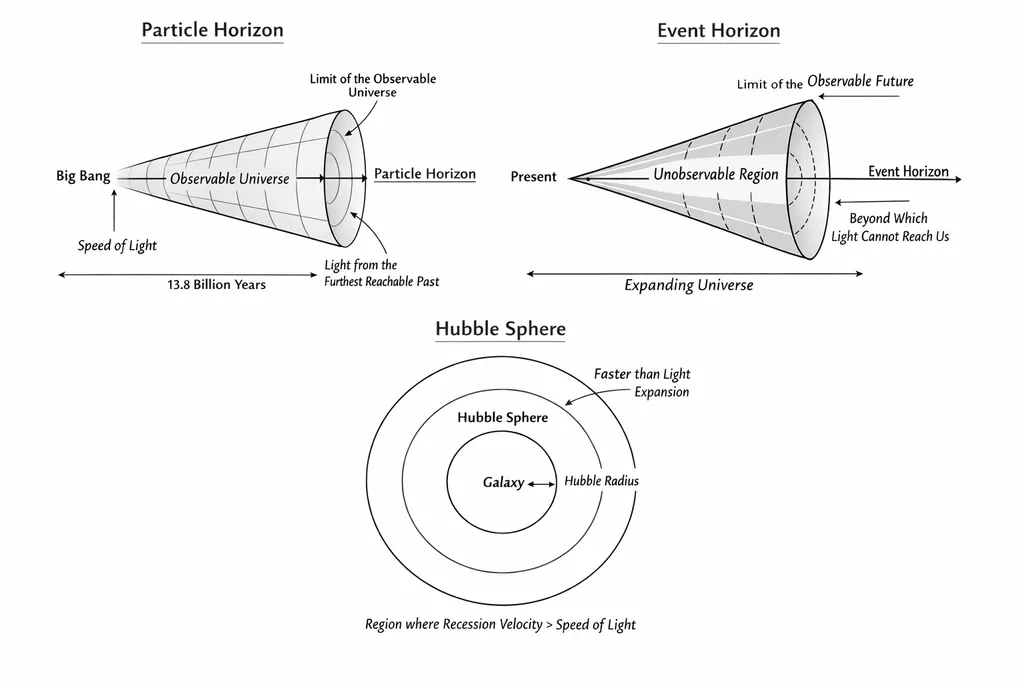
The particle horizon is the most commonly referenced cosmic horizon. It marks the maximum distance from which particles (including photons of light) could have traveled to an observer since the beginning of the universe. In other words, it defines the boundary of the observable universe as it exists right now.
The particle horizon is determined by the conformal time that has elapsed since the Big Bang, multiplied by the speed of light. Because the universe expanded rapidly in its earliest moments and continues to expand today, the particle horizon is far larger than 13.8 billion light-years. At the present epoch, according to the standard Lambda-CDM cosmological model, it sits at a comoving distance of about 46.5 billion light-years, enclosing everything we could, in principle, observe.
One crucial feature of the particle horizon is that it is always growing. As more time passes, light from ever more distant regions has a chance to reach us, and the particle horizon recedes outward. However, the accelerating expansion of the universe means that the rate at which new objects enter our observable volume is slowing, and will eventually cease entirely.
The Cosmic Event Horizon
While the particle horizon tells us what we can see now, the cosmic event horizon tells us what we will ever be able to see, even given infinite time. It represents the largest comoving distance from which light emitted today will eventually reach us.
The current distance to the cosmic event horizon is roughly 16 billion light-years (about 5 gigaparsecs). In a universe dominated by dark energy (as ours appears to be), this event horizon will gradually approach a maximum value of approximately 17.5 billion light-years and then remain fixed forever. Any galaxy beyond this distance is receding from us faster than light can cross the distance, meaning that light it emits right now will never, ever reach us.
The existence of a cosmic event horizon has a profound and somewhat melancholy implication: the observable universe is not just limited in what it shows us of the past; it is also limited in what it will ever show us of the future. Over vast timescales, galaxies beyond the event horizon will redshift into invisibility, fading from our instruments one by one.
The Hubble Sphere
The Hubble sphere, sometimes called the Hubble horizon, is the region around an observer within which the recession velocity of objects due to cosmic expansion is less than the speed of light. Its radius is defined by the Hubble parameter, which measures the current rate of expansion. Objects beyond the Hubble sphere are receding from us faster than light, a statement that sounds like it should violate relativity but does not. General relativity places no speed limit on the expansion of space itself, only on objects moving through space.
The Hubble sphere is not a fixed boundary, and (critically) it is not the edge of the observable universe. Light emitted from beyond the Hubble sphere can still eventually reach us. This is possible because each photon is always moving through its local patch of space at exactly the speed of light. Even if the space between that photon and Earth is currently expanding faster than light, the photon can make progress if the expansion rate of the space it is traversing later drops below the speed of light. When it crosses into the Hubble sphere, it begins gaining ground on us. This is why light from galaxies currently beyond the Hubble sphere is already in our telescopes; it was emitted when those galaxies were beyond the sphere, but it has since crossed into our Hubble volume.
The Optical Horizon (Surface of Last Scattering)
There is a practical horizon that sits inside the particle horizon: the surface of last scattering, sometimes called the optical horizon. This is the farthest distance from which photons specifically could have traveled freely to reach us. It represents the limit of electromagnetic observation and corresponds to about 380,000 years after the Big Bang, when the universe cooled enough for electrons and protons to combine into neutral hydrogen, allowing photons to stream through space unimpeded for the first time.
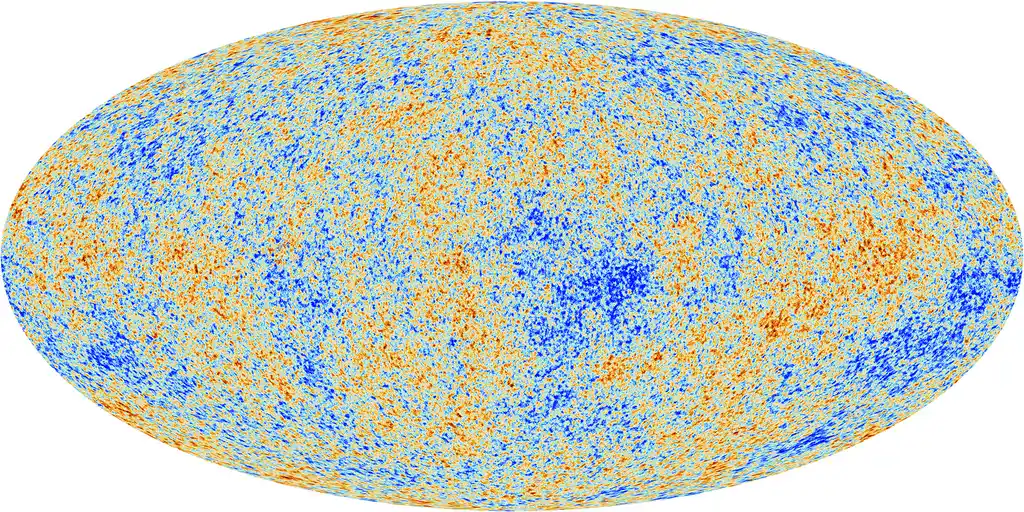
The cosmic microwave background (CMB) radiation we observe today is the afterglow of that moment. It forms a kind of wall of light at the edge of our electromagnetic vision, the oldest light in the universe. When we look at the CMB, we are looking at the universe when it was still an infant: a nearly uniform sea of plasma at a temperature of about 3,000 Kelvin, now redshifted to a cool 2.7 Kelvin.
Beyond the optical horizon, the early universe was opaque to light. We cannot see into that era with electromagnetic radiation. However, the optical horizon is a barrier for photons, not for all information. Future neutrino observatories and gravitational wave detectors may allow us to peer past this wall, probing even earlier epochs of cosmic history, potentially all the way back to the end of cosmic inflation. Each type of messenger effectively carries its own horizon, and each new detection method pushes the effective boundary of our observable universe a little further back in time.
Why Is the Observable Universe 93 Billion Light-Years Across?
One of the most common questions in cosmology is deceptively simple: if the universe is only 13.8 billion years old, how can we see objects 46.5 billion light-years away? The answer lies in the difference between the distance light has traveled and the present-day distance to the object that emitted it.
When the CMB radiation we detect today was first released, the matter that emitted it was only about 42 million light-years away from the matter that would eventually become Earth. But in the 13.8 billion years since that moment, the expansion of space has carried that matter much farther from us. Today, it sits approximately 46.5 billion light-years away. The light itself did not travel 46.5 billion light-years through static space; rather, the space through which it traveled stretched while it was in transit.
This distinction between “light travel distance” (how far the light actually journeyed on its way to us) and “comoving distance” (where the object that emitted it is located now) is essential for understanding the size of the cosmic horizon. It is the expansion of the universe that inflates the observable volume far beyond what the age of the cosmos and the speed of light alone would suggest.
The Horizon Problem: A Puzzle That Reshaped Cosmology
The cosmic horizon does more than set limits on observation. It also gave rise to one of the most important puzzles in modern cosmology: the horizon problem.
When scientists mapped the cosmic microwave background, they found something remarkable. The temperature of the CMB is extraordinarily uniform across the entire sky, varying by only about one part in 100,000. On the face of it, this might seem unsurprising; perhaps the early universe was just naturally smooth. But the standard Big Bang model predicts that widely separated regions of the CMB sky were never in causal contact. At the time the CMB was emitted, the particle horizon was only about 300,000 light-years across. From Earth, this corresponds to a patch of sky about 1 degree across. Yet the CMB is uniform in every direction, across the full 360 degrees.
This meant that two opposite points on the CMB sky, separated by more than about one degree, were causally disconnected; no signal traveling at the speed of light could have passed between them since the beginning of the universe. They had no way to exchange energy, share information, or reach thermal equilibrium. So how did they end up at precisely the same temperature? Without some mechanism to establish that equilibrium across these causally disconnected regions, the observed uniformity of the CMB is deeply mysterious.
Cosmic Inflation: The Solution
The most widely accepted solution to the horizon problem is cosmic inflation, a theory first proposed by physicist Alan Guth in 1980 and later refined by Andrei Linde, Andreas Albrecht, and Paul Steinhardt. Inflation proposes that in the first tiny fraction of a second after the Big Bang, the universe underwent a brief period of exponential expansion, increasing in size by a factor of at least 10²⁶ in roughly 10⁻³² seconds.
Before inflation, the entire observable universe was contained in an incredibly small region, small enough for light to have crossed it and established thermal equilibrium. Inflation then stretched this tiny, uniform patch to enormous scales, far larger than the particle horizon at the time. When the CMB was later emitted, its uniformity was a relic of that pre-inflationary equilibrium, now imprinted across the entire observable sky.
Inflation also elegantly resolves two other problems with the standard Big Bang model: the flatness problem (why the universe appears geometrically flat) and the magnetic monopole problem (why exotic particles predicted by grand unified theories are not observed). It remains one of the cornerstones of modern cosmological theory, though the precise physical mechanism that drove inflation is still an active area of research.
What Lies Beyond the Cosmic Horizon?
Perhaps no question in cosmology is more tantalising than this: what exists beyond the cosmic horizon? The honest answer is that we do not know for certain, and by definition, we cannot observe it directly. But cosmologists have strong reasons to believe that the universe extends far, far beyond our observable patch.
Observations of the CMB and large-scale galaxy surveys show that the observable universe is remarkably homogeneous and isotropic; it looks roughly the same in every direction and at every large-scale distance. The simplest explanation is that the universe is much larger than what we can see, and that our cosmic horizon is simply one observer’s local boundary within a vast, possibly infinite, cosmos. Just as a sailor’s horizon does not mark the edge of the ocean, our cosmic horizon does not mark the edge of reality.
Some theoretical frameworks go even further. Inflationary models suggest the total universe could be immensely larger than the observable portion, possibly by a factor of 10²³ or more. Other speculative ideas, such as the multiverse hypothesis, propose that our observable universe may be just one bubble in a vast foam of disconnected universes, each with its own physical constants and cosmic horizons.
It is also worth noting that the unobservable universe beyond our cosmic horizon may have different properties from the region we can see, or it may be a seamless continuation of the same physics. We simply lack the data to distinguish between these possibilities, and the accelerating expansion of the universe means we are unlikely ever to gain it.
The Fate of the Cosmic Horizon
What will happen to the cosmic horizon in the far future? The answer depends on the nature of dark energy, the mysterious force driving the accelerating expansion of the universe.
In the most widely accepted model (the Lambda-CDM cosmology, where dark energy behaves as a cosmological constant), the cosmic event horizon will approach a fixed comoving limit of roughly 17.5 billion light-years. Any galaxy whose current comoving distance is greater than that is already forever beyond our reach. Those just within it will gradually fade from view as their light is redshifted to ever longer wavelengths. Over trillions of years, the observable universe will become increasingly empty and dark. Eventually, only gravitationally bound structures, such as our Local Group of galaxies, will remain visible.
Extrapolating further, the Lambda-CDM model predicts a universe that will eventually consist of isolated clusters drifting through a vast, empty, featureless void. Future astronomers (if any exist) would have no way of knowing that billions of galaxies once filled the sky. The cosmic horizon will have effectively erased the evidence.
If dark energy behaves differently (for instance, if it strengthens over time in a scenario known as the “Big Rip”), the cosmic horizon could shrink dramatically, eventually tearing apart galaxies, solar systems, and even atoms. Conversely, if dark energy weakens or reverses, expansion could slow or halt, and the cosmic event horizon might expand to encompass far more of the universe.
Peering Deeper: The Future of Cosmic Horizon Science
Our ability to explore the cosmic horizon has never been greater. The James Webb Space Telescope is observing galaxies that formed within the first few hundred million years after the Big Bang, approaching the edge of the observable universe. Planned next-generation instruments promise to push the frontier even further.
But the most exciting prospects may lie not with light, but with entirely new messengers. Gravitational waves, first detected in 2015 by the LIGO collaboration, open a window onto events and epochs that electromagnetic radiation cannot reveal. A future space-based gravitational wave observatory could, in principle, detect signals from the end of cosmic inflation itself, probing the very moment when the cosmic horizon was set in motion.
Neutrino astronomy is another emerging frontier. Because neutrinos decoupled from matter when the universe was about one second old and the temperature was around 10 billion Kelvin (long before photons were freed at the surface of last scattering), a cosmic neutrino background exists that encodes information from an even earlier era than the CMB. Detecting this extraordinarily faint signal remains one of the great experimental challenges in physics, but success would allow us to see past the optical horizon and into the first second of the universe’s existence.
Each new observational window effectively gives us a different cosmic horizon, a different boundary between what we can and cannot see. Taken together, these multiple horizons promise to paint an increasingly complete picture of the universe’s origin and evolution.
Conclusion: The Beauty of a Bounded View
The cosmic horizon is both a limit and an invitation. It tells us, with mathematical precision, how much of the universe we are permitted to see, and in doing so, it reveals the deep structure of spacetime, the history of cosmic expansion, and the fundamental physics that govern reality.
Every advance in cosmology has pushed our effective horizon outward, from the first telescopes that revealed galaxies beyond the Milky Way, to the discovery of the CMB, to the gravitational wave detections that shook spacetime itself. The cosmic horizon reminds us that the universe is not only larger than we observe, but likely larger than we can ever observe. And yet, within our bounded view, there is more than enough wonder to last a lifetime, or a cosmos.
The name Cosmic Horizons captures this spirit perfectly: the enduring human impulse to explore the edges of the known, to peer as far as light, gravity, and ingenuity will allow, and to ask what lies just beyond.
What is the cosmic event horizon?
The cosmic event horizon is the boundary beyond which light emitted today can never reach us, given the accelerating expansion of the universe. It currently sits approximately 16 billion light-years away, distinct from the observable universe boundary of 46 billion light-years, which marks how far ancient light has already traveled since the Big Bang.
How far away is the cosmic event horizon?
The cosmic event horizon is approximately 16 billion light-years from Earth. Unlike the observable universe (46 billion light-years), it defines not how far we can see, but how far we will ever be able to see as dark energy accelerates cosmic expansion.
Is the cosmic event horizon the same as the observable universe?
No. The observable universe (radius ~46 billion light-years) contains everything whose ancient light has already reached us. The cosmic event horizon (~16 billion light-years) is a forward-looking limit: the boundary beyond which light emitted today will never arrive because the universe is expanding too fast.
Will we lose galaxies over the cosmic event horizon?
Yes. Galaxies beyond the event horizon are being permanently lost as dark energy accelerates expansion. Their ancient light still arrives, but any light they emit from now on never will. Over billions of years those galaxies will fade, redshift into invisibility, and vanish from our sky entirely.
What is the difference between the cosmic event horizon and a black hole event horizon?
A black hole event horizon is a one-way boundary around a collapsed mass; nothing inside can escape. The cosmic event horizon is a one-way boundary around us nothing beyond it can ever reach us. Both are points of no return, but one is local and gravitational, the other is cosmological and driven by dark energy.
Further Reading
- Rindler, W. (1956). “Visual Horizons in World Models.” Monthly Notices of the Royal Astronomical Society, 116(6), 662–677. The foundational paper that first clearly defined and classified cosmological horizons.
- Guth, A. H. (1981). “Inflationary universe: A possible solution to the horizon and flatness problems.” Physical Review D, 23(2), 347–356. Alan Guth’s original paper proposing cosmic inflation.
- Davis, T. M. & Lineweaver, C. H. (2004). “Expanding Confusion: Common Misconceptions of Cosmological Horizons and the Superluminal Expansion of the Universe.” Publications of the Astronomical Society of Australia, 21, 97–109. An outstanding paper that clears up many widespread misunderstandings about cosmic horizons, recession velocities, and the Hubble sphere.
- Melia, F. (2007). “The Cosmic Horizon.” Monthly Notices of the Royal Astronomical Society, 382(4), 1917–1921. A concise treatment of the cosmic horizon in the context of general relativistic cosmology.
- Siegel, E. “Starts With A Bang” (Forbes / Big Think). An accessible and scientifically rigorous blog covering inflation, cosmic horizons, and the frontiers of observational cosmology.
Sources & References
Davis, T.M. & Lineweaver, C.H. (2004). Expanding confusion: common misconceptions of cosmological horizons and the superluminal expansion of the universe. Publications of the Astronomical Society of Australia, 21, 97–109. doi:10.1071/AS03040
Planck Collaboration (2020). Planck 2018 results: Cosmological parameters. Astronomy & Astrophysics, 641, A6. doi:10.1051/0004-6361/201833910
Guth, A.H. (1981). Inflationary universe: A possible solution to the horizon and flatness problems. Physical Review D, 23, 347–356. doi:10.1103/PhysRevD.23.347
Ryden, B. (2017). Introduction to Cosmology (2nd ed.). Cambridge University Press.
NASA/JPL. Observable Universe. jpl.nasa.gov
Further reading: Cosmic event horizon on Wikipedia