The Science of Life – From Earth to the Stars

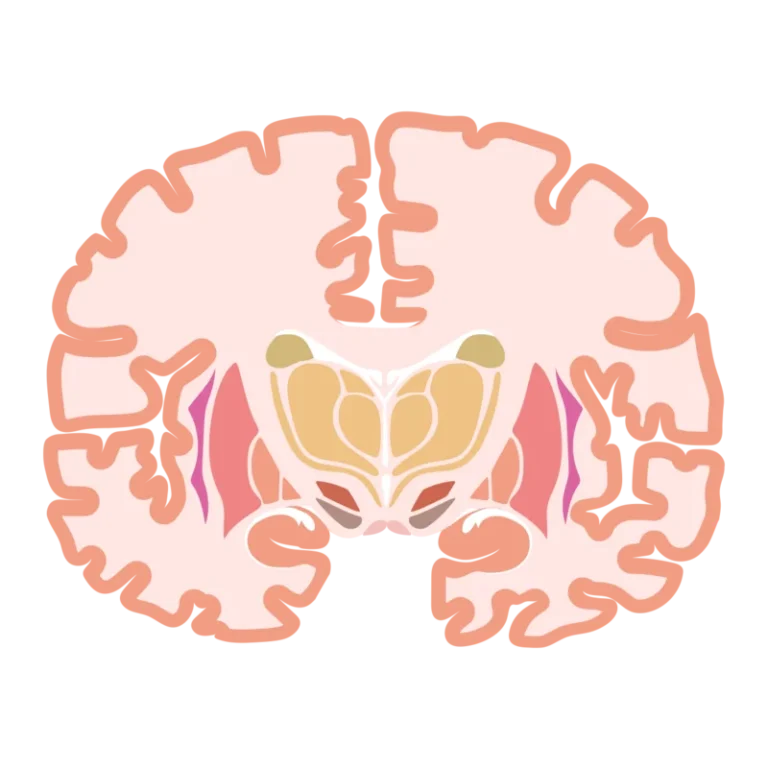
The hippocampus, central to memory formation

The Neuroscience of Memory: How the Brain Stores and Retrieves the Past

Memory is not a single system but a collection of brain processes, declarative, procedural, emotional, and spatial, that encode, store, and retrieve information via distinct neural circuits and molecular mechanisms. You remember your first day of school. You know how to ride a bicycle. You recall, for some reason, that the capital of France is Paris and that otters sleep holding hands. This is the neuroscience of memory: how the brain encodes, stores, and retrieves experience. These memories feel different from each other: some vivid and emotional, some purely factual, some embodied as skill. And they are different, in the most literal neurological sense. The brain uses multiple, partially independent Read more

how galaxies form — A stunning view of a spiral galaxy, showing the grand structure that emerges from billions of years of cosmic evolution.

How Galaxies Form: From the Big Bang to the Milky Way

Look up on a clear, dark night and the Milky Way arches overhead: 200–400 billion stars, bound together by gravity into a structure 100,000 light-years across, slowly rotating through the universe. Below it, through a telescope, lie billions more galaxies, each an island universe of stars. Understanding how galaxies form means tracing this structure back to the early universe. How did this come to be? How did the smooth, nearly uniform plasma of the early universe give rise to the extraordinary structures we observe today: spiral galaxies, elliptical giants, the vast cosmic web of filaments and voids? The answer is a cosmic game of gravity and gas, played over nearly Read more

dark matter candidates — Gravitational lensing around a galaxy cluster reveals the presence of invisible dark matter, which bends light from background galaxies.

Dark Matter Candidates: What Could Dark Matter Actually Be?

Something invisible holds galaxies together. Identifying the dark matter candidates behind it is one of physics’ biggest goals. We can’t see it, can’t touch it, and can’t detect it with any conventional instrument. But we know it’s there because its gravity shapes everything we can observe: the rotation curves of galaxies, the bending of light around galaxy clusters, the large-scale structure of the universe. Dark matter makes up approximately 27% of the universe’s total energy content: about five times the amount of ordinary matter. Every atom, every star, every planet, every person is built from what amounts to a minor impurity in a cosmos dominated by matter we cannot directly Read more

what is time physics — An hourglass measuring time against a cosmic background, representing the mystery of time in physics.

What Is Time? The Physics and Philosophy of Our Strangest Dimension

Key takeaway: Time is a dimension we experience through the relentless increase of entropy and the expansion of spacetime, yet its ultimate nature remains one of science’s deepest mysteries. Yet what is time at its core still eludes us. You are moving through it right now, at the same rate as everyone else on Earth, irresistibly, in only one direction. You remember yesterday but not tomorrow. You age. Things wear out. Causes precede effects. Time seems obvious. Then you try to define it. Augustine of Hippo, writing in the 4th century, captured the problem perfectly: “What then is time? If no one asks me, I know what it is. If Read more

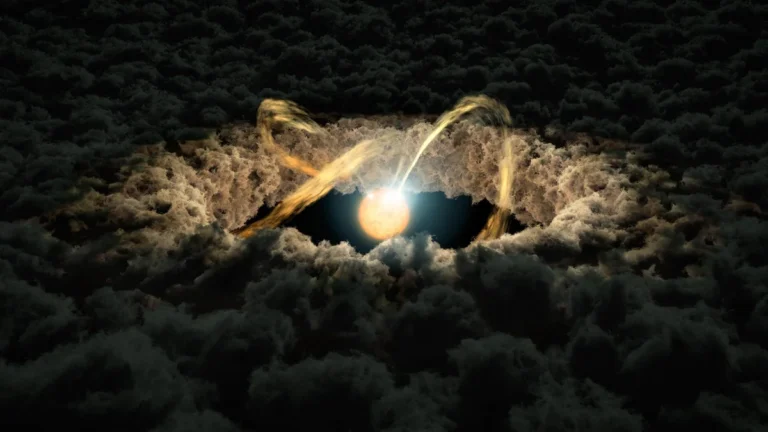
A protoplanetary disk of gas and dust around a young star

How Planets Form: From Dust to Worlds

Every rocky mountain, every ocean, every atom in your body was once a grain of dust floating in a cold disk around a young star. Over millions of years, gravity, chemistry, and the physics of collisions transformed those grains into pebbles, boulders, and eventually planets massive enough to hold atmospheres. This is how planets form: dust becoming worlds over millions of years. Planet formation is one of the most active areas in modern astrophysics. New observations from ALMA (the Atacama Large Millimeter/submillimeter Array) and JWST are revealing protoplanetary disks in stunning detail, and new planetary systems discovered by Kepler and TESS challenge our theoretical models. We’re in the middle of Read more

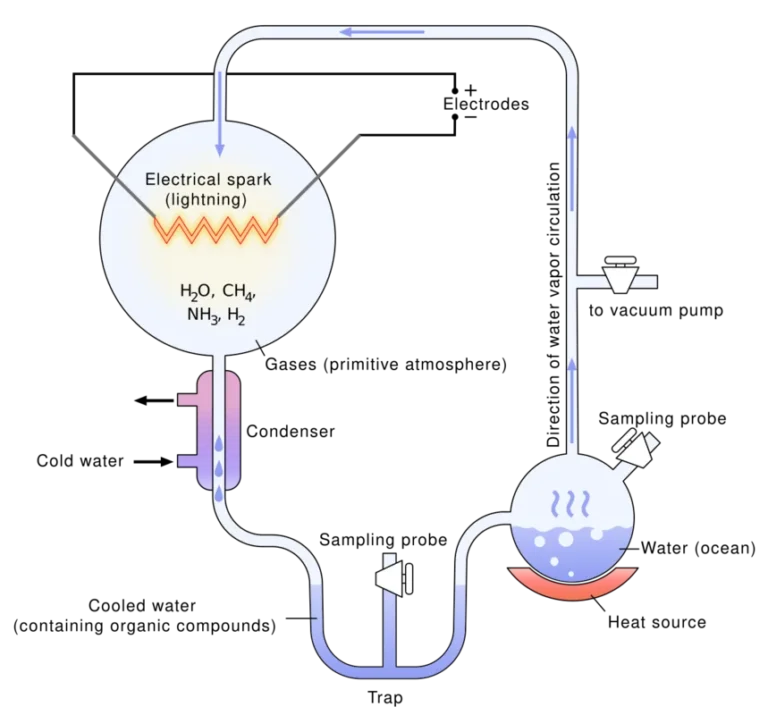
Apparatus like the Miller-Urey origin-of-life experiment

Abiogenesis: How Chemistry Became Life

Abiogenesis is the process by which life arises from non-living matter, a puzzle that begins with simple molecules and ends with self-replicating cells. Four billion years ago, Earth was a hostile place: the surface was bombarded by asteroids, the atmosphere contained no free oxygen, and the oceans were hot and acidic. There was no life anywhere on the planet. Then, roughly 3.5 to 3.8 billion years ago, as suggested by carbon isotopic signatures in ancient Greenland rocks and proposed microfossils from Western Australia (though both remain debated), something happened that has never been fully explained: chemistry became biology. A collection of molecules crossed the threshold from complicated but inert to Read more

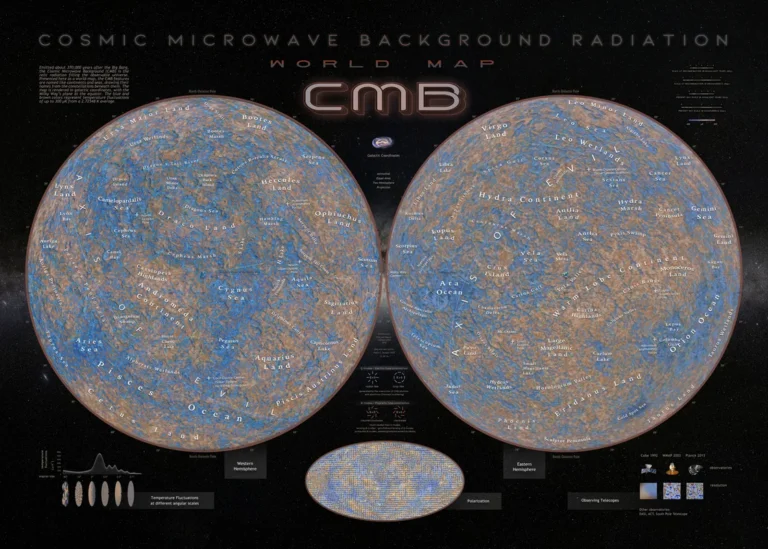
The cosmic microwave background temperature map

Why Does Matter Exist? The Mystery of Baryogenesis

The observable universe is made almost entirely of matter. Stars, planets, galaxies, and every living organism consist of protons, neutrons, and electrons. Antimatter, the mirror opposite of matter, is exceedingly rare. But this fact presents a deep puzzle. The Big Bang should have produced equal amounts of matter and antimatter. According to the laws of physics, these two forms should have annihilated each other completely, leaving behind only energy. Yet we exist. This is the core of the question of why matter exists instead of antimatter, one of the central challenges of modern cosmology. Why Does Matter Exist Instead of Antimatter? The Asymmetry Problem In the early 1960s, physicists recognized Read more

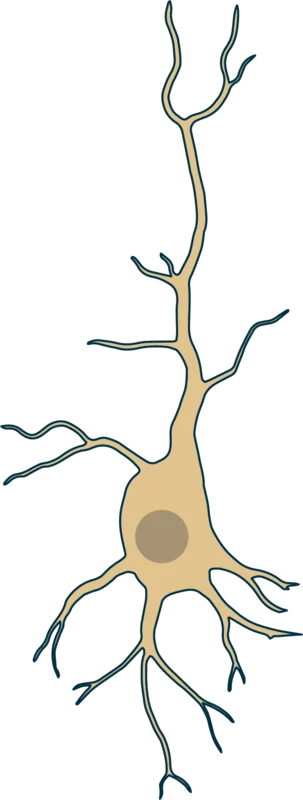
Neurons in the cerebral cortex

Mirror Neurons: The Cells That Let Us Feel What Others Feel

The human brain contains billions of neurons that communicate through electrical and chemical signals. Among these cells, a specific class called mirror neurons has attracted extraordinary attention from scientists and the public alike. First discovered in the early 1990s, these neurons fire both when an individual performs an action and when they observe someone else performing the same action. Understanding what are mirror neurons requires careful examination of the original research, the proposed functions, and the significant limitations of current evidence. What Are Mirror Neurons? Discovery in Macaque Monkeys The story of mirror neurons began in Parma, Italy, at the University of Parma in the lab of neurophysiologist Giacomo Rizzolatti. Read more