
The nearest star system to Earth, Proxima Centauri (part of the Alpha Centauri system), is about 4.2 light-years away. A spacecraft traveling at the fastest speed ever achieved by a human-made object (the Parker Solar Probe at ~700,000 km/h) would take about 6,300 years to get there.
We’re not visiting nearby planets anytime soon. And yet astronomers can already tell you what molecules are in the atmospheres of planets orbiting distant stars, whether they have clouds, whether their days are hotter than their nights, and whether any of them show chemical signs of biological processes.
The technique is called atmospheric characterization, and it is transforming our understanding of planetary science and the search for life.
How Exoplanet Atmospheres Are Detected
Transmission Spectroscopy
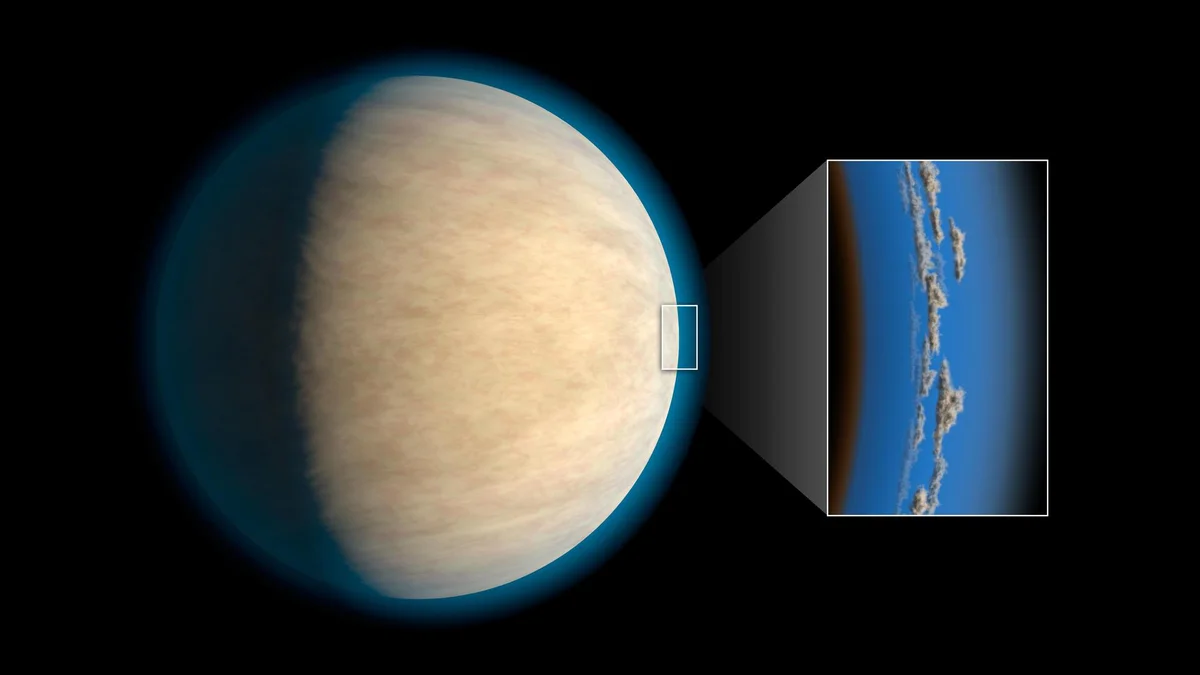
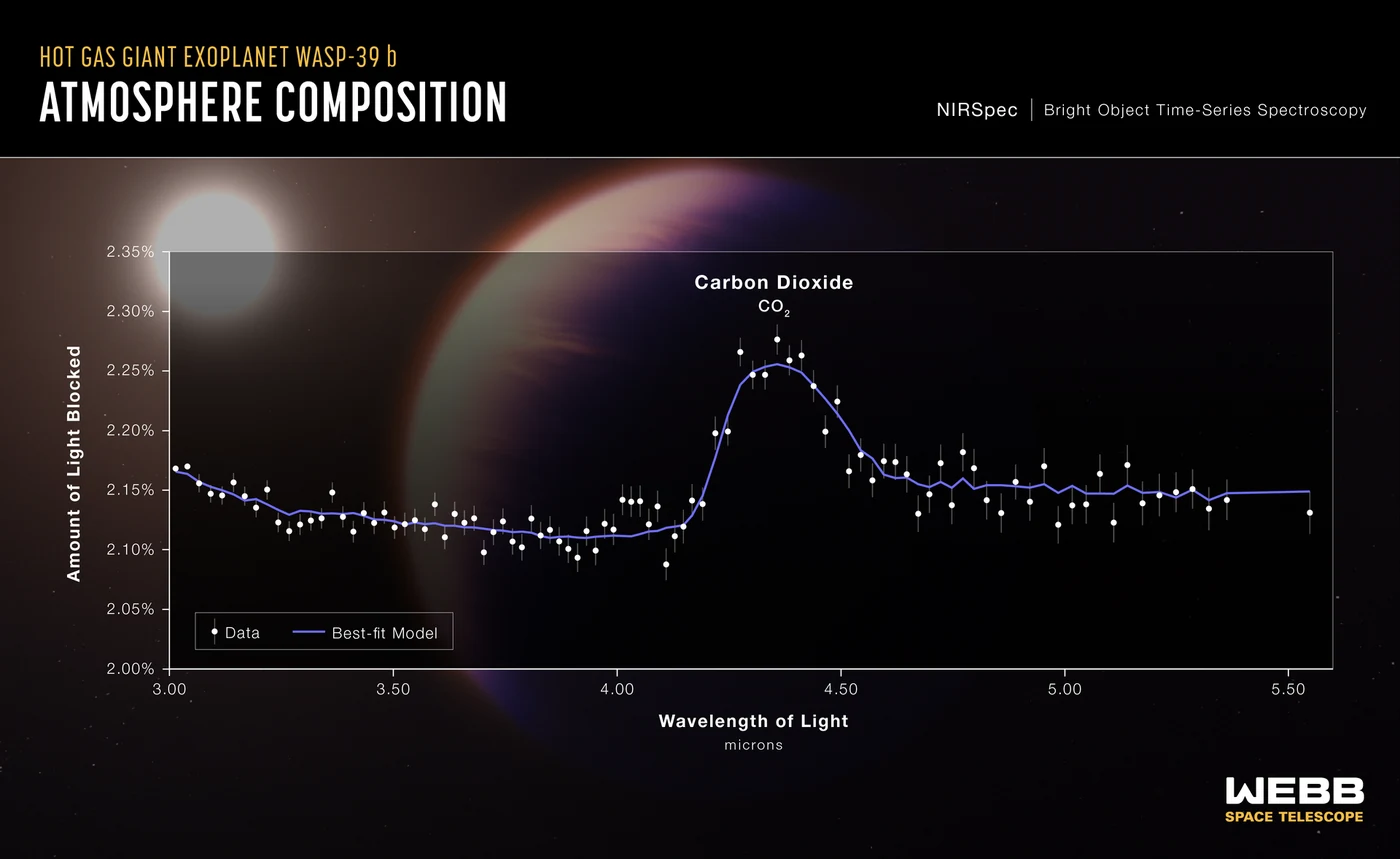
The most powerful technique is transmission spectroscopy. When a planet passes in front of (transits) its host star, a tiny fraction of the starlight passes through the planet’s atmosphere at the edge (the terminator region). Molecules in the atmosphere absorb light at specific wavelengths, their characteristic absorption fingerprints.
By comparing the stellar spectrum during transit (when some light passes through the atmosphere) to the spectrum outside transit (when none does), astronomers extract the atmosphere’s transmission spectrum, the set of wavelengths preferentially absorbed.

The challenge: the atmospheric signal is tiny. For an Earth-like planet around a Sun-like star, the transit signal is already just 84 parts per million (the planet covering 0.0084% of the star’s area). The atmospheric signal, the tiny extra absorption by the atmosphere’s edge, is typically 1–100 parts per million on top of that. To put it in perspective, that’s like detecting a single fingerprint on a microscope slide from 10 kilometers away. Measuring this requires extraordinarily stable telescopes and many transit observations co-added.
JWST is a revolution for transmission spectroscopy. Its large mirror (6.5 meters, versus Hubble’s 2.4 meters), space-based stability, and infrared sensitivity allow atmospheric characterization of planets that were previously out of reach.
Thermal Emission Spectroscopy (Secondary Eclipse)
When a planet goes behind its star (secondary eclipse), the combined star+planet light is briefly replaced by star-only light. The difference tells us the planet’s thermal emission, how much infrared light it radiates.
By observing secondary eclipses at multiple wavelengths and tracking the planet’s infrared brightness over its full orbit, its phase curve, astronomers can build a crude weather map showing hot spots and global winds. They can:
- Map the temperature distribution across the planet’s dayside
- Measure the temperature difference between the planet’s day and night hemispheres
- Detect atmospheric circulation patterns
A hot Jupiter with an efficient atmosphere (recirculating heat from day to night) shows a smaller day-night temperature contrast than one with a sluggish atmosphere. Some hot Jupiters show temperature maps with the hottest point offset from the sub-stellar point, evidence of strong atmospheric wind patterns.
Direct Imaging and High-Resolution Spectroscopy
For planets far from their stars (wide orbits), direct imaging is possible: separating the planet’s light from the star using coronagraphs or starshades. Combined with high-resolution spectroscopy, this can reveal atmospheric composition including carbon dioxide, water vapor, methane, and even wind velocities through Doppler shifts.
The handful of directly imaged planets so far are young gas giants, hot and bright from formation heat, orbiting far from their stars. The Nancy Grace Roman Space Telescope and LIFE (Large Interferometer for Exoplanets) concepts aim to directly image mature rocky planets, alongside ESA’s dedicated ARIEL mission (launch 2029) and ground-based Extremely Large Telescopes.
What We’ve Found: Hot Jupiters, TRAPPIST‑1, and Rocky Planets
As of 2024, astronomers have probed the atmospheres of over 100 exoplanets, mostly hot Jupiters, with a growing number of sub-Neptunes and rocky planets now being characterized.
Hot Jupiters: Atmospheric Laboratories
The first atmospheric detections were on hot Jupiters: gas giants orbiting extremely close to their stars, with equilibrium temperatures of 1000–3000 K. These are the worst candidates for life, but the best for atmospheric characterization: they’re large, hot, and transit frequently.
Hot Jupiter atmospheres show:
- Water vapor (H₂O), detected in dozens of hot Jupiters
- Carbon monoxide (CO) and carbon dioxide (CO₂)
- Sodium and potassium (in some clear atmospheres)
- Iron and magnesium vapor (in the hottest atmospheres, where metal clouds form)
- Clouds and hazes, many hot Jupiters show flat, featureless spectra suggesting high-altitude clouds that mute the molecular features below
The temperature-pressure profiles of hot Jupiter atmospheres, retrieved from multi-wavelength observations, confirm basic predictions of atmospheric chemistry models.

The TRAPPIST-1 System: Rocky Planet Atmospheres
The TRAPPIST-1 system, seven rocky planets orbiting an ultra-cool red dwarf 40 light-years away, is the primary target for rocky planet atmospheric characterization with JWST. Three of the seven planets orbit in the habitable zone (the region where liquid water could exist on a rocky planet’s surface).
JWST thermal emission measurements of TRAPPIST-1b and TRAPPIST-1c (the two innermost, non-habitable-zone planets) published in 2023 found no evidence of thick atmospheres, consistent with these planets being airless or having very thin atmospheres. This was actually an important result: it demonstrates that planets orbiting close to M dwarfs may have their atmospheres stripped by stellar irradiation.
Results for the habitable-zone planets are more eagerly anticipated. JWST is accumulating observations, but the signal-to-noise requirements for detecting a potentially Earth-like thin atmosphere are extremely demanding: requiring dozens of transit observations. For deeper context on how we find these worlds, see our guide on how scientists detect exoplanets.
K2-18b: A Sub-Neptune with Interesting Chemistry
K2-18b is a 8.6 Earth-mass sub-Neptune 124 light-years away, orbiting in its star’s habitable zone. JWST transmission spectroscopy published in 2023 detected carbon dioxide, methane, and possibly dimethyl sulfide (DMS), a molecule produced almost exclusively by marine phytoplankton on Earth.
The DMS detection is tentative (below 3 sigma significance) and should not be interpreted as evidence of life. K2-18b is likely a “Hycean world”, a hydrogen-rich atmosphere over a liquid water ocean (if models are correct). DMS production in Hycean worlds could potentially be abiotic.
But the detection illustrates the remarkable sensitivity JWST has already achieved, and points toward the type of biosignature searches that will characterize the next decade.
L 98-59d and Other Small Planets
JWST has been accumulating transmission spectra for smaller rocky planets around M dwarfs. A 2024 preprint (Lustig-Yaeger et al.) suggests a tentative CO₂ detection for L 98-59d (a sub-Earth-mass planet): if confirmed, it would be the smallest planet ever to show atmospheric features.
The field is advancing rapidly.
Biosignature Detection: Challenges and False Positives
The ultimate goal of exoplanet atmosphere characterization is detecting biosignatures, atmospheric signs of life.
The classic biosignature is the simultaneous presence of oxygen (O₂ or O₃, ozone) and methane (CH₄) in an atmosphere. On Earth, oxygen is maintained by photosynthesis and methane by microbial metabolism. In the absence of life, these two gases react rapidly and can’t coexist at significant levels, their simultaneous presence implies biological production of both.
Other potential biosignatures:
- Nitrous oxide (N₂O), produced by microbial denitrification
- Dimethyl sulfide (DMS), produced by marine organisms
- Phosphine (PH₃), biologically produced in certain anoxic environments (the disputed Venus phosphine claim illustrates the difficulty)
False positive biosignatures are a serious concern. Abiotic processes can produce oxygen (photolysis of CO₂ or H₂O), methane (volcanic outgassing, water-rock reactions), and other potentially biogenic molecules. A single biosignature molecule is weak evidence; a combination consistent with a complex biosphere is stronger. That’s why scientists also consider contextual evidence: the host star’s ultraviolet environment, the planet’s mass and radius, and whether water vapor is present – to rule out false positive scenarios.
Current JWST capabilities can detect CO₂, H₂O, CH₄, and CO in favorable rocky planet atmospheres. Detecting O₂ (a biosignature) is beyond current capabilities: it will require next-generation telescopes. The planned Habitable Worlds Observatory (formerly known as the Large UV/Optical/IR Surveyor, or LUVOIR) is designed specifically to search for biosignatures on nearby rocky planets. For more on the types of signals astronomers seek, see our discussion of biosignatures vs technosignatures.
What Atmospheric Diversity Tells Us
The planets detected so far have atmospheres ranging from essentially none (tidally heated lava worlds), to sulfur clouds (Venus analogs), to high-metallicity gas rich in carbon molecules (sub-Neptunes), to inflated hydrogen envelopes. Diversity is the rule, not the exception.
This diversity carries implications:
- Atmospheric composition depends on formation history, orbital evolution, and the properties of the host star
- M dwarf planets may frequently lose their atmospheres to stellar radiation, making habitability harder
- Carbon-rich (“secondary carbon”) atmospheres may be common in mini-Neptunes and sub-Neptunes
- Earth-like thin nitrogen-oxygen atmospheres may be relatively rare, or just hard to detect
Every atmosphere we characterize expands the parameter space of planetary types and their chemical diversity. After centuries of knowing only our own solar system, we are for the first time building a comparative planetology across stellar systems, the foundation for eventually understanding where and how life can exist in the cosmos.
Sources
- Madhusudhan, N. et al. (2023). Carbon-bearing Molecules in a Possible Hycean Atmosphere. Astrophysical Journal Letters, 956(1), L18.
- Lustig-Yaeger, J. et al. (2023). A JWST transmission spectrum of a sub-Earth rocky exoplanet. Nature Astronomy, 7, 1317–1328.
- Greene, T.P. et al. (2023). Thermal emission from the Earth-sized exoplanet TRAPPIST-1b using JWST. Nature, 618, 39–42.
- NASA Exoplanet Exploration. (2024). Exoplanet Atmospheres.
- ESA. (2024). ARIEL – Atmospheric Remote-sensing Infrared Exoplanet Large-survey.
What is atmospheric characterization of exoplanets?
Atmospheric characterization is the technique astronomers use to analyze the chemical composition, temperature, and cloud cover of exoplanet atmospheres by studying the light that passes through or reflects off them.
How does transmission spectroscopy work for exoplanets?
Transmission spectroscopy works by measuring starlight that passes through a planet’s atmosphere during a transit, where molecules absorb specific wavelengths, creating a unique absorption spectrum that reveals atmospheric composition.
What molecules can be detected in exoplanet atmospheres?
Commonly detected molecules include water vapor, carbon dioxide, methane, and oxygen, which are identified by their distinct absorption fingerprints in the planet’s transmission spectrum.
Can exoplanet atmospheres show signs of life?
Yes, astronomers look for biosignature gases like oxygen and methane in combination, which could indicate biological processes, though such detections require careful confirmation to rule out non-biological sources.
What is the role of the James Webb Space Telescope in studying exoplanet atmospheres?
The James Webb Space Telescope is the most powerful tool for exoplanet atmospheric characterization, using its infrared sensitivity to detect molecular fingerprints and study the chemistry of distant worlds with unprecedented detail.
Further reading: Exoplanet atmosphere on Wikipedia