
The observable universe is made almost entirely of matter. Stars, planets, galaxies, and every living organism consist of protons, neutrons, and electrons. Antimatter, the mirror opposite of matter, is exceedingly rare. But this fact presents a deep puzzle. The Big Bang should have produced equal amounts of matter and antimatter. According to the laws of physics, these two forms should have annihilated each other completely, leaving behind only energy. Yet we exist. This is the core of the question of why matter exists instead of antimatter, one of the central challenges of modern cosmology.
Why Does Matter Exist Instead of Antimatter? The Asymmetry Problem
In the early 1960s, physicists recognized a fundamental problem in cosmology. The Standard Model of particle physics treats matter and antimatter almost symmetrically. Particle reactions that create matter also create antimatter. The Big Bang, a purely energetic event, should have generated a perfectly balanced universe. Annihilation reactions between matter and antimatter would have then wiped out everything. The result would be a cosmos filled with radiation and nothing else.
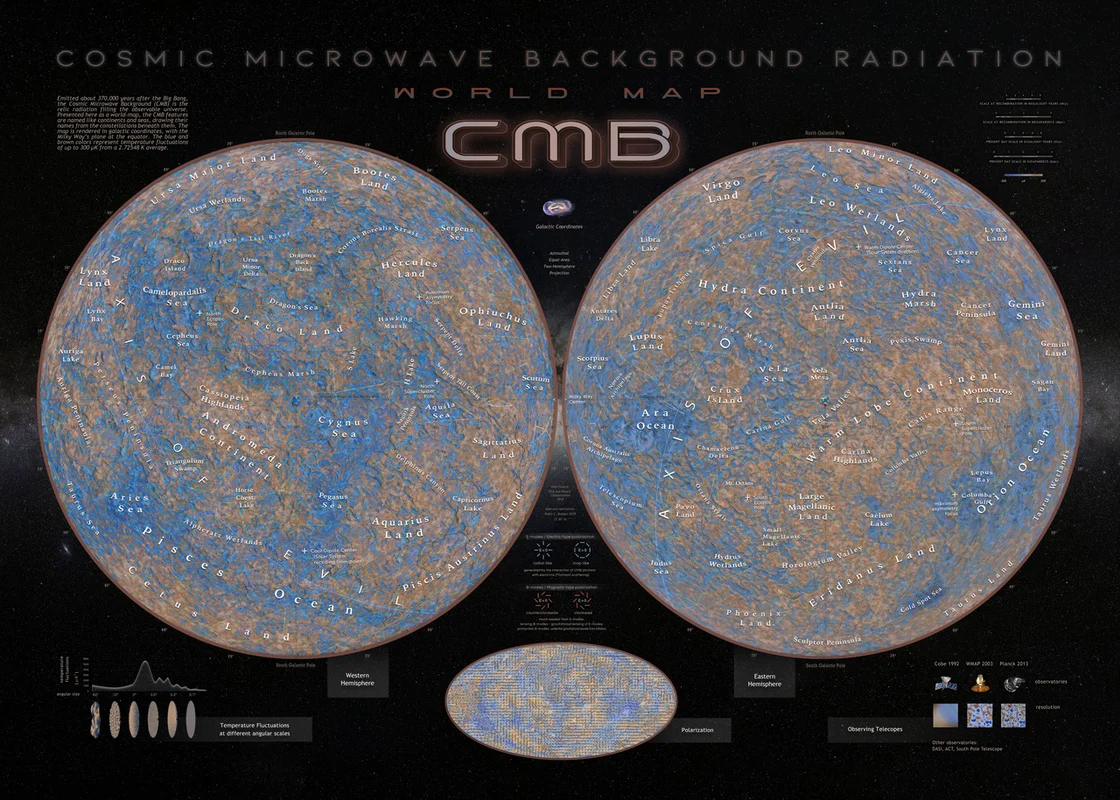
But observations show otherwise. The universe contains matter. Every measurement of the cosmic microwave background radiation, the afterglow of the Big Bang, indicates that matter particles outnumber antimatter particles by a factor of roughly one part in a billion. That tiny excess, one extra matter particle for every billion matter-antimatter pairs, is what makes galaxies, stars, and life possible.
Physicists call this disparity the baryon asymmetry. Baryons are particles made of three quarks, such as protons and neutrons. The universe today has a net positive baryon number. The baryon asymmetry parameter, denoted η, has a value of about 6 × 10⁻¹⁰. This number represents the excess of baryons over antibaryons relative to the number of photons.
The Three Conditions That Explain the Asymmetry
In 1967, Soviet physicist Andrei Sakharov proposed a framework for understanding how the asymmetry could arise. He identified three necessary conditions for baryogenesis, the process that generates more matter than antimatter. These conditions collectively explain why does matter exist instead of antimatter in our universe.
Baryon Number Violation
The first condition states that baryon number must not be conserved. Baryon number is a quantum number that counts the difference between baryons and antibaryons. In the Standard Model, baryon number is conserved in all known particle interactions. However, many grand unified theories and extensions of the Standard Model predict baryon number violation at high energies. These processes would allow the universe to generate a net baryon number from an initially symmetric state.
The Standard Model does contain a subtle form of baryon number violation through sphaleron processes. These are non-perturbative interactions that violate both baryon and lepton number. Sphalerons become active at extremely high temperatures, above 100 GeV. The early universe, during the electroweak phase transition, likely experienced this condition.
CP Violation
The second condition requires CP violation. CP is a combined symmetry of charge conjugation (C) and parity (P). CP violation means that the laws of physics treat particles and antiparticles differently. Without CP violation, any process that creates matter would be exactly mirrored by a process that creates antimatter. The net baryon number would remain zero.
The Standard Model includes CP violation through the Cabibbo-Kobayashi-Maskawa (CKM) matrix. This matrix describes how quarks change flavor through weak interactions. CP violation in the Standard Model arises from a single complex phase in the CKM matrix. However, the magnitude of this CP violation is far too small to explain the observed baryon asymmetry. The Standard Model predicts a baryon asymmetry about ten orders of magnitude smaller than what we observe.
Departure from Thermal Equilibrium
The third condition demands that the universe depart from thermal equilibrium. In thermal equilibrium, particle reactions occur at the same rate in both directions. Any baryon asymmetry would be washed out by reverse processes. For baryogenesis to succeed, the expanding and cooling universe must create conditions where baryon-generating reactions proceed faster than the reverse reactions.
In the early universe, the rapid expansion provided this departure from equilibrium. In extensions of the Standard Model, first-order phase transitions could also generate out-of-equilibrium conditions. The decay of heavy particles, if they decay slowly compared to the expansion rate, can also satisfy this condition.

Experimental Evidence for CP Violation
CP violation is a subtle effect. It was first discovered in 1964 by James Cronin and Val Fitch in the decay of neutral kaons. The K meson system showed that the decay rates of particles and antiparticles were not identical. This discovery earned the Nobel Prize in 1978.
Kaon Systems
The neutral kaon, denoted K⁰, is a bound state of a down quark and an anti-strange quark. Its antiparticle, the anti-K⁰, is a strange quark and an anti-down quark. These two particles mix through weak interactions. The resulting mass eigenstates, K_S and K_L, have different lifetimes. The short-lived K_S decays primarily into two pions. The long-lived K_L decays into three pions. However, a small fraction of K_L decays produce two pions, a clear signature of CP violation.
B Meson Systems
In the early 2000s, experiments at the BaBar detector at SLAC and the Belle detector at KEK in Japan confirmed large CP violation in B meson systems. The B⁰ meson contains a bottom quark and a down antiquark. Its antiparticle contains an anti-bottom quark and a down quark. These experiments measured CP violation in the decays of B mesons into J/ψ and K_S, known as the “golden mode.” The results matched the predictions of the CKM mechanism.
However, the CP violation observed in kaon and B meson systems is still insufficient to explain the baryon asymmetry. The Standard Model also contains CP violation in the strong interaction, known as the strong CP problem. The neutron electric dipole moment is extremely small, suggesting that strong CP violation is either absent or highly suppressed.
Beyond the Standard Model: Leptogenesis
Given the insufficiency of Standard Model CP violation, physicists have developed extensions. One prominent theory is leptogenesis. This mechanism generates an asymmetry in leptons first, which is then converted into a baryon asymmetry through sphaleron processes.
The Seesaw Mechanism
Leptogenesis is often connected to the seesaw mechanism, which explains the small masses of neutrinos. The seesaw mechanism introduces heavy right-handed neutrinos. These particles have masses far above the electroweak scale, typically 10⁹ to 10¹⁴ GeV. They interact with ordinary leptons through Yukawa couplings.
CP Violation in Heavy Neutrino Decays
In leptogenesis, heavy right-handed neutrinos decay in the early universe. These decays produce light leptons and Higgs bosons. CP violation in these decays creates an excess of leptons over antileptons. The out-of-equilibrium condition is satisfied because the heavy neutrinos decay slowly relative to the expansion rate.
The lepton asymmetry is then processed by sphalerons into a baryon asymmetry. This mechanism elegantly ties together three mysteries: neutrino masses, the matter-antimatter asymmetry, and CP violation at high energies.
Present Status and Future Experiments
The question remains unresolved. No single experiment has confirmed baryogenesis or leptogenesis beyond the Standard Model. Physicists continue to search for answers.

Neutrinoless Double Beta Decay
One key test for leptogenesis is neutrinoless double beta decay. This process, if observed, would confirm that neutrinos are Majorana particles. Majorana particles are their own antiparticles, a necessary condition for the seesaw mechanism. Experiments such as GERDA, EXO, and KamLAND-Zen are searching for this decay.
Electric Dipole Moment Searches
CP violation beyond the Standard Model would produce measurable electric dipole moments (EDMs) for particles like the neutron or electron. The current upper limits on the neutron EDM are about 3 × 10⁻²⁶ e·cm. Next-generation experiments aim to improve sensitivity by two orders of magnitude. A detection would provide direct evidence for new CP-violating physics.
High-Energy Colliders
The Large Hadron Collider continues to search for new particles that could mediate baryogenesis. Supersymmetric particles, heavy Higgs bosons, and extra gauge bosons are all candidates. So far, no such particles have been found. The next generation of colliders, such as the Future Circular Collider, may probe higher energies.
Cosmological Observations
Measurements of the cosmic microwave background and primordial element abundances provide constraints on the baryon asymmetry. The Planck satellite has measured the baryon density to high precision. Future surveys like CMB-S4 will test models of baryogenesis that predict deviations from the Standard Model.
Why This Problem Matters
The baryon asymmetry is not a minor detail. It is the reason the universe contains structures at all. Without the asymmetry, the universe would be a uniform bath of photons and neutrinos. No stars, no planets, no life.
Resolving the problem would also reveal fundamental physics beyond the Standard Model. It would tell us about CP violation at high energies, the nature of neutrinos, and possibly the mechanism of electroweak symmetry breaking. It connects the smallest scales of particle physics to the largest scales of cosmology. Explore our guide to The Universe for more context.
The answer to why matter exists instead of antimatter remains one of the deepest unsolved problems in science. It sits at the intersection of particle physics, cosmology, and the fundamental symmetries of nature.
Sources & References
- Sakharov, A.D. “Violation of CP Invariance, C Asymmetry, and Baryon Asymmetry of the Universe.” JETP Letters, 5, 24 (1967). https://www.sciencedirect.com/science/article/pii/B9781483197234500105
- Planck Collaboration. “Planck 2018 Results. VI. Cosmological Parameters.” Astronomy & Astrophysics, 2020. https://www.aanda.org/articles/aa/full_html/2020/09/aa33910-18/aa33910-18.html
- Canetti, L., Drewes, M., & Shaposhnikov, M. “Matter and Antimatter in the Universe.” New Journal of Physics, 2012. https://iopscience.iop.org/article/10.1088/1367-2630/14/9/095012
- Particle Data Group. “CP Violation in the Quark Sector.” Progress of Theoretical and Experimental Physics, 2022. https://academic.oup.com/ptep/article/2022/8/083C01/6651665
Further reading: Baryon asymmetry on Wikipedia