
Abiogenesis is the process by which life arises from non-living matter, a puzzle that begins with simple molecules and ends with self-replicating cells. Four billion years ago, Earth was a hostile place: the surface was bombarded by asteroids, the atmosphere contained no free oxygen, and the oceans were hot and acidic. There was no life anywhere on the planet.
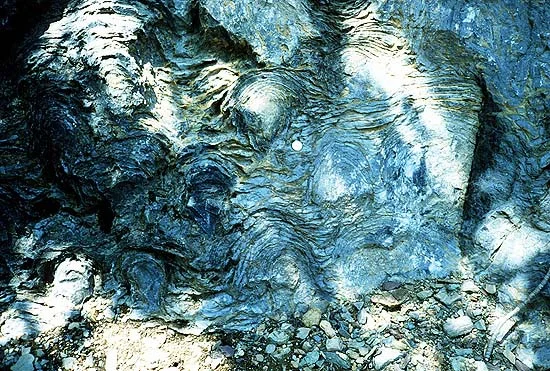
Then, roughly 3.5 to 3.8 billion years ago, as suggested by carbon isotopic signatures in ancient Greenland rocks and proposed microfossils from Western Australia (though both remain debated), something happened that has never been fully explained: chemistry became biology. A collection of molecules crossed the threshold from complicated but inert to self-organizing, self-replicating, and metabolizing. (For the broader story of when and where life first emerged, see The Genesis of Life, our companion overview article.)
The study of how this happened is called abiogenesis. It is one of the deepest unsolved problems in science.
Why Abiogenesis Is Hard

The difficulty is not explaining that life began: we know it did, because we are here. The difficulty is identifying the specific chemical steps that bridged the gap between a prebiotic soup of organic molecules and the first entity we would recognize as alive.
Life requires at minimum four things working simultaneously: information storage (a molecule that encodes heritable instructions), catalysis (molecules that speed up chemical reactions needed for metabolism), compartmentalization (a membrane that separates inside from outside), and replication (the ability to copy the information molecule).
Modern cells solve all four using a division of labor: DNA stores information, proteins do catalysis and structure, lipid membranes form compartments, and RNA acts as an intermediary. But which came first? DNA requires proteins to replicate. Proteins require DNA to be synthesized. This is the chicken-and-egg problem of the origin of life. Something had to come first.
A common intuitive objection: how can life, with its high degree of order, arise spontaneously? The answer is that abiogenesis does not violate thermodynamics because it is a local decrease in entropy powered by an external energy source: UV radiation, lightning, or geothermal gradients. The overall entropy of the universe still increases.
The Miller-Urey Experiment: Life’s Building Blocks From Scratch
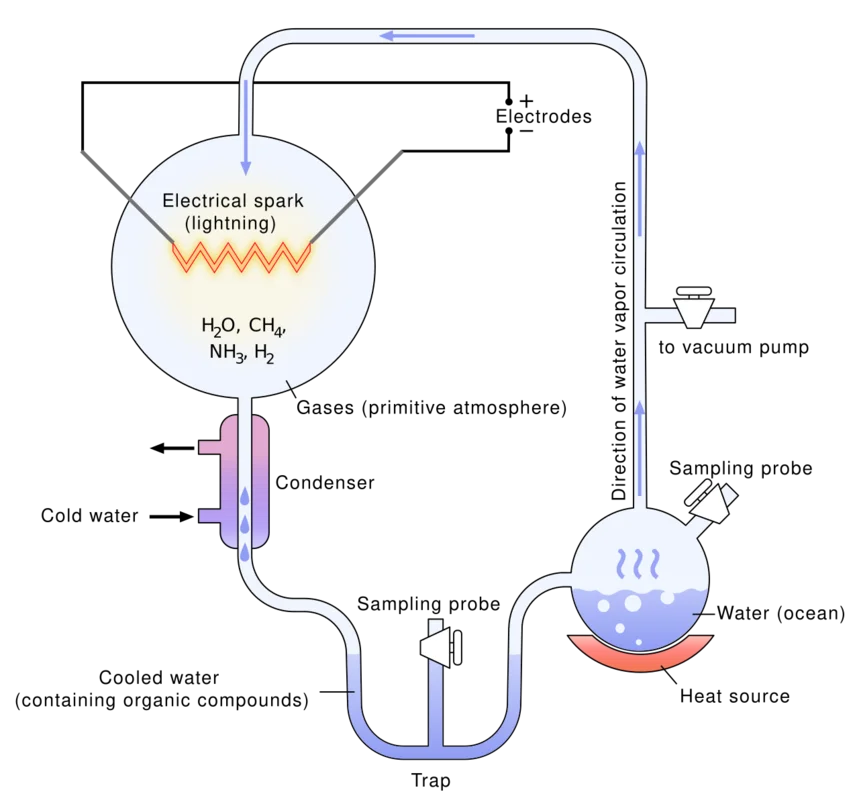
The modern scientific approach to abiogenesis began on a morning in 1953 at the University of Chicago, when Stanley Miller, a graduate student, came in to check an experiment he had left running over the weekend. Miller and his advisor Harold Urey had filled a glass apparatus with gases thought to represent early Earth’s atmosphere: methane, ammonia, hydrogen, and water vapor, and subjected them to electrical sparks to simulate lightning. After a week, the water at the bottom had turned brown, a murky broth rich in organic molecules.
When Miller analyzed it, he found amino acids: the building blocks of proteins. From simple gases and electricity, the experiment produced the molecules that form the structural foundation of all life on Earth. The Miller-Urey experiment was a landmark: it demonstrated that organic molecules do not require living organisms to form. They can arise spontaneously from simple chemistry under plausible early Earth conditions.
Since 1953, updated experiments with more realistic atmospheric compositions, and studies of organic-rich meteorites like the Murchison meteorite (which fell in Australia in 1969 containing over 90 amino acids), confirm that the universe is extraordinarily good at making organic chemistry. Building blocks are abundant. The question is assembly.
The RNA World Hypothesis
The leading framework for solving the chicken-and-egg problem is the RNA world hypothesis. RNA is uniquely suited as a primordial molecule because it can do two things DNA and proteins cannot individually do: store genetic information and act as an enzyme (a ribozyme) that catalyzes chemical reactions. An RNA molecule could in principle store the instructions for its own replication and carry out that replication itself, without proteins.
The RNA world hypothesis proposes that before DNA and proteins existed, early life relied on RNA for both functions. Over time, DNA took over information storage (being more chemically stable) and proteins took over catalysis (being more chemically versatile), leaving RNA in its modern intermediary role.
Key experimental support: in the 1980s, Thomas Cech and Sidney Altman independently discovered naturally occurring ribozymes, RNA molecules that catalyze specific chemical reactions. This won them the 1989 Nobel Prize in Chemistry and provided the first direct evidence that RNA can act as both information molecule and enzyme. Since then, researchers have synthesized RNA molecules capable of partial self-replication in the laboratory.
The outstanding problem is explaining how the first RNA molecules arose spontaneously. RNA nucleotides are complex. Assembling them from simpler chemicals requires specific conditions and concentrations that are still debated. Research groups have demonstrated plausible prebiotic syntheses of RNA nucleotides from even simpler precursors, but the full pathway from simple chemistry to functional RNA remains incomplete.
Where Did It Happen? Hydrothermal Vents vs. Warm Little Ponds
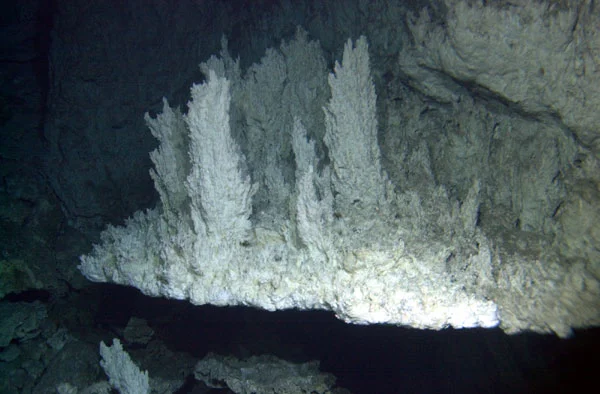
Two environments dominate the debate over where abiogenesis occurred. Deep-sea alkaline hydrothermal vents, like the Lost City field discovered in 2000, offer natural proton gradients across mineral membranes that are chemically analogous to the proton gradients powering ATP synthesis in modern cells. Mike Russell and colleagues have argued that life bootstrapped itself from these pre-existing geological proton pumps, with vent minerals acting as primitive cell walls.
Warm little ponds, proposed by Darwin and formalized by Jack Szostak and others, offer a different advantage: wet-dry cycles. When tidal pools or rain-fed ponds evaporate and refill, they concentrate chemicals and can drive the formation of RNA-like polymers on mineral surfaces. Laboratory experiments have shown that fatty acid vesicles (primitive membranes) form spontaneously under these conditions and can absorb RNA from their environment, creating a plausible precursor to the modern cell.
Both environments may have played roles at different stages. The origin of metabolism and the origin of the genetic polymer may not have happened in the same place.
From Protocells to LUCA
The final step before recognizable biology is the formation of protocells: compartmentalized, self-replicating systems enclosed by a lipid membrane. Laboratory studies by Jack Szostak’s group at Harvard have shown that fatty acid vesicles can grow, divide, and selectively absorb RNA molecules without any protein machinery. These are far simpler than modern cells but capture the essential architecture: a genome-like molecule inside a membrane-enclosed compartment.
Once a protocell could replicate its RNA and divide, Darwinian evolution could begin. Variants that replicated faster, resisted degradation better, or captured nutrients more efficiently would outcompete others. This is not life by design; it is chemistry self-organizing under selection pressure.
From these early replicators, the lineage eventually produced LUCA, the Last Universal Common Ancestor: not the first cell, but the ancestral population from which all modern life descends. A 2024 phylogenomic study placed LUCA at approximately 4.2 billion years ago, implying that the transition from chemistry to recognizable biology was remarkably rapid.
What Remains Unsolved
Abiogenesis research has made remarkable progress, but the full chemical narrative from simple molecules to the first living cell remains incomplete. The key open problems are: how RNA nucleotides first formed and polymerized without enzymatic help; how the genetic code (the mapping from RNA sequences to amino acids) originated; and how the transition from the RNA world to the modern DNA-RNA-protein world occurred.
What the field has established: the building blocks of life form easily under prebiotic conditions, fatty acid membranes self-assemble spontaneously, RNA can act as both gene and enzyme, and protocell-like systems can grow and divide without proteins. The individual steps are increasingly understood. The full connected pathway is still being assembled.
Sources
- Miller, S. L. (1953). A production of amino acids under possible primitive Earth conditions. Science, 117(3046), 528–529. https://doi.org/10.1126/science.117.3046.528
- Cech, T. R. (1986). RNA as an enzyme. Scientific American, 255(5), 64–75. https://www.scientificamerican.com/article/rna-as-an-enzyme/
- Szostak, J. W., Bartel, D. P., & Luisi, P. L. (2001). Synthesizing life. Nature, 409(6818), 387–390. https://doi.org/10.1038/35053176
- Moody, E. R. R., et al. (2024). The nature of the last universal common ancestor and its impact on the early Earth system. Nature Ecology & Evolution, 8, 1654–1666. https://doi.org/10.1038/s41559-024-02461-1
What is abiogenesis?
Abiogenesis is the origin of life from non-living matter through chemical processes. It refers to the natural transition from complex organic chemistry to self-replicating, metabolizing biological systems, without invoking any preceding life.
What did the Miller-Urey experiment prove?
It demonstrated that amino acids can form spontaneously from simple gases under conditions plausible for early Earth, showing that organic chemistry does not require living organisms and that the raw materials of life can arise from physics and chemistry alone.
Why is the RNA world hypothesis significant?
Because RNA can both store genetic information and catalyze chemical reactions, it resolves the chicken-and-egg problem of which came first, DNA or proteins. The RNA world hypothesis proposes RNA served both roles before DNA and proteins evolved their separate specialized functions.
Has abiogenesis been proven?
No. Scientists have demonstrated that many individual steps are chemically plausible: amino acid formation, RNA nucleotide synthesis, self-assembling membranes, and partial RNA self-replication. But the complete connected pathway from simple chemistry to the first living cell has not yet been reproduced in the laboratory.
Further reading: NASA Astrobiology Program, and Abiogenesis on Wikipedia.