

For most of the 20th century, psychedelic compounds were effectively off-limits to science. Schedules and stigma made research nearly impossible. The pharmacology was known; what these compounds did in the brain was not. Today, research on psychedelics and consciousness is booming.
That changed. Beginning in the early 2000s, a handful of research groups, at Imperial College London, Johns Hopkins University, NYU, and a growing number of other institutions, began running rigorous clinical trials with psilocybin, LSD, DMT, and ketamine. These studies have dramatically expanded our understanding of psychedelic brain effects and their implications for consciousness research. What they found transformed both psychiatry and the science of consciousness.
What Psychedelics Do in the Brain
Psilocybin, the active compound in psilocybin mushrooms, is converted in the body to psilocin, which binds primarily but not exclusively to serotonin 5-HT2A receptors, particularly dense in cortical areas (it also interacts with 5-HT1A and 5-HT2C receptors). This binding does not simply amplify or suppress brain activity. It reorganizes it.
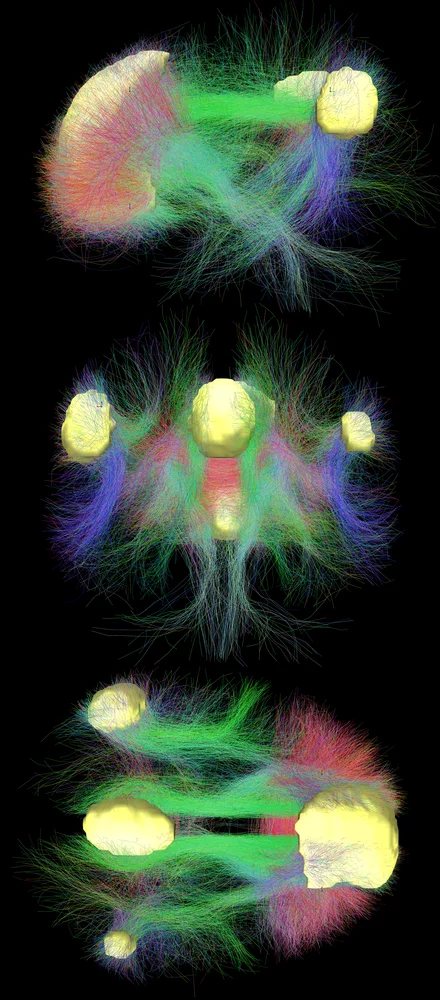
Under psilocybin, the default mode network (DMN): a set of interconnected brain regions most active during self-referential thought, mind-wandering, and autobiographical memory – shows dramatic suppression. The same network that constructs the narrative self, the running story of who you are, goes quiet. Activity becomes less constrained by the usual connectivity patterns. Regions that rarely communicate begin exchanging signals.
Neuroscientist Robin Carhart-Harris, who led much of the early imaging research at Imperial College London, described this as a transition to a more entropic brain state.
What Is the Entropic Brain Hypothesis?
The entropic brain hypothesis, which Carhart-Harris developed with colleagues, proposes that ordinary waking consciousness sits at a particular level of neural entropy: neither too ordered (as in deep sleep or anesthesia) nor too disordered. Psychedelics push the brain toward higher entropy: more random, more flexible, more connected across its usual boundaries.

This maps loosely onto the phenomenology. Users report dissolution of the boundary between self and world, increased associative thinking, synesthesia, and experiences of unity. The usual architecture of experience relaxes. What gets called mystical experience, a sense of boundary dissolution, of interconnection, of being part of something vast, appears most often when the DMN suppression is most complete.
The REBUS Model
In 2019, Carhart-Harris and theoretical neuroscientist Karl Friston proposed the REBUS model: Relaxed Beliefs Under Psychedelics. It draws on predictive processing: the framework in which the brain is understood as a prediction machine, constantly generating models of the world and updating them with incoming sensory data.
In ordinary cognition, prior beliefs, the brain’s predictions, strongly constrain perception. What you expect shapes what you see, hear, and feel. The REBUS model proposes that psychedelics flatten the hierarchy: priors are weakened, sensory information is weighted more heavily, and the brain’s top-down control over experience loosens.
This produces several of the characteristic features of psychedelic experience: unusual perceptions that bypass expectation, the felt meaningfulness of things normally passed over, the sense that the familiar has become strange. The brain is, temporarily, less sure of what it knows, and that uncertainty opens space.
The REBUS model is testable and has generated predictions that have held in subsequent research. It connects psychedelic pharmacology to a general theory of cognition rather than treating these compounds as anomalies.
Psilocybin for Depression: Clinical Trial Evidence
The clinical findings have been substantial enough to reshape psychiatry.
In a 2021 trial published in The New England Journal of Medicine, researchers at Imperial College London compared psilocybin therapy to a leading SSRI antidepressant (escitalopram) in patients with moderate-to-severe depression. After six weeks, both groups showed similar reductions in depressive symptoms on standard scales. But patients in the psilocybin group showed significantly greater improvements in emotional processing, sense of well-being, and the ability to feel pleasure, measures that SSRIs typically leave relatively unchanged.
Johns Hopkins researchers published results in 2020 showing that two doses of psilocybin, combined with psychological support, produced large and durable reductions in depression and anxiety in patients with major depressive disorder, effects that persisted at the 12-month follow-up.
The FDA granted psilocybin “breakthrough therapy” designation for treatment-resistant depression in 2018 and for major depressive disorder in 2019. Clinical approval is pending further trials.
The mechanism is not fully understood. The suppression of the DMN, and the loosening of rigid thought patterns that may underlie rumination, is a leading candidate. Neuroimaging shows that after psilocybin treatment, the default mode network shows increased flexibility and reduced connectivity within the network itself. Patients describe the experience as a reset: patterns of thought that had seemed locked in place are suddenly movable.
Crucially, the therapeutic context includes set and setting: the subject’s mindset and the physical environment – which profoundly shape outcomes. Even in clinical trials, the quality of the experience (e.g., intensity of mystical-type effects) predicts long-term benefit. After the acute session, patients undergo integration work with therapists to process insights and translate them into lasting behavioral change.
LSD and Its Role in Research
LSD (lysergic acid diethylamide) deserves special mention. While it shares the 5-HT2A receptor mechanism with psilocybin, LSD’s effects are notably longer-lasting: typically 8 to 12 hours versus 4 to 6 hours for psilocybin. Recent research has explored LSD’s potential in treating anxiety at end of life and in enhancing creativity and cognitive flexibility. A 2016 study at Imperial College London using magnetic resonance spectroscopy found that LSD not only suppresses DMN activity but also increases thalamic connectivity to sensory regions, which may help explain its vivid visual effects and capacity to broaden associative thinking.
DMT and Near-Death Experience
N,N-dimethyltryptamine (DMT) is an endogenous compound: it is produced in the human body in small quantities, though its physiological role remains unclear. When administered in research settings, it produces some of the most intense and short-lived experiences in psychopharmacology: complete departure from ordinary reality, encounters with what subjects describe as entities, and experiences structurally similar to near-death reports.
A 2018 study by Timmermann et al. at Imperial College London compared the phenomenology of DMT experiences to near-death experiences using validated rating scales. The striking similarity raises the question of what neural architecture generates these structurally similar experiences, and what that architecture might tell us about consciousness at its edge.
This does not mean near-death experiences are caused by endogenous DMT release. The evidence for that hypothesis is weak.
Ketamine and the Dissociative State
Ketamine operates through a different mechanism: it is primarily an NMDA receptor antagonist, blocking glutamate signaling rather than targeting serotonin. Its effects are also dissociative: the sense of separation between self and body, or between self and the environment.
Ketamine is used clinically as an anesthetic and, more recently, has been approved in modified form (esketamine) for treatment-resistant depression. The antidepressant effect appears within hours, dramatically faster than conventional antidepressants, and is thought to involve rapid synaptogenesis: the growth of new synaptic connections in prefrontal circuits.
In consciousness research, ketamine has been used to model psychosis (ketamine psychosis resembles certain features of schizophrenia) and to study dissociation. High-dose ketamine experiences produce what some researchers describe as ego death, a complete loss of self-reference, while leaving basic perceptual processing relatively intact.
What Psychedelics Reveal About Consciousness
The research has generated several concrete insights relevant to consciousness science.
The self is a construction, not a given. The DMN encodes and maintains the narrative self. When DMN activity is suppressed sufficiently, the self does not simply become less prominent: it disappears as an experienced reality. Subjects do not report a dimmer version of themselves; they report no self at all, or a dissolution of the boundary that made self and world distinct. This supports theories, like those of Thomas Metzinger, that the self is a model the brain runs rather than a feature of reality.
The ordinary brain is highly constrained. What psychedelics do is not add new content to experience so much as remove constraints. The hierarchical prediction system that normally determines what we perceive and think, loosened, produces a radically different quality of experience from the same sensory inputs. Ordinary consciousness, by this reading, is a very specific suppression of possibility, and psychedelics briefly lift it.
Mystical experience has a neural substrate. The experiences subjects describe, unity, boundary dissolution, noetic quality (the sense that something important has been understood), transcendence, are not random. They correlate with specific patterns of brain activity, particularly DMN suppression. They are reproducible, ratable on validated scales, and associated with lasting changes in personality and well-being. Whatever their ultimate meaning, they are lawful features of a particular brain state.
The Consciousness Research Angle
Carhart-Harris has argued that psychedelic states represent a window into what he calls primary consciousness: a less filtered, less hierarchically organized mode of experience that may be evolutionarily older than ordinary waking consciousness. This is speculative, but it suggests that the ordinary waking state is not the only valid form of consciousness, and perhaps not the most fundamental one.
In relation to Integrated Information Theory (IIT), the entropic brain state under psychedelics is interesting but not straightforward. IIT proposes that consciousness corresponds to the quantity of integrated information (phi) in a system. A hyper-connected brain could paradoxically reduce phi if information becomes redundant, so whether psychedelics increase or decrease phi is debated. The relationship between neural entropy and phi remains an open question.
For the search for minds beyond Earth, the psychedelic research carries an indirect implication: if ordinary waking consciousness is one operating mode among several, and other modes can be accessed by altering receptor chemistry, then the space of possible conscious experiences, across species, across substrates, across configurations we have not imagined, may be far larger than any single example suggests.
Where the Research Stands
Psychedelic-assisted therapy for depression and end-of-life anxiety has the most robust clinical evidence and is advancing toward regulatory approval. MDMA-assisted therapy for PTSD received FDA advisory committee review in 2024, though the committee ultimately recommended against approval; the final FDA decision is pending. The field is moving faster than at any point since research was shut down in the 1970s.
It is important to note that these studies take place in carefully controlled clinical settings with psychological support: not in recreational contexts. At typical therapeutic doses, classic psychedelics like psilocybin and LSD are physiologically non-toxic, causing no organ damage, though psychological risks such as acute anxiety and, in vulnerable individuals, psychotic episodes are real. Controlled settings minimize these dangers while maximizing therapeutic potential. The National Institute on Drug Abuse continues to monitor these compounds’ safety profiles.
The consciousness science is more tentative. The entropic brain hypothesis and REBUS model have generated productive research, but they are frameworks, not settled theories. What psychedelics reveal, that the self is fragile, that ordinary consciousness is constrained, that the brain can generate radically different modes of experience through specific pharmacological changes, is well established. What it means for the deep questions of consciousness remains open.
The coming decade of clinical and basic research promises to deepen both insights and questions, and perhaps to reveal minds we have not yet imagined.
How do psychedelics affect the brain’s default mode network?
Psychedelics like psilocybin suppress the default mode network (DMN), a set of brain regions involved in self-referential thought and autobiographical memory, reducing its usual hierarchical control.
What is the ‘entropic brain’ theory in psychedelic research?
The entropic brain theory proposes that psychedelics push consciousness toward higher-entropy states, loosening the rigid constraints of ordinary experience and allowing more flexible brain activity.
Which serotonin receptors do psychedelics primarily bind to?
Psychedelics like psilocybin primarily bind to serotonin 5-HT2A receptors, which are dense in cortical areas, though they also interact with 5-HT1A and 5-HT2C receptors.
What have recent clinical trials revealed about psychedelics and consciousness?
Rigorous trials since the early 2000s at institutions like Imperial College London and Johns Hopkins have shown that psychedelics reorganize brain activity, transforming both psychiatric treatment and the scientific understanding of consciousness.
Why was psychedelic research largely impossible for most of the 20th century?
Psychedelic research was effectively off-limits due to legal schedules and stigma, which prevented rigorous scientific study despite known pharmacology.
Sources & References
- Carhart-Harris, R. L., et al. (2012). “Neural correlates of the psychedelic state as determined by fMRI studies with psilocybin.” PNAS, 109(6), 2138-2143. https://doi.org/10.1073/pnas.1119598109
- Carhart-Harris, R. L., et al. (2014). “The entropic brain: a theory of conscious states informed by neuroimaging research with psychedelic drugs.” Frontiers in Human Neuroscience, 8, 20. https://doi.org/10.3389/fnhum.2014.00020
- Carhart-Harris, R. L., & Friston, K. J. (2019). “REBUS and the anarchic brain: toward a unified model of the brain action of psychedelics.” Pharmacological Reviews, 71(3), 316-344. https://doi.org/10.1124/pr.118.017160
- Timmermann, C., et al. (2018). “DMT models the near-death experience.” Frontiers in Psychology, 9, 1424. https://doi.org/10.3389/fpsyg.2018.01424
- Griffiths, R. R., et al. (2006). “Psilocybin can occasion mystical-type experiences having substantial and sustained personal meaning and spiritual significance.” Psychopharmacology, 187(3), 268-283. https://doi.org/10.1007/s00213-006-0457-5
- Popova, V., et al. (2019). “Efficacy and safety of flexibly dosed esketamine nasal spray combined with a newly initiated oral antidepressant in treatment-resistant depression.” American Journal of Psychiatry, 176(6), 428-438. https://pubmed.ncbi.nlm.nih.gov/31109201/
- National Institute on Drug Abuse. “Psychedelic and Dissociative Drugs.” https://nida.nih.gov/research-topics/psychedelic-dissociative-drugs