
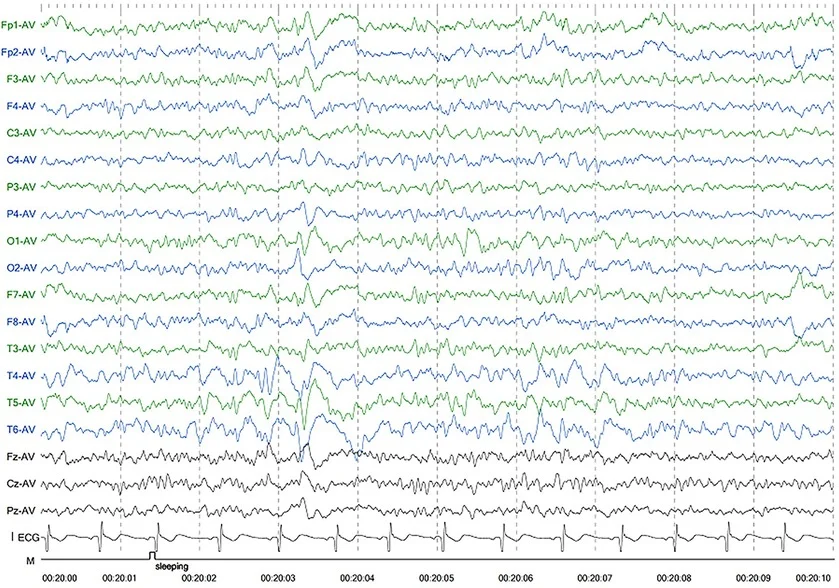
Disorders of consciousness reveal that awareness can exist without behavioral expression, challenging how we diagnose and treat patients.
In 2006, a woman lay in a hospital bed in Cambridge, clinically diagnosed as being in a vegetative state. She showed no behavioral signs of awareness. She did not track movement, respond to commands, or demonstrate any of the criteria neurologists use to infer consciousness. By every clinical standard, the lights were off.
Then neuroscientist Adrian Owen asked her to imagine playing tennis.
Her supplementary motor area lit up on the fMRI scan, the same pattern seen in healthy volunteers imagining the same thing. He asked her to imagine walking through her home. A different network activated: the parahippocampal gyrus, the parietal cortex, the premotor cortex, precisely the regions involved in spatial navigation in conscious people.
She could not move, could not speak, could not signal. But she was following instructions. Someone was home.

Vegetative State vs. Minimally Conscious State
The disorder of consciousness spectrum runs from coma, no arousal, no awareness, through to full recovery. Two states in the middle are frequently confused, clinically and publicly.
A person in a vegetative state shows arousal without awareness. Their eyes may open. They have sleep-wake cycles. They may startle, grimace, or make sounds. But they show no reproducible, purposeful responses to their environment. They are awake in the sense that the brainstem is functioning, but awareness, the sense of something being there, is absent, or so it appears.
A person in a minimally conscious state (MCS) shows fluctuating, inconsistent but real signs of awareness. They may track movement with their eyes. They may reach toward objects. They may occasionally follow a simple command. The awareness is fragmentary, but it is there.
The clinical distinction matters enormously. Misdiagnosis is common. A 2009 study published in BMC Neurology found that 41 percent of patients diagnosed as vegetative were actually minimally conscious. They could not reliably demonstrate awareness on the behavioral measures clinicians used, but awareness was present.
Owen’s fMRI work, and subsequent research using EEG-based methods that do not require expensive scanners, has shown that some patients classified as vegetative can follow commands, answer yes/no questions by imagining different activities, and demonstrate consistent awareness. They are conscious, trapped in a body that cannot signal the fact.
The Perturbational Complexity Index

How do you measure consciousness directly, without relying on behavior?
Neuroscientist Marcello Massimini and colleagues developed a tool called the perturbational complexity index (PCI). A brief pulse of transcranial magnetic stimulation (TMS) is delivered to the brain. EEG electrodes record the resulting electrical echo. The complexity of that echo, how differentiated and integrated the brain’s response is, correlates with the state of consciousness.
In deeply anesthetized patients, the brain responds to TMS with a simple, stereotyped response with low complexity, whereas in conscious brains the response is highly differentiated across space and time. In patients with disorders of consciousness, PCI tracks the level of preserved awareness more reliably than behavioral assessments alone, as validated by Casarotto and colleagues in Annals of Neurology.
PCI is not infallible. It can be confounded by skull defects, medication effects, or focal lesions, so it is used alongside behavioral assessments. But it gives clinicians something behavioral testing cannot: a measure of what the brain is doing internally, rather than what it is showing externally. For a patient who is aware but cannot move, that distinction is the difference between being seen and being invisible.
The Split-Brain Experiments
In the 1960s, neurosurgeon Joseph Bogen and neuropsychologist Roger Sperry performed a remarkable set of experiments on patients who had undergone corpus callosotomy: surgical severing of the corpus callosum, the main fiber tract connecting the two cerebral hemispheres, performed to control severe epilepsy.
The experiments revealed that severing the connection between the hemispheres created what appeared to be two independent cognitive systems sharing one skull.
Information shown to the left visual field (processed by the right hemisphere) could not be verbally reported, the language centers are in the left hemisphere and had no access to the information. But the right hand, controlled by the left hemisphere, could not identify an object that the left hand, controlled by the right hemisphere, had just handled by touch. Each hemisphere knew things the other did not.
When the right hemisphere was asked whether it agreed with a decision the left hemisphere had just made, it sometimes disagreed: and the left hemisphere (which controls speech) would confabulate a reason for the right hemisphere’s dissent that it had actually not witnessed. For instance, a patient might point to an object shown to the left visual field (the right hemisphere saw it) but then verbally explain the choice by pointing to a different object on the right, inventing a plausible but false reason for their action.
The left hemisphere, Michael Gazzaniga later called the interpreter: a module that constructs post-hoc narratives about behavior it did not initiate or observe. The interpreter is not omniscient about the rest of the brain. It is a storyteller, and this bears similarity to the modular view of cognition, where different brain systems operate semi-independently and the conscious self stitches them into a coherent narrative.
Some researchers argue the hemispheres retain partial integration through subcortical pathways, limiting the independence of the two streams.
This raises a genuinely unresolved question: in a split-brain patient, are there two streams of consciousness? Two subjects sharing one body? Or is consciousness somehow unified despite the disconnection? The patients themselves report feeling like one person. But the experimental evidence suggests the hemispheres operate with considerable independence.
Locked-In Syndrome
Locked-in syndrome sits at the opposite end of the spectrum from vegetative state. The patient is fully conscious, fully aware, often fully intact cognitively: and completely unable to move any voluntary muscle except, in most cases, the eyes.
Jean-Dominique Bauby, the editor of Elle magazine, suffered a brainstem stroke in 1995 that left him with locked-in syndrome. He dictated his memoir, The Diving Bell and the Butterfly, by blinking: a transcriptionist cycled through the alphabet, and Bauby blinked when she reached the letter he wanted. The book was published in 1997, two days before his death.
The neural substrate of locked-in syndrome is clear: damage to the ventral pons, the motor output pathway from the cortex to the body, while leaving the cortex intact. The brain is working. The channel to the world is severed.
For consciousness research, locked-in syndrome is instructive precisely because it demonstrates the dissociation between consciousness and the ability to demonstrate it. A person with locked-in syndrome fails every behavioral test of awareness: unless the examiner knows to look at the eyes. An examiner who does not know may conclude, incorrectly, that consciousness is absent.
The implications for vegetative state diagnosis are obvious. If some vegetative patients retain covert awareness, as Owen’s research suggests, they may be in a condition closer to locked-in syndrome than to true unconsciousness. The difference is one of degree, and the degree matters morally as much as it does medically.
What Disorders of Consciousness Reveal
These cases illuminate what consciousness is by showing what happens when it breaks down or becomes inaccessible.
The vegetative state reveals that arousal and awareness are dissociable. You can be awake, brainstem functioning, eyes open, sleep cycles present, without there being anyone home in the cortical sense.
The minimally conscious state reveals that awareness can exist in fragments: flashing on and off, inconsistent, but real.
The split-brain cases reveal that unified conscious experience may be a construction: assembled in real time from distributed processing that can, under the right conditions, fall apart.
Locked-in syndrome reveals that consciousness has no necessary behavioral expression. It can exist in complete silence.
Together, they suggest that consciousness is not a single thing. It is a cluster of capacities, arousal, awareness, self-monitoring, integration, expression, that can come apart. Any theory of consciousness that treats it as binary, on or off, struggles to account for what clinical neurology has found in the space between.
The PCI and the Future of Consciousness Medicine
The development of objective consciousness metrics, PCI, EEG-based command-following, fMRI paradigms, represents one of the more consequential advances in clinical neuroscience in recent decades.
For the estimated 350,000 to 500,000 patients living with disorders of consciousness in the United States alone (source: American Academy of Neurology), misdiagnosis is not an abstract concern. Treatment decisions, family decisions, legal decisions: all depend on whether someone is conscious. Getting that wrong, in either direction, carries enormous weight.
The field is moving toward routine use of neurophysiological markers rather than relying solely on behavioral assessment. It is also raising questions that courts, hospitals, and families have not fully prepared to answer: if a patient classified as vegetative can answer yes/no questions using brain signals, what are their legal rights? Can they consent to or refuse medical treatment? Landmark cases, such as the 2021 Re M in the UK, and ongoing debates about the use of fMRI for end-of-life decisions as outlined by the American Academy of Neurology, are now central to these ethical and legal discussions.
These are not hypothetical futures. They are cases in clinical literature now.
The Deepest Question
Disorders of consciousness raise, in the sharpest possible way, the question that runs through all consciousness research: what exactly is it that makes a being a subject rather than an object?
We do not have a complete answer. But the clinical evidence from these conditions has given us something important: proof that consciousness can be present without being visible, absent while arousal is intact, fragmented while identity persists, and whole while behavior is entirely suppressed.
Whatever consciousness is, it is not simply what you can see from the outside. That is a lesson with consequences far beyond the clinic.
What is a vegetative state?
A vegetative state is a disorder of consciousness where a person has sleep-wake cycles and basic reflexes but shows no behavioral signs of awareness or purposeful response to stimuli.
How can someone be aware but unable to show it?
Functional MRI or EEG can detect brain activity patterns, such as imagining playing tennis, that match conscious thought, revealing awareness even when the person cannot move or speak.
What is the difference between a vegetative state and a minimally conscious state?
In a vegetative state, there is no behavioral evidence of awareness, while in a minimally conscious state, there are intermittent but reproducible signs of self or environmental awareness.
What is the perturbational complexity index?
The perturbational complexity index is an EEG-based measure that assesses the brain’s ability to generate complex electrical responses to stimulation, indicating consciousness without relying on behavior.
Can patients in a vegetative state recover?
Yes, some patients may transition to a minimally conscious state or recover further, though outcomes vary widely depending on the cause and extent of brain injury.
Sources & References
- Schnakers, C., et al. (2009). “Diagnostic accuracy of the vegetative and minimally conscious state: clinical consensus versus standardized neurobehavioral assessment.” BMC Neurology, 9, 35. https://doi.org/10.1186/1471-2377-9-35
- Owen, A. M., et al. (2006). “Detecting awareness in the vegetative state.” Science, 313(5792), 1402. https://doi.org/10.1126/science.1130197
- Monti, M. M., et al. (2010). “Willful modulation of brain activity in disorders of consciousness.” New England Journal of Medicine, 362(7), 579-589. https://doi.org/10.1056/NEJMoa0905370
- Giacino, J. T., et al. (2002). “The minimally conscious state: definition and diagnostic criteria.” Neurology, 58(3), 349-353. https://doi.org/10.1212/wnl.58.3.349
- Casali, A. G., et al. (2013). “A theoretically based index of consciousness independent of sensory processing and behavior.” Science Translational Medicine, 5(198), 198ra105. https://doi.org/10.1126/scitranslmed.3006294
- Casarotto, S., et al. (2016). “Stratification of unresponsive patients by an independently validated index of brain complexity.” Annals of Neurology, 80(5), 718-729. https://doi.org/10.1002/ana.24779
- Gazzaniga, M. S. (2005). “Forty-five years of split-brain research and still going strong.” Nature Reviews Neuroscience, 6(8), 653-659. https://doi.org/10.1038/nrn1723
- Laureys, S., et al. (2005). “The locked-in syndrome: what is it like to be conscious but paralyzed and voiceless?” Progress in Brain Research, 150, 495-511. https://doi.org/10.1016/S0079-6123(05)50034-7
- Giacino, J. T., et al. (2018). “Practice guideline update recommendations summary: disorders of consciousness.” Neurology, 91(10), 450-460. https://doi.org/10.1212/WNL.0000000000005926
Further reading: Disorder of consciousness on Wikipedia