
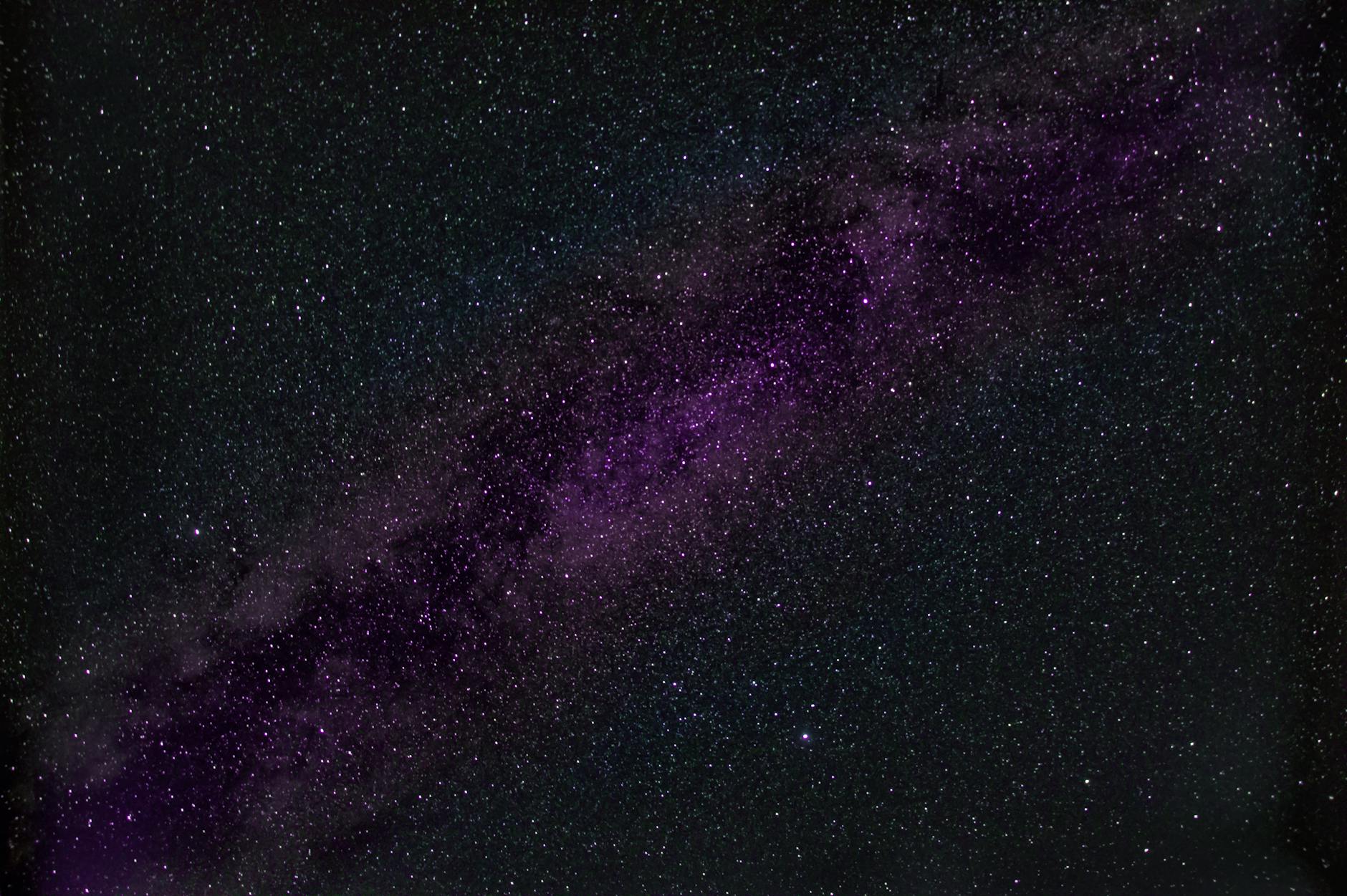
On a clear night far from city lights, the faint band of light stretching across the sky is our view from inside a spiral galaxy. The Milky Way galaxy, the galaxy that contains our solar system, every star visible to the naked eye, and an estimated 100–400 billion stars in total, is a barred spiral galaxy roughly 100,000 light-years in diameter. Understanding our galactic home means understanding a system of extraordinary scale and complexity that has been assembling itself for over 13 billion years.
We have a special challenge in studying the Milky Way galaxy: we are inside it. There is no vantage point from which to photograph it from the outside. Everything we know about its structure has been pieced together from measurements made from within: star surveys, radio maps, infrared observations that pierce the dust that obscures the galactic center, and, since 2015, precise astrometric measurements from the Gaia space telescope.
Structure: A Barred Spiral Galaxy

The Milky Way galaxy is classified as a barred spiral galaxy Designated SBbc in the morphological classification system. Its defining structural features are:
The disk: A flat, rotating disk of stars, gas, and dust approximately 100,000–120,000 light-years in diameter and about 1,000 light-years thick. The disk contains most of the galaxy’s stars, including the Sun, arranged in spiral armsThe Sun is located about 26,000 light-years from the galactic center, in a minor arm called the Orion Arm (or Orion Spur), between two major arms: the Perseus Arm and the Carina-Sagittarius Arm.
The central bar: A roughly rectangular structure of stars, gas, and dust stretching across the center of the galaxy, approximately 27,000 light-years long. The bar connects to the inner spiral arms. Most galaxies of the Milky Way’s mass have bars, and the Milky Way’s was confirmed as barred in the late 20th century through infrared surveys.
The bulge: A roughly spheroidal region at the galaxy’s center, roughly 10,000 light-years across, densely packed with old stars. The bulge harbors the supermassive black hole at the galactic center (Sagittarius A*) and is a site of intense star formation and stellar evolution.
The haloA roughly spherical region of space surrounding the disk, extending to radii of at least 130,000 light-years (and possibly much farther), populated by old globular clusters, scattered old stars, and, most importantly, dark matter. The halo is the most massive component of the galaxy by far when dark matter is included.
Spiral armsThe disk contains four major spiral arms: the Norma, Crux-Centaurus, Carina-Sagittarius, and Perseus arms, and several minor arms. The arms are not rigid structures; they are density waves propagating through the disk where star formation is enhanced. Stars move in and out of the arms as the wave passes.
Sagittarius A*: The Galactic Center Black Hole
At the very center of the Milky Way lies Sagittarius A* (Sgr A*, pronounced “Sagittarius A-star”), a supermassive black hole with a mass of approximately 4.15 million solar masses. It was first detected as an anomalously bright radio source in 1974. For decades, its nature was debated; the decisive evidence came from the orbits of stars near the galactic center, which, tracked over more than two decades by teams at the Max Planck Institute and UCLA, traced the tight elliptical orbits expected around an enormous point mass.
In May 2022, the Event Horizon Telescope collaboration released the first direct image of Sgr A*. A ring-shaped emission of hot plasma around the black hole’s shadow, consistent with the predictions of general relativity. This followed the EHT’s 2019 image of M87*, the supermassive black hole at the center of the Messier 87 galaxy.
Sgr A* is currently relatively quiet; it is not actively accreting material at a high rate. Occasional flares occur when stars or gas clouds pass close to the black hole, producing brief brightenings in X-rays and infrared. A cloud of gas called G2 passed close to Sgr A* in 2013–2014 and produced a modest response, suggesting the black hole can be transiently activated by infalling material.
The Milky Way’s Age and Formation

The Milky Way is approximately 13.5 billion years old, formed roughly 300 million years after the Big BangIt assembled through the hierarchical merging of smaller galaxies and protogalactic fragments in the early universe. The oldest stars in the Milky Way galaxy, found in ancient globular clusters, date to 12–13 billion years ago, bearing witness to this early assembly.
Gaia’s astrometric data has revolutionized our understanding of the Milky Way’s formation history. One of the most significant revelations was the discovery of the Gaia-Enceladus (or Gaia-Sausage) merger event: approximately 8–10 billion years ago, the early Milky Way collided and merged with a dwarf galaxy of comparable mass. This merger dynamically heated and restructured the galactic halo, depositing a large population of accreted stars with distinctive orbital properties. It is likely responsible for the thick disk of the Milky Way galaxy.
The Milky Way has continued to absorb smaller satellite galaxies throughout its history. The Sagittarius Dwarf Elliptical Galaxy is currently being tidally disrupted and absorbed, leaving a stream of stars that wraps around the galaxy. The Magellanic Clouds (the Large and Small) are irregular dwarf galaxies bound to the Milky Way and will eventually merge with it in the future, though their exact trajectory is uncertain.
The Milky Way’s Satellite Galaxies
The Milky Way is surrounded by roughly 60 known satellite galaxies, most of them small, faint dwarf galaxies. The two most prominent are:
The Large Magellanic Cloud (LMC)Located about 160,000 light-years away, the LMC is the largest satellite galaxy, with a mass of roughly 10¹⁰ solar masses. It contains its own giant molecular clouds and active star-forming regions, including the Tarantula Nebula, the most active star-forming region in the Local Group and host to some of the most massive stars known.
The Small Magellanic Cloud (SMC): About 200,000 light-years away, with roughly one-third the mass of the LMC. The LMC and SMC are connected by a bridge of gas and stars, and both are currently in the process of interacting gravitationally with the Milky Way galaxy.
Both Clouds are visible to the naked eye from the Southern Hemisphere as detached patches of the Milky Way. They contain hundreds of millions of stars and are the closest external galaxies to Earth observable without a telescope.
The Great Andromeda Collision

The Milky Way is not isolated. It is the second-largest member of the Local Group, a gravitationally bound collection of roughly 80 galaxies spanning about 10 million light-years. The largest member is the Andromeda Galaxy (M31), approximately 2.5 million light-years away, with roughly twice the stellar mass of the Milky Way.
Andromeda is approaching the Milky Way at about 110 kilometers per second. In approximately 4.5 billion years, the two galaxies will begin to interact gravitationally, and in roughly 5–8 billion years they will merge to form a single elliptical galaxy, sometimes called “Milkomeda” or “Andromeda Collision” in popular accounts. The Sun will likely survive the collision, displaced to a different orbit in the merged galaxy but not destroyed; stellar collisions are vanishingly unlikely even during galactic mergers, because the space between stars is so vast.
The Galaxy’s Dark Matter Halo
The visible matter (stars, gas, dust) accounts for only about 5–10% of the Milky Way’s total mass. The dominant mass component is dark matter, distributed in a roughly spherical halo that extends to at least 200,000 light-years from the galactic center and possibly much farther. The total mass of the Milky Way galaxy, including dark matter, is estimated at roughly 1–1.5 × 10¹² solar masses.
Evidence for the dark matter halo comes primarily from: – Stellar kinematics: The orbital velocities of stars and gas in the outer disk remain roughly constant far beyond the point where they should decline if only visible matter were present. This “flat rotation curve” requires additional invisible mass. – Globular cluster orbits: The velocities of globular clusters in the halo require a deep gravitational potential well extending far beyond the visible disk. – Satellite galaxy dynamics: The orbits and velocities of satellite galaxies like the Magellanic Clouds require a massive halo to prevent them from escaping.
The nature of the dark matter particles constituting this halo remains one of the biggest unsolved problems in physics and astronomy.
How big is the Milky Way?
The Milky Way’s disk is approximately 100,000–120,000 light-years in diameter. Including its outer reaches and dark matter halo, it may extend to 300,000 light-years or more. The disk is about 1,000 light-years thick in the region where the Sun orbits. The Sun is located about 26,000 light-years from the galactic center, roughly halfway between the center and the outer edge, in a minor arm called the Orion Spur.
How many stars are in the Milky Way?
Estimates range from about 100 billion to 400 billion stars, with 200–300 billion commonly cited. The uncertainty arises from difficulty measuring the faintest, most numerous stars (red dwarfs) and the total mass budget. If all stars were counted equally by number, red dwarfs would dominate; they make up roughly 75% of all stars but contribute only a small fraction of the galaxy’s total luminosity.
Where is the Milky Way’s black hole?
The Milky Way’s central supermassive black hole, Sagittarius A* (Sgr A*), is located at the galactic center, about 26,000 light-years from Earth in the direction of the constellation Sagittarius. It has a mass of approximately 4.15 million solar masses. It was first imaged directly by the Event Horizon Telescope in 2022. Sgr A* is currently in a low-activity state but occasionally flares when infalling material temporarily increases its accretion rate.
What type of galaxy is the Milky Way?
The Milky Way is a barred spiral galaxy, classified as SBbc. It has a central bar connecting two major inner spiral arms, several other outer spiral arms, a central bulge of old stars, and an extended halo of dark matter. The bar, central bulge, spiral arm structure, and rotation curve all characterize it as a typical large spiral galaxy. It is slightly smaller than the Andromeda Galaxy (M31), which is the largest member of the Local Group.
Will the Milky Way collide with another galaxy?
Yes, the Andromeda Galaxy (M31), currently about 2.5 million light-years away, is approaching the Milky Way at about 110 km/s. In approximately 4.5 billion years, the two galaxies will begin to merge, with the full merger completing over the following few billion years. The resulting system will likely be an elliptical galaxy. Individual stars are extremely unlikely to collide during the merger because the distances between stars are so enormous, but orbits will be drastically disrupted and the spiral structure of both galaxies will be destroyed.
How long does it take the Sun to orbit the Milky Way?
The Sun orbits the center of the Milky Way at a velocity of about 230 kilometers per second, completing one orbit (called a galactic year, or cosmic year) in approximately 225–250 million years. Since the solar system formed about 4.6 billion years ago, it has completed roughly 18–20 orbits of the galaxy. The last time the Sun was in approximately this galactic position, the Triassic extinction event was beginning and dinosaurs were just emerging.
Sources
Ghez, A.M. et al. (2008). Measuring distance and properties of the Milky Way’s central supermassive black hole with stellar orbits. The Astrophysical Journal, 689(2), 1044–1062. doi:10.1086/592738
Event Horizon Telescope Collaboration. (2022). First Sagittarius A Event Horizon Telescope results. I. The shadow of the supermassive black hole in the center of the Milky Way. The Astrophysical Journal Letters*, 930(2), L12. doi:10.3847/2041-8213/ac6674
Helmi, A. et al. (2018). The merger that led to the formation of the Milky Way’s inner stellar halo and thick disk. Nature, 563(7729), 85–88. doi:10.1038/s41586-018-0625-x
Gravity Collaboration. (2019). A geometric distance measurement to the galactic center black hole with 0.3% uncertainty. Astronomy & Astrophysics, 625, L10. doi:10.1051/0004-6361/201935656
McConnachie, A.W. et al. (2009). The remnants of galaxy formation from a panoramic survey of the region around M31. Nature, 461(7260), 66–69. doi:10.1038/nature08327
Bland-Hawthorn, J., & Gerhard, O. (2016). The galaxy in context: structural, kinematic, and integrated properties. Annual Review of Astronomy and Astrophysics, 54(1), 529–596. doi:10.1146/annurev-astro-081915-023441
Further reading: Milky way galaxy on Wikipedia