
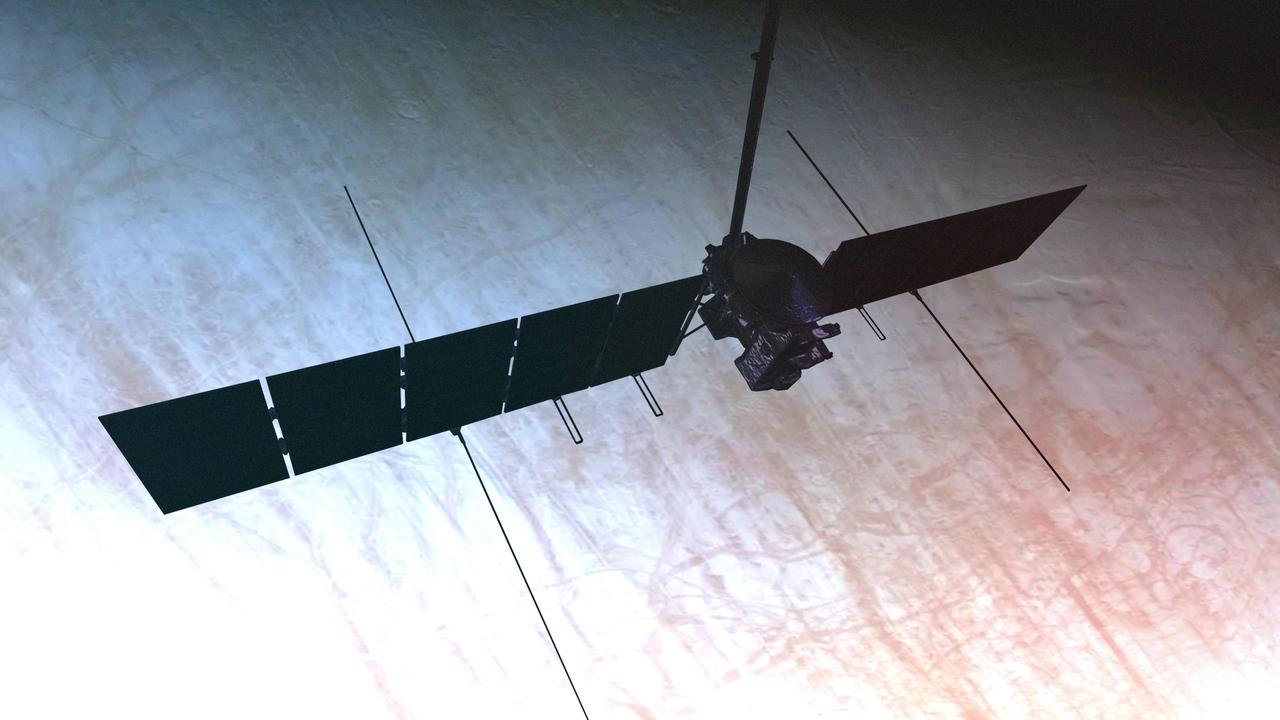
Europa Clipper launched on October 14, 2024, riding a SpaceX Falcon Heavy into deep space on a course for Jupiter. It will not arrive until April 2030.
That five-and-a-half-year journey reveals how far NASA will go to answer one question. Does the ocean beneath Europa’s ice shell have the conditions to support life?
This is not a speculative mission. Europa has a confirmed liquid water ocean, a source of internal heat driven by Jupiter’s gravity, and chemistry that includes salts and possibly organics. What Europa Clipper is going to answer is not whether the ocean exists (that was settled by NASA’s Galileo spacecraft in the 1990s) but what kind of ocean it is, and whether the ingredients for biology are present and interacting.
The Ocean in an Ice Shell

Europa is Jupiter’s fourth-largest moon, slightly smaller than Earth’s Moon. It completes an orbit every 3.5 days. Jupiter’s gravity constantly flexes and stretches the moon’s interior. That tidal flexing (the same mechanism that makes Io volcanically active) generates heat. On Europa, that heat flows into an ocean of liquid water beneath an ice shell.
The ocean is deep. Current estimates place it between 60 and 150 kilometers. This dwarfs any ocean on Earth. Scientists estimate it contains about twice as much liquid water as all Earth’s oceans combined. Above it sits the ice shell, 10 to 30 kilometers thick and scarred by ridges, bands, and chaotic terrain where ice has broken apart and refrozen.
The Hubble Space Telescope observed what appeared to be water vapor near Europa’s south pole in 2013 and again in 2016. These observations were tentative. Confirming whether Europa has active plumes (columns of ocean material ejected through ice fractures, as Enceladus does) is a primary objective for Europa Clipper. If plumes exist, what the mission can detect changes entirely.
Nine Instruments, One Question
Europa’s ocean is sealed beneath kilometers of ice, separated from direct observation by vacuum and radiation. Specialized tools are required to study it. Europa Clipper carries nine scientific instruments that, across 49 planned flybys at altitudes as low as 25 kilometers, will build a complete picture of the moon’s habitability.
Sounding the Ice
REASON The Radar for Europa Assessment and Sounding is an ice-penetrating radar that transmits radio waves through the ice shell and listens for reflections, timing how long it takes the signal to bounce off internal layers and the ocean-ice boundary below. It will map the shell’s internal structure and identify liquid water pockets within the ice. A thinner shell, or one with embedded water lenses, means more exchange between the ocean and the surface, and more opportunity for chemistry to cycle between them.
E-THEMIS, a thermal infrared imager searches for warm spots on the surface: signatures of geological activity or water intrusion from below. A geologically active Europa is also a chemically active one.
Sampling Plumes and Chemistry
MASPEX The Mass Spectrometer for Planetary Exploration is one of the most sensitive mass spectrometers ever sent to the outer solar system. It analyzes Europa’s thin exosphere and any plume material for organic molecules, oxygen compounds, and the chemical signatures of complex chemistry. At Enceladus, Cassini’s mass spectrometer found molecular hydrogen, silica nanoparticles, and complex organics: evidence of hydrothermal reactions between hot rock and water. MASPEX will look for analogous signals at Europa.
SUDA The Surface Dust Analyzer has the most direct shot at ocean material of any instrument on the mission. If plumes are active, SUDA flies through them and captures ejected particles for direct chemical analysis. It can identify organic molecules and biosignature chemistry that has never been filtered through kilometers of ice. Cassini’s plume encounters at Enceladus fundamentally changed how scientists think about ocean world habitability; SUDA is designed to do the same at Europa.
UVS, the Ultraviolet Spectrograph, detects plume activity in UV light and maps surface composition. MISE, the Mapping Imaging Spectrometer for Europa maps the surface in infrared, identifying salts, organics, and ice phases: the distribution of salt deposits revealing where water has come up through the ice and where ocean-surface exchange is most active.
Imaging and Magnetic Sounding
The Europa Imaging System (EIS) provides high-resolution cameras to map the surface in detail not seen since Galileo. The Magnetometer and PIMS The Plasma Instrument for Magnetic Sounding works together to measure Europa’s magnetic environment and refine estimates of the ocean’s depth and salinity. Saltier water is a better electrical conductor and creates a stronger magnetic signature; together, these instruments will read the ocean’s properties without ever touching it.
The Habitability Case

Three conditions are considered necessary for life as we understand it: liquid water, a source of energy, and the right chemistry. Europa appears to meet all three, based on current remote data, which Clipper will put to a rigorous test.
The ocean is liquid. The tidal heating provides energy. On the ocean floor, where hot rock likely meets saltwater, hydrothermal chemistry would produce reduced compounds (molecular hydrogen, hydrogen sulfide) that drive chemosynthetic ecosystems (communities of microbes that use chemical energy instead of sunlight) in Earth’s own deep-sea hydrothermal vents. Those ecosystems, discovered in 1977, need no sunlight. Europa’s ocean floor may have direct analogs.
The chemistry question is more complicated. Life requires not just water and energy but a sustained cycle of reactions: reactive chemicals coming together to fuel the processes biology depends on. On Earth’s surface, photosynthesis produces oxygen. On Europa’s surface, Jupiter’s intense radiation bombards the ice, creating oxidants: hydrogen peroxide, oxygen, and sulfates. Whether those surface oxidants can reach the ocean below (through cracking ice or plumes cycling material back inward) is a critical unknown. Without that transport, the ocean chemistry may be too stable to drive the reactive cycles life needs. Europa Clipper’s instruments will constrain how much oxidant exchange is actually occurring.
It is important to be precise about what the mission will not resolve. Europa Clipper will not land or drill through the ice. A detection of biosignatures by SUDA in a confirmed plume would be extraordinary. However, the mission’s primary goal is habitability assessment: characterizing whether the ocean could support life, not confirming whether it does. That confirmation would require a future lander.
Why This Mission Matters Beyond Europa
The significance of Europa Clipper extends beyond the single moon it is flying to study. If Europa’s ocean is habitable (if the chemistry is right, if energy exchange between ocean and rock works the way models suggest) it establishes a template.
Several confirmed or strongly suspected ocean worlds exist in the solar system: Enceladus (active plumes, confirmed organics), Titan (global subsurface ocean beneath its hydrocarbon atmosphere), Ganymede and Callisto (internal oceans inferred from magnetic data), and potentially others. These worlds harbor liquid water not because they orbit in a star‘s habitable zone, but because of internal energy (tidal forces, radioactive decay) entirely independent of solar warmth. If the first such world examined in detail has conditions for life, the implications for where biology can exist in the universe are profound.
Europa Clipper also builds the methodology for future searches. The instruments flying to Europa are prototypes for what will eventually fly to Enceladus, Titan, and be carried in concept studies for exoplanet characterization. What the mission learns about reading ocean chemistry from orbit (through ice, through plumes, through magnetic fields) becomes the technique library for the next generation of searches. False biosignatures and measurement ambiguity are risks in any detection; the rigorous multi-instrument approach Europa Clipper uses is designed to cross-check results and eliminate alternate explanations.
What Happens Next

Europa Clipper completed a Mars gravity assist in March 2025 and will use an Earth gravity assist in December 2026 before arriving at Jupiter in April 2030. The science phase (49 Europa flybys over roughly four years) begins shortly after Jupiter orbit insertion.
The first detailed surface images since Galileo will arrive within months of arrival. Plume searches begin on the earliest flybys. REASON and magnetometer data will start resolving the ice shell thickness question within the first year of operations.
The answer to whether Europa’s ocean is habitable will not arrive in a single headline. It will emerge from the accumulation of flyby data (thermal maps, radar profiles, mass spectra, magnetic readings) synthesized over years into a picture that either supports or challenges the case for life in the outer solar system.
Europa Clipper is not a probe designed to confirm life. It is a probe designed to determine whether asking that question in earnest is justified, and to build the scientific foundation for the mission that would come next if the answer is yes.
What is Europa Clipper’s mission?
Europa Clipper is a NASA spacecraft designed to determine whether Jupiter’s moon Europa has conditions that could support life. It will conduct 49 close flybys using nine scientific instruments to characterize the ocean beneath the ice, the ice shell’s thickness and structure, surface chemistry, and whether active plumes are venting ocean material into space.
When does Europa Clipper arrive at Jupiter?
Europa Clipper launched in October 2024 and is scheduled to arrive at Jupiter in April 2030. It uses gravity assists from Mars (March 2025) and Earth (December 2026) to build up speed for the journey to the outer solar system.
Does Europa definitely have an ocean?
Yes. NASA’s Galileo spacecraft confirmed the existence of a subsurface liquid water ocean in the 1990s through magnetic field measurements. The ocean is estimated to be 60–150 kilometers deep, and scientists estimate it contains roughly twice the water volume of all Earth’s oceans combined.
Could Europa Clipper actually detect signs of life?
Potentially, if active plumes exist. The SUDA instrument can directly capture and analyze particles ejected from plumes, and MASPEX can detect organic molecules and biosignature chemistry. However, the mission’s primary goal is habitability assessment: determining whether the ocean could support life, not direct life detection, which would require a future lander mission.
Why is Europa considered a stronger candidate for life than Mars?
Europa has a liquid water ocean right now, likely in contact with a rocky seafloor where hydrothermal chemistry may be ongoing: conditions analogous to deep-sea hydrothermal vent ecosystems on Earth that host life without any sunlight. Mars had surface water billions of years ago and is now a cold, dry desert. The key difference is that Europa’s potential habitat is active today.
Sources & References
Pappalardo, R.T. et al. (2024). Europa Clipper: Mission overview and science objectives. Space Science Reviews, 220, 1. doi:10.1007/s11214-024-01070-5
Kivelson, M.G. et al. (2000). Galileo magnetometer measurements: A stronger case for a subsurface ocean at Europa. Science, 289, 1340–1343. doi:10.1126/science.289.5483.1340
Roth, L. et al. (2014). Transient water vapor at Europa’s south pole. Science, 343, 171–174. doi:10.1126/science.1247051
Waite, J.H. et al. (2017). Cassini finds molecular hydrogen in the Enceladus plume: Evidence for hydrothermal processes. Science, 356, 155–159. doi:10.1126/science.aai8703
Hand, K.P. et al. (2017). Report of the Europa Lander Science Definition Team. NASA JPL.
Chyba, C.F. & Phillips, C.B. (2001). Possible ecosystems and the search for life on Europa. PNAS, 98, 801–804. doi:10.1073/pnas.98.3.801
Further reading: Europa Clipper on Wikipedia