The Science of Life – From Earth to the Stars

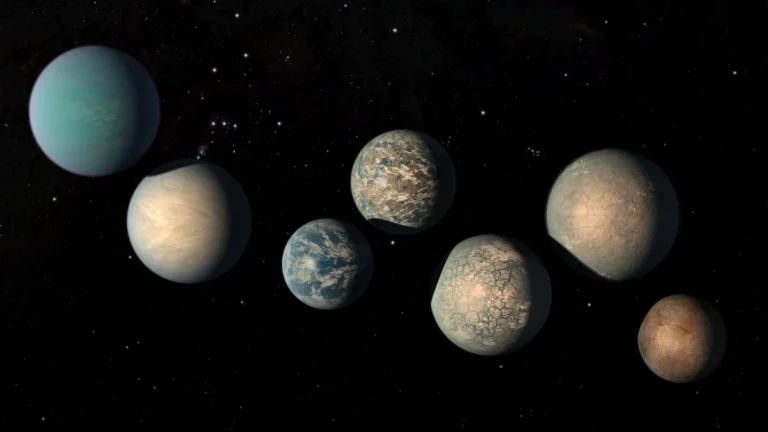
Artist illustration of an exoplanet atmosphere

Methane as a Biosignature: Why It Hints at Alien Life

The search for life beyond Earth hinges on identifying biosignatures – chemical markers in a planet’s atmosphere that are best explained by biological processes. Among the most compelling candidates is methane biosignature exoplanets, a topic that has gained urgency with the launch of the James Webb Space Telescope (JWST). Methane alone is not proof of life, but when detected alongside other gases like oxygen or carbon dioxide, it can become a powerful indicator of a living world. This article explores why methane is such a promising biosignature, how JWST can detect it, and what caveats scientists must consider. Methane Biosignature Exoplanets: Why Methane Matters Methane (CH₄) is a simple organic Read more
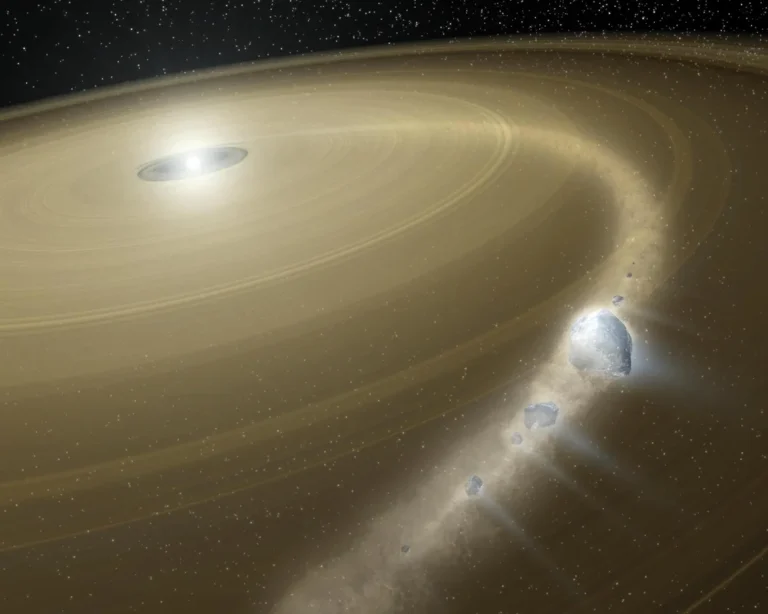
Artist illustration of a white dwarf star

How White Dwarfs Cool: The Slow Dance of Stellar Remnants

Understanding how white dwarfs cool over time is essential for using these dense stellar remnants as cosmic clocks that measure the age of the Milky Way and the history of nearby star populations. White dwarfs are the final evolutionary stage of stars like our Sun – objects that have shed their outer layers and left behind an Earth-sized core of degenerate matter. Their cooling, driven by photon and phonon processes, follows a predictable yet complex trajectory that astronomers have increasingly refined over decades. The Birth of a White Dwarf: From Red Giant to Stellar Ember A white dwarf begins its cooling journey the moment its progenitor star exhausts its nuclear Read more

A dusty debris disk around a young star

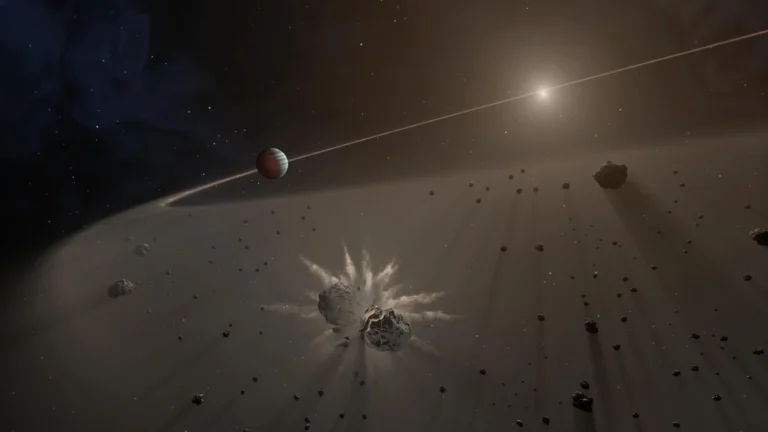
Epsilon Eridani: A Young Planetary System That Mirrors Our Solar System’s Past

Just 10.5 light-years away in the constellation Eridanus, Epsilon Eridani is one of the closest planetary systems to our own, and one of the youngest yet found around a Sun-like star. At only a few hundred million years old, this orange dwarf is still encircled by dusty debris belts and shaped by at least one giant planet, giving astronomers a rare snapshot of what our own solar system may have looked like during its violent youth. Astronomers study the Epsilon Eridani exoplanet system as a nearby snapshot of how our own solar system may have looked in its youth. Key Orbital and Physical Parameters The system likely contains more planets. Read more

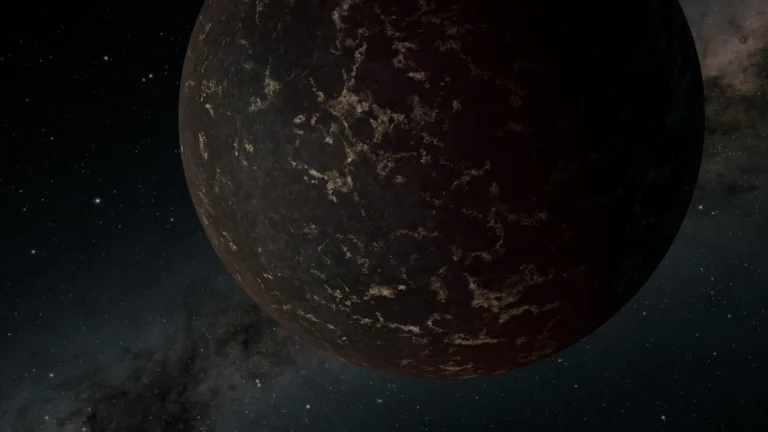
Artist illustration of a tidally locked world orbiting a red dwarf

Tidal Locking and Habitability: The Strange Worlds That Never Rotate

The tidal locking effect on exoplanet habitability represents one of the most intriguing challenges in modern astrophysics, forcing scientists to reconsider traditional assumptions about what makes a planet capable of supporting life. When a planet becomes tidally locked to its host star, one hemisphere experiences perpetual daylight while the other remains in endless darkness, creating conditions that seem profoundly inhospitable. Yet recent climate models and observational data suggest that these strange worlds may harbor habitable niches along the narrow boundary between day and night, offering new hope for finding life around the most common stars in the galaxy. How the Tidal Locking Effect on Exoplanet Habitability Works Tidal locking occurs Read more

scientific paradigm shift — A telescope pointed at the night sky, symbolizing the Copernican revolution in astronomy.

Scientific Paradigm Shifts: How Science Actually Changes Its Mind

Science is often portrayed as a steady march of progress, each discovery adding a brick to an ever-growing wall of knowledge. But that picture is wrong. Real scientific history looks more like decades of quiet accumulation followed by sudden, disorienting upheaval. The Earth moves. Continents drift. Atoms are mostly empty space. The germ theory of disease, showing that invisible microbes cause illness, was the shift; the discovery that H. pylori causes ulcers is a classic case of anomaly-driven revision within that paradigm. Real progress often comes through a scientific paradigm shift. Each of these discoveries didn’t just add a new fact. They forced scientists to discard entire worldviews and rebuild Read more

Living cells, the basic unit of life

What Is Life? Biology’s Most Fundamental Unanswered Question

We can sequence a genome, synthesize a cell membrane, and build molecules that replicate themselves. We can detect metabolism in distant ocean worlds and observe amino acids forming in meteorites. We can edit the DNA of living organisms with molecular scissors. And yet we still cannot fully answer what is life. But we still cannot answer a deceptively simple question: what is life? The failure isn’t for lack of trying. Physicists, chemists, biologists, and philosophers have proposed dozens of definitions. Each one either excludes things we would clearly call alive, includes things we clearly wouldn’t, or is so vague it’s not useful. Quick Definition: Life is a self-sustaining chemical system Read more

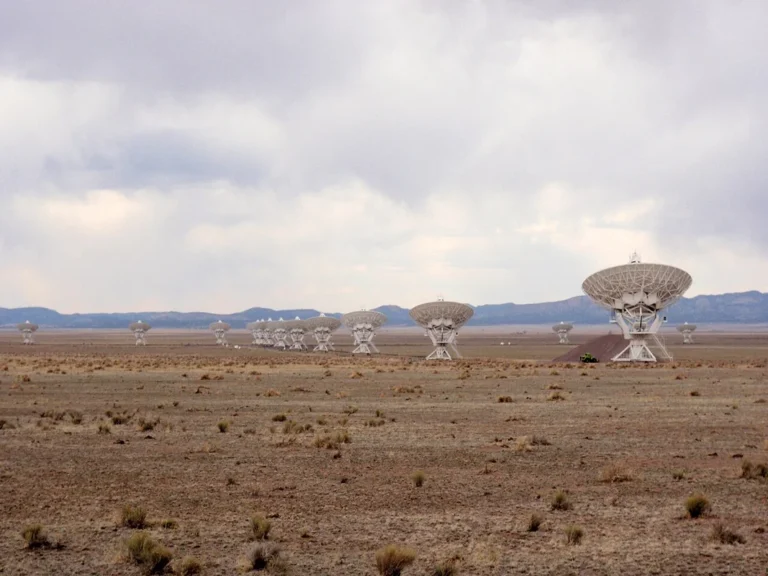
A radio telescope array of the kind SETI uses to listen for signals

SETI: 60 Years of Listening for Alien Signals

On April 8, 1960, at the National Radio Astronomy Observatory in Green Bank, West Virginia, a 26-meter radio telescope pointed toward two nearby sun-like stars, Tau Ceti and Epsilon Eridani, and listened. That moment marks the start of modern SETI history. Project Ozma, run by astronomer Frank Drake, was the first systematic scientific search for radio signals from extraterrestrial intelligence. It listened for about 150 hours over several weeks, found nothing, and changed science forever. Not because of what it found. Because of the question it asked. Before Project Ozma, searching for alien signals was the stuff of science fiction. Drake made it respectable science, a legitimate astronomical program subject Read more

mathematics describes nature — Complex mathematical equations on a blackboard, representing the deep connection between mathematics and physical reality.

Why Mathematics Describes Nature: The Unreasonable Effectiveness of Math

In 1960, physicist Eugene Wigner published a short essay with a remarkable title: “The Unreasonable Effectiveness of Mathematics in the Natural Sciences.” It captured a genuine mystery: why mathematics describes nature at all. Wigner’s puzzle was simple but deep. Mathematics is a purely human intellectual creation, invented (or discovered, depending on your philosophy) without any reference to the physical world. Mathematicians prove theorems because they are logically consistent, not because they describe anything real. And yet, over and over again, the most abstract mathematical structures, developed with no physical application in mind, turn out to describe nature with uncanny precision. Why should this be? It is, as Wigner wrote, “a Read more