
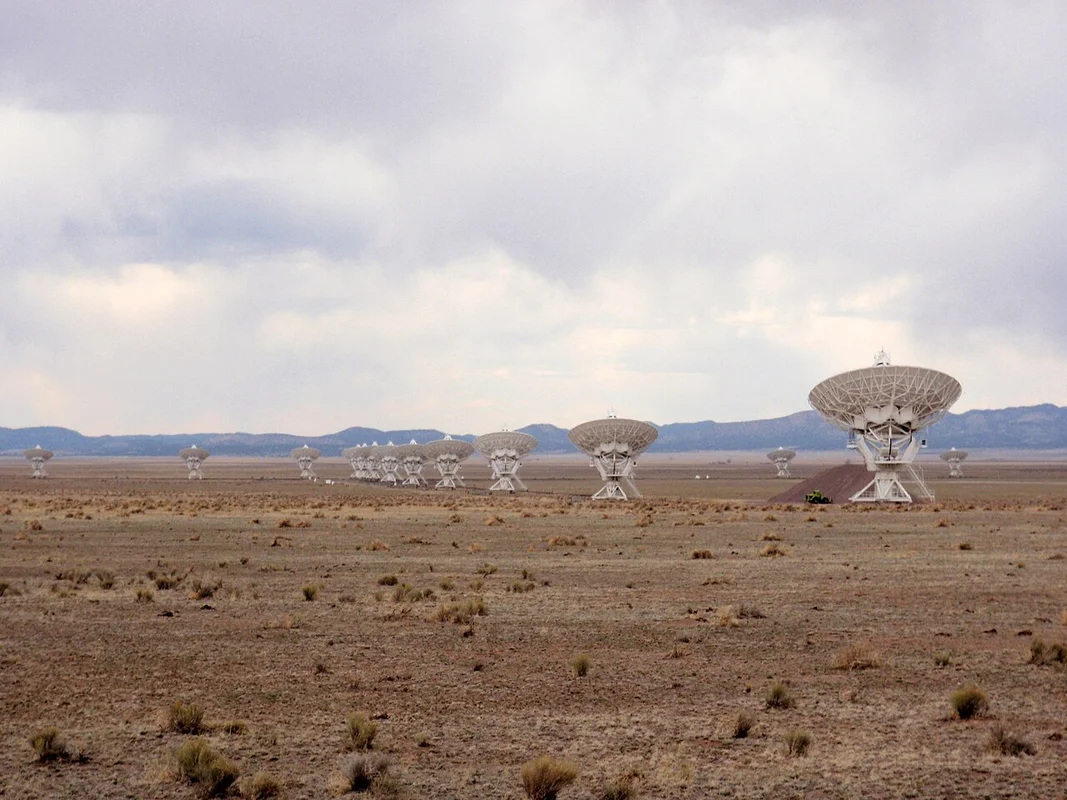
On April 8, 1960, at the National Radio Astronomy Observatory in Green Bank, West Virginia, a 26-meter radio telescope pointed toward two nearby sun-like stars, Tau Ceti and Epsilon Eridani, and listened. That moment marks the start of modern SETI history.
Project Ozma, run by astronomer Frank Drake, was the first systematic scientific search for radio signals from extraterrestrial intelligence. It listened for about 150 hours over several weeks, found nothing, and changed science forever.
Not because of what it found. Because of the question it asked.
Before Project Ozma, searching for alien signals was the stuff of science fiction. Drake made it respectable science, a legitimate astronomical program subject to the same standards of rigor as any other. The field of SETI (the Search for Extraterrestrial Intelligence) has been growing ever since.
Why Radio? The Reasoning Behind the Strategy

The choice of radio frequencies wasn’t arbitrary. In a 1959 paper in Nature, physicists Giuseppe Cocconi and Philip Morrison argued that microwave radio frequencies were the most logical choice for interstellar communication:

– Low energy: Radio photons are cheap to produce, even for civilizations limited to current human technology levels. – Low absorption: Radio waves travel through the galaxy with minimal absorption by interstellar gas and dust. – Universal physics: Any technological civilization would understand electromagnetism. – The cosmic waterhole: The frequency range between the 21 cm hydrogen line (1.42 GHz) and the 18 cm hydroxyl line (1.67 GHz) is quiet, free of natural radio noise, and brackets the frequencies associated with water, the most universal chemical in the cosmos. Cocconi and Morrison called it the “cosmic waterhole”, a natural gathering place.
Drake chose 1.42 GHz (the hydrogen frequency) for Project Ozma. It remains one of the most searched frequencies in SETI.
But radio is just one option. The search has expanded dramatically over 60 years.
Frank Drake and the Drake Equation
In 1961, Drake convened a small scientific meeting in Green Bank: the first conference ever held on the scientific question of extraterrestrial intelligence. To structure the discussion, he wrote a simple equation on a blackboard.
The Drake Equation estimates the number of communicating civilizations in the galaxy as the product of factors:
N = R* × fp × ne × fl × fi × fc × L
Where: – R* = rate of star formation – fp = fraction of stars with planets – ne = average number of habitable planets per star – fl = fraction of habitable planets where life arises – fi = fraction of life-bearing planets where intelligence evolves – fc = fraction of intelligent civilizations that develop communicable technology – L = average lifespan of such a civilization
Today, the first three terms are known with reasonable confidence from exoplanet observations, thanks in part to missions that have provided the data needed to estimate how common exoplanets like Earth really are. The rest remain deeply uncertain, spanning ranges from optimistic (intelligent life is common) to pessimistic (we may be alone).
The equation’s value is not its numerical output: which ranges from “millions of civilizations” to “we may be the only one,” depending on your assumptions. Its value is as a framework for identifying where our ignorance lies.
The Wow! Signal: SETI’s Greatest Mystery
On August 15, 1977, volunteer researcher Jerry Ehman was reviewing data from the Big Ear radio telescope at Ohio State University. He found a signal so striking that he wrote “Wow!” in the margin of the printout.
The Wow! signal appeared exactly as a narrowband radio signal from deep space should appear. It was at the hydrogen frequency (1420 MHz), had the right duration for a signal from a fixed point in the sky (72 seconds, exactly the time Big Ear would track one spot as Earth rotated), had a signal-to-noise ratio of 30 (enormously above background), and showed no obvious explanation in terms of terrestrial or solar system sources.
The signal was never detected again. Follow-up observations over subsequent months and years by multiple observatories found nothing.
The Wow! signal remains unexplained. It could have been a natural astrophysical phenomenon, a one-time terrestrial interference that appeared astrophysical, or, the SETI community’s most exciting but unconfirmed speculation, an actual signal from a technological source.
Without a second detection, no conclusion is possible. It remains the single most intriguing anomaly in SETI history.
The Evolution of SETI Technology
The tools of SETI have transformed radically since Project Ozma.
1960s–1980s: Single-channel, few-frequency searches. Early SETI could monitor one or a few frequency channels at a time. Missing a narrowband signal outside the monitored frequencies was likely.

1970s–1990s: SERENDIP and Multichannel Spectrum Analyzers. The development of digital signal processing allowed monitoring thousands, then millions of frequency channels simultaneously. The SERENDIP program (Search for Extraterrestrial Radio Emissions from Nearby Developed Intelligent Populations) piggybacks on regular astronomical observations, using spare computing capacity.
1999: SETI@home. The distributed computing project SETI@home recruited millions of home computers to analyze data from the Arecibo radio telescope, creating what was effectively one of the most powerful computers in the world for signal processing. At its peak, SETI@home had 5.2 million participants. It was discontinued as an active computation project in 2020 (though the data remains available).
2016: Breakthrough Listen. The Breakthrough Listen initiative, funded by Yuri Milner with $100 million over 10 years, is the most comprehensive SETI search in history. It uses the Green Bank Telescope, the Parkes Observatory, and other facilities to survey one million nearby stars and 100 nearby galaxies across a wide frequency range. Breakthrough Listen has published detailed data publicly and has so far found no confirmed signals.
Optical SETI: The assumption that radio is the only sensible channel may be wrong. A civilization more advanced than ours might use lasers, tight beams of coherent light, for communication. Optical SETI searches for nanosecond laser pulses that would outshine a star briefly. The PANOSETI project and instruments at Lick Observatory are scanning for such pulses.
Technosignatures: Modern SETI has expanded beyond radio signals to search for any detectable sign of technology; technosignatures. These include: – Anomalous stellar brightness variations that could indicate megastructures (Dyson spheres) – Atmospheric biosignatures inconsistent with biology alone (industrial pollutants, nuclear testing byproducts) – Anomalous heat signatures from inefficient energy use – Laser communications – Gravitational wave modulations
The star KIC 8462852 (Tabby’s Star) generated enormous excitement in 2015 when its unusual dimming pattern was briefly considered as possible evidence of an alien megastructure. Subsequent research concluded the dimming was caused by circumstellar dust, but the episode demonstrated that technosignature searches are scientifically credible and potentially productive.
METI: Should We Send Messages?
SETI is passive, we listen. But some researchers advocate METI (Messaging Extraterrestrial Intelligence), actively transmitting signals intended to reach and be understood by alien civilizations.
The Arecibo Message, transmitted in 1974, was the first deliberate broadcast to the stars. Crafted by Drake and Carl Sagan, it encoded basic information about humanity in a 1,679-bit binary sequence broadcast toward the globular cluster M13.
METI is controversial. Stephen Hawking and others have argued it could be dangerous: a concern that has been explored through frameworks like the Dark Forest hypothesis, which suggests that broadcasting our location to unknown civilizations is a gamble when we have no idea whether they’d be friendly or hostile. Proponents argue the risk is low (we’ve been broadcasting radio and TV for a century already, and any civilization advanced enough to visit us would have spotted us long ago) and the potential reward is enormous.
No international consensus or governance framework for METI exists, which itself concerns many scientists.
What Silence Means (And Doesn’t)
After 60+ years of searching, SETI has not found a confirmed signal. What does this tell us?
Less than many people think. SETI has sampled a tiny fraction of the search space: a small number of stars, over a limited frequency range, using specific signal assumptions. The parameter space of possible signals from possible locations is effectively infinite. As is often the case in science, absence of evidence is not evidence of absence when the search has been so limited.
More than the optimists admit. Breakthrough Listen’s comprehensive survey of nearby stars and Kepler’s statistical sample of exoplanets have established that if powerful, continuous, isotropic radio beacons exist around nearby sun-like stars, they would have been detected. The null result constrains, it doesn’t prove, the absence of certain types of transmitters in our stellar neighborhood.
The absence of SETI signals is one of the most important data points in astrobiology: a data point that says something, even if we’re not sure what.
The Next Chapter in SETI History
Several major new capabilities are coming online:
The ngVLA (next-generation Very Large Array) will dramatically increase sensitivity for radio SETI. The Square Kilometre Array (SKA): a massive radio telescope under construction in South Africa and Australia – will be the most sensitive radio instrument in history, capable of detecting airport-grade radar emissions from a star 50 light-years away.
These instruments will allow systematic searches of millions of stars, rather than the thousands or tens of thousands covered by current campaigns. If technological civilizations are broadcasting at any detectable level, the next generation of SETI may find them.
Or it won’t, and the Fermi paradox will deepen.
What Finding a Signal Would Mean
A confirmed SETI detection would be the most significant event in human history.
It would prove that intelligence is not a cosmic accident: that the universe generates mind in more than one place. It would raise immediate, urgent questions about their nature, intentions, and message. It would upend philosophy, religion, and our understanding of our place in the cosmos.
It would also mean we had answered, at last, the question Frank Drake asked with his radio telescope in 1960: are we alone?
Sixty years on, the dish is still pointing at the sky. We’re still listening.
Sources
– Drake, F. & Sobel, D. (1992). Is Anyone Out There? The Scientific Search for Extraterrestrial Intelligence. Delacorte Press. – Cocconi, G. & Morrison, P. (1959). Searching for Interstellar Communications. Nature, 184, 844–846. – Ehman, J.R. (1998). The ‘Wow!’ Signal. Big Ear Radio Observatory. – Breakthrough Listen. (2023). Breakthrough Listen Open Data Archive. Berkeley SETI Research Center. – SETI Institute. (2023). SETI Research. SETI Institute. – NASA. (2023). Are We Alone in the Universe?. NASA Exoplanet Exploration.
What is SETI?
SETI stands for the Search for Extraterrestrial Intelligence, a scientific field dedicated to detecting signals from alien civilizations, typically using radio telescopes.
When did SETI begin?
SETI began on April 8, 1960, with Project Ozma, when astronomer Frank Drake used a radio telescope to listen for signals from two nearby stars.
What was Project Ozma?
Project Ozma was the first systematic scientific search for radio signals from extraterrestrial intelligence, conducted by Frank Drake in 1960 using a 26-meter radio telescope.
Why do SETI searches use radio frequencies?
Radio frequencies are used because they are low-energy to produce, travel through the galaxy with minimal absorption, and are considered the most logical choice for interstellar communication.
Has SETI ever found alien signals?
No, SETI has not found any confirmed alien signals; Project Ozma listened for about 150 hours and detected nothing, but the search continues.
Further reading: Search for extraterrestrial intelligence on Wikipedia