
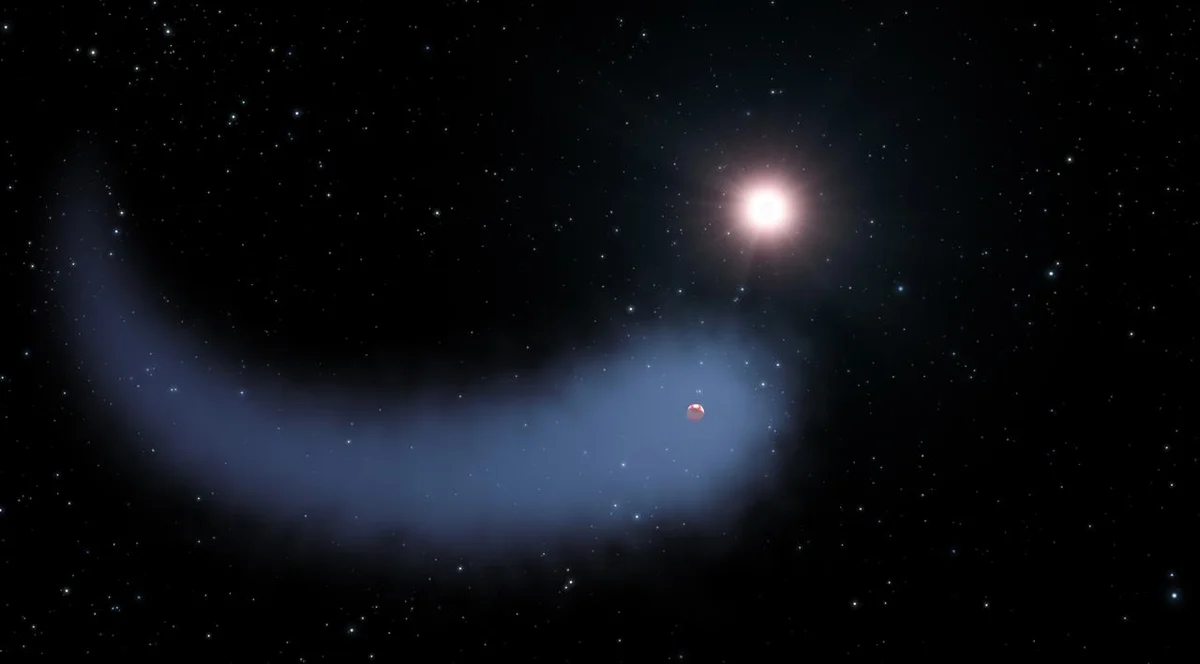
The study of planetary evolution has revealed that an atmosphere is not a permanent feature; even worlds with thick, stable air envelopes can lose their gaseous layers over cosmic timescales. Central to this understanding is the process of atmospheric escape on terrestrial planets, a phenomenon that shapes whether a rocky world ends up like Venus, Earth, or the barren surface of Mars. By examining the mechanisms that strip atmospheres, thermal escape, non-thermal escape, and sputtering, scientists can explain why some exoplanets retain their air while others become exposed, airless rocks.
This article explores the three dominant escape processes, using both well-studied examples from our solar system (particularly Mars) and observations of exoplanets like hot Jupiters to illustrate the underlying physics.
Understanding Atmospheric Escape on Terrestrial Planets
Atmospheric escape on terrestrial planets refers to the loss of gas molecules from a planet’s upper atmosphere to space. Unlike giant planets that hold onto hydrogen and helium through immense gravity, terrestrial worlds, rocky planets with thin or moderate atmospheres, are vulnerable to stripping. The rate and type of escape depend on factors including stellar radiation, planetary magnetic fields, gravity, and atmospheric composition.
Terrestrial planets in our solar system offer a natural laboratory. Venus has a thick CO₂ atmosphere but almost no water. Earth retains its nitrogen-oxygen envelope, while Mars lost most of its air. Exoplanet observations, particularly from the Hubble Space Telescope and the James Webb Space Telescope, now extend these lessons to planets orbiting other stars, including intensely irradiated hot Jupiters that shed material at astonishing rates.
The Three Main Escape Mechanisms
Thermal Escape (Jeans Escape and Hydrodynamic Escape)
Thermal escape occurs when molecules in the upper atmosphere gain enough kinetic energy from heat to exceed the planet’s escape velocity. It comes in two forms: Jeans escape and hydrodynamic escape.
- Jeans Escape: In this process, individual molecules in the high-temperature exosphere reach escape speed by random thermal motion. Lighter gases like hydrogen and helium escape most easily. Earth loses about 3 kg of hydrogen per day through Jeans escape (Lammer et al., 2008). Mars, with lower gravity, loses hydrogen at a higher per-mass rate.
- Hydrodynamic Escape: When a planet receives intense stellar extreme ultraviolet (EUV) radiation, as hot Jupiters do, the upper atmosphere can heat to thousands of Kelvin. Instead of individual molecules escaping, the entire upper atmosphere flows outward like a wind. This is called hydrodynamic escape. For a small terrestrial planet orbiting close to its star, hydrodynamic escape can strip an entire atmosphere in as little as 100 million years.
Observed case: Hot Jupiters HD 209458b (nicknamed Osiris) was the first exoplanet observed to have an escaping atmosphere. Hubble detected a massive cloud of hydrogen being blown off the planet, forming a comet-like tail. This is a classic example of hydrodynamic escape driven by stellar EUV heating. The escape rate is estimated at about 1–6 × 10⁹ grams per second. Similar escape has been observed on HD 189733b, where atoms of heavier elements like carbon and oxygen are also dragged away by the hydrogen outflow.
Non-Thermal Escape (Ion Pickup and Charge Exchange)
Non-thermal escape does not rely on heat alone. Instead, chemical reactions, solar wind interactions, and electric fields impart enough energy to individual atoms or ions to exceed escape velocity.
- Ion Pickup: Solar wind, a stream of charged particles from the star, interacts with a planet’s upper atmosphere. When neutral atoms in the exosphere are ionized by solar UV or by charge exchange, the newly formed ions are “picked up” by the solar wind’s magnetic field and accelerated away. This is a key mechanism for losing heavier atoms like oxygen and nitrogen.

- Charge Exchange: An energetic solar wind proton can capture an electron from a neutral atom in the atmosphere, turning that atom into an ion that then gets carried away.
- Dissociative Recombination: When an atmospheric molecule like O₂⁺ recombines with an electron, it splits into two energetic oxygen atoms, each of which can have enough speed to escape.
Observed case: Mars NASA’s MAVEN mission (Mars Atmosphere and Volatile Evolution) measured the rate of atmospheric loss on Mars in real time. During solar storms, the escape rate of oxygen and carbon dioxide increases dramatically. MAVEN data shows that non-thermal escape, primarily through ion pickup and dissociative recombination, removes about 0.3 kg of Martian atmosphere per second – a rate consistent with MAVEN’s published range of 0.1–0.6 kg/s depending on solar conditions, and significant over billions of years. This process has been a major driver of the transition from Mars’s early, thicker atmosphere to its current thin state. For more details, see the MAVEN mission results.
Sputtering
Sputtering occurs when energetic particles, such as solar wind ions or neutral atoms accelerated in a planetary magnetic field, collide with atoms in the upper atmosphere. The impact transfers momentum, kicking some atmospheric atoms upward and out of the gravity well.
- Direct Sputtering: Solar wind ions hit atmospheric atoms directly, knocking them into space.
- Recycling Sputtering: Some atoms knocked upward can crash into other atoms, creating a cascade that ejects material even from lower altitudes.
Sputtering is particularly effective for planets without a strong protective magnetic field, because the solar wind reaches deeper into the atmosphere. It also preferentially removes lighter isotopes, enriching the remaining atmosphere in heavier isotopes – a signature that planetary scientists can measure.
Observed case: Venus Venus lacks an intrinsic global magnetic field, so the solar wind interacts directly with its ionosphere. Sputtering, combined with ion pickup, has been implicated in the loss of Venus’s ancient water. Measurements from ESA’s Venus Express mission indicated that hydrogen and oxygen escape rates are consistent with sputtering and non-thermal processes. The ratio of deuterium to hydrogen in Venus’s atmosphere today is about 150 times Earth’s ratio, strongly suggesting that a large amount of hydrogen (from water) was lost over time, with lighter hydrogen preferentially escaping. For a scientific overview, see the Venus Express mission page.
How Planetary Properties Affect Escape
The rate of atmospheric escape on terrestrial planets depends on several key factors:
- Gravity: Higher gravity means higher escape velocity, so heavier planets hold onto atmospheres more easily. Earth holds oxygen well; Mars, with only 38% of Earth’s gravity, loses it.
- Magnetic Field: A planetary magnetic field (like Earth’s) deflects the solar wind, reducing non-thermal escape and sputtering. Mars and Venus lack such protection, making them far more vulnerable.
- Stellar Activity: Young stars emit far more UV and X-ray radiation, driving stronger escape. A planet orbiting an active M-dwarf star (like TRAPPIST-1) may lose its entire atmosphere within a few hundred million years.

- Distance from Star: Closer planets receive more stellar radiation, increasing thermal escape. This is why hot Jupiters shed gas while colder ones do not.
- Atmospheric Composition: Lighter molecules (H₂, He) escape more readily than heavier ones (CO₂, N₂, O₂). A planet with abundant hydrogen may lose it faster than a nitrogen-dominated world.
Comparing Escape Rates Across Terrestrial Planets
To put these processes in context, here is a quantitative summary of atmospheric escape across Venus, Earth, and Mars:
| Planet | Primary Escape Mechanisms | Approximate Current Escape Rate (kg/s) | Atmospheric Consequences |
|---|---|---|---|
| Venus | Ion pickup, sputtering | ~1–3 (H), ~0.1 (O) | Loss of ancient water; 150× Earth D/H ratio |
| Earth | Jeans escape (H), non-thermal (O, N) | ~3 × 10⁻⁵ (H), negligible for heavy gases | Minimal loss (<1% total atmosphere over history) |
| Mars | Ion pickup, dissociative recombination, sputtering | ~0.1–0.6 (combined, MAVEN range) | ~2/3 of early atmosphere lost; transition to thin current state |
These rates highlight a key lesson: planetary properties such as gravity, magnetic protection, and distance from the star determine whether escape is a slow trickle (Earth) or a catastrophic drain (Mars, ancient Venus). For exoplanets, these same factors govern habitability over billions of years.
Implications for Habitability
Understanding atmospheric escape is crucial for assessing an exoplanet’s potential to host life. An atmosphere protects surface life from cosmic radiation, helps regulate temperature, and, by retaining water, enables a stable hydrological cycle. If a terrestrial planet loses its atmosphere, it becomes uninhabitable.
- The Habitable Zone Tightens: Current models suggest that planets around M-dwarf stars, the most common stars in the galaxy, may struggle to retain atmospheres due to stellar flares and constant high UV output. This reduces the optimistic habitable zone for such stars.
- Water Loss: The combination of thermal and non-thermal escape can strip water through a process called “runaway greenhouse followed by escape.” Venus may have suffered this fate. Earth avoided it because of its distance from the Sun and its protective magnetosphere.
- Atmospheric Biosignatures: If an exoplanet’s atmosphere is escaping, telescopic observations can detect it. These “atmospheric tails” provide indirect evidence of composition and escape rate. The presence of escaping oxygen, for example, might tell us about the balance of production and loss.
1. What is the main difference between thermal and non-thermal escape?
Thermal escape is driven by heat energy (temperature) causing molecules to reach escape velocity. Non-thermal escape relies on chemical reactions, solar wind interactions, or electric fields to impart energy, independent of temperature. Non-thermal processes often remove heavier atoms that thermal escape cannot.
2. Can atmospheric escape happen on Earth?
Yes, but at very low rates. Earth loses about 3 kg of hydrogen per day via Jeans escape (Lammer et al., 2008) and some oxygen and nitrogen through non-thermal processes. However, Earth’s strong magnetic field protects it from major stripping. Over billions of years, Earth has lost very little of its total atmosphere (probably under 1%).
3. How do scientists detect atmospheric escape on exoplanets?
They use transit spectroscopy: as an exoplanet passes in front of its star, starlight filters through the planet’s atmosphere. Absorption lines from escaping atoms (especially hydrogen and oxygen) appear blueshifted because the gas is moving towards Earth. Observations from Hubble and JWST have detected such escaping tails on several hot Jupiters.
4. Could atmospheric escape create a new ocean on a planet?
No. Atmospheric escape removes gas to space, not to the surface. In fact, it depletes water by stripping hydrogen (the water molecule’s light component) while oxygen may remain or be lost separately. This process can turn a water-rich world into a dry one.
5. Why does Mars have less atmosphere than Earth?
Mars is smaller (lower gravity), lacks a global magnetic field, and is farther from the Sun. Non-thermal escape (ion pickup) and sputtering by the solar wind have been stripping its atmosphere for billions of years. MAVEN data suggest that about two-thirds of Mars’s atmosphere has been lost to space.
Sources & References
- NASA. MAVEN Mission Overview. https://science.nasa.gov/mission/maven/
- ESA. Venus Express: Science Results. https://www.esa.int/Science_Exploration/Space_Science/Venus_Express
- NASA. James Webb Space Telescope: Exoplanet Atmospheres. https://www.nasa.gov/webb
- Lammer, H., et al. (2008). Atmospheric Escape and Evolution of Terrestrial Planets and Satellites. Space Science Reviews, 139(1-4), 339–376.
- Owen, J. E., & Mohanty, S. (2016). Atmospheric Escape from Hot Jupiters. Monthly Notices of the Royal Astronomical Society, 459(4), 4088–4106.
Further reading: Atmospheric escape on Wikipedia