The Science of Life – From Earth to the Stars

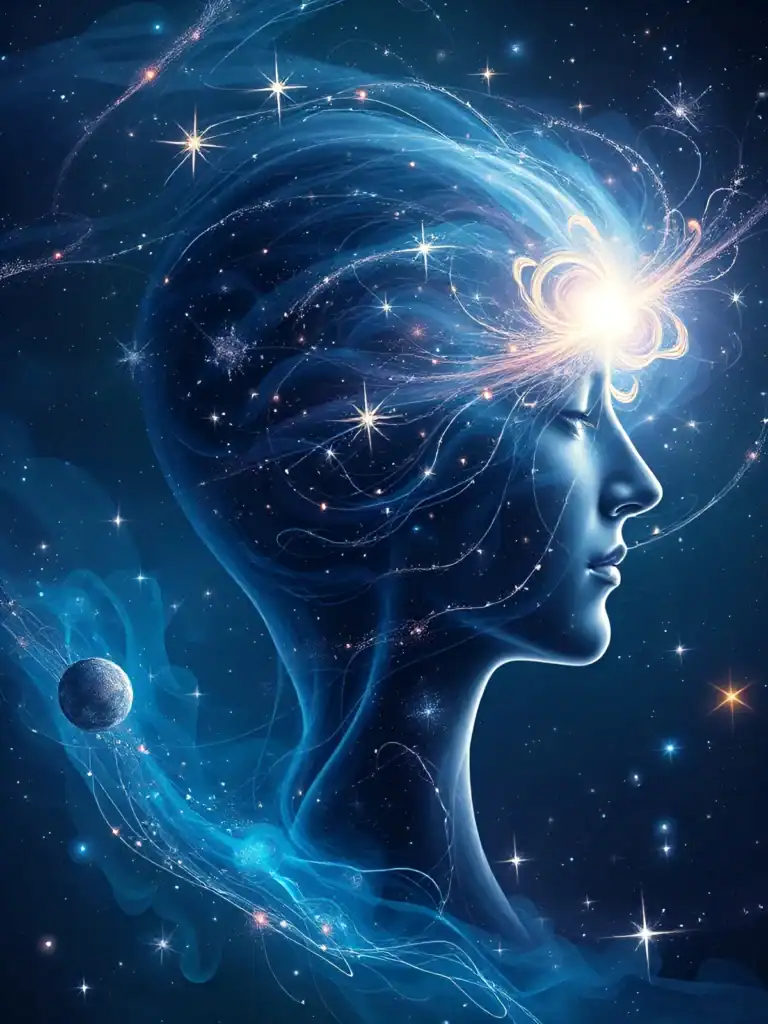
Human profile silhouette with cosmic neural network visualization representing consciousness, theories, and sentience

The Spark Within: Consciousness Meaning, Theories, and Real-World Impact

Consciousness meaning isn’t just academic jargon, but what exactly is it? Why does it matter? Let’s dive in. Waking Up: A Mystery Hiding in Plain Sight You open your eyes to morning light. For a heartbeat, there’s only sensation: warmth on your skin, rustle of sheets, maybe the smell of coffee drifting in. Then you arrive. Memories click into place, plans for the day surface, and suddenly the world feels like something. That feeling, the simple fact that life is experienced from the inside, is what philosophers and scientists refer to as consciousness. Brains are fantastic at processing information, but why does all that electrical chatter come bundled with an Read more

Golden cosmic web filaments connecting galaxies in deep space, representing the large-scale structure of the universe

The Sentient Universe: Consciousness, Matter, and the Self-Aware Cosmos

What Are We Inside Of? When most people consider traditional cosmologies, they picture a creative force outside the universe, an architect who wound up the cosmic clock and stepped away. But modern physics suggests a radically different image. What if the universe itself is a living, self-organizing system, and we are not spectators from outside, but expressions of it? This is not metaphysics or wishful thinking; it is a perspective shift suggested by modern physics, cosmology, and information theory: space may not be empty, matter may not be fundamental, and consciousness may not be separate from the fabric of reality. In this framework, you are not a separate soul in Read more

Genesis of Life

The Genesis of Life: How Did Life Begin on Earth?

Introduction: The Genesis of Life The genesis of life on Earth remains one of the greatest mysteries in science. How did life begin on Earth? Was our origin an unlikely cosmic accident, or is life a natural outcome in any world with the right conditions? This ancient question now sits at the cutting edge of astrobiology, exoplanet discovery, and the quest to determine whether we are alone in the universe. Understanding alien biosignatures is key to answering this question. Recent scientific advances have dramatically sharpened our picture of life’s beginnings. By combining fossil, geochemical, and genomic evidence, researchers have uncovered clues pointing to an early, rapid emergence of life on Read more

Satellite view of Africa from space showing the Sahara desert, equatorial rainforests, coastal regions, and cloud formations illustrating human origins and evolution

Where Did Humankind Originate? The Out-of-Africa Theory Explained

The Search for Our Origins Where did humankind originate? It’s more than a scientific puzzle; it’s central to understanding who we are. For centuries, people have looked to religious texts, oral traditions, and, later, archaeology and genetics to uncover the truth. Today, the overwhelming consensus in anthropology and genetics supports one powerful idea: modern humans, Homo sapiens, originated in Africa and spread to populate the rest of the world. This is known as the Out-of-Africa theory, which has reshaped how we view ourselves as a species. The Out-of-Africa Theory: A Scientific Overview Where did humankind originate? The Out-of-Africa theory proposes that anatomically modern humans evolved in Africa around 200,000 to Read more

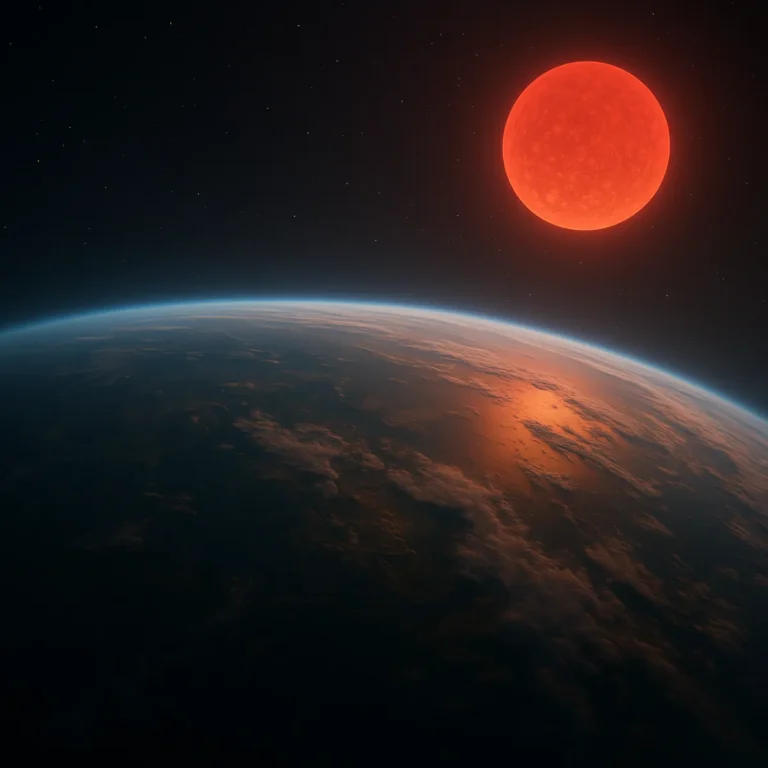
Illustration of a red sun rising above a calm ocean on an exoplanet horizon

Could K2-18 b Alien Life Thrive in One of the Galaxy’s Harshest Environments?

A World of Extreme Elements and Rhythmic Change on K2-18 b K2-18 b orbits a dim red dwarf star roughly 124 light-years from Earth in the constellation Leo. It sits within its star’s habitable zone, where temperatures could allow liquid water, but this world is far from an Earth-like paradise. JWST spectroscopy reveals a hydrogen-rich atmosphere containing methane (CH₄) and carbon dioxide (CO₂) (NASA 2024). These gases suggest the planet could host liquid-water oceans beneath its atmosphere, possibly making it a Hycean world, a proposed class of ocean planets with thick hydrogen envelopes. This discovery is similar to other JWST observations of CO2 in exoplanet atmospheres. For comparison, the ocean Read more

Alien figure standing on desert highway with world map backdrop

TRAPPIST-1 Exoplanets & JWST: Hunting Atmospheres in the Habitable Zone

Searching for signs of life in these worlds requires a deep understanding of alien biosignatures. Why TRAPPIST-1 Matters for Alien Life Research This red dwarf system has transformed exoplanet science. For broader context on rocky world habitability, compare with Kepler-22b, a habitable-zone candidate 620 light-years away. This nearby ultracool dwarf, is about 39 light-years away, hosts seven rocky exoplanets. Among these, three of them orbit the habitable zone, where conditions might allow liquid water. With the powerful James Webb Space Telescope (JWST) focused on this system, scientists uncover secrets about these exoplanets’ atmospheres and surface conditions, deepening our understanding of habitability around M dwarfs like this Trappist system. For a Read more

A star

JWST Detects CO₂ in Exoplanet Atmospheres — A Remarkable Discovery in Alien Atmospheres

The James Webb Space Telescope (JWST) is fundamentally transforming our comprehension of distant worlds by detecting and analyzing CO₂ in exoplanet atmospheres with unprecedented precision. As a key molecule in planetary climate regulation, carbon dioxide plays a crucial role in maintaining temperature stability and driving atmospheric chemistry, essential for habitability. While Earth’s atmosphere contains about 0.04% CO₂, even slight variations in exoplanetary CO₂ levels can significantly influence climate dynamics. These chemical markers are essential components in the study of alien biosignatures. How JWST Detects CO₂ in Exoplanet Atmospheres Transmission Spectroscopy When an exoplanet transits its host star, starlight filters through its atmosphere, leaving molecular “fingerprints.” JWST’s NIRSpec (Near-Infrared Spectrograph) detects Read more