
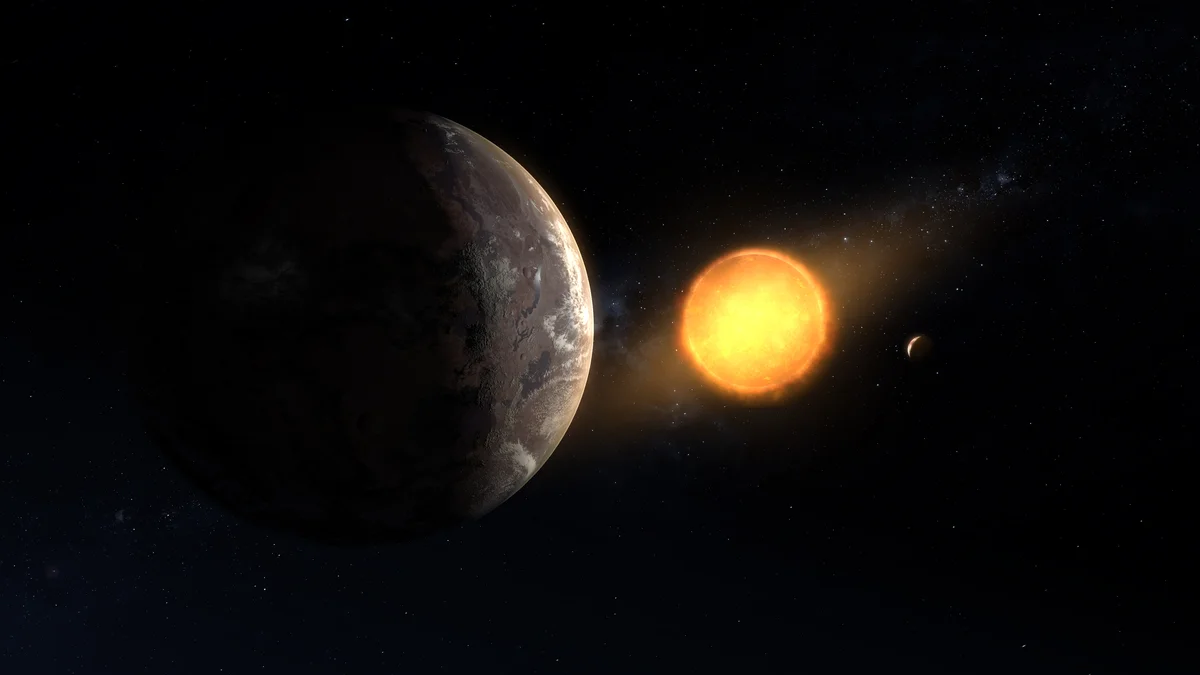
The exoplanet habitability index is a composite metric that astronomers use to prioritize which of the thousands of known exoplanets warrant closer study in the search for life beyond Earth. Rather than relying on a single measurement, researchers combine data on a planet’s size, temperature, atmospheric composition, and stellar environment to generate a numerical score that reflects how likely it is to support life as we know it. This article explains the key indices, the Earth Similarity Index, the Habitable Zones Distance Index, and the Biological Complexity Index, and shows how they are applied to real exoplanets, including some of the most promising candidates discovered to date.
What Is an Exoplanet Habitability Index?
An exoplanet habitability index is a standardized numerical value (usually between 0 and 1) that ranks an exoplanet’s potential to host liquid water on its surface and maintain stable conditions for life. The higher the score, the more “habitable” the planet is considered, but no index guarantees the presence of life – only that conditions are likely suitable for it. Different indices weigh different factors, but all rely on data obtained by telescopes such as NASA’s Kepler Space Telescope, the Transiting Exoplanet Survey Satellite (TESS), and ground-based observatories.
The most widely used is the Earth Similarity Index (ESI), developed by a team led by Dirk Schulze-Makuch and Abel Méndez at the University of Puerto Rico at Arecibo. The ESI measures how closely a planet resembles Earth in key physical properties: radius, density, surface temperature, and escape velocity. The formula produces a value from 0 (least Earth-like) to 1 (identical to Earth). However, a high ESI does not automatically mean a planet is habitable – for example, a hot, dense world with a high ESI could still be uninhabitable due to a runaway greenhouse effect.
Real Exoplanet Scores: How the ESI Works in Practice
To understand the exoplanet habitability index in action, consider some of the most highly ranked exoplanets according to the ESI. One of the top-scoring planets is TRAPPIST-1e, one of seven Earth-sized worlds discovered orbiting the ultracool dwarf star TRAPPIST-1, about 40 light-years from Earth. TRAPPIST-1e has an ESI of approximately 0.95 ( – commonly cited, but exact value may vary slightly by source). It receives about the same amount of stellar radiation as Earth, has a radius close to Earth’s, and is believed to be a rocky world. Its score places it near the top of the habitability list.
Another highly ranked candidate is Proxima Centauri b, the nearest known exoplanet, at just 4.24 light-years away. Its ESI is approximately 0.87, but its habitability is complicated by its orbit around a red dwarf star, which can produce intense stellar flares that may strip its atmosphere. This illustrates a key limitation of any exoplanet habitability index: it cannot account for unpredictable astrophysical threats.
At the lower end, planets like Kepler-452b (often called “Earth’s cousin”) have ESI values around 0.83 – high, but less than the TRAPPIST-1 worlds. Kepler-452b is about 60% larger than Earth, giving it higher gravity, and orbits a Sun-like star at a distance consistent with Earth’s. Still, its larger size makes it more likely to be a “super-Earth” with a thick atmosphere, which could be too dense for surface life.
Beyond ESI: Other Key Habitat Indexes
While the ESI is the most publicized metric, it is far from the only one. Astronomers have developed several complementary indexes to capture different aspects of habitability.
Habitable Zones Distance Index (HZD)

The HZD measures how far a planet lies from the center of its star’s habitable zone, defined as the region where liquid water can exist on a planetary surface. A value of zero means the planet is at the perfect center of the habitable zone; positive values indicate orbits closer to the star, and negative values indicate orbits farther out. For example, GJ 667Cc, a super-Earth about 22 light-years away, has an HZD close to zero, meaning it is in the optimal region where water could remain liquid. However, HZD does not consider planetary atmosphere or composition, a planet in the zone with no atmosphere would freeze or boil.
Biological Complexity Index (BCI)
The BCI attempts to estimate the likelihood that a planet could develop complex life, such as multicellular organisms. It factors in planetary age, surface temperature, and the stability of the star. Older planets around long-lived stars score higher. Earth scores a perfect 1.0 on the BCI, while Mars scores about 0.7, and Jupiter’s moon Europa (not an exoplanet, but a comparison point) scores near zero. Among exoplanets, Kepler-442b (about 1,200 light-years away) has a BCI of about 0.84, partly because its star is a K-dwarf, which is smaller and longer-lived than the Sun. This gives complex life billions of years to potentially evolve.
Limitations of the Exoplanet Habitability Index
No exoplanet habitability index is perfect, and scientists are careful to emphasize that these scores are only rough guides. Most exoplanets are discovered via the transit method (measuring dips in a star’s brightness) or radial velocity method (measuring stellar wobbles), which provide limited information. We rarely know the exact mass, atmospheric composition, or surface conditions.

For instance, a planet with a high ESI might have no atmosphere, a toxic atmosphere, or a molten surface from tidal heating. The habitable zone itself is a moving target – recent research has shown that some planets outside a star’s traditional habitable zone might still be habitable if they have thick greenhouse atmospheres, while planets inside the zone could be sterile due to stellar radiation.
Moreover, the ESI is biased toward Earth-like conditions – it penalizes planets that might harbor life in non-Earth-like environments, such as water worlds or planets with methane-based biochemistry. As astrobiologist Lisa Kaltenegger of Cornell University has noted, “The search for life shouldn’t be limited to Earth clones. We need to think about the full range of possible biosignatures.”
Top 5 Candidate Exoplanets by Composite Index
To see how these metrics work together, below are five exoplanets often cited in studies of habitability. Their scores come from the Planetary Habitability Laboratory (PHL) at the University of Puerto Rico at Arecibo PHL Habitable Worlds Catalog.
| Exoplanet | Star | Distance (ly) | ESI | HZD | BCI | Key Notes |
|---|---|---|---|---|---|---|
| TRAPPIST-1e | TRAPPIST-1 (red dwarf) | 40 | ~0.95 | −0.2 | ~0.84 | Very good candidate; flares possible |
| Proxima Centauri b | Proxima Centauri (red dwarf) | 4.24 | ~0.87 | +0.2 | ~0.77 | Nearest exoplanet; flare risks high |
| Kepler-442b | K-dwarf | ~1,200 | ~0.84 | −0.1 | ~0.84 | Old star, long stability |
| GJ 667Cc | M-dwarf | ~22 | ~0.84 | −0.02 | ~0.73 | In optimal zone; high uncertainty |
| Kepler-452b | G-dwarf | ~1,400 | ~0.83 | −0.2 | ~0.79 | “Earth’s cousin”; larger size raises questions |
Note: ESI and other values are approximate and may vary slightly among sources.

The Role of Next-Generation Telescopes
Current exoplanet habitability index calculations rely heavily on indirect data. The James Webb Space Telescope (JWST), launched in December 2021, is now beginning to change this by directly imaging some exoplanet atmospheres. For example, in 2023, NASA’s James Webb Space Telescope detected carbon dioxide in the atmosphere of the exoplanet WASP-39b, though that planet is a hot gas giant not considered habitable. Future observations with JWST and the upcoming Nancy Grace Roman Space Telescope (scheduled for launch in the late 2020s) will be able to probe the atmospheres of smaller, rocky exoplanets like TRAPPIST-1e.
These observations can provide data on whether a planet has water vapor, methane, or oxygen – potential biosignatures. That data will feed back into the exoplanet habitability index models, making them more accurate. As ESA’s CHEOPS mission continues to characterize exoplanet radii and the ARIEL mission (planned for 2029) will analyze atmospheric chemistry, the habitability index will evolve from a rough estimate into a data-driven classification system.
How the Exoplanet Habitability Index Guides Future Missions
The exoplanet habitability index is not just an academic exercise – it directly influences which targets space agencies will study further. NASA’s Habitable Worlds Observatory (currently in planning) will aim to directly image Earth-like exoplanets orbiting Sun-like stars. The index helps astronomers rank the thousands of known candidates to select the few dozen most promising for follow-up.
For instance, the list of high-ESI planets above is already being used to prioritize observations. TRAPPIST-1e, with its very high ESI and BCI, is a prime target for JWST’s atmospheric characterization programs. Similarly, the nearby Proxima Centauri b will be studied by future ground-based telescopes like the Extremely Large Telescope (ELT) in Chile. The index ensures that scarce telescope time is spent on objects with the highest chance of yielding evidence of habitability – or even life.
Conclusion
The exoplanet habitability index provides a systematic, data-driven way to rank the thousands of known exoplanets according to their potential to support life. While the Earth Similarity Index is the most familiar, combining it with other metrics, the Habitable Zones Distance Index, the Biological Complexity Index, and many others, gives astronomers a richer picture. These scores are not definitive, but they are essential for guiding observations with cutting-edge telescopes and for focusing the search for signs of life. As new data from JWST, Roman, and ELT come in, the indices will continue to be refined, bringing us closer to answering one of humanity’s oldest questions: Are we alone in the universe?
1. What is the difference between the Earth Similarity Index (ESI) and the Exoplanet Habitability Index?
The ESI is a specific metric that measures how similar a planet is to Earth in physical parameters. The term exoplanet habitability index is broader – it refers to any composite score (including ESI, HZD, BCI, etc.) that ranks a planet’s habitability potential.
2. Can an exoplanet with a high ESI be uninhabitable?
Yes. A high ESI indicates a planet is Earth-like in size and temperature, but it does not account for atmospheric toxicity, stellar flares, tidal locking, or lack of a magnetic field – all of which could make it uninhabitable.
3. How are these indices calculated if we can’t see the planet directly?
Scientists infer radius and density from transit data and radial velocity measurements. Surface temperature is estimated from the star’s luminosity and the planet’s orbit. Atmospheric composition is mostly unknown for rocky exoplanets, so indices assume Earth-like properties.
4. What is the highest ESI planet known?
As of 2025, TRAPPIST-1e (ESI ≈ 0.95) is often cited as the highest-scoring exoplanet, though scores can vary slightly between catalogs.
5. Does a high index mean life definitely exists?
No. The index only suggests that conditions could be favorable for life as we know it. No current telescope can directly confirm the presence of life on an exoplanet – that would require detecting biosignatures in its atmosphere, which is the goal of future missions.
Sources & References
- Planetary Habitability Laboratory, University of Puerto Rico at Arecibo. Habitable Worlds Catalog. PHL Habitable Worlds Catalog
- Méndez, A., & Schulze-Makuch, D. (2011). Earth Similarity Index: A New Tool for Finding Habitable Exoplanets. Astrobiology Science Conference.
- NASA Exoplanet Exploration. The Search for Habitable Worlds. NASA Exoplanet Exploration
- European Space Agency (ESA). CHEOPS mission. ESA CHEOPS
- Kaltenegger, L. (2017). How to Characterize Habitable Worlds and Signs of Life. Annual Review of Astronomy and Astrophysics.
Further reading: Planetary habitability on Wikipedia