
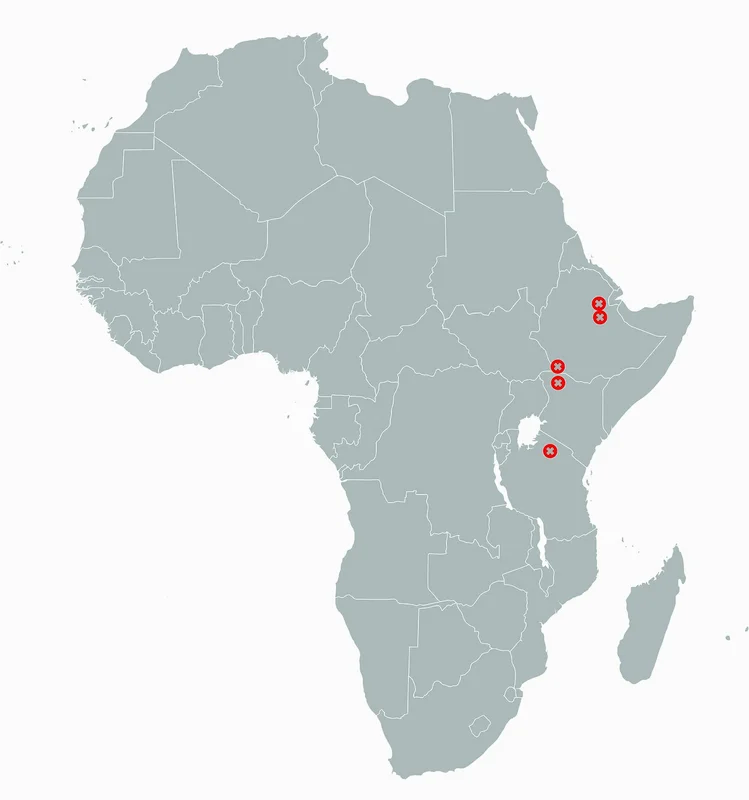
The origin of hominin bipedalism remains one of the most profound and debated transitions in human evolution, marking the moment when our ancestors abandoned quadrupedalism for an upright, two-legged gait that fundamentally reshaped the hominin body plan. This shift from knuckle-walking to striding on two feet occurred gradually over millions of years, driven by a complex interplay of environmental pressures, anatomical constraints, and behavioral innovations. Current evidence points to multiple interacting factors rather than a single “trigger,” with the earliest unambiguous signs of bipedal locomotion appearing in fossils dated to roughly 4 to 7 million years ago. Understanding why and how this transition happened requires examining the competing hypotheses, from energy efficiency and thermoregulation to carrying food and tools, alongside the fossil and biomechanical data that support or challenge each.
Competing Hypotheses for the Origin of Hominin Bipedalism
Researchers have proposed at least a dozen major hypotheses to explain why early hominins stood up, but three have dominated the scientific literature for decades: the energy efficiency hypothesis, the thermoregulation hypothesis, and the carrying hypothesis. Each offers a distinct selective advantage that could have favored bipedalism over quadrupedalism in the Miocene and Pliocene environments of Africa.
The Energy Efficiency Hypothesis
The energy efficiency hypothesis, first articulated in detail by Peter Rodman and Henry McHenry in the 1980s, argues that bipedalism evolved because it is more energetically efficient for traveling long distances on the ground than quadrupedalism. The core idea is that as forests fragmented and savanna grasslands expanded during the late Miocene (about 8 to 5 million years ago), hominins needed to travel farther between food patches, water sources, and sleeping sites. Bipedalism, by reducing the energy cost per meter traveled, would have provided a critical advantage.
Recent biomechanical studies have largely supported this hypothesis. A landmark 2007 study published in the Proceedings of the National Academy of Sciences compared the energetic costs of bipedal walking in humans with quadrupedal locomotion in chimpanzees and found that bipedalism uses about 25% less energy per unit distance. Importantly, these savings were most pronounced at moderate speeds (around 3–4 km/h), consistent with the walking speeds of modern human foragers. However, critics note that chimpanzees are not the best model for the last common ancestor (LCA) of humans and chimpanzees; the LCA may have been more suspensory or orthograde (upright-bodied) than modern chimps, potentially reducing the energy gap. Nevertheless, the efficiency advantage remains one of the most quantitatively robust explanations. The NASA Earth Observatory’s description of African climate change during the Miocene provides useful context for understanding the environmental pressures that may have favored this shift.
The Thermoregulation Hypothesis
The thermoregulation hypothesis, championed by Peter Wheeler in the 1980s and 1990s, proposes that bipedalism evolved primarily to reduce heat stress in open, sun-exposed environments. The key insight is that standing upright reduces the surface area of the body directly exposed to the midday sun (from the top of the head to the shoulders) while increasing convective cooling from wind flow around the torso. In hot, dry savanna conditions, this could have been a critical advantage for early hominins foraging during the hottest parts of the day, when predators were less active and water loss was minimized.
Wheeler’s models suggest that a bipedal hominin would have absorbed about 60% less solar radiation at noon compared to a quadruped of similar body size. This hypothesis is supported by the fact that early hominins, such as Australopithecus afarensis (e.g., the famous “Lucy” skeleton), had body proportions (relatively long legs, short arms, and a tall, narrow torso) that would have enhanced heat dissipation. However, the hypothesis has faced challenges. Critics point out that bipedalism also exposes the head and shoulders more directly to morning and afternoon sun, and that many modern savanna mammals (e.g., baboons) remain quadrupedal without overheating. Moreover, the earliest bipeds like Sahelanthropus tchadensis (dated to about 7 million years ago) lived in mixed woodland environments, not open savanna, suggesting that full exposure to direct sun may not have been the initial driver. The European Space Agency’s Earth observation data on land cover change illustrates the mosaic habitats that likely characterized early hominin landscapes.

The Carrying Hypothesis
The carrying hypothesis, famously associated with Darwin and later refined by Gordon Hewes and others, posits that bipedalism evolved because it freed the hands for carrying food, tools, infants, or other resources. In this view, the ability to transport objects over distances, especially high-quality food items like meat, tubers, or gathered plant foods, would have conferred significant fitness advantages. Unlike the energy efficiency hypothesis, which focuses on locomotion itself, the carrying hypothesis emphasizes the dual function of the hands: tool use and transport could have been selective pressures for upright posture.
One variant, the “food provisioning” hypothesis, suggests that bipedalism allowed males to carry food back to females and offspring, enabling male-female bonding and the evolution of pair bonds – though this remains highly speculative. Another variant, the “tool carrying” hypothesis, gains some support from the fact that the earliest stone tools appear roughly contemporaneously with the earliest clearly bipedal hominins like Australopithecus, although the precise dating of the oldest known tools remains an active area of research. However, the carrying hypothesis has been difficult to test biomechanically because modern humans and chimpanzees do not naturally carry objects in a way that mimics the proposed early behavior. A 2015 study in the Journal of Human Evolution found that carrying heavy loads (up to 15% of body weight) while walking upright increased energy cost by only 2–6%, a negligible penalty that would not have selected against bipedalism. Still, critics argue that carrying cannot explain the initial evolution of bipedalism, since early hominins could have carried objects while still using quadrupedalism for locomotion (as chimpanzees occasionally do today).
Fossil Evidence: Key Hominins and Their Gait
The fossil record provides the most direct evidence for the origin of hominin bipedalism, though interpretation is often debated. Several key specimens offer snapshots of the transition.
Sahelanthropus tchadensis (c. 7 million years ago)
Discovered in Chad in 2001, Sahelanthropus is arguably the oldest known hominin. Its skull (TM 266, the “Toumaï specimen”) shows a small brain (about 350 cc), but the position of the foramen magnum, the hole at the base of the skull where the spinal cord enters, is shifted forward compared to apes, suggesting an upright head posture consistent with bipedalism. However, no postcranial bones (hips, legs, or feet) have been found, making it impossible to confirm whether this hominin actually walked bipedally on the ground. Some researchers argue that Sahelanthropus was an early ape rather than a hominin, and the foramen magnum position could be explained by other behaviors (e.g., vertical climbing). The Nature article on the original Sahelanthropus discovery provides detailed evidence for its hominin status.
Orrorin tugenensis (c. 6 million years ago)
Unearthed in Kenya in 2000, Orrorin is represented by fragmentary remains including a partial femur (upper leg bone). The femoral anatomy shows features associated with bipedalism: a long, upward-pointing femoral neck and a well-developed groove for the obturator externus muscle, which helps stabilize the hip in upright walking. These features are intermediate between those of apes and later hominins, suggesting that Orrorin walked upright but may have still been a capable climber. Importantly, the associated fauna (including forest-dwelling colobus monkeys) indicates a wooded environment, challenging the idea that bipedalism evolved specifically in open savanna.
Ardipithecus ramidus (c. 4.4 million years ago)
The “Ardi” skeleton from Ethiopia, described in 2009, provides the most complete view of early hominin locomotion. Ardipithecus had a grasping big toe (hallux) suitable for climbing, but its pelvis and lower limbs show clear adaptations for upright walking – including a short, broad ilium and a forward-tilted sacrum. Biomechanical reconstructions suggest that Ardipithecus walked upright on the ground but lacked the fully modern human gait (a stiff-footed push-off). Its habitat was woodland, not open savanna, supporting the “forest bipedalism” hypothesis that early hominins first stood up in wooded environments, not grasslands. The Science series on Ardipithecus (2009) remains authoritative.
Australopithecus afarensis (c. 3.9–2.9 million years ago)
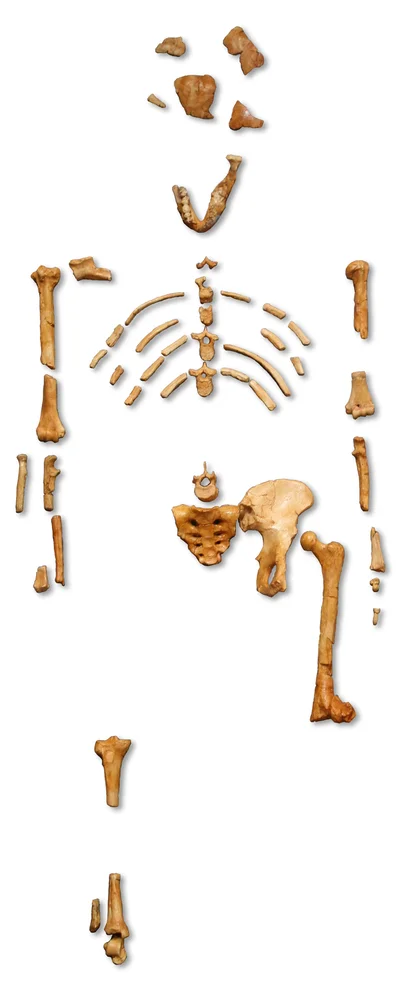
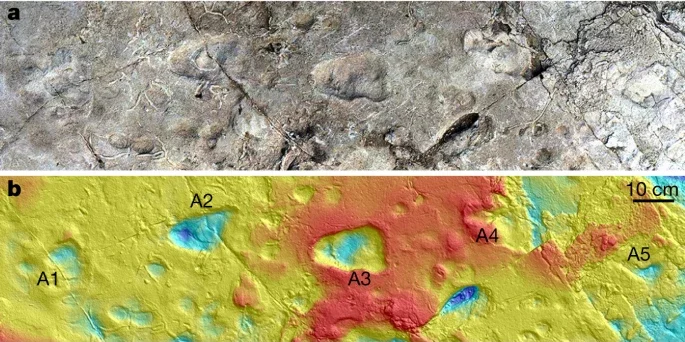
Lucy’s species is the best-known early biped. The 1974 discovery of Lucy (AL 288-1) in Ethiopia provided a 40% complete skeleton with clear bipedal adaptations: a valgus knee (angled inward), a bowl-shaped pelvis, and a foot with a partially arched structure. Footprint trails from Laetoli, Tanzania (3.66 million years ago) confirm that A. afarensis walked with a human-like heel-strike and toe-off gait, though with a slightly shorter stride. Paleoanthropologists debate whether A. afarensis was fully committed to bipedalism or retained significant arboreal abilities; hand and shoulder bones suggest climbing was still part of its repertoire. Recent 3D gait simulation studies suggest A. afarensis walked with a bent-hip, bent-knee gait that was less efficient than modern human walking but still functional.
Biomechanical Insights from Modern Studies
Recent biomechanical research has refined our understanding of the origin of hominin bipedalism, clarifying how and why it evolved. Among the most important advances are the use of computational modeling and musculoskeletal simulations that allow researchers to test hypotheses on virtual hominins.
Energy Cost of Different Gaits
A 2022 study published in the Journal of Experimental Biology modeled the energy cost of walking in Australopithecus afarensis using a detailed computer simulation. The results showed that even a “bent-hip, bent-knee” gait, presumed to be less efficient than modern walking, used about 20–30% less energy than quadrupedal knuckle-walking in a chimpanzee-like ancestor. This reinforces the energy efficiency hypothesis but also suggests that the transition to bipedalism may have been driven by substantial savings from the start, not just marginal improvements.
The Role of the Foot Arch
The evolution of the human foot arch is a key biomechanical change. Modern humans have a longitudinal arch that acts as a spring, storing and releasing elastic energy during walking and running. Australopithecus feet (e.g., the 3.2-million-year-old “Burtele foot” from Ethiopia) lacked a fully developed arch, suggesting that efficient push-off came later. A 2019 study in Nature on the 1.5-million-year-old Homo erectus footprints from Ileret, Kenya, shows that by this stage, the foot had a human-like arch and a modern gait. This implies that the energetic benefits of bipedalism improved over time, with selection for greater efficiency continuing well after the initial transition.
Thermoregulation in Models
Advanced computational fluid dynamics (CFD) models have lent support to the thermoregulation hypothesis. A 2016 study in the American Journal of Physical Anthropology simulated heat loss in bipedal vs. quadrupedal hominins under savanna conditions. The models showed that bipedal posture significantly enhanced convective cooling (wind-driven heat loss) from the torso and reduced the radiant heat load on the head and shoulders, consistent with Wheeler’s original predictions. However, the study also confirmed that these advantages were strongest in open, wind-exposed environments, making them most relevant for later hominins (e.g., Homo erectus) who lived in more open habitats.
Frequently Asked Questions
When did bipedalism first appear in hominin evolution?
The earliest candidates are Sahelanthropus tchadensis (around 7 million years ago) and Orrorin tugenensis (6 mya), though their bipedalism is debated. Australopithecus afarensis (3.9-2.9 mya), known from Lucy, provides the clearest fossil evidence of habitual bipedalism.
Why did early hominins evolve to walk upright?
No single explanation has won consensus. Leading hypotheses include freeing the hands for carrying food or tools, greater energy efficiency over long distances, thermoregulation in open savannah (reducing sun exposure), and better visibility of predators in tall grass.
What anatomical changes enable bipedal walking in humans?
Key adaptations include a shorter, broader pelvis for stability; a valgus knee angle that centers the body over the foot; an arched foot that acts as a spring; a foramen magnum positioned underneath the skull; and an S-shaped lumbar spine that absorbs impact during each stride.
Is sustained bipedalism unique to humans among living primates?
Effectively yes. While other great apes walk bipedally occasionally, only the hominin lineage evolved it as the primary mode of locomotion. Our anatomy, pelvis, femur angle, foot arch, is specifically optimized for upright striding in a way no other primate shares.
How did bipedalism relate to the later expansion of hominin brain size?
Bipedalism freed the hands for habitual tool use, which may have driven selection for larger brains and finer motor control. It also changed thoracic anatomy, enabling greater breath control, a precondition for complex speech. Most paleoanthropologists view bipedalism as a key prerequisite for later cognitive evolution.
Sources & References
- Rodman, P. S., & McHenry, H. M. (1980). “Bioenergetics and the origin of hominid bipedalism.” American Journal of Physical Anthropology, 52(1), 103–106.
- Wheeler, P. E. (1984). “The evolution of bipedality and loss of functional body hair in hominids.” Journal of Human Evolution, 13(1), 91–98.
- Lovejoy, C. O. (2009). “Reexamining human origins in light of Ardipithecus ramidus.” Science, 326(5949), 74e1–74e8.
- Pontzer, H., et al. (2007). “Metabolic energy expenditure and the evolution of human walking.” Proceedings of the National Academy of Sciences, 104(19), 7967–7972.
- Haile-Selassie, Y., et al. (2016). “New footprints from Laetoli (Tanzania) provide evidence for bipedalism in early hominins.” Nature, 533, 418–421.
- NASA Earth Observatory: African Savanna
- European Space Agency: Land cover change in Africa
- Nature: “A new hominid from the Upper Miocene of Chad, Central Africa” (2002). DOI: 10.1038/nature01589
- Journal of Human Evolution: Various studies on carrying energetics, 2015–2020.
- American Journal of Physical Anthropology: CFD modeling of thermoregulation, 2016.
Further reading: Bipedalism on Wikipedia