
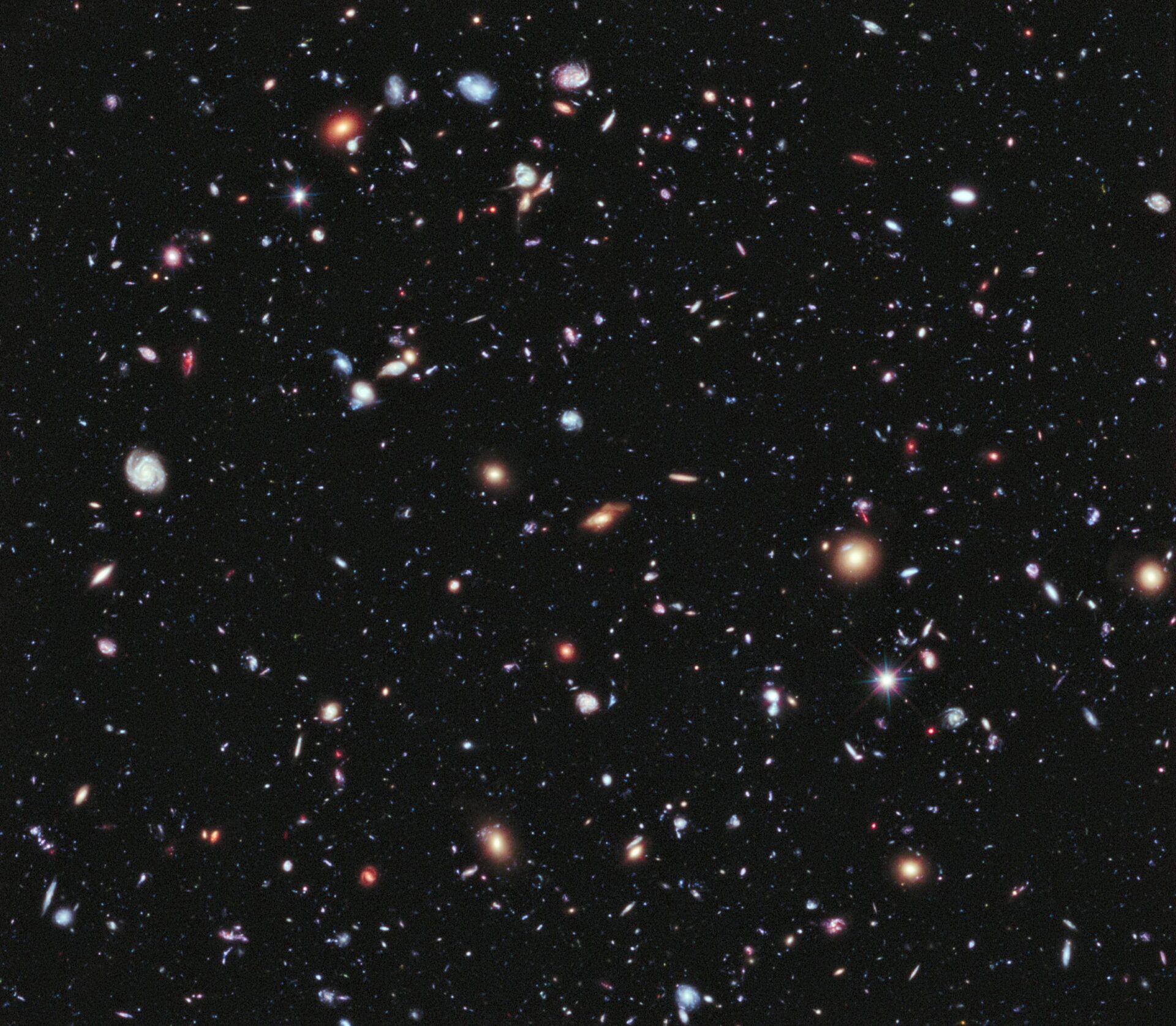
The observable universe vs event horizon distinction is one of cosmology’s most misunderstood boundaries. Most people use “observable universe” and “cosmic event horizon” interchangeably. Even some science communicators blur the line. They are not the same thing. They are not even close to the same thing. And once you understand the difference, the universe becomes a significantly stranger and lonelier place than you imagined.
The key difference: The observable universe is what we have seen. The cosmic event horizon is what we will ever see. And the second is much smaller.
Imagine a bubble of light from the past, inside a smaller, shrinking bubble of possible future contact. This is the reality of our cosmic situation.
The Observable Universe: Everything Whose Light Has Already Arrived
The observable universe is defined by the past. It is a sphere centered on Earth — not because we are special, but because we are the observers — containing every point in space from which light has had time to reach us since the Big Bang, 13.8 billion years ago.
You might expect that sphere to have a radius of 13.8 billion light-years. It does not. It has a radius of approximately 46 billion light-years.
The reason is cosmic expansion. Space itself stretched while that ancient light was traveling. A photon that left a galaxy 13 billion years ago started its journey from a point that was then only a few hundred million light-years away. By the time it reached us, that same point had been carried by expansion to roughly 46 billion light-years distant. We see the galaxy as it was then; it is now somewhere else entirely.
The observable universe is therefore everything we can see, have seen, or could in principle observe with a perfect telescope. It is bounded by the particle horizon — the farthest distance from which light has had time to arrive since the Big Bang.
It is not a wall. It is not the edge of the universe. It is the edge of our information about the universe.
The Cosmic Event Horizon: Everything We Will Ever See

The cosmic event horizon is defined by the future. It is the maximum distance from which light emitted today can ever reach us — given that the universe is not just expanding, but accelerating in its expansion, driven by dark energy.
That boundary sits at approximately 16 billion light-years (this is the comoving distance—the distance we would measure if we could freeze expansion today) — less than half the radius of the observable universe.
This is not a measurement of how much we have already seen. It is a hard limit on how much we will ever see. Any galaxy beyond 16 billion light-years from us right now is emitting light that will never arrive. The expansion of space between us and that galaxy is outpacing the speed of light itself. Not because anything is moving faster than light — space is not a thing that moves, it expands — but because enough of it is expanding fast enough to prevent the light from making headway.
Those galaxies are not gone. They still exist. We may still see their ancient light for billions of years. But they are cosmologically unreachable, permanently and irrevocably beyond our horizon. Here’s the crucial point: the comoving distance to this horizon is fixed. However, as space expands, the physical distance increases, and one by one, galaxies are carried over the edge.
Observable Universe vs Event Horizon: The Key Distinction

| Observable Universe | Cosmic Event Horizon | |
|---|---|---|
| Defined by | Light that has already reached us | Light we will ever receive |
| Radius | ~46 billion light-years | ~16 billion light-years |
| Boundary type | Particle horizon (past) | Event horizon (future) |
| Driven by | Age of the universe | Dark energy (accelerating expansion) |
| Changes with time? | Grows as universe ages | Number of reachable galaxies shrinks over time |
Think of the observable universe as a growing archive of all news that has ever arrived. The event horizon is a shrinking postal service that determines what future news can ever be delivered.
The observable universe grows over time — as the universe ages, light from more distant regions arrives. The cosmic event horizon, in practical terms, represents a shrinking number of galaxies we can ever interact with, because dark energy is continuously pushing more of them over the edge. (Note: This is distinct from the Hubble horizon, where recession velocity equals c; the event horizon is a stricter, future-oriented limit.)
A Paradox Explained: If galaxies are disappearing over the horizon, why is the observable universe still growing? Because new, older light from within the current 46-billion-ly radius is still arriving, making our map of the past more complete, even as the future frontier for new information closes.
Dark Energy: The Engine Behind the Horizon
Without dark energy, the cosmic event horizon would not exist in its current alarming form. In a universe expanding at a constant rate — or decelerating due to gravity — light from any galaxy would eventually reach us, given infinite time.
Dark energy changes that. First proposed to explain the 1998 discovery that the universe’s expansion is accelerating, dark energy acts as a kind of anti-gravity embedded in the fabric of spacetime itself. As the universe grows, the total amount of dark energy grows with it, pushing expansion faster and faster.
The consequence: a galaxy currently sitting just beyond 16 billion light-years is receding from us faster than light can close the gap. That gap will only widen. It is a cosmic ratchet with no reverse.
The Nobel Prize in Physics 2011 was awarded to Saul Perlmutter, Brian P. Schmidt, and Adam G. Riess for the discovery of this accelerating expansion — one of the most unsettling findings in the history of science.
What We Are Already Losing

Here is the part that does not make the textbooks often enough: we are already losing galaxies.
The Andromeda Galaxy and the Local Group are gravitationally bound to us — they will never cross our event horizon. But beyond the Local Group, every galaxy is already receding. The most distant galaxies currently visible to us are already beyond our event horizon. Their ancient light is still in transit, still arriving across billions of years of travel. But those galaxies are, in a physically meaningful sense, already gone. No signal we send today will ever reach them. No signal they send today will ever reach us.
Cosmologist Lawrence Krauss has described this as one of the most melancholy facts in all of science: future civilizations, born billions of years from now in an otherwise empty-looking universe, will have no way to detect the Big Bang, no way to observe the cosmic microwave background, and no way to know that other galaxies ever existed. The evidence is already receding over the horizon.
Why This Matters Beyond Philosophy
The distinction between the observable universe and the cosmic event horizon is not merely semantic. It has direct consequences for:
Cosmological measurements. When astronomers measure the Hubble constant — the rate of cosmic expansion — they are working within the observable universe. The event horizon defines the limit of what those measurements can ever address. This horizon also affects current measurements of dark energy’s equation of state (w). Astronomers use probes like supernovae inside our event horizon to infer the properties of what lies permanently beyond it.
The fate of cosmology itself. As the universe expands and galaxies recede, the observable universe will become increasingly sparse. The cosmic microwave background will redshift out of detectability. The evidence base for the Big Bang and for dark energy will gradually disappear behind the event horizon — not for us, but for civilizations in the deep future.
SETI and contact. Any civilization beyond ~16 billion light-years cannot communicate with us, ever, regardless of technology. The universe places a hard cap on the community of minds that can ever exchange information. This reality profoundly shapes the search for life, framing the difference between finding biosignatures vs technosignatures and the ultimate scope of any galactic community.
The Loneliness Implication
The observable universe contains an estimated two trillion galaxies. “The vast majority of those two trillion galaxies are already, for all practical future purposes, ghosts.” The cosmic event horizon contains far fewer that we will ever meaningfully interact with — and that number is shrinking.
We are not at the center of the universe. But we are inside a bubble. Beyond the bubble, the universe continues — possibly infinitely — but it continues in a direction we can never travel and from which no news can ever arrive. This cosmic isolation echoes in other profound questions, like those raised in The Fermi Paradox Reconsidered: Why the Silence May Be Expected.
The observable universe is everything we have seen. The cosmic event horizon is everything we will ever see. The gap between those two statements is where the real strangeness of modern cosmology lives.
What is the difference between the observable universe and the cosmic event horizon?
The observable universe (radius ~46 billion light-years) contains everything whose light has already reached us since the Big Bang. The cosmic event horizon (~16 billion light-years) is the boundary beyond which light emitted today will never reach us, because dark energy is accelerating the expansion of space faster than light can cross the gap. The observable universe looks backward in time; the event horizon looks forward into an ever-shrinking future.
Why is the observable universe larger than the cosmic event horizon?
The observable universe is large because it includes light that left its sources up to 13.8 billion years ago, ancient light already in transit. The cosmic event horizon is smaller because it reflects only what future light, emitted now or later, can still reach us. Dark energy is continuously accelerating expansion, making the future window smaller than the accumulated past.
Is the cosmic event horizon the edge of the universe?
No. The universe almost certainly extends far beyond both boundaries. The cosmic event horizon is the edge of our reachable universe, the boundary of what can ever communicate with us. What lies beyond is real but permanently inaccessible.
Can we ever reach galaxies beyond the cosmic event horizon?
No. Even traveling at the speed of light, any spacecraft leaving today toward a galaxy beyond ~16 billion light-years would never arrive. The expansion of space between here and there outpaces any possible travel. This is not a technology limitation; it is a hard physical boundary imposed by dark energy.
Will the cosmic event horizon change in the future?
In terms of which galaxies are inside it, yes, it will shrink. Dark energy will push more galaxies over the horizon over time. The comoving distance of the horizon itself is relatively stable (with a latest consensus value around ~16.5 billion light-years from the Planck 2018 results), but the number of galaxies reachable from Earth will decrease. Future civilizations will inherit a cosmologically lonelier universe.
Sources
- Lineweaver, C.H. & Davis, T.M. (2005). Misconceptions about the Big Bang. Scientific American, 292(3), 36–45.
- Davis, T.M. & Lineweaver, C.H. (2004). Expanding Confusion: Common Misconceptions of Cosmological Horizons. Publications of the Astronomical Society of Australia, 21(1), 97–109.
- Perlmutter, S. et al. (1999). Measurements of Omega and Lambda from 42 High-Redshift Supernovae. The Astrophysical Journal, 517(2), 565–586.
- Krauss, L.M. & Scherrer, R.J. (2007). The Return of a Static Universe and the End of Cosmology. General Relativity and Gravitation, 39(10), 1545–1550.
- Gott, J.R. et al. (2005). A Map of the Universe. The Astrophysical Journal, 624(2), 463–484.
- NASA’s Universe of Learning. The Cosmic Distance Scale. https://imagine.gsfc.nasa.gov/features/cosmic/
- Planck Collaboration. (2020). Planck 2018 results. VI. Cosmological parameters. Astronomy & Astrophysics, 641, A6. https://www.aanda.org/articles/aa/full_html/2020/09/aa33910-18/aa33910-18.html
- NASA. (2024). Dark Energy, Dark Matter. https://science.nasa.gov/dark-energy/
- Wikipedia contributors. (2024). Observable universe. In Wikipedia, The Free Encyclopedia. https://en.wikipedia.org/wiki/Observable_universe