
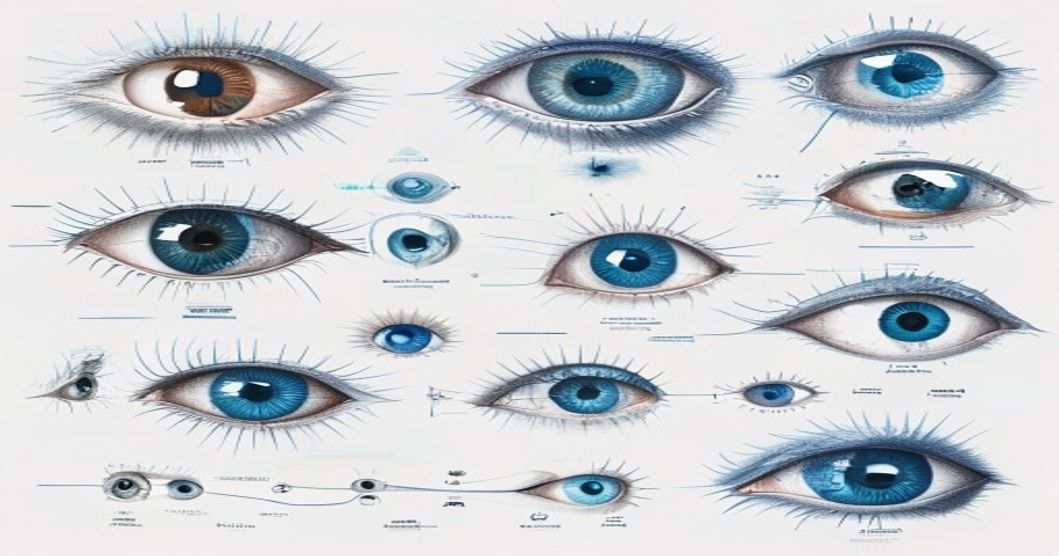
The creationist argument sounds airtight: What use is half an eye? If vision only works when the whole system is complete (retina, lens, optic nerve, brain), then every intermediate stage is useless. Natural selection has nothing to select for. The eye, therefore, could not have evolved. The evolution of the eye, step by step, is the answer to that argument, and it is more complete than Darwin could have imagined.
Charles Darwin worried about this himself. In On the Origin of Species he called the eye “an organ of extreme perfection” and admitted the idea of it evolving by natural selection seemed “absurd in the highest degree.”
Then he answered his own objection, and the science has spent 165 years proving him right.
The eye did not need to be perfect to be useful. It only needed to be slightly better than nothing. That single principle, followed step by step across geological time, built every eye that has ever existed.
Stage Zero: The Light-Sensitive Patch
The starting point is not mysterious. Single-celled organisms have photoreceptive proteins today. The molecule at the heart of your vision rhodopsin is ancient. While microbes use a different class of photoreceptive proteins, the core principle (light-sensing molecules are ancient) remains.
The first multicellular “eyes” in animal evolution were likely simple patches of these photoreceptive cells embedded in the skin of early animals like flatworms or jellyfish ancestors. They detected light versus dark. That is all.
That is enough.
An organism that can tell day from night can synchronize its internal clock. One that can detect a shadow (a predator moving overhead) and react is dramatically more likely to survive than one that cannot. A one-percent advantage, sustained across ten thousand generations, is not trivial. It is transformative. Crucially, even this simple sensor required co-evolving neural processing to be useful; the brain and eye evolved together from the very start, a link illustrated by shared genetic toolkits like the Pax6 gene, a master regulator for both eye and neural development.
The Nilsson-Pelger Calculation: 364,000 Years Is All It Takes

In 1994, biologists Dan-Eric Nilsson and Susanne Pelger published one of the most important papers in evolutionary biology. They asked a deceptively simple question: Starting from a flat patch of photoreceptive cells, how many generations does it take to evolve a fully functional camera eye (a lens, a focused image, the works)?
They built a mathematical model. Every mutation had to be small (a 1% change per step). Every step had to be selectable, meaning it had to improve vision by a measurable amount. They applied realistic selection coefficients from population genetics.
How Fast Can Eyes Evolve? The Math Behind Eye Evolution
The answer: approximately 1,829 generational steps. For a small, fast-reproducing animal, this translates to roughly 364,000 years.
In geological terms, that is nothing. The Earth is 4.5 billion years old. The Cambrian explosion when complex eyes first appear in the fossil record in predators like Anomalocaris was ~540 million years ago. The Nilsson-Pelger model shows that complex eyes could have evolved hundreds of times over in the time available. In fact, distinct optical systems (camera, compound, mirror eyes) appear to have evolved independently at least 40 to 65 separate times across the animal kingdom. This doesn’t mean starting from zero each time; it often involved co-opting the same ancient genetic toolkit (like Pax6) to build different optical structures in different lineages.
The eye is not improbable. It is inevitable, given enough light-sensitive cells and enough generations.
The Living Proof: A Chambered Nautilus Has No Lens

You do not need to trust the math. The intermediate stages are not theoretical; they are alive today.
The chambered nautilus (Nautilus pompilius) has an eye that looks like a pinhole camera. It has no lens. Seawater flows directly into the eye chamber. The image it forms is dim and slightly blurry, but it works. The nautilus navigates, hunts, and avoids predators with it. As detailed in Animal Eyes (Land & Nilsson, 2012), the nautilus eye is a textbook example of a functional pinhole camera stage. If this stage is so useful, why did lenses evolve at all? The nautilus’s dim, slow world doesn’t demand a sharp image. But for active predators in complex, bright environments (like reefs or land), the survival advantage of a lens (focusing more light and providing sharper resolution) was immense.
This is the exact intermediate stage the Nilsson-Pelger model predicts. A deep cup, a narrow aperture, no lens. It is not a broken eye. It is a functional eye that never needed to get better, because the nautilus’s environment and lifestyle do not demand higher resolution.
Why the Human Eye Is Badly Designed (and Why That Matters)
The human eye has two features that no engineer would tolerate, and both of them are powerful evidence for gradual, unguided evolution.
1. The blind spot. Your retina has a hole in it. The optic nerve exits through the back of the eye, creating a region with zero photoreceptors. You have a blind spot in each eye right now. (Your brain fills it in, which is why you do not notice it.)
2. The backwards retina. Your photoreceptor cells point away from the incoming light. The signal-processing neurons and blood vessels sit in front of the photoreceptors, between them and the light source. The light has to pass through a layer of wiring before it hits the detector. This is the opposite of how any engineer would design a camera sensor.
The octopus (whose eye evolved completely independently from ours) does not have this problem. Its retina is wired the correct way around. No blind spot. Better low-light performance.
The human eye’s “backwards” architecture is a direct result of our evolutionary history. Vertebrate eyes evolved from an infolding of brain tissue. The photoreceptors happened to end up pointing inward. Once that basic architecture was established, every subsequent improvement built on it. There was no going back to redesign from scratch; that is not how evolution works.
A designed system would not have a blind spot. An evolved system carries its history in its flaws.
Compare these stages side by side:
| Stage | Structure | Example Animal | What It Can Do |
|---|---|---|---|
| 1 | Flat photoreceptive patch | Limpet (Patella) | Light/dark detection only |
| 2 | Shallow cup | Abalone | Crude directional sensing |
| 3 | Deep cup (pinhole) | Chambered Nautilus | Basic image formation, no lens |
| 4 | Transparent fluid fills cup | Primitive fish larvae | Brighter image, some focus |
| 5 | Differentiated lens | Octopus, vertebrates | Sharp, focused camera image |
Each row is an improvement on the last. Each improvement was selectable. The creationist argument (that intermediate stages are useless) is empirically false. You can watch the intermediates eat their dinner in the Pacific Ocean right now.
The Lens’s Accidental Origin: How a Stress Protein Found a New Job

Here is where the story gets chemically elegant.
A lens must be transparent. Transparency in a biological tissue is not the default; most cells are packed with proteins that scatter light. Evolution needed a protein that could fill the entire lens cell, be present in extraordinarily high concentration, and still allow light to pass through without scattering.
It found one by raiding the parts bin.
Crystallins the proteins that make up your eye lens are not unique to eyes. In most animals, the dominant lens crystallin is a close relative of αB-crystallin, a heat shock protein (HSP) whose original job is helping other proteins fold correctly under thermal stress.
At some point, a mutation caused this protein to be expressed in high concentrations in the embryonic cells of a developing eye. The result happened to be transparent. Selection kept it. Over time, lens cells became so packed with crystallin that they ejected their nuclei and organelles entirely, becoming, essentially, bags of transparent protein.
Your eye lens is made of proteins whose ancestors were molecular chaperones. Evolution does not engineer solutions. It scavenges and repurposes. This is one of the most beautiful examples of co-option in all of biology.
Irreducible Complexity: The Argument That Doesn’t Hold
Michael Behe‘s concept of irreducible complexity most famously applied to the bacterial flagellum has also been applied to the eye. The claim: remove any single component, and the system fails. Therefore, the system could not have evolved incrementally.
The nautilus already disproves it. A lens-free eye is not a broken camera-eye. It is a different, functional system at an earlier stage.
More fundamentally, irreducible complexity assumes the components of a system have no prior function. But crystallins had a prior function (heat shock response). Rhodopsin had a prior function (light detection in single cells). The proteins of the optic nerve had prior functions in neural signaling throughout the body.
Complex biological systems do not build from nothing. They are assembled from pre-existing parts, each with its own evolutionary history. Irreducible complexity, as a logical argument, fails to account for co-option.
The next time someone asks ‘What use is half an eye?’ you can point to the nautilus hunting in the deep sea, a living snapshot of evolution in progress.
What use is 5 percent of an eye?
More than zero percent. A 5% eye (a light-sensitive patch) tells its owner whether it is day or night, and whether a shadow is moving overhead. That information is enough to improve survival odds. Selection does not need perfection. It only needs better than before.
Did the eye evolve once or many times?
Distinct optical structures evolved independently at least 40 to 65 times. This often involved co-opting the same ancient genetic toolkit, like the Pax6 gene, to build different optical structures in different lineages. Camera eyes, compound eyes, mirror eyes, and pinhole eyes all evolved separately.
What is the Nilsson-Pelger eye model?
A 1994 mathematical model showing that approximately 1,829 small, selectable steps (roughly 364,000 years for a fast-reproducing organism) are sufficient to evolve a fully functional camera eye from a flat patch of photoreceptive cells.
Why does the human eye have a blind spot?
Because the optic nerve exits through the back of the retina, creating a region with no photoreceptors. This is a consequence of how vertebrate eyes evolved from infolded brain tissue. The octopus, whose eye evolved independently, has no blind spot.
Is the eye evidence against evolution?
No. Darwin raised this question himself and answered it in On the Origin of Species. The living nautilus, the Nilsson-Pelger model, the independent evolution of eyes in dozens of lineages, and the molecular history of crystallin proteins all confirm that eyes evolved by natural selection.
The evolution of the eye is one of the most thoroughly documented sequences in all of evolutionary biology, with each transitional stage observable in living species today.
Sources
- Nilsson, D.-E. & Pelger, S. (1994). A pessimistic estimate of the time required for an eye to evolve. Proceedings of the Royal Society B, 256(1345), 53–58. doi:10.1098/rspb.1994.0048
- Land, M.F. & Nilsson, D.-E. (2012). Animal Eyes (2nd ed.). Oxford University Press.
- Salvini-Plawen, L. & Mayr, E. (1977). On the evolution of photoreceptors and eyes. Evolutionary Biology, 10, 207–263.
- Piatigorsky, J. (2007). Gene Sharing and Evolution: The Diversity of Protein Functions. Harvard University Press.
- Darwin, C. (1859). On the Origin of Species. Chapter 6: Difficulties on Theory.
Further reading: Evolution of the eye on Wikipedia