

Beyond the Habitable Zone: Ocean Worlds and the New Search for Life
For decades, the search for life beyond the habitable zone and extraterrestrial life has been guided by a single, elegant idea: look for planets in the habitable zone. This region around a star, often called the Goldilocks zone, marks the narrow orbital band where temperatures allow liquid water to pool on a world’s surface. Not too hot, not too cold. It’s a powerful concept that helped astronomers prioritize thousands of exoplanet candidates discovered by missions like Kepler and TESS.
But the Goldilocks zone was always a framework built around a single data point: Earth. Now, a growing body of evidence demands we think bigger. Beneath the frozen crusts of moons in our own outer solar system, vast oceans of liquid water persist in total darkness, heated not by starlight but by the gravitational squeeze of their parent planets. The possibility of life beyond the habitable zone is no longer theoretical; these ocean worlds sit far outside the Sun’s goldilocks band, and yet they may be among the most promising places in the cosmos to find living organisms.
This shift has major implications. If life can arise in a sunless ocean buried beneath kilometers of ice, then the number of potentially habitable worlds in the universe isn’t limited to a thin ring around each star. It could be almost everywhere. For a deeper look at how the scale of the universe shapes what we can observe, see our guide to the cosmic horizon.
What Is an Ocean World?
An ocean world is any planetary body that harbors a significant volume of liquid water, whether on its surface or hidden beneath an icy shell. Earth is the most familiar example, with surface oceans covering roughly 71 percent of the planet. But the ocean worlds generating the most excitement among astrobiologists today look nothing like Earth. They are frozen moons in the outer solar system, where surface temperatures plunge to minus 160 degrees Celsius, and sunlight is a dim memory.
Tidal heating, caused by gravitational forces, keeps these oceans liquid. As a moon orbits its planet, changing gravity flexes its interior, creating friction and heat, much like bending a paperclip warms it. This energy is enough to sustain liquid water for billions of years, even in the cold outer solar system. The NASA Astrobiology Program has identified ocean worlds as one of the highest-priority targets in the search for life beyond Earth.
The Three Ingredients
Before examining any world, it’s useful to define what astrobiologists want. The search for life breaks a vast question into testable parts. Drake’s equation did this; astrobiology now uses a three-ingredient framework: liquid water, chemical building blocks, and energy. Wherever these appear together on Earth, life follows. The question is whether this also holds elsewhere. Understanding how these factors differ from the biosignatures and technosignatures scientists search for in exoplanet atmospheres reveals just how broad the search for life has become.
Because of this three-part framework, the case for life beyond the habitable zone is especially compelling: many ocean worlds appear to check all three boxes.
Water is the easy one. Global oceans are strongly indicated on Europa, Enceladus, Titan, and several other moons. Some of these oceans, like Europa’s, contain more water than all of Earth’s oceans combined.
Chemistry is increasingly well-evidenced. NASA’s Cassini mission detected sodium salts and simple organic molecules in Enceladus’s plume grains. Europa’s surface shows hydrated salts and sulfur compounds. Titan’s atmosphere is a factory for complex organic molecules. In early 2026, ammonia was identified at Europa from reanalyzed Galileo magnetometer data. This molecule could serve as a nutrient for microorganisms.
Energy is where ocean worlds upend conventional thinking. These worlds do not depend on stellar radiation. Instead, they tap tidal heating and possible hydrothermal activity at the boundary between warm rock and saltwater. Cassini’s detection of molecular hydrogen in Enceladus’s plumes points to water-rock reactions (Waite et al., 2017, Science). These reactions provide chemical energy, much like that which feeds microbial ecosystems at Earth’s deep-sea hydrothermal vents.

The credibility of this framework rests on what we’ve learned about life in Earth’s most punishing environments. Deep beneath the ocean surface, at hydrothermal vents along mid-ocean ridges, thriving ecosystems exist in complete darkness. These communities are powered not by photosynthesis but by chemosynthesis, using chemical energy from mineral-rich water heated by volcanic activity. Entire food webs (from bacteria to tube worms to crabs) flourish without a single photon of sunlight. If complex ecosystems can thrive in these conditions on Earth, the subsurface oceans of Europa and Enceladus become far less alien as potential habitats.
In subglacial lakes beneath Antarctica’s ice sheet, where conditions loosely resemble those beneath an icy moon’s crust, scientists have found active microbial communities surviving in isolation for millions of years. These extremophile organisms demonstrate that life can persist in dark, cold, nutrient-poor environments for geological timescales, exactly the kind of endurance an ocean world would require. The rapid proliferation of complex life in Earth’s oceans during the Cambrian Explosion further illustrates how quickly ecosystems can diversify once the right chemical and energy conditions are in place.
With this framework in hand, each ocean world can be evaluated not as a curiosity but as a candidate.
Rethinking the Goldilocks Zone: Life Beyond the Habitable Zone
The traditional habitable zone model focuses on the distance from a star at which a rocky planet with an atmosphere could sustain liquid water on its surface. It has enabled discoveries such as Kepler-442b, TRAPPIST-1e, and TOI-700d. But it carries a hidden assumption that ocean worlds have dismantled: it treats stellar energy as the primary driver of habitability. This same question (whether life could exist in extreme environments far from their star) is central to the debate over whether a world like K2-18 b could host life in one of the galaxy’s harshest environments.
Europa, Enceladus, Ganymede, Titan, and possibly even tiny Mimas all maintain liquid water oceans despite sitting far outside the Sun’s habitable zone. Their heat comes from within. A 2023 NASA-funded study extended this logic beyond our solar system, identifying 17 exoplanets that could host liquid water beneath icy shells, worlds too distant and cold for surface water but potentially warm enough inside (NASA Exoplanet Exploration). The researchers calculated that some might produce geyser-like eruptions detectable by future telescopes.
The habitable zone hasn’t become irrelevant. It remains the best tool for identifying worlds with surface water. But it is no longer the only framework. Ocean worlds have demonstrated that life beyond the habitable zone is physically plausible, powered from within by tidal forces and radioactive decay on bodies that receive virtually no starlight. The search for life must expand accordingly.
Europa: The Crown Jewel
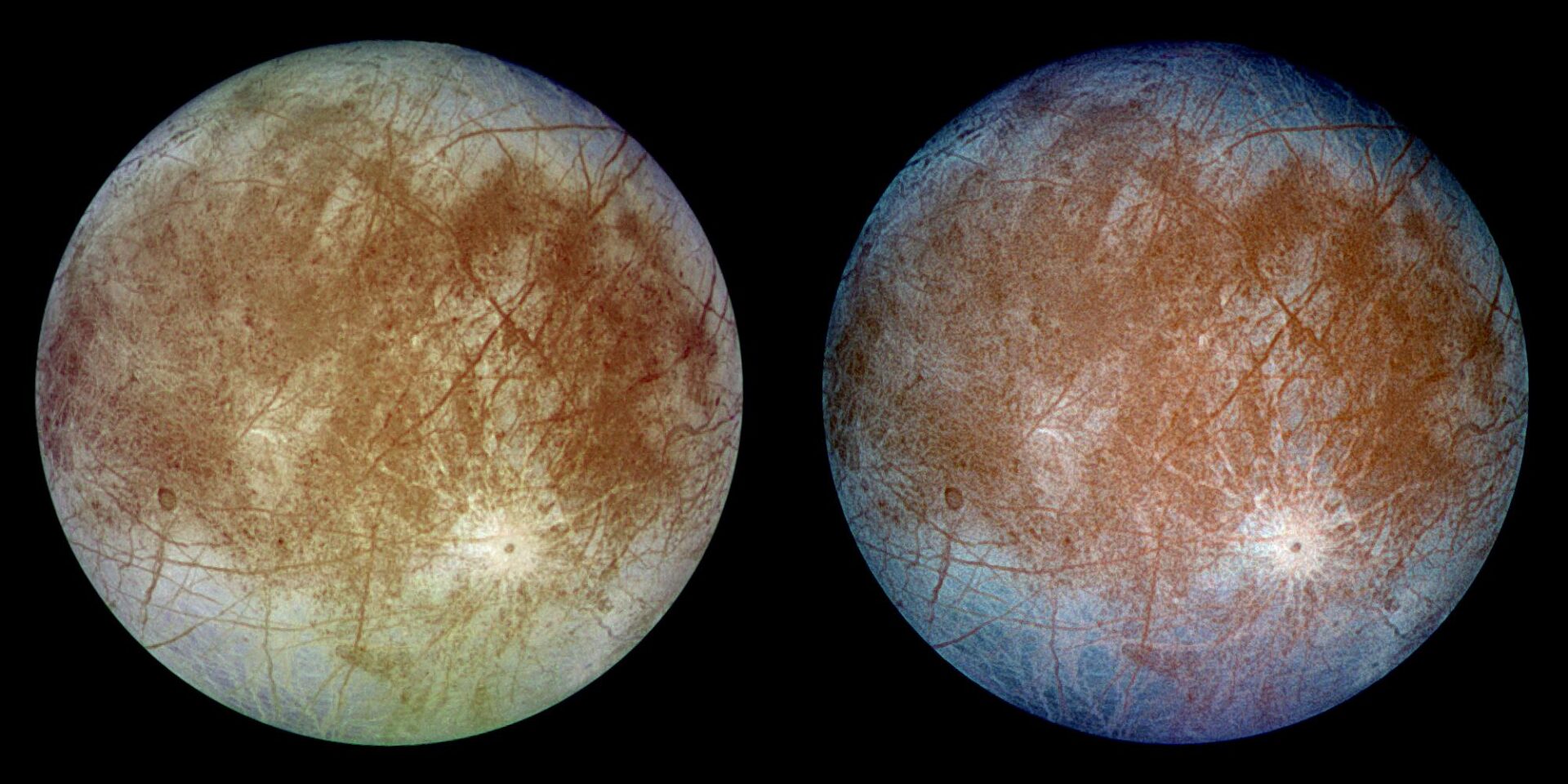
Of all the candidates for life beyond the habitable zone, Jupiter’s moon Europa attracts the most attention, and for good reason. Beneath its smooth, cracked ice shell lies a saltwater ocean estimated to be 60 to 150 kilometers deep, containing more than twice the volume of all of Earth’s oceans combined.
The evidence comes from multiple independent lines of investigation. NASA’s Galileo spacecraft, which orbited Jupiter from 1995 to 2003, detected an induced magnetic field around Europa consistent with a conductive fluid beneath the surface. The moon’s surface is geologically young (relatively few craters and an estimated age of only 40 to 90 million years), suggesting continuous resurfacing from below. Extensive fracture patterns in the ice shell match what tidal flexing models predict.
Europa’s ice shell is estimated to be 10 to 25 kilometers thick. Below it, the ocean stays liquid thanks to the gravitational forces Jupiter exerts as Europa orbits, continuously deforming its interior and generating heat. Early 2026 reanalysis of Galileo magnetometer data revealed evidence of ammonia at Europa, strengthening the case for habitability by identifying a potential microbial nutrient.
What makes Europa especially tantalizing is the possibility of hydrothermal activity on its seafloor. As the moon flexes under Jupiter’s gravity, ocean water may seep into the rocky layer beneath the ocean, become heated, and interact chemically with the rock. This would load the water with minerals and organic compounds before it flows back through cracks and vents, precisely the kind of environment where life first emerged on Earth.
Not all recent findings have been uniformly optimistic. A 2026 study from Washington University in St. Louis calculated that Europa’s seafloor may be calmer and colder than hoped. Europa’s more stable orbit produces weaker tidal forces than those acting on volcanic Io, potentially limiting the geological activity that hydrothermal vents require to persist. Whether this rules out life or demands we look for different biological strategies is exactly what Europa Clipper will investigate.
Europa Clipper: The Mission That Could Change Everything
NASA’s Europa Clipper launched on October 14, 2024, and is now en route to the Jupiter system. The spacecraft performed a gravity assist at Mars on March 1, 2025, and will swing past Earth on December 3, 2026, before arriving at Jupiter in April 2030. It will conduct more than 40 close flybys of Europa, using nine scientific instruments to map the ice shell, analyze surface composition, hunt for water plumes, and measure the ocean’s depth and salinity.
Its thermal-imaging system will search for heat signatures indicative of active geology. Its magnetometer suite will measure how Europa deforms under tidal forces, revealing details about the ocean’s structure. If Europa Clipper confirms that the ocean is habitable, it will mark a watershed moment in astrobiology.
Enceladus: The Tiny Moon with a Big Secret

In the hunt for life beyond the habitable zone, Saturn’s moon Enceladus is only about 500 kilometers across (small enough to fit inside Arizona). But this unassuming world has delivered some of the most electrifying discoveries in planetary science.
In 2005, Cassini observed enormous plumes of water vapor and ice particles erupting from fractures near Enceladus’s south pole, geysers blasting material hundreds of kilometers into space. Analysis revealed the plumes contained not just water but sodium salts, simple organic molecules, and molecular hydrogen, a likely product of hydrothermal reactions between hot rock and ocean water on the seafloor (Waite et al., 2017, Science). In a landmark 2023 result, Cassini data also revealed the presence of phosphorus (a key ingredient for DNA and cell membranes) in Enceladus’s plume material (Postberg et al., 2023, Nature).
Molecular hydrogen is particularly significant. On Earth, microorganisms called methanogens use hydrogen and carbon dioxide as their primary energy source, thriving at deep-sea vents in complete independence from sunlight. The chemistry in Enceladus’s plumes suggests similar energy sources likely exist in its ocean.
Enceladus’s ocean is kept warm by a gravitational resonance with Dione, another of Saturn’s moons, which maintains the orbital eccentricity driving tidal heating. Despite Enceladus’s tiny size, this mechanism sustains a global subsurface ocean in contact with a rocky core, the exact configuration needed for water-rock chemistry.
What sets Enceladus apart is accessibility. Those south-polar plumes are essentially sampling the ocean from within, ejecting interior material into space where a passing spacecraft can analyze it. A future mission designed to fly through the plumes with a mass spectrometer could directly test for biosignatures without ever drilling through ice.
Titan: The Double Ocean World
Saturn’s largest moon, Titan, is unlike anything else in the solar system. It is the only moon with a dense atmosphere (a nitrogen-rich blanket four times denser than Earth’s at the surface). And it is the only world besides Earth where liquid currently flows on the surface, forming rain, rivers, lakes, and seas. The catch is that Titan’s surface liquids are hydrocarbons: primarily methane and ethane.
Titan is sometimes described as a double ocean world. On the surface, its hydrocarbon cycle mirrors Earth’s water cycle in eerie detail: methane clouds, rainfall, carved river channels, and vast seas like Kraken Mare near the north pole. Deep below, beneath a crust of water ice and exotic minerals, Titan harbors a global subsurface ocean of liquid water.
This layered structure creates something no other world we know of offers: a natural laboratory where complex organic chemistry and liquid water can interact. Titan’s atmosphere continuously produces organic molecules that drift down to the surface like fine snow. When impact events punch through the icy crust or when geological processes transport surface material downward, those organics can encounter the liquid water ocean below. Contact between simple organics and water can trigger reactions producing amino acids, nucleic acids, lipids, and proteins, the molecular machinery of life. This process of building complexity from simple chemical rules echoes principles explored in our article on emergence.
This is precisely why NASA chose Selk Crater as Dragonfly’s primary science destination. Selk is an impact site where liquid water and organic compounds likely coexisted on the surface for tens of thousands of years before refreezing. It represents the most accessible location where Titan’s two chemical worlds (hydrocarbon surface and water interior) are known to have mixed.
Dragonfly: Flying Through an Alien World
NASA’s Dragonfly mission will send a rotorcraft lander to Titan, the first drone designed for scientific exploration of another world. Taking advantage of the thick atmosphere and low gravity, Dragonfly will fly between dozens of sites, covering distances far beyond any Mars rover. The mission is expected to launch in 2028 and arrive at Titan in 2034.

Dragonfly will land initially in the Shangri-La dune fields near Titan’s equator, then hop from site to site before reaching Selk. Its instruments will analyze the chemical composition of surface materials using a mass spectrometer and drill system, measure atmospheric conditions, and search for chemical signatures of biological processes. While Dragonfly won’t directly sample the deep subsurface ocean (thought to begin roughly 160 kilometers down), it will reveal how far organic chemistry has progressed and whether the building blocks of life are being actively assembled on this distant world.
The Expanding Roster of Ocean Worlds
Europa, Enceladus, and Titan get the most attention, but the family of suspected ocean worlds keeps growing. This expanding roster has fascinating parallels to discoveries being made in the exomoon frontier, where moons orbiting distant exoplanets may harbor similar subsurface oceans.
At Jupiter, Ganymede (the largest moon in the solar system) is thought to have a saltwater ocean sandwiched between layers of ice deep within its interior. ESA’s JUICE mission, launched in April 2023, is heading to the Jovian system to study it in detail. Callisto, Jupiter’s outermost Galilean moon, may also hide a subsurface ocean beneath its ancient, heavily cratered surface.
At Saturn, Mimas may be the most consequential discovery of all. The small “Death Star” moon surprised scientists when Cassini data revealed it likely harbors a young global ocean beneath its ancient, cratered surface. Unlike Europa or Enceladus, Mimas showed no outward signs whatsoever of an interior ocean (no fractures, no plumes, no youthful terrain). Its surface looks exactly like a dead ball of ice.
This is what makes Mimas so important. It means we cannot identify ocean worlds solely by their surface appearance. If a moon this small, this old-looking, and this geologically quiet can harbor a hidden ocean, the number of ocean worlds in the galaxy could be vastly larger than current estimates.
Every icy body orbiting a giant planet becomes a candidate.
Beyond Saturn, the pattern continues. At Neptune, Triton, the planet’s largest moon, was likely captured from the Kuiper Belt long ago. Covered in various ices, it is strongly suspected to harbor a subsurface ocean and exhibits active geology, including nitrogen geysers observed by Voyager 2 in 1989.
Among dwarf planets, Pluto shows multiple geological features indicating a subsurface ocean. New Horizons data revealed that the massive nitrogen-ice basin Sputnik Planitia is oriented almost directly opposite Pluto’s largest moon, Charon. Because liquid water is denser than the surrounding ice, a subsurface ocean bulging beneath the basin would create a gravitational anomaly that aligns with tidal forces, and that alignment is exactly what we observe. Extensional tectonic features on the surface suggest the ice crust is being pulled apart, consistent with an ocean that may still be slowly freezing and expanding. The surface even shows hints of plate-like behavior, with regions of icy crust colliding and possibly subducting.
The sheer number of ocean worlds in our solar system alone suggests that subsurface oceans are not rare accidents but a common outcome of planetary formation and gravitational physics. And if they are common here, they are likely common around other stars as well.
What Comes Next: The Mission Roadmap
The next decade represents a golden age for ocean world exploration.
Europa Clipper (NASA) launched in October 2024 and will arrive at Jupiter in April 2030, conducting more than 40 close flybys of Europa to map its ice shell and characterize the ocean beneath.

JUICE (ESA) launched in April 2023 and is en route to the Jovian system. It will study Europa and Callisto before entering orbit around Ganymede, providing the first detailed investigation of that giant moon’s subsurface ocean. Together, Europa Clipper and JUICE will deliver complementary perspectives: Clipper provides targeted, repeated sampling of Europa, while JUICE supplies a broad system context across Jupiter’s icy moons.
Dragonfly (NASA) is expected to launch in 2028 and will explore Titan’s surface beginning in 2034, extending the search to an entirely different chemical environment.
Investigating Ocean Worlds, a five-year research initiative led by the Woods Hole Oceanographic Institution (WHOI) and funded by NASA, launched in 2026. The program will develop new methods to analyze carbon-rich molecules that could indicate biological activity, ensuring that when Europa Clipper’s data arrives from Jupiter, scientists will know what to do with it.
A Universe of Hidden Oceans
The discovery that life beyond the habitable zone is possible has rewritten the rules of habitability. The Goldilocks zone remains a valuable tool for finding worlds with surface water, but it was never the complete picture. Tidal heating can sustain liquid oceans for billions of years on worlds that receive virtually no sunlight. Hydrothermal chemistry can power biological processes in total darkness. And the building blocks of life (carbon, hydrogen, nitrogen, oxygen) are among the most common elements in the universe.
The spacecraft that will investigate these hidden oceans is already in flight or being assembled. Within the next decade, Europa Clipper will peer beneath the ice of Jupiter’s most intriguing moon, Dragonfly will soar over the dunes of Titan, and new analytical tools will help determine whether the organic molecules found on these worlds are signatures of biology or products of non-biological chemistry.
The most profound discoveries may still be waiting, not on sunlit surfaces, but in the dark waters beneath alien ice.
What is an ocean world?
An ocean world is any planetary body that harbors a significant volume of liquid water, either on its surface or hidden beneath an icy shell. In our solar system, this includes moons like Europa, Enceladus, Ganymede, Titan, Callisto, and possibly Mimas and Triton.
Can life exist beyond the habitable zone?
Yes, or at least the conditions for life can exist beyond the traditional habitable zone. Ocean worlds like Europa and Enceladus sit far beyond the Sun’s goldilocks band but maintain liquid water oceans through tidal heating. Earth’s deep-sea hydrothermal vents demonstrate that complex ecosystems can survive entirely without sunlight, relying on chemical energy instead.
When does the Europa Clipper arrive at Jupiter?
NASA’s Europa Clipper, launched on October 14, 2024, is scheduled to arrive at Jupiter in April 2030. It will conduct more than 40 close flybys of Europa, using nine instruments to analyze the ice shell, hunt for water plumes, and characterize the subsurface ocean.
What makes Enceladus special in the search for life beyond the habitable zone?
Enceladus is unique because it actively vents its interior ocean into space through south-polar plumes. Cassini confirmed those plumes contain water, sodium salts, molecular hydrogen, organic compounds, and phosphorus, all key ingredients for life. A future mission could fly through the plumes and directly sample the ocean without drilling through any ice.
What is tidal heating and why does it matter for life beyond the habitable zone?
Tidal heating occurs when a moon’s interior is repeatedly flexed and deformed by the gravitational pull of a nearby planet. This friction generates heat deep inside the moon, which can keep a subsurface ocean liquid for billions of years, even far from the warmth of the Sun. It is the primary mechanism enabling life beyond the habitable zone on ocean worlds.
Sources & Further Reading
- Waite, J. H., et al. (2017). Cassini finds molecular hydrogen in the Enceladus plume: Evidence for hydrothermal processes. Science, 356(6334), 155–159. doi:10.1126/science.aai8703
- Postberg, F., et al. (2023). Detection of phosphates originating from Enceladus’s ocean. Nature, 618, 489–493. doi:10.1038/s41586-023-05912-0
- Hand, K. P., et al. (2020). Report of the Europa Lander Science Definition Team. NASA. europa.nasa.gov
- NASA Europa Clipper Mission Overview. science.nasa.gov/mission/europa-clipper
- NASA Cassini Mission. science.nasa.gov/mission/cassini
- ESA JUICE Mission. esa.int – JUICE
- NASA Dragonfly Mission. science.nasa.gov/mission/dragonfly
- WHOI Investigating Ocean Worlds Program. oceanworlds.whoi.edu
- NASA Galileo Mission Archive. solarsystem.nasa.gov – Galileo
- NASA New Horizons Mission. science.nasa.gov/mission/new-horizons
- NASA Astrobiology Program. astrobiology.nasa.gov
- NASA Europa Fact Sheet. science.nasa.gov/europa
- NASA Enceladus Overview. science.nasa.gov/saturn/moons/enceladus
- NASA Titan Overview. science.nasa.gov/saturn/moons/titan
Further reading: Circumstellar habitable zone on Wikipedia