
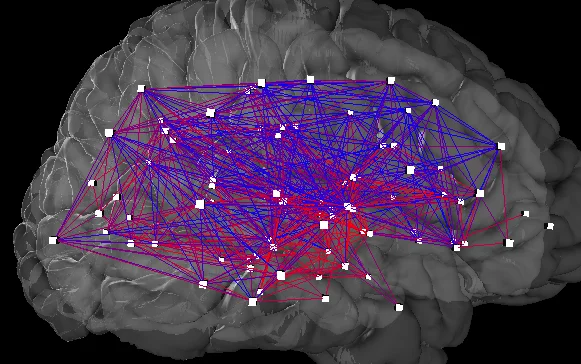
Imagine a patient in a vegetative state, unresponsive for months. Her eyes open, she breathes, but no command, no stimulus, elicits recognition. Then, using a technique derived from Integrated Information Theory, doctors find a subtle signature of complex electrical activity in her posterior cortex. She is later shown to have fragments of awareness. What these doctors measured was not a thought, not a feeling, but something more fundamental – a quantity called phi.
Consciousness is easy to experience and hard to explain. Most theories describe what consciousness does: how it integrates sensory input, directs attention, generates behavior. Integrated Information Theory does something different. It claims to describe what consciousness is.
The Central Claim

Giulio Tononi, a neuroscientist at the University of Wisconsin-Madison, first proposed Integrated Information Theory in 2004 and has refined it since. The core claim is precise: consciousness is identical to integrated information, measured by a quantity called phi (Φ, capital Phi).
A system has high phi when its parts share information in a way that cannot be decomposed into independent components. The whole generates more information than the sum of its parts. When phi is high, the system is conscious. When phi is zero, when a system can be fully described by its parts acting independently, there is nothing it is like to be that system.
This is not a metaphor. Tononi means it literally. Consciousness is phi. More phi means more consciousness. Less phi means less. Zero phi means none. This directly addresses what philosophers call the mind-brain problem: if the subjective experience of seeing red is identical to a specific pattern of integrated information, then the hard problem of consciousness is solved by redefining it away.
Five Axioms, Five Postulates
IIT is built on five axioms: properties that every conscious experience obviously has, from the inside. Each axiom generates a corresponding postulate about the physical substrate of consciousness. The theory aims to identify what neuroscientists call the neural correlates of consciousness, but goes further by claiming that those correlates are themselves the stuff of consciousness.
Existence. Experience exists. It is real, not illusory. The corresponding postulate: the physical substrate must itself have causal power, it must make a difference to what happens.
Composition. Experience is structured. It contains parts: the redness within a visual scene, the tone within a chord. The substrate must be composed of elements that each contribute information.
Information. Every experience is specific. Seeing red is not seeing blue; hearing a C-sharp is not hearing silence. The substrate must specify a particular state from among many possible states.
Integration. Experience is unified. When you see a red ball rolling across a green field, you do not experience four separate things, you experience one thing. The substrate cannot be decomposed into independent parts without losing information. This is where phi lives. Integration measures how much the whole exceeds the parts.
Exclusion. Experience is definite. It has exactly the content it has: no more, no less. The substrate has a single maximum of integrated information; overlapping systems do not each generate separate conscious experiences.
What Phi Predicts
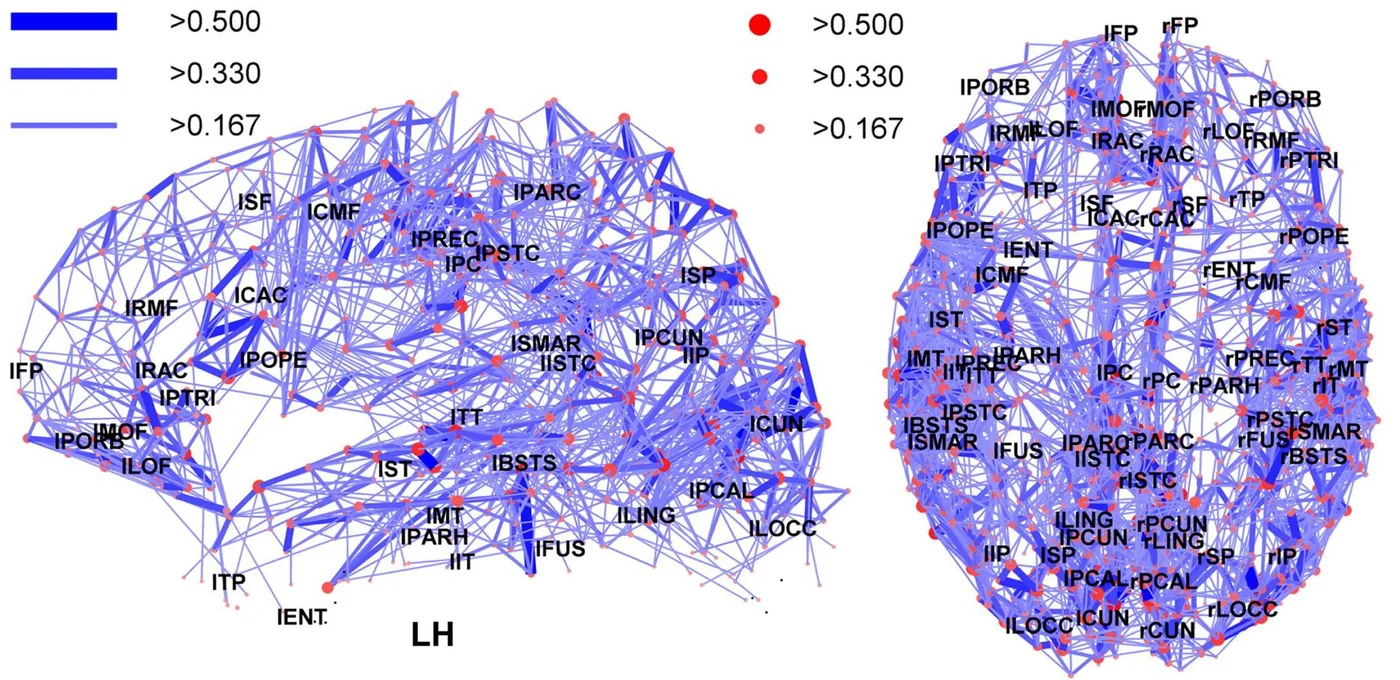
The mathematics of phi produces some striking predictions.
A simple logic gate, a transistor switching between states, has very low phi. A disconnected collection of neurons has low phi. But a densely interconnected network where each element’s state depends on many others can have high phi. To illustrate: a simple pair of XOR gates with recurrent feedback can have nonzero phi, while a feedforward cascade of the same gates may have phi = 0: demonstrating how integration, not just computation, matters.
Consider a concrete example. Take two elements, A and B, each with two possible states (on or off). If they are causally independent, their joint behavior is fully described by their separate behaviors: phi = 0. No integration, no consciousness. Now make A’s next state partly depend on B’s current state, and vice versa. The system now specifies states that cannot be captured by treating A and B independently. The whole specifies more information than the sum of its parts. That extra information, the amount lost when you try to decompose the system, is phi. In a three-element system with full bidirectional coupling, phi is higher still. The more causal interdependence, the higher phi climbs.
The human cerebral cortex, especially during wakefulness, has high estimated phi. During deep dreamless sleep, phi drops significantly: consistent with the reduction in consciousness. Under anesthesia, phi drops further. This matches clinical observation well enough that some researchers have proposed phi-based devices to measure consciousness in surgical patients and in disorders of consciousness.
The cerebellum, despite containing four times as many neurons as the cortex, contributes little to consciousness: and IIT predicts why. The cerebellum has a highly modular, feedforward structure. Its elements process information relatively independently, keeping phi low. The cortex has dense recurrent connectivity, driving phi high.
The Uncomfortable Implications
IIT’s logic does not stop at brains. If consciousness is phi, then any system with sufficiently high phi is conscious: regardless of whether it is made of neurons, silicon, or anything else. This provokes the question of conscious AI: could a machine ever experience subjective reality, and under what conditions?
This has two uncomfortable implications in opposite directions.
First: some very simple systems might be faintly conscious. In IIT 3.0, a single element, such as a single isolated neuron, has zero phi, because a system requires at least two causally interacting parts to produce integration. However, IIT distinguishes between local phi (φ, lower case), which measures integration within a subsystem or mechanism, and global Phi (Φ, upper case), which measures integration for the whole system. A group of cortical neurons can have high local integration, driving conscious content, while the whole brain has high global integration, binding those contents into a unified experience. A brain region with high φ but disconnected from the rest contributes no Φ. Confusing these two can lead to serious misunderstandings of the theory.
Some philosophers have speculated whether entities like protons might possess a minimal form of integrated information if their quantum properties are considered. This is a fringe extrapolation not rooted in IIT’s core mathematics; the theory makes no such prediction. Tononi accepts the broader implication that consciousness could be more widespread than we assume, sliding IIT toward panpsychism: the view that consciousness is a fundamental feature of physical reality present at many levels. Philosopher Philip Goff has argued it is the theory’s strength, not its weakness.
Second: some complex systems might be less conscious than expected. A modern artificial neural network, despite billions of parameters, may have low phi if its architecture is highly feedforward: information flowing one way without dense recurrent integration. If IIT is correct, a large language model may process information with no inner experience at all.
And then there is Scott Aaronson’s objection. The computer scientist showed mathematically that a specially designed grid of logic gates, a specific construction, not a generic AI, can have arbitrarily high phi. If IIT is correct, that grid is highly conscious. Aaronson found this conclusion absurd enough to constitute a reductio ad absurdum of the theory. Tononi and collaborators have responded, arguing the exclusion postulate rules out such cases: but the debate is active. In contrast, many scientists argue that IIT faces deeper problems of falsifiability, because phi is computationally intractable to calculate for realistic systems, making the theory difficult to test definitively.
IIT vs Global Workspace Theory
The two most serious scientific theories of consciousness make incompatible predictions, and a major collaborative project, the Cogitate Consortium, involving labs across four continents, ran adversarial experiments to test them.
Global Workspace Theory (GWT) predicts that consciousness arises when information is broadcast widely across the brain, particularly in frontal regions. IIT predicts that consciousness resides in the densely integrated posterior cortex, with frontal involvement being downstream consequence rather than cause.
Preliminary results from Cogitate, published in 2023, were indecisive but revealed patterns: the frontal activation GWT predicts was not always present, while the posterior signatures IIT predicts were more consistent. However, both theories had predictions that failed to materialize, and the study authors explicitly avoided declaring a winner. The data were ultimately inconclusive, leaving the competition unresolved.
Measuring Phi in Practice
Calculating phi precisely for a system of any real complexity is computationally intractable. The number of possible partitions of a neural system grows exponentially. Researchers use approximations, the most common is called phi-star (Φ*), but these are contested proxies, not exact measurements.
One practical application has emerged anyway: the perturbational complexity index (PCI), developed by Massimini and colleagues. PCI applies a pulse of transcranial magnetic stimulation to the brain and measures the complexity of the resulting electrical echo. It is important to note that PCI measures the complexity of a brain response, not integrated information directly: it serves as a proxy, not an equivalent measurement. Still, PCI has shown promise in distinguishing conscious states from unconscious ones in patients with disorders of consciousness, even when behavioral signs are absent.
The Cosmic Dimension
If IIT is correct, consciousness is not an accident of biology. It is a property of information structure: present wherever integration exceeds decomposability, at whatever scale, in whatever substrate.
This reshapes the search for minds beyond Earth. We cannot assume alien consciousness looks like ours, or requires neurons, or emerged through Darwinian evolution. A planet-spanning fungal network with dense chemical signaling might have high phi. A distributed crystalline computation in a cold giant’s atmosphere might have high phi. The question shifts from “does it have a brain?” to “does it integrate information in a way that cannot be decomposed?”
We do not yet know how to measure phi in systems we have not designed. But IIT at least provides a principled question. That is further than most theories get.
Where It Stands
IIT is one of the most mathematically rigorous theories of consciousness ever proposed. It makes specific, testable predictions about which brain states are conscious and which are not. It explains the cerebellum paradox. It provides a foundation for measuring consciousness clinically.
It also implies panpsychism (or points in that direction), is computationally intractable to apply at scale, faces serious mathematical objections, and remains contested against Global Workspace Theory in adversarial empirical tests. Many in the consciousness research community remain skeptical: arguing the theory’s axioms are not universally accepted, that its reliance on uncomputable quantities undermines falsifiability, and that the concept of “integration” remains poorly defined.
Whether phi is consciousness or merely correlated with it, whether IIT has found the thing itself or a very good shadow, is still open. The theory has sharpened the question considerably. If you knew phi measured your own subjective experience, would you want to know your value?
What is Integrated Information Theory (IIT)?
Integrated Information Theory is a scientific theory proposing that consciousness is identical to integrated information, quantified by a value called phi (Φ), which measures how much a system’s information is greater than the sum of its parts.
How is phi (Φ) measured in IIT?
Phi is measured by assessing the cause-effect structure of a system, specifically by calculating the amount of information generated by the whole system that cannot be reduced to its independent components.
Can IIT detect consciousness in vegetative patients?
Yes, using techniques derived from IIT, doctors can detect complex electrical activity in the posterior cortex, indicating high phi and suggesting fragments of awareness in patients who appear unresponsive.
Does IIT claim that any system with high phi is conscious?
Yes, IIT implies that consciousness is a fundamental property wherever phi is high, regardless of the substrate, meaning it could apply to biological brains or artificial systems.
What is the central claim of Integrated Information Theory?
The central claim is that consciousness is identical to integrated information, measured by phi, and that a system is conscious when its phi is high and unconscious when phi is zero.
Sources & References
- Tononi, G. (2004). “An information integration theory of consciousness.” BMC Neuroscience, 5, 42. https://doi.org/10.1186/1471-2202-5-42
- Tononi, G., Boly, M., Massimini, M., & Koch, C. (2016). “Integrated information theory: from consciousness to its physical substrate.” Nature Reviews Neuroscience, 17(7), 450-461. https://doi.org/10.1038/nrn.2016.44
- Casali, A. G., et al. (2013). “A theoretically based index of consciousness independent of sensory processing and behavior.” Science Translational Medicine, 5(198), 198ra105. https://doi.org/10.1126/scitranslmed.3006294
- Cogitate Consortium. (2025). “Adversarial testing of global neuronal workspace and integrated information theories of consciousness.” Nature, 642, 133-142. https://doi.org/10.1038/s41586-025-08888-1
- Doerig, A., et al. (2019). “The unfolding argument: why IIT and other causal structure theories cannot explain consciousness.” Consciousness and Cognition, 72, 49-59. https://doi.org/10.1016/j.concog.2019.04.002